Smart Home Recovery Kit Service China: IoT Post-Surgery Monitoring
You have probably heard the cautionary tales. Flying abroad for surgery means you are on your own the moment you leave the hospital. The follow-up is fragmented. Your local doctor has no clue what happened in China. You are stuck deciphering recovery protocols in a language you do not speak.
That old story is dead.
A quiet revolution in medical technology has reshaped post-operative care. We are now coordinating recoveries where a patient’s vitals are streamed in real-time to their surgical team in Shanghai while they recuperate in a serviced apartment. The smart home recovery kit China price makes continuous, hospital-grade monitoring accessible for a fraction of what a single night in a Western ICU costs. This is not a gadget. It is a structural shift in how international patients heal after major procedures.
Key Takeaways
- IoT recovery kits now stream ECG, blood oxygen, and temperature data directly to your surgical team, slashing the risk of undetected post-op complications.
- The smart home recovery kit China price typically ranges from $150 to $400 per week, compared to $2,000+ per night for inpatient monitoring in the US.
- China’s top-tier hospitals are integrating FDA-approved and CFDA-certified wearable sensors into standardized discharge packages for international patients.
- Data security and device calibration are real concerns; working with a coordinator who audits the data pipeline is non-negotiable for safe remote monitoring.
The Problem: The Dangerous Void Between Discharge and Recovery
Post-surgical complications are alarmingly common. A study published in The Lancet found that roughly 7.7% of surgical patients die within 30 days, a rate that makes surgery the third leading cause of death globally. The scariest part? Many of these deaths happen after discharge, not on the operating table. A patient leaves the hospital, and a subtle change in heart rhythm or a silent drop in oxygen saturation goes unnoticed. By the time symptoms become obvious, the window for easy intervention has slammed shut.
For international patients, this danger is magnified. You are in an unfamiliar city. You do not have a primary care physician down the street. The 14-hour flight home is a thrombotic risk. Relying on a paper checklist and a hope that nothing goes wrong is the standard model. It is a model that fails too many people.
Who We Are
We are China Medical Services, a medical concierge firm that connects international patients with the top 5% of China’s 35,000+ hospitals. We are not a hospital. We do not provide medical treatment or clinical diagnoses. We are your logistical architects—we bridge the gap between you and China’s top-tier medical expertise. Our team handles everything from hospital matching and visa guidance to bilingual medical companions. And now, we integrate IoT-enabled post-surgery monitoring packages to ensure that your recovery is as meticulously managed as your surgery.
Why IoT-Enabled Recovery Kits Are Redefining Post-Op Safety
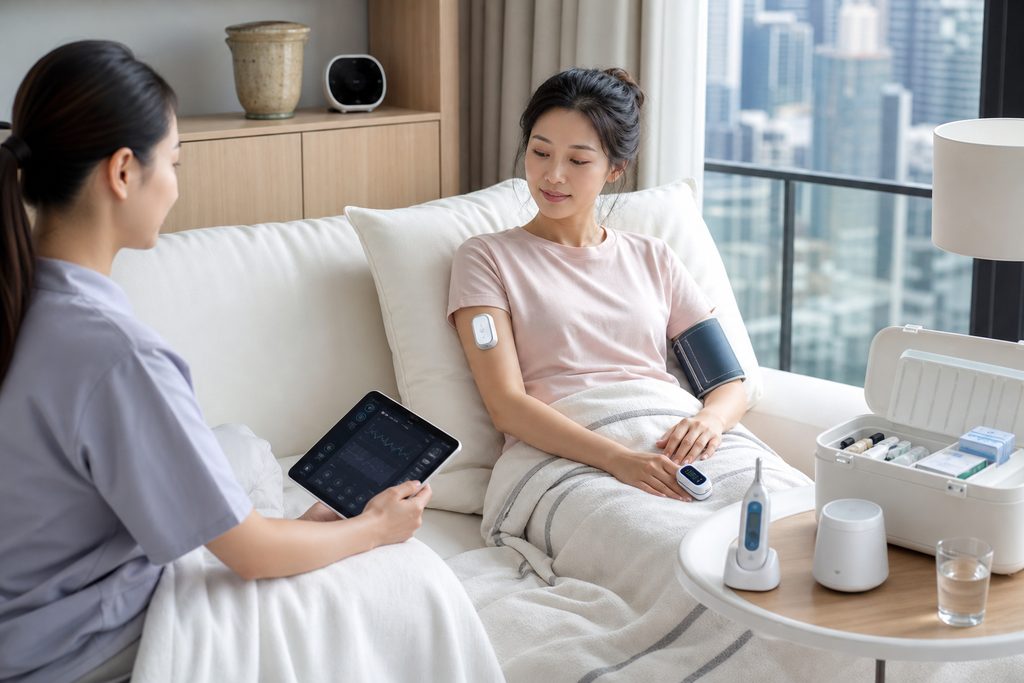
The core of this service is deceptively simple. Before discharge, a clinical technician fits you with a lightweight kit. This typically includes a medical-grade chest patch, a pulse oximeter, and a smart thermometer. These devices are not consumer fitness trackers. They are clinical tools that capture electrocardiogram (ECG) data, respiratory rate, skin temperature, and SpO₂ levels. That data is encrypted and streamed to a cloud dashboard monitored by a nurse coordinator at the hospital where you had surgery.
A deviation from your expected recovery corridor triggers an alert. A nurse reviews the data. If necessary, they initiate a video call within minutes. The system transforms a passive recovery into an actively managed one.
Why Clinical Volume Drives Better Monitoring Protocols
Chinese hospitals manage surgical volumes that are staggering by Western standards. Fuwai Hospital in Beijing performs over 14,000 cardiac surgeries annually—the highest volume of any heart center on the planet. When you operate at that scale, you accumulate a massive dataset on post-operative recovery patterns. Surgeons at these high-volume centers have seen it all. They know exactly what a dangerous atrial fibrillation trend looks like on a remote dashboard because they have watched it unfold in thousands of patients.
This clinical experience feeds directly into the algorithms and alert thresholds used in their IoT recovery kits. A top-tier Chinese cardiac center can often detect a nascent pericardial effusion from subtle remote data trends before a patient feels a single symptom. That is the power of scale.
Technology You Can Actually Trust
A fair question surfaces: how does remote patient monitoring work after surgery abroad without cutting corners? The hardware used in these packages is often the same equipment cleared by the FDA and used in Western home-health programs. We see devices from established manufacturers like Mindray and Lepu, which hold CE marks and CFDA approvals. The difference is the integration. In a fragmented US healthcare system, a patient might get a monitor, but the data often feeds into a black hole.
Here, the monitoring service is bundled. The hospital’s international department assigns a case manager. The kit does not just collect data; it closes the loop. If your blood pressure spikes at 3 a.m., someone who understands your specific surgical history sees it. That is the structural advantage.
The Smart Home Recovery Kit China Price: A Stark Economic Reality
Let’s talk numbers. The cost of inpatient stay is the single biggest line item in most surgical bills. A single night in a US hospital can cost $2,000 to $3,000, even without intensive care. A night in a private room at a JCI-accredited international hospital in Shanghai might cost $500 to $800. But the smart home recovery kit China price for a weekly rental starts around $150 and can reach $400 for a comprehensive multi-parameter package with 24/7 tele-nursing support.
This is not a minor savings. It is a structural cost shift. By moving monitoring from the hospital ward to a comfortable apartment, the total episode-of-care cost can drop by 60% or more. And you recover in a private space, eat your own food, and sleep without the constant interruptions of a hospital floor. The economic logic is unassailable.
What a Smart Post-Operative Care Package Actually Includes
When you book smart post operative care China packages through a coordinator like us, you are not just renting a box of electronics. You are securing a temporary clinical safety net. A typical package for an international patient recovering from a major orthopedic or cardiac procedure looks like this:
- Medical-Grade Wearable Patch: Continuous single-lead ECG, heart rate, respiratory rate, and activity level. Worn for 7 days, waterproof.
- Wireless Pulse Oximeter: Spot-checks or continuous SpO₂ monitoring, critical for detecting respiratory compromise.
- Bluetooth Blood Pressure Cuff: Daily readings automatically logged and transmitted.
- Tablet Interface: A pre-configured device for video consultations and displaying your personalized recovery dashboard.
- 24/7 Alert Response Protocol: A clear escalation pathway from automated alert to nurse review to surgeon notification.
This is not a one-size-fits-all box. If you are recovering from a spinal fusion, the emphasis is on activity monitoring and neurological check prompts. For a cardiac ablation, the focus is relentless rhythm surveillance. The package is configured to the specific risk profile of your procedure.
Is an IoT Health Recovery Kit Safe for International Patients?
Skepticism is healthy. You are sending your biometric data into a cloud server in a foreign country. Is IoT health recovery kit safe for international patients, or is this a privacy nightmare dressed up as innovation? The answer depends entirely on the hospital and the coordinator you use.
China’s top-tier academic hospitals are acutely aware of international data security standards. The international departments we work with deploy end-to-end encryption, de-identified data streams, and strict role-based access controls. A nurse can see your ECG. A hospital administrator cannot. The data is typically hosted on hospital-controlled servers, not third-party consumer clouds.
But. And this is a critical but. Not all medical technology recovery packages China are created equal. Some smaller, unaccredited clinics might use repurposed consumer gadgets with dubious security. That is dangerous. The safety of the kit is a direct function of the institution standing behind it. Our team only coordinates packages from hospitals ranked in the Fudan Top 100 or holding JCI accreditation. You can explore these institutions on our top-ranked hospitals database.
The IoT Post Surgery Monitoring Service Shanghai Cost and Logistics
Shanghai has become the epicenter of this innovation. The IoT post surgery monitoring service Shanghai cost is competitive because the city’s top hospitals—like Zhongshan Hospital Fudan University and Ruijin Hospital—have invested heavily in their international wings. These are not makeshift programs. They are dedicated VIP centers with English-speaking coordinators who manage the entire remote monitoring workflow.
Here is how the logistics typically unfold. You fly to Shanghai on an S2 visa, arranged with a letter of invitation from the hospital’s international department. Your surgery is performed. Before discharge, a technician fits your kit and runs a 24-hour in-hospital validation—the device’s data is cross-checked against the bedside monitors to ensure accuracy. You then move to a recovery apartment within a 10-minute radius of the hospital. For the next 7 to 14 days, you are monitored remotely. A bilingual companion checks on you daily. A follow-up appointment is pre-scheduled. Only when the surgeon signs off do you fly home.
This model is not a futuristic concept. It is running right now. And the cost of the entire monitoring package is often less than the price of two nights in a private room.
What You Need to Know Before Going Alone
Trying to piece this together independently is a fast track to frustration. The barriers are real and structural.
- Visa Requirements: You cannot just book a flight and show up. Medical treatment requires an S2 visa, which demands an official invitation letter from a Chinese hospital. Obtaining that letter without a local coordinator—someone who can hand-carry your medical records to the international department—can take weeks of dead-end emails.
- Payment Systems: Chinese public hospitals operate on a pre-paid deposit system. Your overseas credit card will likely fail on their payment terminal. You need a local payment method or a coordinator who can handle the deposit on your behalf. WeChat Pay and Alipay dominate; foreign cards are often rejected.
- Data and Follow-Up Continuity: Getting your IoT data integrated into your medical record back home is a manual, messy process. A discharge summary in Chinese is useless to your GP in London. You need a translated, clinically coherent summary that includes the remote monitoring trends.
How We Help You Navigate This
These barriers exist for structural reasons. Language, payment rails, and medical coding systems were not designed for cross-border interoperability. That is precisely what we solve.
Our process begins with a deep dive into your case. We review your diagnostics and match you with the appropriate specialist at a Shanghai-based hospital or another city in our network of 37 cities. We secure the invitation letter for your S2 visa. We handle the pre-payment logistics so you are not stuck at a cashier window with a declined card.
On the ground, a bilingual medical companion—from $200 per day—takes you through admission, stays with you during discharge, and ensures the IoT recovery kit is properly fitted and validated. We coordinate the daily monitoring reports and schedule your follow-up. When you are cleared to fly, we provide a comprehensive, translated medical summary for your physician at home. You are never a box on a dashboard. You are a person with a dedicated team.
Frequently Asked Questions
The alert protocol is tiered. An abnormal reading triggers an automated notification to the on-call nurse coordinator. The nurse reviews the data stream immediately. If the deviation is clinically significant, they initiate a video call to your tablet. If you do not respond, or if the situation appears urgent, they dispatch an ambulance to your registered recovery address. The hospital’s emergency department is pre-alerted. You are not calling an unknown dispatcher in a foreign language—your care team is activating a planned response.
The kit is designed to catch problems early, but it is not a guarantee against all emergencies. It is a safety net, not an impenetrable shield. You must still keep your scheduled follow-up appointments and report any subjective symptoms.
Can I just buy a smartwatch and use that instead of a medical kit?
No. Absolutely not. A consumer smartwatch uses photoplethysmography (PPG) to estimate heart rate and can be wildly inaccurate during arrhythmias or poor perfusion. It cannot detect a subtle ST-segment change indicative of cardiac ischemia. A medical-grade IoT kit uses a single-lead ECG patch with adhesive electrodes, which provides a diagnostic-quality waveform. The difference is the difference between a toy and a clinical tool. Relying on a smartwatch for post-surgical monitoring is a dangerous gamble.
Is the data shared with my doctor back home?
We facilitate this, but it requires your explicit consent. The hospital will not automatically send your data overseas due to privacy regulations. We work with you to export the de-identified monitoring summary and integrate it into a translated discharge report. This report is formatted to be clinically useful for your primary care physician or specialist. The raw data stream, however, typically remains on the hospital’s secure server.
What if the device falls off or stops working?
The kits include redundant sensors where possible. The monitoring nurse also tracks data continuity. If a signal drops, they will call you to troubleshoot. Common fixes are simple—replacing an electrode, reconnecting Bluetooth. If a hardware failure occurs, a replacement unit is couriered to your apartment. This is one reason we insist on recovery accommodations within a close radius of the hospital.
Your Next Step
Recovering from surgery in a foreign country no longer means being cut off from clinical supervision. The technology to stream hospital-grade monitoring into a comfortable apartment exists and is deployed at scale in China’s leading hospitals. The smart home recovery kit China price makes this level of care accessible, but the real value is the peace of mind—knowing that a subtle complication will not go unnoticed.
If you are considering a procedure and want to understand how a fully integrated, IoT-monitored recovery could work for your specific case, we are here to walk you through it. Learn more about how our coordination works on our patient services page. There is no pressure. Just a conversation about your options.
For more medical information and treatment options in China, visit chinamedservices.com (China Medical Services).
