Critical Care Transport Within China Service: Moving ICU Patients Between Hospitals Safely
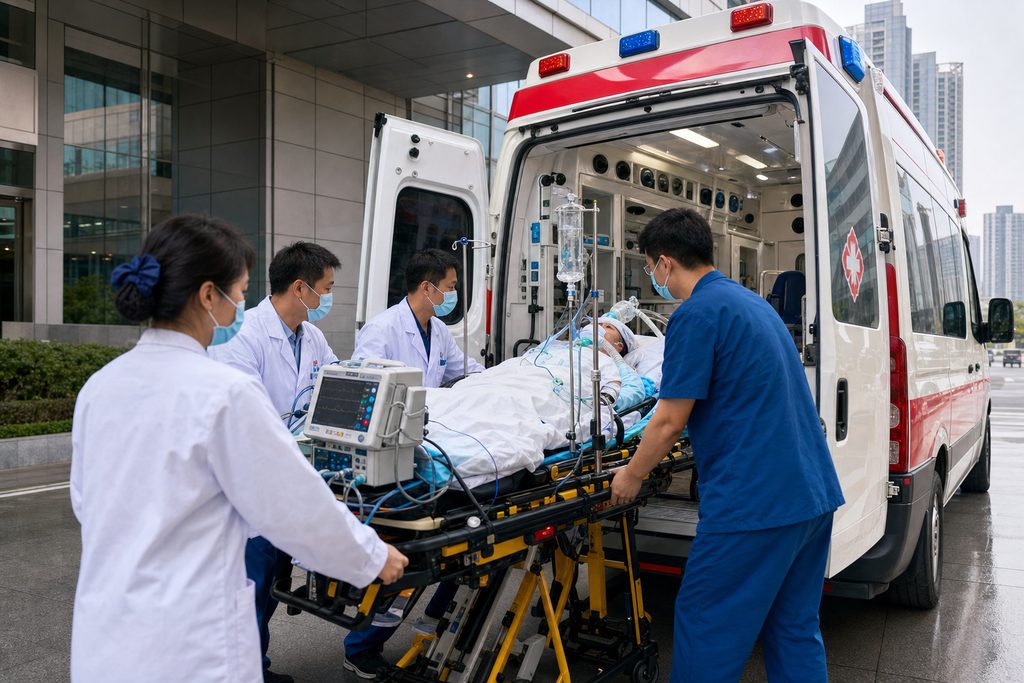
What happens when a loved one is lying in an ICU bed in one Chinese hospital, but the specialized care they need is in another facility 600 kilometers away? The clock is ticking. The patient is unstable. And you need to move them without causing harm.
That is the precise moment when a critical care transport service becomes the only bridge between a crisis and a solution. We have coordinated these transfers for international patients across 37 cities. The logistics are intense. The stakes could not be higher. But the process is far more structured and safer than most families imagine.
Key Takeaways
- A ground-based ICU ambulance transfer between major Chinese cities typically costs from $800 to $3,500, while a medical air transport can range from $8,000 to $25,000 depending on distance and clinical requirements.
- China operates a tiered emergency transport network where dispatched ambulances are classified by capability — only Type C ambulances are equipped for true intensive care monitoring and intervention during transit.
- Without a bilingual medical coordinator, international families face significant delays because public hospital transfers require administrative clearance, bed confirmation, and clinical handover documentation that is exclusively in Mandarin.
- You should never authorize a transfer until the receiving hospital has confirmed bed availability in writing and a physician at the sending hospital has signed off on transport stability — verbal promises are not enough.
The Problem: A Critically Ill Patient Cannot Stay Where the Resources Do Not Match the Condition
China has over 35,000 hospitals. But fewer than 1,800 are classified as Grade III Class A — the highest tier capable of handling complex multi-organ failure, advanced neurosurgery, or sophisticated cardiac interventions. A patient admitted through an emergency department in a smaller city may initially be stabilized. Then the scans come back. The diagnosis shifts. Suddenly, the local hospital’s neurosurgery department lacks the intraoperative MRI guidance needed for a safe resection. Or the cardiac team does not have a hybrid operating suite. The patient needs to be moved. Fast.
We have seen this scenario unfold most often in provincial capitals that are not among the top-tier medical hubs. A foreign national on a business trip collapses in Ningbo. The local hospital does an excellent job of resuscitation. But the definitive repair — a complex aortic arch replacement — requires transfer to Zhongshan Hospital in Shanghai. That is roughly 220 kilometers. Moving a patient on a ventilator with continuous vasopressor support across that distance is not a matter of calling an ordinary ambulance. It requires a mobile ICU.
Who We Are
We are not a hospital. We do not employ doctors or provide clinical care. Our team functions as your logistical architects when you need to navigate the Chinese healthcare system as an international patient. For critical care transfers, we coordinate between the sending hospital, the receiving hospital, the ambulance service provider, and your family. We verify that the transport team has the right equipment — ventilators, syringe pumps, portable monitors, and a physician trained in transport medicine. We translate clinical summaries, secure bed confirmations, and ensure the receiving ICU team knows exactly when your loved one will arrive and what they will need upon arrival. We handle the chaos so you can focus on the person who matters.
Why China’s Critical Care Transport Infrastructure Delivers Results
Ambulance Tiers Are Strictly Regulated — You Get What the Condition Demands
China’s emergency medical service system categorizes ambulances into four types. Type A is basic patient transport — a van with a stretcher. Type B is an emergency ambulance with basic life support. Type C is the mobile intensive care unit. These vehicles carry ventilators, defibrillators, multi-channel monitors, infusion pumps, and suction equipment. They are staffed by a critical care physician and a specialized nurse. Type D is for neonatal transport with incubators. When you call for a transfer, the sending hospital’s emergency department assesses the patient and determines which category is required. No private company can simply send a van with oxygen and call it an ICU transfer. The regulatory framework mandates that the transport team’s capability matches the patient’s acuity. This prevents the kind of dangerous under-equipping that plagues less regulated markets.
For a patient on a ventilator with titrated sedation and continuous arterial pressure monitoring, only a Type C ambulance is appropriate. The physician on board can adjust ventilator settings, manage sudden hypotension, and handle airway emergencies while the vehicle is moving. That is the standard. And it is enforced.
Medical Air Transport Is Available and Operates Under Civil Aviation Safety Protocols
When the distance exceeds 300 kilometers or ground transport time would exceed four hours, fixed-wing air ambulances become the safer option. These are typically turboprop aircraft — King Air 350 or similar — configured with stretcher systems, medical oxygen, and the same monitoring capability as a ground ICU. The flight crew includes a critical care physician and a flight nurse. The aircraft operate under China’s civil aviation regulations, and medical flights are coordinated with airport authorities to minimize ground transfer time. The patient is moved directly from the hospital to the aircraft via a coordinated ambulance-to-aircraft handoff.
Is medical air transport safe in China for ICU patients? The short answer is yes — when properly coordinated. The aircraft used for these missions are maintained to the same standards as commercial aviation. The medical crew is trained in altitude physiology and the specific challenges of managing a critically ill patient at cabin altitudes of 8,000 feet. Barometric pressure changes affect endotracheal tube cuffs, chest tube drainage systems, and intracranial pressure. The transport physician accounts for all of these variables before takeoff. We have coordinated air transfers for patients with traumatic brain injuries, post-cardiac arrest, and multi-organ failure. The safety record, when protocols are followed, is strong.
The Cost Structure Reflects Real Resource Allocation — Not Inflated Western Pricing
Critical care transport China cost is a question every family asks. And the numbers are more transparent than many expect. A ground ICU transfer between cities within a 200-kilometer radius typically ranges from $800 to $2,500. Longer distances — 400 to 600 kilometers — push that to $2,500 to $3,500. These figures include the ambulance, the physician, the nurse, all consumables, and the coordination fee. A fixed-wing air ambulance from a secondary city to Shanghai or Beijing generally runs from $8,000 to $18,000 for domestic routes. Longer interprovincial flights can reach $25,000.
Why are these costs lower than comparable transfers in the United States, where a fixed-wing air ambulance often exceeds $40,000? The structural reasons are straightforward. Physician and nurse salaries in China are lower. Aircraft operating costs, while significant, benefit from lower domestic fuel and maintenance expenses. And the administrative overhead — the billing and insurance complexity that inflates US healthcare costs — is largely absent. Chinese hospitals settle transport fees directly with the family or the coordinating service. There is no multi-party insurance negotiation driving up the price before the ambulance even starts its engine.
The ICU patient transfer between hospitals China price also varies by region. Transfers originating in Shanghai, Beijing, or Guangzhou tend to be at the lower end of the range because multiple competing ambulance services operate in those cities. Transfers from more remote provinces — Gansu, Yunnan, Inner Mongolia — cost more because the nearest Type C ambulance may be stationed hours away and must travel to the patient before the actual transfer begins.
| Transfer Type | Distance Range | Estimated Cost (USD) | Typical Crew |
|---|---|---|---|
| Ground ICU (Type C Ambulance) | Under 200 km | $800 – $2,500 | Critical care physician + ICU nurse |
| Ground ICU (Type C Ambulance) | 200 – 600 km | $2,500 – $3,500 | Critical care physician + ICU nurse |
| Fixed-Wing Air Ambulance | Domestic (under 1,500 km) | $8,000 – $18,000 | Flight physician + flight nurse + pilot |
| Fixed-Wing Air Ambulance | Long-haul domestic (1,500+ km) | $18,000 – $25,000 | Flight physician + flight nurse + pilot |
What You Need to Know Before Attempting This Alone
Families sometimes try to arrange a transfer themselves. We understand why. The instinct to act fast is overwhelming. But the barriers are real and they can delay the transfer by critical hours or days.
- Bed Confirmation Must Be in Writing: The receiving hospital’s ICU will not accept a transfer until an attending physician has reviewed the clinical summary and formally agreed to admit. That agreement comes in the form of an internal bed reservation notice — a document written entirely in Chinese. Without it, the ambulance will not depart. We have seen cases where a verbal “yes” from a department coordinator evaporated when the shift changed, and the family was left with a patient mid-transfer and no destination.
- Clinical Handover Documentation Requires Precise Translation: The sending hospital must prepare a transfer summary that includes current vital signs, ventilator settings, infusion rates, recent lab results, and imaging findings. Any ambiguity in translation — a medication name, a lab value unit, a surgical note — can cause the receiving team to reject the transfer or, worse, to accept the patient with incomplete understanding of the case. This is not a job for a general translator. It requires someone who understands both medical terminology and the specific documentation standards of Chinese hospitals.
- Payment Must Clear Before Transport: Public hospital ambulance services and third-party air ambulance operators require payment confirmation before dispatch. International wire transfers can take days. Alipay and WeChat Pay — the dominant domestic payment platforms — often have transaction limits for foreign cards. A family stuck in a hotel room trying to pay a $12,000 air ambulance invoice through a platform that caps foreign card transactions at $1,500 per day is in a very difficult position.
How We Help You Navigate This
When a family calls us, the first thing we do is get the clinical picture straight. We request the current medical records from the sending hospital. Our bilingual medical coordinators review the ventilator settings, the hemodynamic support, the neurological status, and the imaging. We translate the key findings into a structured clinical summary that meets the receiving hospital’s admission standards. Then we contact the target hospital’s international department or ICU director directly.
We do not send a generic inquiry. We send a case presentation that answers the questions the receiving physician will ask before they ever pick up the phone: What is the primary diagnosis? What interventions have been done? What is the current stability? Why does this patient need to move? What specific resource at the receiving hospital is required that the sending hospital lacks? When the receiving hospital confirms bed availability, we get that confirmation documented.
Simultaneously, we engage the ambulance service. For a ground transfer, we verify that the dispatched unit is a Type C ambulance with a physician credentialed in critical care. For an air transfer, we coordinate the ground ambulance legs on both ends — hospital to airport, airport to hospital — and confirm the flight plan with the aviation operator. We monitor the transfer in real time. The sending hospital knows when the ambulance will arrive. The receiving ICU knows when the patient will roll through their doors. You get updates in English at every stage.
For international patient critical care transfer Shanghai, Beijing, or Guangzhou, this coordination layer is what prevents the cascade of small failures that can turn a controlled transfer into a crisis. A bed that was promised but not confirmed. A payment that did not clear. A clinical summary that was translated incorrectly. These are the failure points. We close them.
If you are considering a longer-term treatment plan after the acute transfer is complete, our team can also help you understand the broader landscape of top-ranked hospitals across China and which facilities are best equipped for specific conditions. For families who need ongoing support navigating appointments, language barriers, and hospital logistics, our bilingual medical companion service provides on-the-ground assistance throughout the treatment journey.
Frequently Asked Questions
You cannot easily do it alone. The dispatch centers for Type C ambulances operate in Mandarin. The clinical assessment required to determine transport stability must be conducted by a physician who can communicate with the sending hospital’s ICU team. Your practical options are to work through the sending hospital’s international department — if they have one — or to engage a medical coordination service that can handle the dispatch, translation, and clinical handover on your behalf. Attempting to call an ambulance service directly without language support will result in delays and a high probability of miscommunication about the patient’s acuity.
This is the reason a critical care physician rides in the ambulance or on the aircraft. The transport team carries resuscitation medications, airway equipment, and defibrillation capability. They can intubate, start vasopressors, manage arrhythmias, and perform chest decompression if needed. The vehicle or aircraft diverts to the nearest appropriate hospital if stabilization cannot be achieved en route. Before any transfer, the sending physician must certify that the patient is stable enough for transport. That certification is not a guarantee — no transfer of a critically ill patient is zero-risk — but it is a clinical judgment that the benefit of reaching the receiving hospital outweighs the risk of the journey.
A ground transfer between cities in the same province can often be arranged within 4 to 8 hours, assuming the receiving hospital confirms bed availability quickly. An air ambulance transfer typically requires 12 to 24 hours because of flight planning, aviation clearances, and crew scheduling. The limiting factor is almost never the ambulance or aircraft availability. It is the administrative clearance — the bed confirmation, the clinical handover review, and the payment settlement. That is where most delays occur, and that is where experienced coordination makes the biggest difference in speed.
In a Type C ICU ambulance, the cabin is configured for clinical care. There is typically one seat for a family member in the front cab, but not in the patient compartment. The medical team needs unobstructed access to the patient. In a fixed-wing air ambulance, one family member can usually accompany the patient if the aircraft configuration allows and the medical crew approves. That decision is made on a case-by-case basis depending on the patient’s stability and the space constraints of the specific aircraft.
Yes, and it is done routinely. The ventilator used in air transport is certified for aviation use — it compensates for altitude-related changes in gas density and barometric pressure. The transport physician monitors end-tidal CO2, oxygen saturation, and airway pressures continuously. The primary risks are related to the physiological effects of altitude: expansion of trapped gas in the chest or cranium, reduced oxygen partial pressure, and the vibration and noise of the aircraft. The transport team is trained to manage all of these. Before departure, they review imaging to rule out untreated pneumothorax or intracranial air, both of which can expand dangerously at altitude. If those risks are present, the transfer may be delayed or a ground alternative may be recommended.
Your Next Step
Moving a critically ill patient between hospitals is never a simple decision. But when the local facility has reached the limit of what it can offer, transfer is not an option — it is a necessity. The infrastructure exists in China to do this safely. The ambulances are equipped. The airframes are maintained. The physicians are trained. What determines whether the transfer goes smoothly or becomes a nightmare is the coordination layer in between.
If you are facing this decision right now, start by getting a clear clinical picture and a documented bed confirmation. Do not move a patient on a verbal promise. And if the language barrier, the payment logistics, or the administrative complexity feels overwhelming, reach out to a team that handles these transfers regularly. We are here to make sure the only thing you have to worry about is being there for the person you love.
For more medical information and treatment options in China, visit chinamedservices.com (China Medical Services).
