First Hospital of Zhengzhou University: Guide for International Patients
Key Takeaways
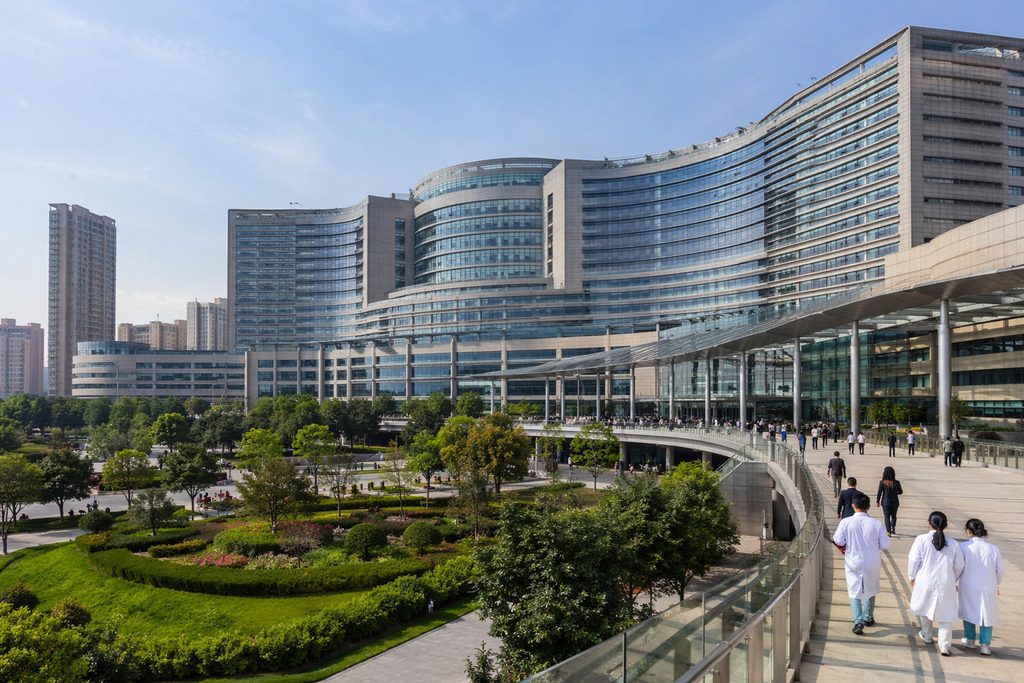
- The First Hospital of Zhengzhou University is one of the largest single-site hospitals in the world, handling more than 10,000 outpatient visits on a typical day across a campus of thousands of beds.
- It sits in Zhengzhou, a central China rail hub roughly 2.5 hours from Beijing and 4 hours from Shanghai by high-speed train — geography that matters if you plan to combine consultations in more than one city.
- Public outpatient registration in China generally cannot be locked in from overseas in advance. Surgical scheduling follows an in-person consultation, not a remote request.
- Foreign patients need an S2 visa for short-stay medical treatment, not an M visa. The M category is for commercial and trade activity and has nothing to do with hospital care.
According to China’s National Health Commission, the country operates more than 35,000 hospitals. A few hundred of them carry the “Grade 3A” designation and the patient volume that comes with it. The First Hospital of Zhengzhou University is one of those few hundred — and for international patients weighing a trip to central China, it is often the first name that comes up.
This guide is written for people outside China who are trying to understand what this hospital actually is, what it can and cannot do for a foreigner, and how the practical steps work.
The Problem: Big Hospital, Small Door for Foreigners
Scale cuts both ways. A hospital that sees 10,000 outpatients a day has enormous clinical depth. It also has queues, a Chinese-language registration system, and a scheduling culture built around walk-in volume rather than appointment slots booked months ahead.
That mismatch is the real obstacle. A patient in Dubai or Toronto can read about a Chinese hospital’s oncology or cardiac program online, but the website will not let them pick a surgeon and a date. There is no equivalent of the online booking flow Western patients expect. Registration happens on the day, in person, usually before 8 a.m. for the most sought-after clinics.
So the question is not whether the medicine is good. It is whether you can get to the right department, at the right time, with your records translated and understood. That is a logistics problem, and it is solvable.
Why Zhengzhou Delivers Results for Complex Cases
Zhengzhou is not Beijing or Shanghai, and that is partly the point. Costs run lower, queues are shorter than at the most famous tertiary centers, and the hospital still carries full Grade 3A status with subspecialty depth across oncology, surgery, and critical care.
Clinical Volume as a Quality Signal
Chinese tertiary hospitals concentrate cases in a way Western systems rarely do. A department that performs hundreds of a given procedure annually builds pattern recognition that a low-volume center cannot. The First Hospital of Zhengzhou University operates at a scale where complex surgical teams run near-daily case loads rather than weekly ones. Volume is not a guarantee of outcome — no honest advisor would say it is — but it is a legitimate factor when comparing where to be treated.
Cost Structure Without the Western Overhead
Zhengzhou University hospital cost for foreigners typically lands well below comparable care in the United States or Western Europe. The structural reasons are straightforward: physician salaries are lower in absolute terms, hospital administration is leaner, and the public system negotiates drug and device pricing centrally. A procedure quoted at $120,000 in the US may come in at a fraction of that here. Exact figures vary by hospital, department, and case complexity, and any number you see online is an estimate until a clinician reviews your records.
The Central China Location Advantage
Zhengzhou sits on the intersection of China’s north-south and east-west high-speed rail lines. If your case needs a second opinion from a specialist in Beijing or Shanghai, you can physically get there and back the same day. That flexibility is worth more than it sounds when you are managing a serious diagnosis.
Is First Hospital of Zhengzhou University Good for International Patients?
Here is the honest answer: it is a strong clinical institution, but it is not a purpose-built international hospital. There is a difference.
Private international hospitals in China — think United Family, Jiahui, Parkway — are designed around foreign patients. English-speaking staff, JCI accreditation, direct insurance billing, appointment systems that work like a Western clinic. The First Hospital of Zhengzhou University is a public tertiary hospital. Its international department exists and can assist foreign patients, but the day-to-day environment is Chinese-language and high-volume.
What that means in practice:
- You will likely need a bilingual companion for registration, payment, and navigation. Not a nice-to-have — a practical necessity.
- Payment is generally upfront. Public hospitals collect before service; insurance reimbursement happens afterward, on your own.
- You can request the international or VIP channel, which offers senior specialists and English support at roughly 1.5 to 2 times the standard fee.
- Subspecialty quality varies. Some departments are nationally competitive; others are solid regional providers. Matching your specific condition to the right department matters more than the hospital’s overall reputation.
If your priority is a Western-style hospital experience with a private room and an English-speaking nurse at 2 a.m., a private international hospital is the better fit. If your priority is clinical depth at a lower cost and you are willing to accept a more complex environment, a major public hospital like this one is a reasonable choice.
How to Book an Appointment at First Hospital of Zhengzhou University
This is where most foreign patients get stuck, so let’s walk through it properly.
Standard public outpatient registration cannot be reserved from overseas in advance. You register on the day, in person, with your passport. For popular specialists, that means arriving early — often before 7 a.m. — because the day’s allocation is finite.
Surgery is a two-step process. First you attend an outpatient consultation. The specialist reviews your case, orders any additional imaging or labs, and if surgery is indicated, issues an admission request. Only then does the hospital schedule the procedure. No reputable Chinese public hospital will book a surgical date for a patient they have never examined. Anyone who tells you otherwise is not describing how the system works.
For patients who want to reduce uncertainty before flying, the practical sequence looks like this:
- Send existing imaging, pathology, and lab reports for a written second opinion from the relevant specialty.
- If the written review suggests a feasible path, follow with a video consultation to discuss goals and hear the team’s recommendation.
- If you want a specialist seen on your behalf before committing to travel, a proxy consultation can be arranged using your materials.
- Once a plan is clear and you agree to it, coordinate arrival, hospital communication, and admission logistics.
That staged approach exists for a reason. It avoids the expensive mistake of flying 8,000 miles for a consultation that could have been answered by email.
Zhengzhou Hospital China Treatment Price: What to Expect
Cost questions deserve real numbers, with the caveat that every figure below is an estimate. Final pricing depends on the hospital, the department, the complexity of your case, and whether you use the standard or VIP channel.
For context, comparable procedures in the United States frequently exceed six figures. The gap is structural, not a sign of lower-quality care.
| Service category | Typical range in China (USD) | US comparison |
|---|---|---|
| Specialist outpatient consultation | $30 – $150 (standard); $150 – $400 (VIP/international) | $300 – $600 |
| Advanced imaging (MRI, CT) | $150 – $600 | $1,000 – $5,000 |
| Coronary bypass surgery | $12,000 – $20,000 | $120,000+ |
| Joint replacement (hip or knee) | $8,000 – $18,000 | $35,000 – $75,000 |
| Comprehensive health screening | $300 – $1,500 | $2,000 – $8,000 |
These ranges are indicative only and vary by hospital and case complexity. Any quote you receive before a clinician has reviewed your records is provisional.
One structural point that surprises Western patients: Chinese public hospitals generally require payment before treatment. There is no “bill you later” model. International insurance may reimburse afterward, but you will need to fund the care upfront and file the claim yourself. Some private international hospitals offer direct billing; most public tertiary hospitals do not.
Practical Considerations: Visa, Records, and Language
Most public tertiary hospitals do not bill international insurers directly. You pay upfront and seek reimbursement from your insurer afterward, subject to your policy terms. Some private international hospitals in China do offer direct billing. Confirm coverage with your insurer before you travel, and get pre-authorization in writing where your policy requires it.
Major Chinese tertiary hospitals have established complication management protocols and critical care capacity. That said, you should discuss risks, consent, and escalation procedures with your treating team in advance, through an interpreter if needed. Travel insurance that specifically covers medical complications, and a clear plan for who accompanies you, are both worth arranging before departure.
Hospitals themselves do not sell packaged medical tourism products. Third-party coordinators assemble them — typically bundling appointment coordination, interpretation, airport transfer, and accommodation. If you are quoted a package, ask exactly which services are included, whether hospital fees are separate, and what happens if the appointment cannot be secured. Transparency on those three points separates a legitimate coordinator from a reseller.
It depends entirely on the procedure. A diagnostic workup might take three to five days. A major surgery with recovery could mean three to six weeks on the ground. Build in buffer time for pre-operative testing and post-operative review, and do not book a return flight until your treating team confirms you are fit to travel.
Your Next Step
The First Hospital of Zhengzhou University is a serious clinical institution, and for the right case it is a genuinely strong option. But the medicine is only half the equation — the other half is getting your records in front of the right specialist, understanding the realistic cost, and navigating a system that was not designed with foreign patients in mind.
We are China Medical Services, a bilingual coordination team that works with 340+ top-ranked hospitals across 37 cities. We are not a hospital and we do not provide diagnoses or treatment. What we do is translate your records, coordinate appointments through official hospital channels, and put a bilingual companion beside you on the ground.
If you want a clear picture of whether this hospital fits your case, start with a conversation. No pressure, no obligation — just an honest read on your options.
Frequently Asked Questions
Yes. The hospitals used for international patients are JCI-accredited and follow the same international safety standards as top hospitals in the US and Europe. Surgical teams perform high volumes of procedures — often more than their Western counterparts — which studies show leads to better outcomes.
Costs vary by procedure and hospital, but international patients typically save 40-80% compared to US prices — even when factoring in travel and accommodation. A consultation with our team will give you an exact, all-inclusive quote with no hidden fees.
Send us your existing medical reports to get started. We handle everything from hospital selection and appointment scheduling to visa assistance and post-operative recovery planning. Your medical records are reviewed by the specialist before you even book a flight.
For more medical information and treatment options in China, visit chinamedservices.com (China Medical Services).
