Beard Restoration Cost in China: Real Prices, Top Clinics, Honest Risks
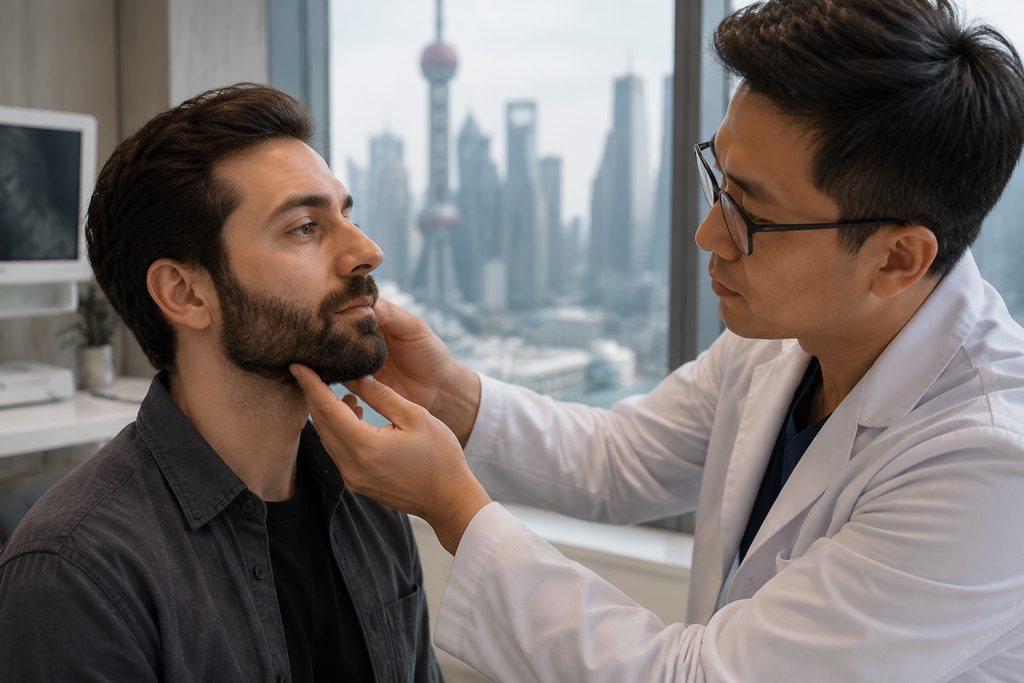
Beard Restoration Cost in China: Real Prices, Top Clinics, and What Nobody Tells You
You have probably seen the ads promising a full beard for the price of a weekend trip. That framing is misleading in both directions — it undersells what good clinics actually charge and oversells what a single procedure can guarantee. What is true is this: the beard transplant cost in China typically lands between $1,800 and $5,500, depending on graft count, clinic tier, and city. In the United States or the UK, the same procedure runs $7,000 to $15,000. The gap is real. So is the homework you need to do before booking.
This guide walks through the actual numbers, the difference between a $2,000 quote and a $5,000 one, how to evaluate clinics in Shanghai and Beijing, and the failure modes nobody puts on their pricing page.
Key takeaway: Beard transplant cost China pricing is driven by graft count and clinic tier, not by city prestige alone. A 1,500-graft FUE procedure at a solid hospital-affiliated clinic in Chengdu can cost less than half of the same procedure at a premium Shanghai international clinic — and both can produce good results if the surgeon is experienced.
How This Actually Works, Step by Step
Most international patients assume they book a date, fly in, and get the procedure. That is not how Chinese hospitals operate, and understanding the sequence will save you both money and a wasted trip.
Step 1 — Send your photos and history. You email clear photos of your beard area from three angles, plus any relevant medical history (previous transplants, skin conditions, medications). A clinic coordinator reviews these and gives a preliminary graft estimate.
Step 2 — Get a written quote range. Reputable clinics will not give you a final number from photos alone. They give a range — say, 1,200 to 1,800 grafts — and explain that the final count is determined in person.
Step 3 — Book a consultation slot. Here is the part that surprises people: at most Chinese public hospitals, you cannot pre-book a specific surgeon’s outpatient slot from overseas the way you would at a US clinic. You either go through the hospital’s international department (which can arrange appointments, usually at 1.5 to 2 times the standard fee) or you arrive and register in person on the day.
Step 4 — In-person assessment and same-day or next-day surgery. The surgeon examines your donor area, draws the beard line, and confirms the graft count. Many clinics perform the procedure the same day or the following morning.
Step 5 — Follow-up. You return at 24 to 48 hours for a wash and check. Then you fly home. Most of the healing and all of the growth happens after you leave, which is why choosing a clinic with responsive remote follow-up matters more than choosing one near your hotel.
What Drives the Price Up or Down
Two clinics in the same city can quote you $2,000 and $5,200 for what sounds like the same procedure. The variables are concrete.
- Graft count. This is the single biggest factor. Filling patchy cheeks needs 500 to 800 grafts. Building a full beard from near-nothing can require 2,500 to 4,000. Most Chinese clinics price per graft, typically $1.20 to $2.50 per graft at hospital-affiliated clinics, higher at premium international facilities.
- Technique. FUE (follicular unit extraction) is the standard. It leaves no linear scar and is what most international patients want. FUT, which removes a strip of scalp, is cheaper but leaves a scar and is rarely the right choice for beard work.
- Surgeon seniority. A department chief with 15 years of beard-specific experience charges more than a junior surgeon. This is not marketing — beard angle and direction are harder to get right than scalp hair, and a poorly angled beard looks unnatural permanently.
- Clinic type. Public hospital plastic surgery or dermatology departments, private hair-restoration chains, and international hospitals all price differently. Public hospital departments are usually the cheapest per graft but have the longest waits and least English support.
- City. Beijing and Shanghai carry a premium of roughly 15 to 30 percent over Chengdu, Wuhan, or Xi’an for equivalent quality.
| Procedure Scope | Grafts | China Price Range (USD) | US/UK Price Range (USD) |
|---|---|---|---|
| Patchy cheeks / small fill | 500–800 | $1,200–$2,000 | $3,500–$6,000 |
| Moderate density restoration | 1,000–1,500 | $1,800–$3,200 | $6,000–$10,000 |
| Full beard reconstruction | 2,000–3,000 | $3,000–$5,000 | $9,000–$14,000 |
| Premium international clinic, full beard | 2,500–4,000 | $5,000–$8,000 | $12,000–$18,000 |
Prices vary by hospital and case complexity. Treat every figure above as a planning range, not a quote.
A Realistic Timeline
From first email to walking out of the clinic, most international patients spend four to eight weeks. Here is how that breaks down, including the steps people forget.
| Stage | Typical Duration | What Happens |
|---|---|---|
| Research and shortlisting | 1–2 weeks | Compare clinics, request quotes, verify surgeon credentials |
| Photo review and written estimate | 3–10 days | Clinic reviews photos, returns graft range and price range |
| Appointment coordination | 1–3 weeks | International department arranges a slot; public hospital general slots cannot be pre-booked from abroad |
| Visa application (S2) | 1–3 weeks | S2 is the short-stay category used for medical treatment. Processing times vary by consulate |
| Travel and in-person consult | 2–3 days | Surgeon confirms graft count, draws the beard line |
| Procedure | 4–8 hours | Usually one session; large cases may split across two days |
| Initial recovery before flying | 2–4 days | Scabbing begins; clinic wash and check |
| Visible growth | 4–6 months | Transplanted follicles shed, then regrow |
| Final result assessment | 9–12 months | Full density and texture apparent |
The waiting steps are where trips fall apart. Document translation, if the hospital requires your records in Chinese, adds three to seven days. Visa processing in peak season can stretch to three weeks. Build buffer into your plans.
What Can Go Wrong — and What Happens Then
This is the section most pricing articles skip. Read it before you pay a deposit.
Graft count comes in higher than the estimate. The most common surprise. Photos flatten depth and hide thinning areas. If the surgeon says you need 2,200 grafts instead of 1,500, your bill rises by roughly $800 to $1,500. Ask upfront whether the quoted price is capped or per-graft.
Poor beard angle or direction. Beard hair grows at specific angles. Follicles placed at the wrong angle stick out or lie flat in unnatural patterns. This is the hardest complication to fix and the main reason surgeon experience matters more than clinic decor. Correction means another procedure, more donor depletion, and more money.
Donor area overharvesting. If the clinic takes too many follicles from the back of your scalp, that area thins permanently. This is why graft count has a ceiling based on your own donor density — a clinic that promises 4,000 grafts without examining you is guessing.
Infection or poor healing. Rare but real. Signs include spreading redness, pus, or fever after day three. Reputable clinics provide a direct contact for post-operative problems. Get that contact in writing before you leave.
Shock loss. Temporary shedding of nearby native hair after the procedure. Usually resolves in two to four months. Not a sign of failure, but it alarms people who were not warned.
If a clinic guarantees a specific final density, refuses to name the operating surgeon, or quotes a price far below every competitor, walk away. Beard restoration is permanent. There is no undo button.
Evaluating Clinics in Shanghai and Beijing
The two cities dominate the high end of the market. Knowing what to look for matters more than which city you pick.
For beard restoration price Shanghai, expect the widest range in the country — from roughly $2,000 at a public hospital plastic surgery department to $8,000 at a premium international clinic with English-speaking staff and private rooms. Shanghai also has the deepest concentration of clinics experienced with international patients, which reduces communication risk.
For the best beard transplant clinic Beijing options, the advantage is academic medicine. Several of Beijing’s top-tier hospitals sit in the Fudan ranking’s highest tier and have plastic surgery departments with genuine research depth. The tradeoff is process: general outpatient registration means queuing, and English support is thinner unless you go through an international department.
Whichever city you choose, verify these five things:
- The name and registration of the surgeon who will actually operate — not the clinic’s founder
- Whether they perform beard work regularly, not just scalp transplants
- Before-and-after photos of beard cases specifically, ideally at 12 months
- A written quote that states per-graft pricing and whether it is capped
- A named post-operative contact and a follow-up protocol
If you want to compare hospital tiers and specialty rankings before shortlisting, our department-by-department top hospital rankings list the leading institutions across 45 specialties, and the Fudan-ranked top hospitals by city shows which cities concentrate the strongest programs.
Practical Considerations: Records, Visa, Payment, and Follow-Up
Records. Bring photos of your beard at its best and worst, plus a list of medications. If you have any scalp or skin condition, get a dermatologist’s note before traveling. Active skin disease in the donor or recipient area is a contraindication.
Visa. Foreign patients coming to China for medical treatment use the S2 visa, annotated for medical purposes. Stays beyond 180 days require S1. Accompanying family members also apply for S2. The M visa is for commercial and trade activity and has nothing to do with medical treatment — if anyone tells you otherwise, they are wrong. Always confirm current requirements with the nearest Chinese embassy or consulate, since documentation rules change.
Payment. Public hospitals require prepayment; insurance reimbursement happens afterward, and most international policies do not cover cosmetic procedures. Private international hospitals often bill insurers directly. Beard restoration is almost always classified as cosmetic, so assume you are paying out of pocket.
Language. China’s top hospitals handle enormous patient volumes — some see over 10,000 outpatient visits a day. Signage, registration systems, and consent forms are in Chinese. Without language support, even simple steps like paying a fee or finding the right floor become obstacles.
Follow-up at home. Your growth phase happens after you leave China. Confirm the clinic will review photos remotely at month 3, 6, and 12. A clinic that disappears after payment is a clinic you cannot hold accountable.
Frequently Asked Questions
At accredited hospitals and licensed clinics, yes — beard transplantation uses the same FUE technique performed worldwide, and complication rates are low when the surgeon is experienced. The risk is not the country; it is unlicensed operators and clinics that cut corners on sterility or graft handling. Verify the clinic’s license and the surgeon’s registration before booking.
In the US and UK, beard transplants typically run $7,000 to $15,000. In China, the same procedure generally costs $1,800 to $5,500 at hospital-affiliated clinics, and up to $8,000 at premium international facilities. Turkey sits between the two, often $2,500 to $4,500 including a hotel package.
You can arrange a consultation and a provisional surgical slot through a hospital’s international department, but general outpatient appointments at public hospitals cannot be pre-booked from abroad. The final graft count and price are confirmed in person. Plan for a consultation day before surgery.
It depends on the area you want covered and your natural density. Small cheek patches need 500 to 800 grafts. A full beard reconstruction can require 2,500 to 4,000. Only an in-person examination can give you an accurate number, and your donor area’s density sets the ceiling.
Transplanted follicles shed within two to four weeks, then begin regrowing around month three. Most patients see meaningful density by month six and assess the final result at nine to twelve months. Anyone promising visible results in a month is not being straight with you.
Your Next Step
The beard transplant cost in China is genuinely lower than Western pricing, but the savings only matter if the result is good. Choose the surgeon before the price, confirm the graft count in person, and get the follow-up protocol in writing. Our team connects international patients with accredited Chinese hospitals and clinics, coordinates appointments through official international departments, and provides bilingual support on the ground — we do not perform procedures and we do not promise outcomes. If you want help shortlisting clinics or understanding what a realistic quote looks like for your case, you can start with a free consultation and we will walk you through the options at your pace.
This article is for general information only and is not medical advice. Cosmetic and surgical procedures carry risks, and individual suitability varies. Consult a qualified, licensed physician before making any treatment decision.
For more medical information and treatment options in China, visit chinamedservices.com (China Medical Services).
