Nasal Airway Check in China: A Quick Guide for Foreign Patients
Nasal Airway Check in China: A Quick Guide for Foreign Patients
In the United States, a specialist ENT consultation for chronic nasal obstruction can take six to eight weeks to schedule, and a CT scan of the sinuses may add another $800 to $1,500 out of pocket. At a top-tier Chinese hospital, the same workup — nasal endoscopy, imaging, and a senior physician’s assessment — typically happens within a single morning, often for a fraction of that price. That gap is why so many international patients now ask us about the nasal airway check cost China hospitals charge, and what the process actually involves.
This guide walks through the practical realities: what a nasal airway check includes, how to arrange one remotely, what it costs, and where the genuine friction points are.
How This Actually Works, Step by Step
Most international patients assume they can simply book an appointment online and fly in. Chinese public hospitals don’t work that way. Regular outpatient registration is same-day, walk-in based, and the queue starts early. Here is the realistic sequence.
You begin by sending us your existing records — a CT or MRI of the sinuses if you have one, any prior endoscopy notes, allergy testing, sleep study results, and a short written description of your symptoms. Our team translates the relevant documents into Chinese and routes them to the appropriate ENT department at a shortlisted hospital.
A Chinese ENT specialist reviews the file and returns a written assessment: whether a nasal airway check is warranted, what specific tests they recommend, and roughly how long the visit should take. That written second opinion typically costs $300–500 depending on the hospital tier.
If you want to speak with the physician directly before committing to travel, a video consultation runs $100–300 at a standard international department, or $500–800 with a senior specialist. For complex cases — say, a suspected structural obstruction combined with sleep apnea — a multidisciplinary review involving ENT, pulmonology, and sleep medicine is possible at $1,500–2,000.
Once you decide to come, we coordinate the appointment through the hospital’s official international department or VIP channel. This is not a queue-jumping arrangement. It is case management: document translation, formal registration, and a confirmed slot with a named department.
On the day itself, a bilingual medical companion meets you at the hospital, handles registration and payment, walks you through each station, and interprets between you and the clinical staff. Expect that service to run from $300 per day.
What a Nasal Airway Check Actually Involves
Patients often arrive expecting a single test. In practice, a thorough nasal airway assessment is a bundle of evaluations, and which ones you need depends on your symptoms.
Anterior rhinoscopy is the starting point — the physician uses a speculum and light to inspect the front of the nasal cavity. It takes two minutes and costs almost nothing.
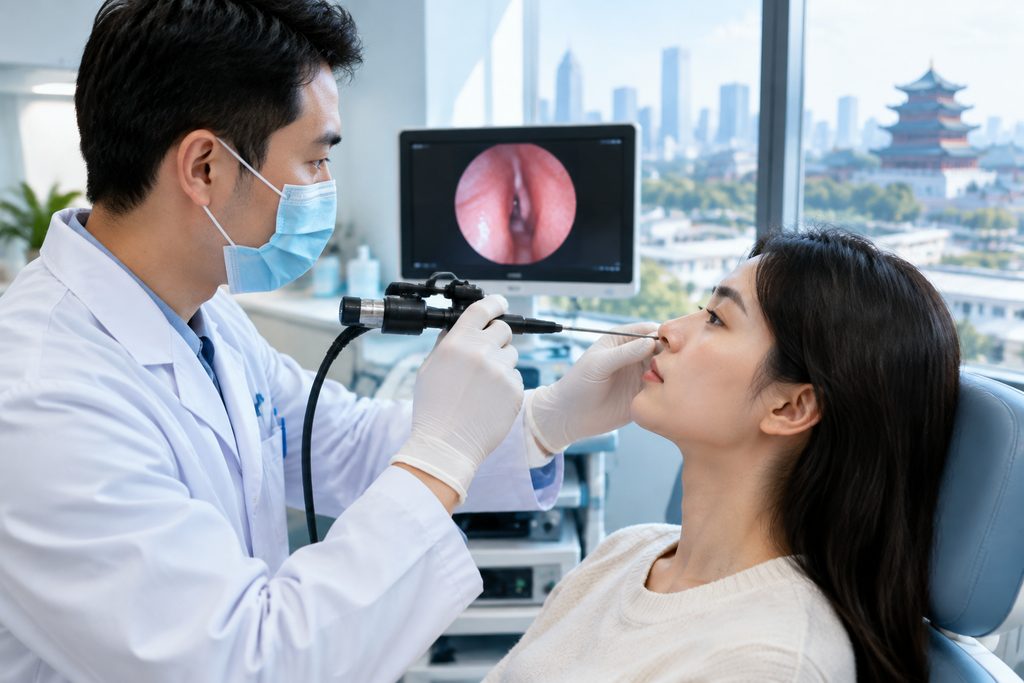
Nasal endoscopy is the workhorse. A thin flexible or rigid scope with a camera is passed through the nostril to examine the nasal passages, septum, turbinates, and the opening of the sinuses. It is performed in the clinic, usually without sedation. A topical decongestant and anesthetic spray numbs the passage first. The procedure itself takes five to fifteen minutes.
Imaging comes next if the endoscopy suggests something structural. A sinus CT is the standard. Some hospitals also offer cone-beam CT, which delivers a lower radiation dose.
Acoustic rhinometry or rhinomanometry measures airflow and cross-sectional area objectively. Not every hospital stocks this equipment, but major ENT centers in Beijing, Shanghai, and Guangzhou generally do.
Allergy testing — skin prick or serum IgE — is added when allergic rhinitis is suspected as the underlying driver.
If sleep-disordered breathing is part of the picture, a home sleep apnea test or an overnight polysomnography study may be recommended. That adds a night to your schedule.
A Realistic Timeline
Here is what the process looks like for a patient traveling from Europe or North America, assuming no urgent complications.
| Stage | What Happens | Typical Duration |
|---|---|---|
| Records submission | You send reports; we translate and forward | 2–4 days |
| Written second opinion | ENT specialist reviews and responds | 3–7 business days |
| Video consultation (optional) | Live discussion with the clinical team | Scheduled within 1–2 weeks |
| Appointment coordination | International department slot confirmed | 1–3 weeks lead time |
| Visa (S2) | Application with hospital invitation letter | 1–3 weeks, varies by consulate |
| Travel and arrival | Flights, hotel, airport transfer | 1–2 days |
| Hospital visit | Consultation, endoscopy, imaging | Half day to full day |
| Results and plan | Written findings, treatment recommendation | 1–3 days after tests |
Total, from first email to standing in the clinic: roughly three to six weeks. The waiting steps people forget are document translation and appointment lead time. Neither is instant.
What Can Go Wrong — and What Happens Then
Honesty matters more than reassurance here.
The appointment slot isn’t available when you want it. Senior ENT specialists at top hospitals are busy. If the department cannot confirm a slot matching your requested dates, our coordination fee is refunded in full. You can also shift to a different hospital or a private international clinic, which usually has more scheduling flexibility.
Your existing imaging is unusable. Sometimes scans are too old, poorly captured, or in a format the hospital cannot open. In that case you repeat the CT on site. Budget an extra $150–400 depending on the hospital.
The endoscopy reveals something unexpected. A polyp, a deviated septum requiring surgical correction, or a mass that needs biopsy. This changes the plan and possibly extends your stay. Nothing is performed without your informed consent, and any surgical recommendation can be taken home for a second opinion before you decide.
Language and navigation friction. Chinese tertiary hospitals can see over 10,000 outpatients daily. Signage is largely in Chinese. Without a bilingual companion, even finding the right floor becomes a genuine obstacle. This is not a sales pitch — it is simply what the buildings are like.
Insurance doesn’t reimburse. Public hospitals require upfront payment; you claim reimbursement afterward. Private international hospitals often bill insurers directly, but at higher prices. Check your policy before you travel.
Choosing Where to Have Your Nasal Airway Assessment in China
Three broad options exist, and they suit different patients.
Top public hospitals — the kind ranked in the Fudan Hospital Rankings — offer the deepest specialist expertise, the highest patient volumes, and the lowest prices. The trade-off is crowding, limited English, and rigid scheduling. You can browse ENT rankings and other specialties through our department-by-department top hospital listings.
Private international hospitals such as United Family, Jiahui, Parkway, and Raffles employ English-speaking staff, hold JCI accreditation, bill insurance directly, and feel closer to a Western clinic. Prices run higher — often 1.5 to 2 times the public VIP channel. See the full private international hospital directory for comparison.
Hospital international or VIP departments sit in between. You get senior specialists and English coordination inside a public institution, at roughly 1.5 to 2 times standard public pricing.
For a straightforward nasal airway check without suspected complications, a public hospital VIP department is usually the best value. For complex cases needing coordinated multidisciplinary input, the same applies — but expect longer lead times.
Practical Considerations: Records, Visa, Payment, and Follow-Up
Records. Gather everything before you write to anyone. Prior imaging, endoscopy notes, allergy results, medication lists, and a plain-language symptom history. The more complete the file, the more precise the remote assessment.
Visa. Foreign patients coming to China for medical treatment apply for the S2 visa, annotated for medical purposes. Stays exceeding 180 days fall under S1. Accompanying family members apply for S2 as well. Note that the M visa is strictly for commercial and trade activity — it is not a medical visa, despite what some online sources claim. Requirements change, so confirm current rules with your nearest Chinese embassy or consulate.
Payment. Public hospitals want payment upfront — cash, international card, or bank transfer depending on the institution. Private hospitals frequently accept direct insurance billing.
Language. Assume you will need interpretation unless you’re at a private international clinic. A bilingual medical companion handles registration, queuing, payment, wayfinding, and translation throughout the visit.
Follow-up at home. Ask for a written summary in English before you leave, including imaging files and the physician’s recommendations. Your local ENT can then continue care without repeating the workup.
Frequently Asked Questions
At a public hospital, expect roughly $150–400 for consultation, nasal endoscopy, and basic testing combined. A sinus CT adds $150–400. Private international hospitals run higher, often $600–1,200 for the same bundle. Prices vary by hospital and case complexity, so a firm quote requires your records first.
Yes. Nasal endoscopy is a routine, low-risk procedure performed in outpatient clinics worldwide, and Chinese ENT departments at major hospitals perform it daily in high volumes. Minor nosebleeds or brief discomfort are the most common side effects. Serious complications are rare. If you have a bleeding disorder or take anticoagulants, tell the physician in advance.
The clinical portion — consultation plus endoscopy — usually takes 30 to 60 minutes. If imaging is added, budget two to three hours total at the hospital. Results and a written plan typically arrive within one to three days.
Not directly at most public hospitals, where same-day registration is the norm. What you can do remotely is send records, obtain a written second opinion, and have our team coordinate a confirmed appointment through the hospital’s international department before you fly. That is the practical route.
Yes, most foreign nationals do. The applicable category is S2 for short medical stays. You will typically need a hospital invitation letter and supporting documents. Approval is never guaranteed and depends on consulate review.
Your Next Step
A nasal airway check in China is fast, well-equipped, and considerably cheaper than equivalent care in the US or Western Europe — but it rewards preparation. Getting your records translated, securing a confirmed appointment, and having someone bilingual beside you on the day makes the difference between a smooth morning and a frustrating one.
China Medical Services connects international patients with more than 340 top-ranked hospitals across 37 cities, handling records translation, appointment coordination, and bilingual accompaniment. We are not a medical provider and we do not promise specific clinical outcomes. If you’d like to understand your options, start with a free consultation — no obligation, and no pressure.
This article is for general information only and does not constitute medical advice. Always consult a qualified physician about your individual condition before making treatment decisions.
For more medical information and treatment options in China, visit chinamedservices.com (China Medical Services).
