Eye Checkup in China for Foreigners: Costs, Top Hospitals, and How to Book
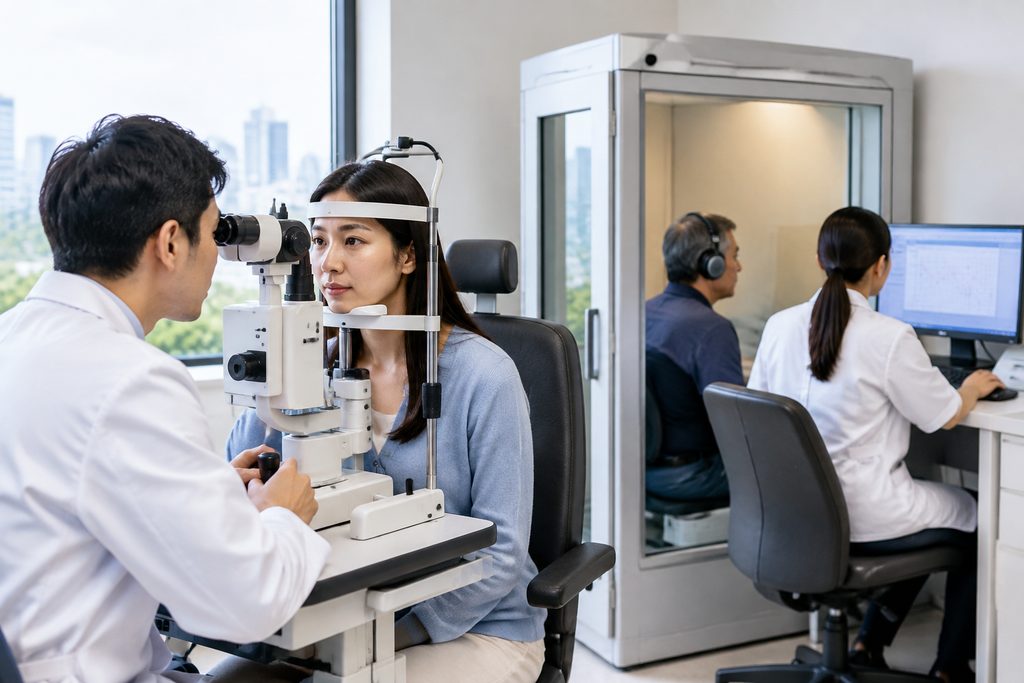
Eye Checkup in China for Foreigners: The Short Answer
A comprehensive private eye checkup in China costs roughly $150 to $600 at an international department, and $60 to $200 at a standard public hospital. The full visit takes two to four hours. No referral is needed, and most clinics see you within days rather than months.
Now the complication. Chinese public hospitals do not let you reserve an ordinary outpatient slot from overseas. You either walk in and queue the same day, or you go through the hospital’s international or VIP channel, which costs about 1.5 to 2 times more and pre-books your appointment in advance. That single distinction shapes everything below.
Who This Is Right For — and Who It Isn’t
China’s eye care capacity is genuinely large. Zhongshan Ophthalmic Center in Guangzhou and Beijing Tongren Hospital both handle patient volumes that would overwhelm most Western eye clinics, and both appear among China’s top-ranked specialty hospitals in the Fudan rankings. Volume is not the same as suitability, though. Here is an honest split.
Usually a good fit:
- Expats and long-stay visitors who need a routine exam, updated prescription, or glaucoma screening
- Medical travelers booking a comprehensive eye exam package in China while already in the country for other reasons
- Patients seeking a second opinion on a retinal, corneal, or cataract diagnosis, with reports in hand
- Anyone priced out of a $400–$900 private eye exam in the US or a long public wait at home
Probably not the right move:
- Acute trauma, sudden vision loss, or suspected retinal detachment — go to the nearest emergency department wherever you are
- Anyone expecting a same-day surgical date. In public hospitals, surgery is scheduled only after an in-person consultation
- Patients who cannot travel with a companion and have no Mandarin or English support arranged
- Complex pediatric cases requiring long-term continuity with one specific physician
The Options, Compared
Three real pathways exist, and they are not interchangeable. The table below reflects typical 2025 pricing, which varies by hospital and case complexity.
| Pathway | Typical Exam Cost | Booking | Language | Best For |
|---|---|---|---|---|
| Public hospital, standard outpatient | $60–$200 | Same-day queue only | Mostly Chinese | Budget-conscious, flexible travelers |
| Public hospital, international / VIP department | $150–$600 | Pre-booked | English-speaking staff | Foreigners wanting a fixed appointment |
| Private international hospital | $250–$800 | Pre-booked, often same week | English throughout | Insurance direct billing, Western-style service |
Which column suits you depends mostly on two things: whether you need a guaranteed appointment time, and whether you can navigate a Chinese-language queue. If both answers are “no,” the standard public route is fine and cheap. If either is “yes,” budget for the international tier.
Is an Eye Exam in China Safe for Tourists?
This is the question that decides most trips, so it deserves a direct answer. Is eye exam in China safe for tourists? For routine diagnostic exams, yes — the equipment at major Chinese eye hospitals is current-generation and often newer than what you would find in a mid-sized Western clinic, simply because the patient volume justifies the investment.
Two caveats matter. First, safety in a Chinese hospital is largely a function of communication. If you cannot read the intake form or understand the technician’s instructions during a visual field test, results get muddied. Second, sterilization standards vary by institution. Major teaching hospitals and JCI-accredited private facilities follow recognized protocols; small neighborhood clinics may not.
One more practical note. China’s 340+ top-ranked hospitals — the top 5% of the country’s 35,000+ hospitals, ranked by Fudan and JCI — are concentrated in major cities. Beijing alone hosts 21 of the Fudan Top 100, Shanghai 18, Guangzhou 10. Outside those cities, the international-patient infrastructure thins out quickly.
Where to Go: Best Eye Hospital Shanghai for Foreigners and Beyond
Shanghai is the most common entry point for foreign patients, and for good reason. The city pairs top-tier ophthalmology with a dense cluster of international hospitals that bill insurance directly. If you are searching for the best eye hospital Shanghai for foreigners, you are usually weighing two categories rather than two buildings.
On the public side, Fudan University-affiliated eye and ENT hospitals carry strong specialty reputations, and their international departments handle foreign patients routinely. On the private side, facilities such as United Family, Jiahui, Parkway, and Raffles offer English-speaking staff, JCI accreditation, and direct insurance billing — at roughly double the public-tier price.
Beijing answers a slightly different question. How much does eye checkup cost in Beijing? Expect $70–$220 at a standard public hospital and $180–$650 at an international department. Beijing Tongren Hospital is the name most ophthalmologists mention first, and Peking Union Medical College Hospital handles complex referrals. You can browse ranked options by city on our Fudan-ranked hospital directory, or filter by specialty through the 45-specialty department index.
What It Costs — and What Drives the Variance
A comprehensive eye exam package China price range typically covers refraction, visual acuity, slit-lamp examination, tonometry (eye pressure), fundus photography, and a physician consultation. Optical coherence tomography (OCT) and visual field testing are often add-ons.
- Basic exam, public hospital: $60–$200
- Full package with OCT and visual fields, international department: $250–$600
- Private international hospital, comprehensive: $400–$800
- Written second opinion on existing eye reports: $300–$500
- Video consultation with a Chinese ophthalmology team: $100–$300
What pushes you to the top of a range? Imaging add-ons, a specialist rather than a general ophthalmologist, English interpretation, and whether the hospital is private. What is usually not included: eyeglasses, contact lens fitting, and any treatment or surgery. Those are quoted separately after your exam.
Practical Considerations: Booking, Records, and Payment
If you want to book eye checkup China appointment slots in advance, the international or VIP department is your route. Standard public outpatient registration happens on the day, in person, and often early in the morning. There is no reliable way around this from abroad.
Bring your records. Previous prescriptions, OCT scans, retinal images, and any diagnosis letters should travel with you in English or Chinese. A Chinese ophthalmologist can work from English reports, but the more baseline data you carry, the fewer repeat tests you pay for.
On payment: public hospitals require prepayment, and insurance reimbursement happens afterward, in your home country. Private international hospitals frequently bill insurers directly. Bring a card that works internationally, and carry some cash as backup — not every counter accepts foreign cards.
Visa logistics trip up more patients than any clinical issue. Medical travel to China uses the S2 visa, annotated for medical treatment purposes, with S1 for stays exceeding 180 days. Accompanying family members apply under S2 as well. The M visa is a commercial and trade category and has nothing to do with medical care — do not let anyone tell you otherwise. Requirements shift, so confirm current rules with your nearest Chinese embassy or consulate and bring supporting hospital documents.
After you return home, follow-up is the loose end. Ask for your imaging on a USB drive or via a download link, and request a written summary in English. Without it, your home ophthalmologist starts from zero.
Frequently Asked Questions
Yes, for a standard outpatient exam. You register on the day and queue, and you will likely need help with the Chinese-language process. If you want a confirmed appointment time, use the international department instead — it costs more but removes the uncertainty.
Usually not for routine exams. Most travel policies cover emergencies and accidents, not elective diagnostic visits. Some international health plans reimburse overseas care, but you generally pay upfront and claim afterward. Check your policy wording before you book anything.
You will get a diagnosis and a recommended plan, not a same-day operation. Public hospitals schedule surgery only after an in-person consultation, and you are free to take those findings home for a second opinion. No reputable Chinese hospital will pressure you into immediate surgery — and if one does, that is your signal to leave.
At an international department or private hospital, no. At a standard public hospital, realistically yes. Registration, payment, and technician instructions all happen in Chinese, and eye exams involve a lot of verbal direction.
Your Next Step
An eye checkup in China is affordable, fast, and technically solid — provided you pick the right tier of hospital and sort your visa and language support before you fly. The clinical care is rarely the hard part. The logistics are.
We are China Medical Services, a coordination service rather than a hospital. We do not diagnose, treat, or promise outcomes. What we do is review your existing reports, arrange written second opinions or video consultations with Chinese ophthalmology teams, coordinate hospital appointments through official international departments, and provide bilingual companions on the ground. If you would like to talk through your situation with no obligation, start with a free consultation and we will tell you honestly whether China makes sense for your case.
This article is for general information only and is not medical advice. Always consult a qualified physician about your individual condition.
For more medical information and treatment options in China, visit chinamedservices.com (China Medical Services).
