Heart Screening in Zhengzhou: What to Expect and What It Costs
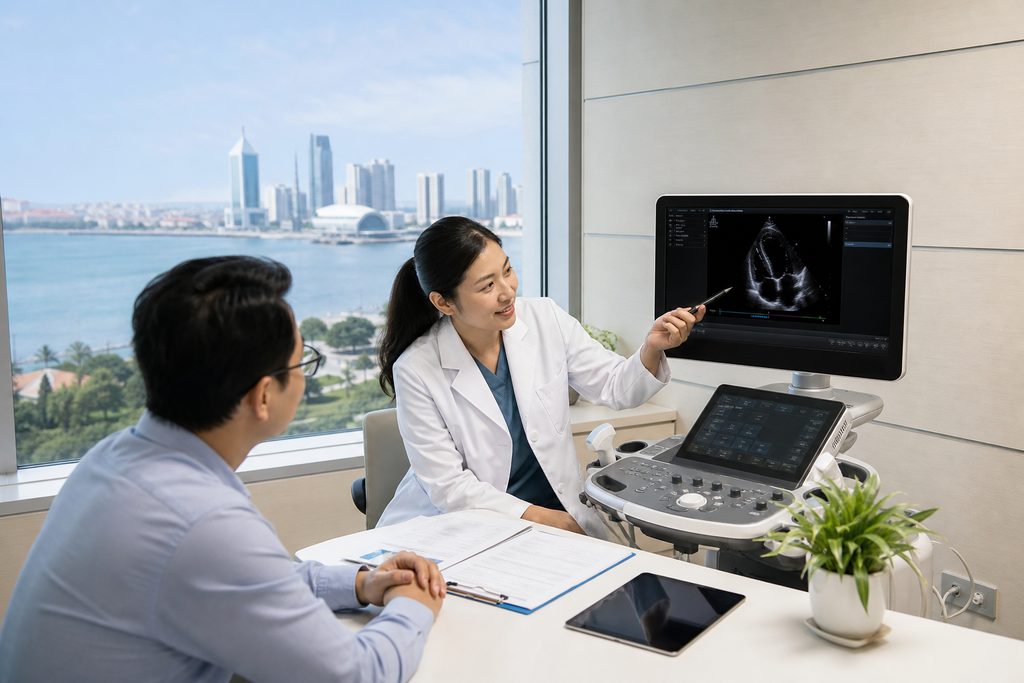
Heart Screening in Zhengzhou: What to Expect
A comprehensive heart screening in Zhengzhou typically costs between $350 and $1,200 at a top-tier public hospital, and roughly $800 to $2,500 at a private international clinic. That price range puts the heart screening cost China-wide at a fraction of what the same panel of tests runs in the United States, where a cardiac CT angiogram alone can bill above $1,500 before insurance. The catch is not the medicine. It is the logistics.
Zhengzhou is not Beijing or Shanghai. It has real cardiac depth, a manageable pace, and far lower hotel and transport costs than the coastal hubs. What it does not have is an English-language front door at most public hospitals. Understanding that gap before you book is the difference between a smooth two-day visit and a frustrating week.
Heart Screening in Zhengzhou: The Short Answer
You can get an excellent cardiac workup in Zhengzhou. The question is whether you can navigate it without help.
Henan Province, where Zhengzhou is the capital, serves a population of roughly 100 million people. Its flagship hospitals handle cardiac volumes that would overwhelm most Western centers. The equipment is current-generation. The cardiologists are trained to international standards, and many have spent fellowships abroad. For a routine screening — bloodwork, ECG, echocardiogram, stress testing, and possibly a coronary CT — the technical quality is not the issue.
The issue is access. Public hospital outpatient registration in China generally cannot be booked from overseas in advance. You queue on the day, in Chinese, at a counter that opens before dawn. Specialists see dozens of patients per morning. There is no appointment slot waiting for a foreign visitor who found the hospital on Google.
Who This Is Right For — and Who It Isn’t
Screening is a specific tool. It fits some people and wastes money for others.
Good candidates typically include:
- Adults over 40 with a family history of early heart disease
- People with controlled risk factors — hypertension, elevated LDL, type 2 diabetes — who want a baseline
- Expats and travelers already in China who want a thorough check without flying home
- Patients whose home-country wait for a cardiology consult runs into months
- Anyone seeking a second data point after an ambiguous result abroad
Who should not pursue this:
- Anyone with active chest pain, breathlessness at rest, or syncope. That is an emergency, not a screening. Go to the nearest emergency department.
- Patients whose known coronary disease is already under active management. You need your treating cardiologist, not a new baseline.
- People expecting a screening to “rule out” heart attack risk entirely. No test panel does that.
- Travelers who cannot stay two to three days. Rushed screening produces incomplete data.
Being honest about that second list matters more than the first. A screening package sold to the wrong person is not a service. It is a delay in real care.
The Options, Compared
Four realistic paths exist for a foreign patient considering cardiac screening in China. Here is how they stack up on the numbers that actually drive the decision.
| Option | Typical Cost (USD) | English Support | Advance Booking | Best For |
|---|---|---|---|---|
| Zhengzhou public hospital, standard channel | $350 – $700 | Limited or none | Not available | Chinese-speaking residents |
| Zhengzhou public hospital, international/VIP channel | $700 – $1,200 | Yes, dedicated staff | Yes, with coordination | Foreign patients wanting top public expertise |
| Zhengzhou private international clinic | $800 – $2,500 | Yes, Western-style service | Yes, direct | Comfort, insurance direct-billing |
| Beijing or Shanghai top-tier hospital | $900 – $3,000 | Yes, established programs | Yes, with coordination | Complex cases needing subspecialty depth |
Which column fits you? If your screening is routine and your budget is the priority, the Zhengzhou public international channel is the strongest value on this table. If you carry international insurance that direct-bills, a private clinic removes the reimbursement headache. And if your history includes prior stents, valve disease, or arrhythmia, the extra cost of a Beijing or Shanghai center is worth it — that is where subspecialty depth concentrates.
What the Screening Actually Includes
Package names vary. The components are fairly standard, and you should confirm exactly which are bundled before you pay.
A basic cardiac panel covers resting ECG, echocardiogram, lipid profile, fasting glucose, blood pressure assessment, and a cardiology consultation. That is the floor. From there, packages add:
- Exercise stress test — treadmill ECG to provoke ischemia under load
- Coronary CT angiography — the most valuable add-on for many patients, and the most expensive
- 24-hour Holter monitor — for palpitations or suspected arrhythmia
- Carotid ultrasound and ankle-brachial index — vascular screening
- Advanced lipid markers — Lp(a), ApoB, hs-CRP
Ask one question before booking: is the coronary CT included, or quoted separately? That single line item often accounts for a third of the total bill, and it is the test most likely to change your management.
How Much Does Heart Screening Cost in Zhengzhou?
Direct answer: $350 to $1,200 at public hospitals, $800 to $2,500 at private international clinics. Final pricing varies by hospital and case complexity.
Three variables move the number most.
Test depth. A blood-and-ECG panel sits at the bottom of the range. Add coronary CT angiography and you climb toward the top. Add a stress test and Holter, and you are at the ceiling.
Channel. The international/VIP route costs roughly 1.5 to 2 times the standard fee. You are paying for English-speaking staff, advance scheduling, and a shorter wait — not superior equipment.
Hospital tier. A provincial flagship in Zhengzhou prices below a nationally ranked center in Beijing. For straightforward screening, that gap buys you little clinically.
What is not included, typically: hotel, airport transfers, interpreter time, and any follow-up treatment if screening finds something. Budget those separately. For comparison, the same comprehensive panel in the United States commonly runs $2,000 to $5,000 before insurance, and in Western Europe roughly $1,000 to $2,500 with public-system waits attached.
Is Heart Screening in China Safe?
Yes, with the right expectations. Is heart screening in China safe as a category? The equipment at major Chinese cardiac centers is current-generation, and the procedural volumes are among the highest in the world. Henan’s provincial hospitals perform cardiac catheterizations and surgeries at scale that keeps teams sharp.
Two caveats belong here.
First, screening is non-invasive, so the safety question is mostly about accuracy and follow-up, not procedural risk. A coronary CT exposes you to radiation — modest, but real. Discuss whether you need it rather than accepting it by default.
Second, and more important: a screening result is only useful if someone acts on it. If you return home with a report in Chinese and no cardiologist to interpret it, you have spent money on data, not care. Arrange the interpretation before you arrange the test.
Practical Considerations: Records, Visas, and Payment
Records. Bring your prior ECGs, lipid panels, medication list, and any imaging on disc or in a cloud link. Chinese cardiologists work efficiently and compare against your baseline. Without it, they screen you blind.
Visa. For medical travel to China, the applicable short-stay category is the S2 visa, annotated for medical treatment or private affairs, subject to the latest embassy or consulate requirements and supporting hospital documents. Accompanying family members apply under the same category. Note clearly: the M visa is for commercial and trade activities and has nothing to do with medical treatment. Stays beyond 180 days fall under S1. Approval is never guaranteed, and requirements change — verify with your nearest Chinese embassy before applying.
Payment. Chinese public hospitals require prepayment. International insurance is typically reimbursed after the fact, not settled at the counter. Private international clinics more often direct-bill, which is a genuine convenience if your insurer is on their list. Carry a card that works in China, and confirm the hospital accepts it before arrival.
Language. This is the practical crux. A hospital that sees thousands of outpatients daily runs on Chinese. Registration, payment, queue navigation, and the consultation itself all happen in Mandarin. Even a fluent tourist can lose an afternoon to the wrong queue.
Follow-up. Ask for your report in English, or arrange translation before you leave. Have a cardiologist at home lined up to receive it. Screening without a receiving physician is an unfinished transaction.
If you want to compare Zhengzhou against the broader landscape, our directory of top-ranked Chinese hospitals by city shows which centers hold Fudan rankings in cardiac specialties, and the cardiac surgery department rankings list the top-tier programs nationwide.
Frequently Asked Questions
Not through the standard public outpatient channel — that generally requires same-day, in-person registration in Chinese. Advance booking is realistic through a hospital’s international or VIP department, or through a private international clinic. If you need a confirmed date before you book flights, plan around the international channel.
Expect $350 to $1,200 at public hospitals and $800 to $2,500 at private clinics, depending on whether coronary CT and stress testing are included. That is typically one-third to one-half of US pricing for the same panel. Add hotel, transfers, and interpreter costs to get your true total.
Then you face a real decision, and you should make it with a treating cardiologist — not a screening package. Chinese hospitals can generally arrange follow-up consultation, but admission, treatment planning, and any procedure remain subject to hospital rules and clinical assessment. Some patients choose to continue care in China; others return home with the report. Both are legitimate. Decide before you are under pressure.
Tell the hospital in advance and bring device documentation. Most screening tests remain appropriate, but MRI-based imaging and certain protocols require device-specific clearance. This is exactly the kind of case where a Beijing or Shanghai subspecialty center earns its higher price.
For a short screening visit, the S2 category is the applicable route, subject to current embassy or consulate requirements and supporting documents from the hospital. It is not the M visa, which covers commercial and trade activity only. Confirm the latest rules with your nearest Chinese embassy, since requirements shift.
Your Next Step
Heart screening in Zhengzhou is genuinely good medicine at a genuinely fair price. The friction is administrative, not clinical — booking, language, payment, and getting your results into the hands of a cardiologist who will act on them.
We are China Medical Services, a coordination service, not a hospital. We do not diagnose, and we do not provide medical advice. What we do is help international patients find the right hospital, arrange appointments through official international departments, provide bilingual accompaniment, and guide the visa and travel logistics. Our free consultation page is the place to start — describe your situation, and we will tell you honestly whether Zhengzhou fits your case or whether another city does.
This article is for general information only and does not constitute medical advice. Screening decisions, test selection, and interpretation should be made with a qualified physician who knows your history.
For more medical information and treatment options in China, visit chinamedservices.com (China Medical Services).
