Inside a Full Body Checkup in China: What It Costs and What It Finds
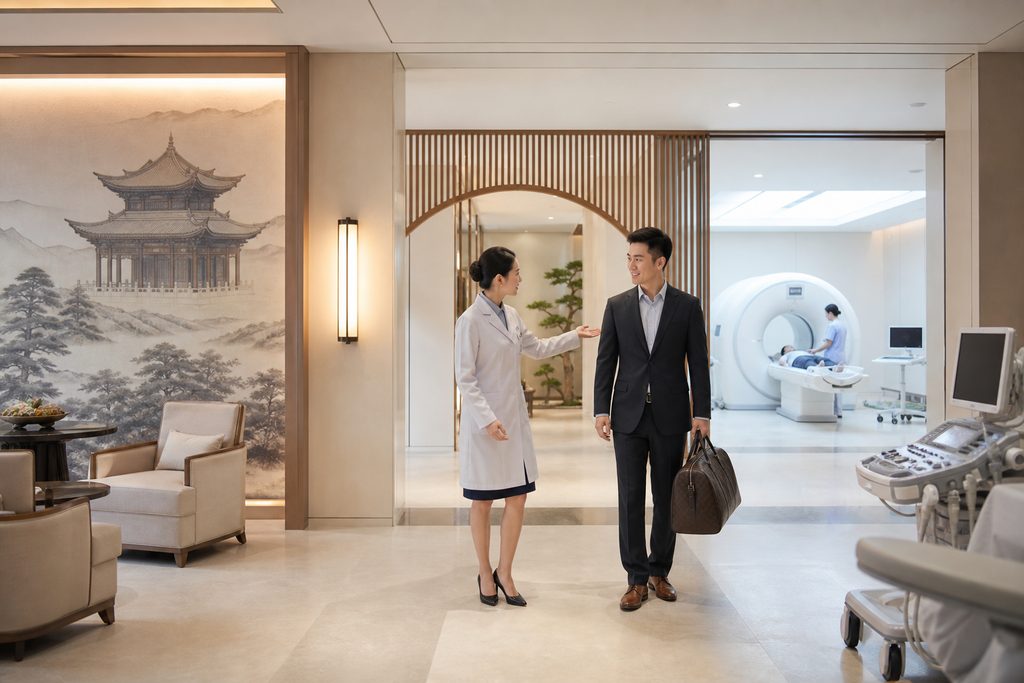
Roughly 1.4 billion outpatient visits happen across China’s 35,000+ hospitals every year, and a growing slice of them are foreigners paying cash for a full body checkup. The full body checkup cost China hospitals charge typically lands between $400 and $3,500 depending on tier, city, and how deep you want the imaging to go. That range covers everything from a solid half-day executive screening in Beijing to a two-day, MRI-heavy workup at a private international clinic in Shanghai.
Here is the catch nobody mentions upfront. A Chinese checkup is not one product. It is a menu, and the menu changes by hospital. Walk in without knowing which tier you are buying and you will either overpay for a package designed for local executives or underbuy and miss the scans that made the trip worthwhile.
Full Body Checkup in China: The Short Answer
Expect to spend $400–$800 at a top public hospital’s international or VIP health screening center, and $1,200–$3,500 at a private international hospital such as United Family, Jiahui, or Raffles. Both tiers use the same imaging equipment in most cases. The difference is waiting time, English-language service, appointment flexibility, and how much of the day you spend in a queue.
A standard package takes four to six hours. Results come back in three to seven working days, usually as a bound report with imaging on disc. If you add a colonoscopy, cardiac stress testing, or a low-dose CT, plan for two visits across two days.
Key takeaway: The price gap between a public hospital VIP package and a private international hospital package is often 2–4x — but the clinical content is frequently near-identical. What you are paying for is access, language, and comfort, not necessarily better medicine.
Who This Is Right For — and Who It Isn’t
Health screening is a tool, not a virtue. It helps some people and wastes money for others.
Usually a good fit:
- Adults 40+ who have not had comprehensive bloodwork or imaging in two or more years
- People with a family history of heart disease, diabetes, or specific cancers who want baseline data
- Expats and travelers already in China for work or family reasons — the marginal cost of adding a screening day is low
- Patients who want a second set of images to take back to their doctor at home
Probably not worth it:
- Anyone with active symptoms — chest pain, unexplained weight loss, a lump. That is a diagnostic workup, not a screening. Screening packages are built to find nothing in particular.
- People under 30 with no risk factors and recent normal bloodwork. The pretest probability of finding something actionable is genuinely low.
- Patients who cannot arrange follow-up. A flagged result with no doctor to interpret it creates anxiety, not health.
- Anyone expecting a single test to rule out cancer. It does not exist, in China or anywhere.
The Options, Compared
| Option | Typical Price (USD) | Time on Site | English Support | Best For |
|---|---|---|---|---|
| Public hospital standard package | $150–$400 | 3–5 hours | Limited or none | Locals; foreigners with a Chinese-speaking companion |
| Public hospital international / VIP center | $400–$800 | 3–5 hours | Yes, staff-assisted | Most international patients |
| Private international hospital (basic) | $1,200–$1,800 | 2–4 hours | Full, native-level | Insurance holders; tight schedules |
| Private international hospital (executive) | $2,000–$3,500 | 1–2 days | Full, with care coordinator | Executive screening price Beijing and Shanghai buyers |
| TCM add-on (acupuncture, constitution assessment) | $80–$250 | 1–2 hours | Varies | Patients wanting a traditional-medicine read on their health |
Which column fits you? If you speak no Mandarin and are flying in specifically for this, the public VIP tier is the value play. If your employer or insurer is paying, or if your schedule cannot absorb a queue, go private. If you want the widest specialist bench and the deepest imaging protocols, the public teaching hospitals in Beijing and Shanghai still hold the edge — that is where the complex cases end up.
What Does a Full Body Checkup in China Include?
More than most Western primary care visits, and less than the brochures imply. A typical mid-tier package covers:
- Bloodwork: complete blood count, liver and kidney panels, fasting glucose, HbA1c, lipid profile, thyroid function, uric acid, and often tumor markers such as CEA, AFP, and CA19-9
- Imaging: chest X-ray or low-dose chest CT, abdominal ultrasound, thyroid ultrasound, carotid ultrasound
- Cardiac: resting ECG, and frequently echocardiography at higher tiers
- Other: urinalysis, stool analysis, body composition, vision and hearing screening, blood pressure and BMI
Higher-tier packages add gastroscopy and colonoscopy under sedation, low-dose chest CT, cardiac stress testing, bone density scanning, and sometimes brain MRI. These are the additions that move the price from $600 to $2,500.
Practical tip: Ask for the itemized list before you pay. Two packages at the same price can differ by an entire endoscopy. Also confirm whether contrast agents, sedation, and pathology fees are included — they often are not.
Tumor markers deserve a specific warning. They are not cancer tests. They are statistical signals that generate false positives at meaningful rates in healthy people, and a raised CA19-9 in someone with no symptoms usually leads to more scans, not answers. Treat them as one data point among many, not a verdict.
What It Costs — and What Drives the Variance
The spread between $400 and $3,500 is not random. Four things move the number.
Hospital tier. A public hospital’s VIP health center charges roughly 1.5–2x its standard rate for the same tests, because you are buying a separate floor, shorter waits, and English-speaking staff. Private international hospitals sit above that, with direct insurance billing and Western-style appointment scheduling.
City. Beijing and Shanghai run 15–30% higher than Chengdu, Wuhan, or Xi’an for comparable packages. The gap narrows at the private tier, where pricing is more standardized.
Imaging depth. A chest X-ray costs a fraction of a low-dose chest CT. Adding MRI — brain, spine, or abdomen — can add $400–$900 on its own.
Endoscopy and sedation. Gastroscopy plus colonoscopy under sedation typically adds $500–$1,200, including anesthesia and pathology.
What is usually not included: follow-up specialist consultations for flagged results, treatment of anything found, and translation of the final report into English unless you specifically request it.
Practical Considerations: Booking, Visas, and Records
Public hospital general outpatient clinics in China generally do not accept advance bookings from overseas. You register on the day, in person, and you queue. For a checkup, the workaround is the hospital’s international or VIP health center, which does accept advance appointments and can usually be arranged a few weeks ahead.
Private international hospitals accept bookings directly and often within days.
On the visa side, medical travel to China falls under the S2 category, which covers short stays for medical treatment and private affairs; stays beyond 180 days use S1. Accompanying family members apply under the same category. Requirements shift, so verify current rules with the nearest Chinese embassy or consulate and bring the hospital’s appointment confirmation as supporting documentation. The M visa is for commercial and trade activity and has nothing to do with medical treatment.
Payment: public hospitals require prepayment, with insurance reimbursed afterward. Private international hospitals frequently bill insurers directly. Bring a card that works in China, and expect the hospital to want payment before the appointment, not after.
Language: this is the single biggest friction point. A top-tier Chinese hospital can see 10,000+ outpatients in a day. Signage, registration kiosks, and most staff operate in Mandarin. If you do not read Chinese, arrange a bilingual companion before you arrive — not on the day.
Records: request the full report, all imaging on disc, and a written English summary. Take these home. A Chinese screening report is far more useful to your doctor abroad if the images travel with it.
For context on which hospitals sit at the top of the system, our overview of China’s top-ranked hospitals by city is a reasonable starting point, as is the breakdown of specialty rankings across 45 departments if a flagged result points you toward a specific field.
Frequently Asked Questions
For the money, often yes — a $600 public VIP package in Shanghai covers ground that would cost several thousand dollars in the US. But “worth it” depends on what you do with the results. Without a doctor at home to interpret them, a screening generates paper, not health. Decide your follow-up plan before you book.
Yes, though the term “package” is looser here than in Thailand or Turkey. Some private hospitals bundle screening with hotel and transfer; most public hospitals do not. What you can reliably arrange is the appointment itself, a bilingual companion for the day, and airport transfer — each booked separately. Be cautious with any operator promising a fixed all-in price before seeing your medical history.
This is the real question, and it deserves a straight answer. A screening can flag something that needs a specialist. In a Chinese public hospital, that means a separate outpatient appointment, usually on another day, with a specialist who may not speak English. You will not be admitted or treated on the strength of a screening alone. If you are flying home soon, get the report and images in hand and arrange follow-up there — or plan enough buffer time in China to pursue it properly.
Private international hospitals: often three to seven days. Public hospital VIP health centers: two to four weeks is safer, especially in spring and autumn, which are peak screening seasons. Avoid the week around Chinese New Year entirely — many centers close or run reduced schedules.
Your Next Step
A full body checkup in China is one of the better-value things you can buy in the country’s healthcare system — provided you pick the right tier, know what is inside the package, and have a plan for the results. The hospitals are real, the equipment is current, and the pricing is transparent once you know where to look.
We are China Medical Services, a coordination team, not a hospital. We do not diagnose or treat anyone. What we do is match you to the right screening center for your age, history, and city, handle the appointment, and put a bilingual companion beside you for the day so nothing gets lost in translation. If you would like to talk through options before committing to anything, start with a free consultation — no obligation, and no pressure to book.
This article is for general information only and is not medical advice. Screening decisions should be made with a qualified physician who knows your history. Prices vary by hospital and case complexity and should be confirmed directly with the provider.
For more medical information and treatment options in China, visit chinamedservices.com (China Medical Services).
