Hotel Near Hospital or City Centre: How the Choice Is Made in China
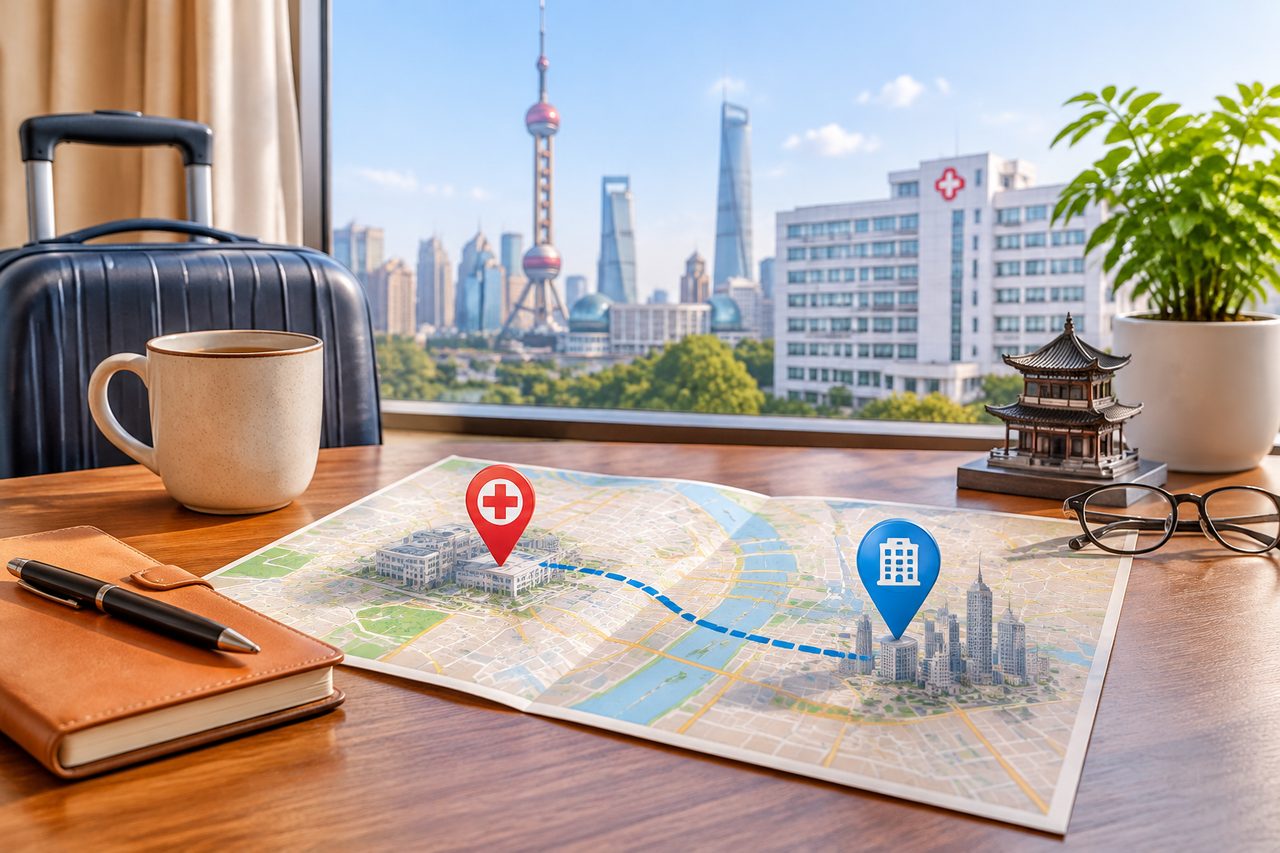
Hotel Near Hospital or Hotel in City Centre: How the Choice Is Made in China
For most international patients coming to China for treatment, the working answer is a hotel near the hospital for the days around admission and procedures, and a city-centre hotel only for the days before or after. The choice is not a matter of taste. It is driven by three hard variables: how many early-morning appointments you have, how far the hospital sits from the city core, and whether anyone in your party can handle a Chinese-language taxi or metro trip under stress. Get those three right, and the hotel question mostly answers itself.
The complication is that China’s top hospitals are enormous and often sit outside the districts where visitors naturally want to stay. A single outpatient day can mean arriving at 7 a.m., queueing for registration, and moving between buildings on a campus the size of a small town. Where you sleep the night before shapes how that day goes. Below, we break down how the decision is actually made, what each option costs in time and money, and the practical details patients tend to overlook.
Key takeaway: Treat accommodation as a clinical logistics decision, not a travel one. Proximity matters most in the 48 hours around any procedure; comfort and access to restaurants, embassies and transport matter most during recovery and waiting periods.
Who This Is Right For — and Who It Isn’t
Not every patient faces the same trade-off. The right answer depends on the shape of your trip.
A hotel near the hospital usually suits:
- Patients with surgery or an admission scheduled within days of arrival, where early check-in times and pre-operative tests cluster tightly.
- Families traveling with an elderly patient or someone with limited mobility, for whom a 40-minute commute each way is genuinely taxing.
- Anyone who will need repeated visits — imaging, lab work, follow-up consultations — spread across a week or more.
- Patients using a hospital’s international or VIP department, which often sits on the same campus as inpatient buildings and tends to run on tighter schedules.
A city-centre hotel usually suits:
- Patients coming for a written second opinion or a consultation only, with no procedure planned on this trip.
- People in the waiting phase — records submitted, decision pending — who want a normal base while they decide.
- Companions and family members staying longer than the patient, who need restaurants, transport links and something to do during long hospital days.
- Patients attending a private international hospital, several of which are located in central business districts rather than on the outskirts.
Where this planning does not help: if your trip is still hypothetical, or you have not yet confirmed which hospital and department will see you, booking accommodation is premature. Hospital assignment drives location, and location drives everything else. Lock the clinical plan first. Patients who book a hotel before confirming the hospital frequently end up paying for a room they barely use.
The Options, Compared
The table below compares the realistic accommodation choices for a medical trip to China. Figures are indicative planning ranges, not quotes; actual prices vary by city, season and hospital district.
| Option | Typical nightly cost (USD) | Travel time to hospital | Best for | Main drawback |
|---|---|---|---|---|
| Budget hotel near hospital | $40–$80 | 5–15 minutes on foot | Pre-op days, repeated visits | Few English-speaking staff; basic rooms |
| Mid-range hotel near hospital | $80–$150 | 5–20 minutes | Families, longer stays | Limited dining and leisure nearby |
| City-centre hotel (3–4 star) | $90–$180 | 30–60 minutes by taxi or metro | Consultation-only trips, companions | Commute on appointment mornings |
| International-brand or serviced apartment | $150–$300 | Varies widely | Long recovery stays, English needs | Cost; may still be far from public hospitals |
| Hospital-adjacent guesthouse or patient housing | $30–$70 | Under 10 minutes | Extended inpatient-adjacent stays | Variable standards; book with care |
Read the table by trip type. If your visit is built around a procedure, the first two rows usually win: the money saved on a cheaper room is easily consumed by taxis and stress. If your visit is exploratory — a second opinion, a consultation, a health check — the city-centre rows make more sense, because you will spend more time outside the hospital than inside it.
Why Chinese Hospital Geography Changes the Calculation
This is the part that surprises first-time visitors. In many Western cities, the leading hospital is a compact building in a central district. In China, the top public hospitals are frequently vast campuses, and some of the most respected sit well outside the traditional tourist core. A hospital may have multiple buildings for outpatient, inpatient, imaging and international services, with internal shuttle buses and separate entrances for each.
That geography has two consequences for accommodation. First, “near the hospital” is not a single location — you need to know which building and which entrance your appointment uses. A hotel that looks adjacent on a map can still be a 20-minute walk from the correct gate. Second, the hospital district itself is usually functional rather than pleasant: convenience stores, pharmacies, cheap eateries, and heavy traffic. That is fine for the days around a procedure and less appealing for a two-week recovery.
Patients researching which institutions to target can start with our directory of top-ranked hospitals by city, which groups the Fudan-ranked institutions geographically. Knowing whether your hospital sits in Beijing’s central districts or on Shanghai’s western edge is the single most useful fact before you search for a room.
How the Decision Is Actually Made: A Step-by-Step Method
When our team helps a patient think through accommodation, we work through the same sequence every time. It is not complicated, but the order matters.
- Step 1: Confirm the hospital and department. Nothing else can be decided until this is fixed. Public hospital outpatient registration generally cannot be booked from overseas in advance; appointments are taken on the day, and surgery follows an in-person consultation. That means your first days in China are usually consultation days, not procedure days.
- Step 2: Map the appointment pattern. One consultation is different from five consecutive mornings of tests. Cluster density decides whether proximity is worth paying for.
- Step 3: Identify the correct campus and entrance. Ask which building handles your department, and whether the international or VIP channel uses a separate address.
- Step 4: Check the commute at the hour you will actually travel. A 25-minute taxi at midday can be 60 minutes at 7:30 a.m. in any major Chinese city.
- Step 5: Split the stay if the trip is long. Many patients book a hospital-adjacent hotel for the procedure window and a city-centre hotel for the recovery or waiting tail. Two bookings often cost less than one long stay in the wrong place.
Ask the hospital or your coordinator for the exact building name and gate number before booking. In large Chinese hospitals, the difference between the main outpatient entrance and the international department entrance can be a 15-minute walk.
What It Costs: Accommodation, Transport and the Hidden Trade-Offs
Accommodation is rarely the largest line in a medical trip to China, but it is the one patients most often mis-budget. A realistic planning frame for a two-week trip looks like this: budget or mid-range hospital-adjacent hotels run roughly $40–$150 per night depending on city and standard; city-centre three- and four-star hotels run $90–$180; international-brand and serviced apartments run $150–$300. Add daily taxis at $5–$15 per trip in most cities, more if you rely on them at peak hours.
What drives the variance is less about star ratings than about three things: the city (Beijing and Shanghai run higher than Chengdu or Xi’an), the season (trade fairs and public holidays can double rates), and proximity to the hospital gate. The hidden cost is time. A patient commuting 50 minutes each way for five morning appointments loses more than eight hours of a week to travel, and arrives at the hospital already tired.
For context on the clinical side of the budget, our guide to top-ranked departments by specialty helps patients understand which institutions lead in their condition — useful when comparing the overall cost of a trip rather than the room rate alone. If you are weighing a private international hospital instead, note that several sit centrally and offer English-speaking staff and direct insurance billing, which changes both the accommodation logic and the billing flow; our private hospital overview covers that route.
Practical Considerations: Visas, Payment, Language and Companions
Visa category. Foreign patients traveling to China for medical treatment generally use the S2 visa, which covers short-stay visits for medical treatment and private affairs; stays beyond 180 days typically fall under S1. Accompanying family members apply under the same category. Requirements and supporting documents are set by the relevant Chinese embassy or consulate and should be checked against the latest published guidance — hospital invitation or appointment documentation is often part of the file. Approval is never guaranteed, and no single visa fits every case.
Payment. Public hospitals generally require prepayment, with insurance reimbursement handled afterward in the patient’s home country. Many private international hospitals can bill insurers directly. For hotels, international cards are widely accepted at mid-range and international-brand properties, while budget hotels near public hospitals may prefer local payment apps — worth confirming before arrival.
Language. This is where the hotel choice and the hospital experience intersect. China’s leading hospitals handle enormous daily volumes, and signage and queues are predominantly in Chinese. A hotel with English-speaking staff helps at the edges, but the harder problem is inside the hospital. Our bilingual medical companion service exists for exactly that gap: queueing, registration, payment, wayfinding and translation, from $300 per day.
Companions. If a family member is traveling with you, their needs should shape the choice as much as yours. A companion spending eight hours a day in a hospital corridor benefits from a hotel with decent food nearby and a straightforward route back. During recovery, a city-centre base with parks, shops and transport often serves the whole party better.
Do not book a non-refundable room before your hospital and department are confirmed. Public hospital schedules can shift, and a confirmed appointment may land at a different campus than expected.
Frequently Asked Questions
Near the hospital for the days around the procedure. Early reporting times, pre-operative tests and post-operative follow-up all cluster tightly, and a short commute reduces fatigue and missed appointments. Move to a city-centre hotel afterward if your recovery allows and your trip is long enough to make the split worthwhile.
Once the hospital, department and approximate dates are confirmed — typically a few weeks ahead for standard hotels. Book earlier if your dates coincide with major trade fairs or public holidays, when rates in cities like Guangzhou and Shanghai rise sharply. Keep the booking flexible until your appointment pattern is clear.
This is common, and it is the strongest argument for refundable rates and split bookings. Build a buffer of a few unbooked days at the end of any procedure-related trip, and confirm the hotel’s extension policy at check-in. Neither a hospital nor a coordinator can guarantee a discharge date in advance.
Your Next Step
The core message is simple: choose accommodation around your clinical schedule, not the other way around, and split the stay when the trip has distinct phases. China Medical Services is a coordination service, not a hospital — we do not diagnose or treat, and we cannot guarantee admission, appointment slots or outcomes. What we can do is help you confirm the right hospital and department first, then plan the practical logistics around it. If you would like to talk through your situation before booking anything, you are welcome to request a free consultation with our team.
This article is for general information only and is not medical advice. Treatment decisions should be made with a qualified physician who has reviewed your individual case.
For more medical information and treatment options in China, visit chinamedservices.com (China Medical Services).
