Cross-Border Ambulance Transfer Service China: Land Medical Transport Coordination
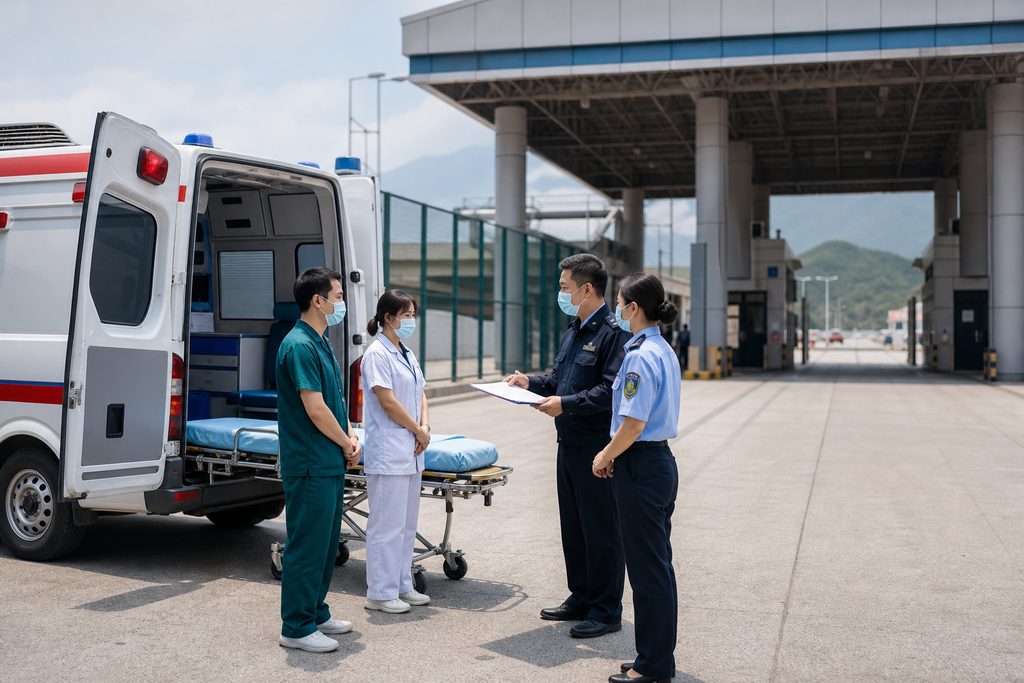
You have probably heard that crossing an international border in a medical emergency is a bureaucratic nightmare. Hours of waiting. Confusion over paperwork. Ambulances turned away at the checkpoint.
The reality is more structured than most people think. But it is not simple.
A land border ambulance transfer into China works through a precise sequence of pre-arranged approvals, synchronized handovers, and strict documentation. When it fails, it is almost always because one piece of that sequence was missing. When it works, a patient moves from a hospital in Hanoi or Vientiane to a specialist center in Nanning or Kunming within a single day.
Our team coordinates these transfers. We are not a hospital. We do not provide medical treatment or clinical diagnoses. We are your logistical architects — we bridge the gap between you and China’s top-tier medical expertise. We handle the paperwork, the bilingual communication, and the moment-by-moment coordination that keeps a cross-border ambulance moving.
Key Takeaways
- A land ambulance transfer across China’s southern borders typically costs between $3,000 and $8,000 depending on distance, medical staffing, and border checkpoint complexity.
- China shares land borders with 14 countries, but only specific checkpoints are designated for medical crossings — choosing the wrong one can add 6-12 hours to a transfer.
- Every cross-border ambulance transfer requires pre-approval from both exit and entry immigration authorities. This cannot be arranged last-minute at the border.
- You need a receiving hospital in China that has confirmed bed availability before the ambulance departs. Without this confirmation, the border authorities will deny entry.
The Problem: When Distance Determines Survival
Medical tourism usually means booking a flight, scheduling a consultation, and planning a procedure weeks in advance. That model collapses when a patient is already hospitalized in a neighboring country and needs urgent transfer to a Chinese facility with more advanced capabilities.
A patient in a Hanoi ICU with a complex cardiac condition. A road accident victim in Luang Prabang requiring neurosurgery that is not available locally. A cancer patient in Yangon whose treatment protocol requires equipment only found in a handful of Asian centers.
These are not hypotheticals. They happen regularly. And the window for action is measured in hours, not days.
The cross border ambulance service China cost and logistics become the deciding factor. A medical evacuation flight is fast but often costs $25,000 to $50,000. For patients in northern Vietnam, Laos, or Myanmar, a land ambulance transfer can be faster than waiting for air logistics and costs a fraction of that amount. But only if the coordination is flawless.
The distance from Hanoi to the Chinese border at Youyi Pass is roughly 170 kilometers. From Vientiane to the Mohan-Boten checkpoint, about 380 kilometers. These are not long distances. The challenge is not the road. It is the handshake between two sovereign medical and immigration systems.
Who We Are
China Medical Services maintains relationships with hospitals across 340+ top-ranked Chinese institutions in 37 cities. We coordinate the full chain of a cross-border land ambulance transfer: identifying the right receiving hospital, securing bed confirmation, arranging the ambulance with appropriate medical staffing, managing immigration pre-clearance at both sides of the border, and providing bilingual communication throughout the journey. We do not operate ambulances ourselves. We connect you with licensed providers and make sure every checkpoint is cleared before the vehicle moves.
How Does International Ambulance Transfer Across China Land Border Work
Let us walk through the actual sequence. This is not a theoretical overview. This is what happens on the ground.
Step 1: Receiving Hospital Confirmation Comes First
Nobody crosses a Chinese land border in an ambulance without a confirmed destination. The receiving hospital must issue an official admission confirmation letter — not a tentative acceptance, not a verbal agreement. A stamped document. This letter is submitted to Chinese immigration as part of the pre-approval package.
Our team identifies the appropriate hospital based on the patient’s condition. We work through the hospital’s international department or VIP channel to secure that confirmation. For patients needing highly specialized care, we consult the Fudan rankings to identify the right facility. A patient requiring liver surgery might be directed to a center in Shanghai or Guangzhou. A cardiac case might point toward Beijing. But for land border transfers, geography matters. The closest top-tier facility that can handle the case is usually the right choice.
Step 2: Dual-Side Immigration Pre-Approval
Both the country of departure and China require advance notification of a medical border crossing. This is not a visa application in the normal sense. It is a specific clearance for a medical transport vehicle and its occupants — patient, medical staff, and family members.
The exit country needs to know: which ambulance, which checkpoint, what time, what medical condition justifies the crossing. China needs to know the same, plus the receiving hospital details and the S2 visa status of the patient and any accompanying family. If the patient does not yet have an S2 visa, emergency arrangements can sometimes be made. But this adds time and uncertainty. We strongly recommend having visa documentation in process before a transfer becomes urgent.
Critical timing note: Immigration pre-approval at major land checkpoints like Youyi Pass (Vietnam-China) and Mohan-Boten (Laos-China) typically requires 24-48 hours. Attempting to show up without pre-clearance will result in the ambulance being held — sometimes for 6 hours, sometimes indefinitely. The patient’s condition determines whether that delay is merely frustrating or genuinely dangerous.
Step 3: The Ambulance Handover at the Border
In most cases, two ambulances are involved. One from the departing country brings the patient to the border. A second Chinese-registered ambulance meets them on the other side. The handover happens in a designated medical transfer zone — a specific area at the checkpoint where immigration formalities are completed and the patient is moved from one vehicle to the other.
This is the most delicate moment in the entire operation. Medical records must be handed over. The receiving team must assess the patient’s stability before accepting the transfer. Bilingual communication is essential. A mistranslated medication list or a misunderstood vital sign trend can have serious consequences.
Our bilingual medical coordinators are present at the handover — either physically or via real-time video link — to ensure nothing is lost in translation.
Step 4: The Final Leg to the Hospital
Once the patient is in the Chinese ambulance, the journey to the receiving hospital begins. This leg is usually the shortest part of the entire process. From the Youyi Pass checkpoint to the nearest major hospital in Nanning is about 190 kilometers. From Mohan-Boten to Jinghong is under 100 kilometers.
But short distance does not mean simple. The receiving hospital needs real-time updates on the patient’s ETA and condition. The emergency department or ICU must be ready. The admitting team needs the medical records translated and summarized before the patient arrives. We handle all of this while the ambulance is in motion.
Medical Transport from Vietnam to China by Road: Specific Routes and Realities
Vietnam accounts for the highest volume of land border medical transfers into China. Three main checkpoints handle these crossings, and they are not interchangeable.
Youyi Pass (Friendship Pass) — Pingxiang, Guangxi: This is the busiest and most experienced checkpoint for medical transfers. Both Vietnamese and Chinese border authorities here are familiar with ambulance crossings. Processing is relatively efficient. The receiving hospitals are typically in Nanning, about 3 hours by road.
Hekou — Lao Cai, Yunnan: This crossing connects to Kunming’s hospital network. The road from Hekou to Kunming takes approximately 5-6 hours. This route makes sense for patients in northern Vietnam who need the specific specialties available in Kunming.
Mong Cai — Dongxing, Guangxi: A coastal crossing. Less frequently used for medical transfers but viable for patients in the Ha Long Bay region who need access to hospitals in Guangxi or beyond.
Each checkpoint has its own administrative rhythm. Different shifts, different officers, different levels of experience with medical cases. Our team knows which checkpoint to use for which scenario and which documentation package each one requires.
Private Ambulance from Laos to China Price and Process
Laos presents a different set of challenges. The primary medical crossing is at Mohan-Boten, where the China-Laos railway also passes. The road infrastructure on the Lao side can be difficult, particularly during the rainy season from May to October.
The private ambulance from Laos to China price typically ranges from $4,000 to $7,000, depending on the pickup location within Laos and the destination hospital in Yunnan. Vientiane to Mohan is a full day’s drive — roughly 10-12 hours. Luang Prabang to Mohan is shorter, around 6-7 hours.
What drives the cost up compared to the Vietnam route? Fewer licensed cross-border ambulance providers operate on the Laos-China corridor. The road conditions require more experienced drivers. And the border checkpoint at Mohan-Boten, while modern, processes fewer medical transfers annually, which means each crossing requires more hands-on coordination.
Practical tip: If a patient in Laos is stable enough for the journey but the road transfer time is concerning, consider a hybrid approach. A short domestic ambulance transfer within Laos to the border town of Boten, overnight stabilization at a local facility if needed, and then crossing into China the following morning when both immigration teams are fresh and processing is faster. This adds a day but reduces risk.
Cross Border Ambulance Service China Cost: A Realistic Breakdown
We get asked about pricing immediately. Understandably. Families need to know if this is even feasible before they start planning.
The cross border ambulance service China cost breaks down into several components. No single number covers every scenario, but here is what you should expect.
| Cost Component | Typical Range (USD) | What Determines the Price |
|---|---|---|
| Ambulance rental (departing country side) | $500 – $1,500 | Distance, vehicle type, medical equipment required |
| Ambulance rental (China side) | $800 – $2,000 | Distance from border to hospital, ICU vs. standard ambulance |
| Medical staffing (doctor + nurse for transfer) | $600 – $1,500 | Duration, patient acuity, specialist requirements |
| Immigration coordination and pre-approval | $500 – $1,200 | Complexity of case, urgency, checkpoint used |
| Receiving hospital admission coordination | from $300 | Hospital tier, urgency, specialist availability |
| Bilingual medical coordination (handover + journey) | from $200/day | Whether coordinator travels to border or manages remotely |
| Total estimated range | $3,000 – $8,000 | Varies by route, distance, patient condition, and urgency |
Compare this to a medical evacuation flight from Hanoi to a Chinese city with an international airport. That typically costs $25,000 to $40,000. Or an air ambulance from Vientiane, which can exceed $50,000 depending on the aircraft type and medical configuration.
The land route is not just cheaper. For patients close to the border, it can be faster. No waiting for flight clearances. No airport transfers at both ends. Just a direct road journey with a single coordinated handover.
That said, land transfers are not always appropriate. A patient on a ventilator with unstable vitals may not tolerate a 6-hour road journey. The decision must be made by the treating physicians on both ends. Our role is to present the option, coordinate the logistics, and let the medical teams decide if it is safe.
Can I Take an Ambulance Across the China Border for Treatment?
The short answer is yes. The honest answer is yes, but only with preparation.
You cannot call an ambulance in Hanoi and tell the driver to head for the Chinese border. That ambulance will be stopped. The patient will be stuck in a vehicle at an immigration checkpoint with no clearance, no receiving hospital, and no plan. This is not a hypothetical. It has happened.
The correct sequence is:
- Identify and confirm the receiving hospital in China first
- Obtain the admission confirmation letter
- Apply for immigration pre-approval on both sides
- Arrange the ambulance with appropriate medical staffing
- Coordinate the exact timing of the border crossing
- Execute the handover in the designated transfer zone
Skip any one of these steps and the transfer stalls. Skip two or three and it fails completely.
Also, the patient and any accompanying family members need valid travel documents. For medical treatment in China, this means an S2 visa with the purpose of medical treatment clearly noted. The S2 visa is specifically for short-term private visits including medical treatment. Do not attempt to cross on a tourist visa or a business visa. Border authorities will check.
Book Land Ambulance Transfer to Chinese Hospital: What We Actually Do
When a family contacts us to book land ambulance transfer to Chinese hospital services, here is what happens behind the scenes.
First, we review the patient’s medical records. We need to understand the diagnosis, current stability, and what specific treatment or intervention is needed in China. This determines which hospitals we approach.
We then contact the international departments of appropriate hospitals. We present the case. We ask the critical question: can you admit this patient, and can you provide the specific care they need? If the answer is yes, we secure the admission confirmation letter.
Simultaneously, we begin the immigration pre-approval process on both sides. This involves submitting documentation packages to the exit country’s border authority and to China’s immigration office at the specific checkpoint being used. We track these submissions and follow up until we have written confirmation.
We then arrange the ambulances. On the departure side, we work with a licensed provider in that country. On the China side, we coordinate with a Chinese ambulance service that has cross-border clearance. We confirm the medical staffing for both legs — doctor, nurse, equipment — based on the patient’s needs.
On the day of transfer, our bilingual coordinator is in contact with both ambulance teams, both immigration posts, and the receiving hospital. We track the patient’s location in real time. We troubleshoot any issues at the border. We make sure the receiving hospital is ready when the ambulance pulls in.
After admission, we continue to support the patient and family with bilingual medical companion services during their hospital stay — helping with communication, navigating hospital procedures, and coordinating with the medical team.
Frequently Asked Questions
With all documentation in order, 24 to 48 hours. If the patient already has an S2 visa and the receiving hospital has been identified, we can sometimes move faster. If visas need to be arranged or the medical case is complex and requires consultation with multiple hospitals, plan for 3 to 5 days. Emergency transfers with incomplete documentation are possible but carry higher risk of delay at the border. We do not recommend them unless there is genuinely no alternative.
The ambulance is staffed by a doctor and nurse equipped to manage the patient’s condition during transport. If the patient becomes unstable, the medical team follows established protocols — stabilization in the ambulance, diversion to the nearest appropriate facility, or continued transport if the receiving hospital is closer. The decision rests with the medical team, not with logistics coordinators. We ensure that the ambulance carries appropriate equipment and medications for the specific patient, and that the staffing level matches the patient’s acuity.
Which Chinese hospitals are most experienced with cross-border land ambulance admissions?
Hospitals in border-adjacent cities see the highest volume. In Guangxi, the First Affiliated Hospital of Guangxi Medical University in Nanning and the Guangxi Zhuang Autonomous Region People’s Hospital both have experience receiving patients via the Youyi Pass crossing. In Yunnan, the First Affiliated Hospital of Kunming Medical University and Yunnan Provincial First People’s Hospital regularly admit patients from Laos, Myanmar, and northern Vietnam. For cases requiring more specialized care, patients are sometimes transferred onward to top-tier centers in larger cities, but the initial receiving hospital is almost always the
For more medical information and treatment options in China, visit chinamedservices.com (China Medical Services).
