Peking University Third Hospital: IVF and Orthopedics for International Patients
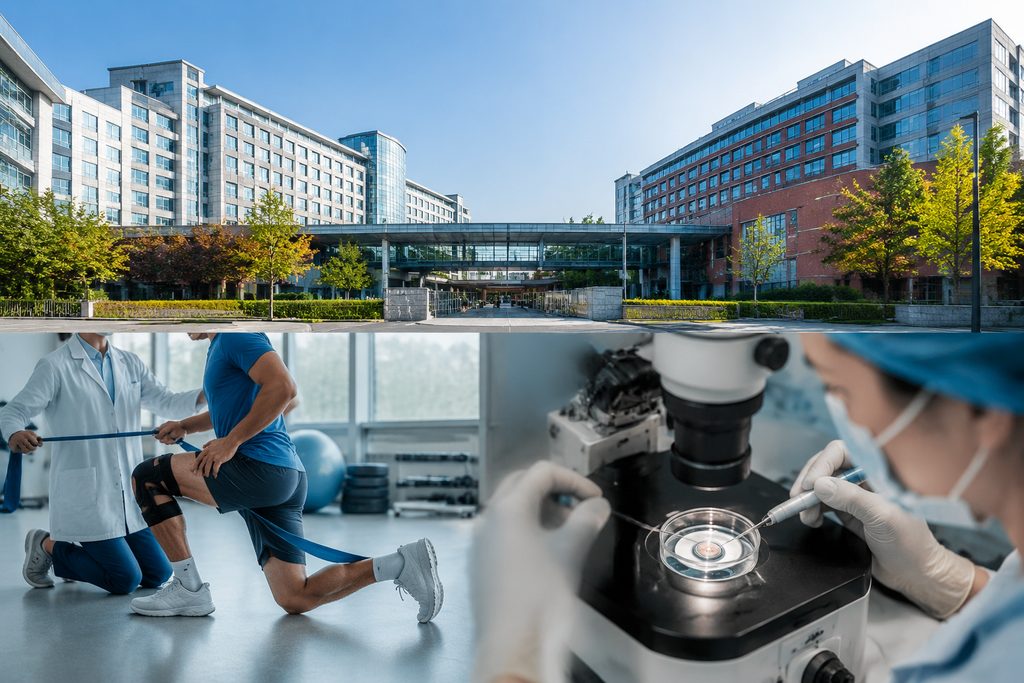
What if the two medical specialties you need most—advanced fertility treatment and complex joint replacement—were both world-class, under one roof, and accessible at a fraction of Western prices? For many international patients, that combination sounds too good to be true. It isn’t. It exists at Peking University Third Hospital in Beijing. But getting in the door, understanding the real Peking University Third Hospital IVF cost, and navigating the system without speaking Mandarin requires a strategy. That’s where the gap between knowing about the hospital and actually receiving care lives.
Key Takeaways
- Peking University Third Hospital runs one of the world’s largest reproductive medicine centers, completing over 15,000 IVF cycles annually with success rates that match leading Western clinics.
- Orthopedic surgery here—particularly knee and hip replacements—costs roughly 70-80% less than in the United States, performed by surgeons who do hundreds of these procedures each year.
- The hospital’s public-facing system is not designed for overseas patients. Without Chinese language skills and local knowledge, you cannot independently book a surgery slot or IVF cycle from abroad.
- All international patients must go through the hospital’s official International Medical Center channel, which provides English coordination, priority scheduling, and transparent bundled pricing.
The Problem: When Waiting or Paying at Home Is Not an Option
In the United States, a single IVF cycle costs between $15,000 and $30,000, often excluding medication. In the UK, NHS funding is limited by strict postcode lotteries and age cutoffs—many women wait over a year just for a consultation. Canada’s public system covers almost no IVF in most provinces. For orthopedics, the numbers are equally grim. A total knee replacement in America averages $35,000 to $50,000. In Australia, waiting times for elective joint surgery in the public system stretch past 300 days in some states.
These aren’t minor inconveniences. They are life-altering delays. A 42-year-old woman with diminished ovarian reserve does not have a year to wait. A 60-year-old man with bone-on-bone knee pain cannot put his life on hold for 18 months while his mobility deteriorates. The frustration is real. So is the financial strain. And when patients start searching for alternatives, they find a confusing landscape of medical tourism options—some reputable, many not. Peking University Third Hospital Beijing international patient service stands out in this noise for a reason few marketing brochures mention: it is not a private boutique clinic built for foreigners. It is a massive, public, top-tier Chinese teaching hospital with genuine clinical heft. That changes everything about the quality of care you receive.
Who We Are
We are China Medical Services. We are not a hospital. We do not provide medical treatment or clinical diagnoses. Our team acts as your logistical architects—we bridge the gap between you and China’s top-tier medical expertise. We handle hospital matching, appointment coordination through official international department channels, bilingual medical companion services, visa guidance, and every practical detail of your journey. Think of us as the team that ensures you walk into the right specialist’s office, with the right medical records translated, at the right time, without the chaos. We work with 340+ top-ranked hospitals across 37 cities. Peking University Third Hospital is one of our most requested destinations.
Why Peking University Third Hospital Delivers Results
Reproductive Medicine: Volume and Precision at a Scale the West Cannot Match
The Reproductive Medicine Center at Peking University Third Hospital is not just large. It is foundational. Mainland China’s first IVF baby was born here in 1988. Since then, the center has grown into a clinical powerhouse that performs more than 15,000 IVF cycles per year. To put that in perspective, many reputable US fertility clinics complete 500 to 1,000 cycles annually. Volume matters in IVF. Embryologists who handle thousands of cases develop a tactile, almost intuitive skill with embryo selection, vitrification, and ICSI procedures that simply cannot be taught in a textbook.
Success rates are reported in line with top Western clinics—around 50-60% clinical pregnancy rate per embryo transfer for patients under 35, with natural declines for older age groups. The lab technology is current-generation: time-lapse embryo monitoring, preimplantation genetic testing (PGT-A and PGT-M), and advanced cryopreservation protocols. The Peking University Third Hospital IVF cost for international patients typically ranges from $6,000 to $10,000 per fresh cycle, depending on medication protocols and whether genetic testing is added. That is roughly one-third to half of the US price point. Frozen embryo transfers cost significantly less.
One structural advantage that is rarely discussed: Chinese regulations permit certain techniques and protocols that face more restrictive oversight in some Western countries. This is not about cutting corners. It is about clinical flexibility for complex cases—older patients, repeated implantation failure, severe male factor infertility. The center’s research arm publishes extensively in international journals, and many senior physicians completed fellowships in the US, Europe, or Japan. The language barrier exists, but the clinical expertise is globally calibrated.
Orthopedics: A High-Volume Joint Replacement Center with a Sports Medicine Edge
Ask any orthopedic surgeon what predicts a good surgical outcome, and they will tell you: experience. A surgeon who performs 300 knee replacements a year has seen anatomical variations, complication patterns, and recovery trajectories that a surgeon doing 50 a year simply has not encountered. At Peking University Third Hospital, the orthopedics department is one of China’s busiest. The hospital is the official medical partner for China’s national athletic teams, which means its sports medicine division handles elite-level shoulder, knee, and spine cases constantly.
That sports medicine DNA filters into the joint replacement unit. Surgeons here were early adopters of minimally invasive techniques, computer-navigated alignment, and enhanced recovery after surgery (ERAS) protocols that get patients mobile within hours of a knee or hip replacement. The data supports the approach: average length of stay for a primary total knee replacement is 3-5 days, and infection rates are reported below 1%, consistent with international benchmarks. For patients asking “is Peking University Third Hospital good for knee replacement,” the answer is yes—and the evidence is in the case volume, the sub-specialization of the surgeons, and the integration of rehabilitation into the surgical pathway.
Cost is the obvious draw. A total knee replacement here, including implant, hospital stay, and surgeon fees through the international department, typically runs between $12,000 and $18,000. Compare that to $35,000-$50,000 in the US or £12,000-£15,000 in UK private hospitals. The implant brands used—Zimmer, Stryker, DePuy Synthes—are the same multinational manufacturers you would find in any Western operating room. The best orthopedic surgeon Beijing international patient services connect you with will likely be a professor-level specialist who speaks some English and operates with a team accustomed to treating overseas patients through the hospital’s dedicated international channel.
Cost Advantage Without Quality Compromise
Lower cost does not mean lower quality here. It means different economics. Chinese public hospitals operate on high volume, lower per-case margins. Physician salaries are a fraction of Western levels. Malpractice insurance costs are lower. Pharmaceutical pricing is nationally negotiated. Hospital construction costs per square meter are cheaper. None of these factors reduce the quality of the surgery or the IVF lab work. They simply reduce the bill. The trade-off is not clinical. It is operational: you need someone to translate your records, schedule your appointments, and guide you through a system built for Chinese citizens, not international visitors. That is a solvable problem.
What You Need to Know Before Going Alone
We see patients try this independently. Some succeed. Many hit walls they did not anticipate. The barriers are real and specific:
- Appointment booking: The public registration system—whether via the hospital’s WeChat mini-program or the on-site kiosks—requires a Chinese ID number and a local phone number. Overseas patients cannot use it. Walk-in registration at the public windows is theoretically possible but practically useless for specialist consultations; top doctors are booked weeks in advance. The International Medical Center has a separate scheduling process. You need someone to access it.
- Medical records and translation: Chinese physicians expect complete records: imaging on CD or USB, translated summaries, pathology reports, previous surgery notes. A stack of English-language documents with no Chinese translation will slow everything down. Some departments require specific formatting for IVF records—cycle details, hormone panels, semen analysis parameters. Getting this wrong means your first consultation is wasted.
- Payment and insurance: The international department accepts payment via cash, UnionPay, and major credit cards, but direct insurance billing is limited. Most patients pay upfront and seek reimbursement from their insurer later. We help you get the right documentation—itemized invoices, diagnosis codes, treatment summaries—so your claim is not rejected on a technicality.
How We Help You Navigate This
These barriers exist for structural reasons, not malice. The hospital’s primary mission is serving China’s population. International patients are a small, specialized segment. Our entire service is built around closing the gap between what the hospital requires and what an overseas patient can reasonably provide on their own.
Before you travel, we collect and translate your medical records, share them with the relevant department head for a preliminary review, and confirm that your case is appropriate for treatment here. We coordinate your appointment through the official International Medical Center channel—not a backdoor, not a fixer, but the legitimate pathway the hospital has established for foreign patients. We arrange your visa support documentation (S2 visa for medical treatment, with the hospital’s invitation letter as supporting material). We book your airport transfer and accommodation near the hospital campus in Haidian District.
During your treatment, a bilingual medical companion stays with you. This person handles registration, payment queues, pharmacy runs, and real-time translation during consultations. They ensure you understand what the doctor is saying—and that the doctor understands your questions. After discharge or embryo transfer, we coordinate follow-up communication, medication logistics, and any necessary rehabilitation or repeat visits. The goal is continuity. You are not abandoned once the procedure is done.
Frequently Asked Questions
Expect $6,000 to $10,000 for a fresh IVF cycle including standard medications, monitoring, egg retrieval, ICSI, embryo culture, and transfer. PGT-A adds approximately $2,000-$3,000. Frozen embryo transfers cost $2,000-$3,500. These are international department prices, which include English coordination and priority scheduling. They are higher than what Chinese citizens pay through the public system but still well below Western private clinic rates. Exact pricing is confirmed after your medical records are reviewed and a treatment protocol is proposed.
You cannot book directly through the public hospital website or app. The pathway is through the hospital’s International Medical Center, which has dedicated English-speaking coordinators. You or your medical concierge service contacts this department, submits translated medical records and a treatment request, and receives a pre-approval and cost estimate before travel. Appointments are then scheduled for specific dates. Our team handles this entire process—from initial contact to confirmed appointment letter—as part of our hospital appointment coordination service, which starts from $300.
Yes. The orthopedics department performs a high volume of joint replacements annually with outcomes—infection rates, revision rates, functional recovery scores—that are comparable to accredited Western centers. The surgeons use the same implant systems (Zimmer, Stryker, etc.) and many have international training. The key difference is the care model: post-operative physiotherapy is more self-directed than in some Western hospitals, and the nursing culture expects more family involvement. We prepare you for these differences so there are no surprises.
This is the question every patient should ask. Peking University Third Hospital is a full-service tertiary hospital with ICU capabilities, 24/7 emergency surgery backup, and every medical subspecialty on-site. If a complication arises during a knee replacement or an IVF cycle, you are already inside one of China’s most comprehensive medical institutions. Our team stays with you throughout, communicating with your family back home and ensuring you understand every clinical decision. We also help you access follow-up care once you return to your home country, including transfer of medical records and imaging to your local physician.
Yes, and this is more common than you might think. Couples sometimes schedule a joint consultation trip: one partner for fertility treatment, the other for an orthopedic evaluation. Because both departments operate within the same hospital, we can coordinate appointments across specialties during a single visit. This is logistically efficient and reduces travel costs. The International Medical Center is accustomed to handling multi-department cases for overseas patients.
Your Next Step
Peking University Third Hospital represents a genuine intersection of clinical excellence and cost accessibility—two things that rarely coexist in global healthcare. The orthopedics department delivers joint replacements at a fraction of Western prices with outcomes that hold up to scrutiny. The reproductive medicine center offers IVF success rates competitive with top Western clinics at a cost that makes multiple cycles financially feasible. The catch is not the quality of care. It is the complexity of access.
If you are seriously considering treatment here, start with a conversation. Tell us what you need—a knee replacement, an IVF cycle, a second opinion, a combined trip—and we will give you a clear picture of what is possible, what it costs, and how long it takes. No pressure. No vague promises. Just the information you need to make a decision. Request a free consultation and our patient coordination team will respond within one business day.
For more medical information and treatment options in China, visit chinamedservices.com (China Medical Services).
