Medical Treatment in Shanghai China: Foreign Patient Guide to 18 Fudan Top 100 Hospitals
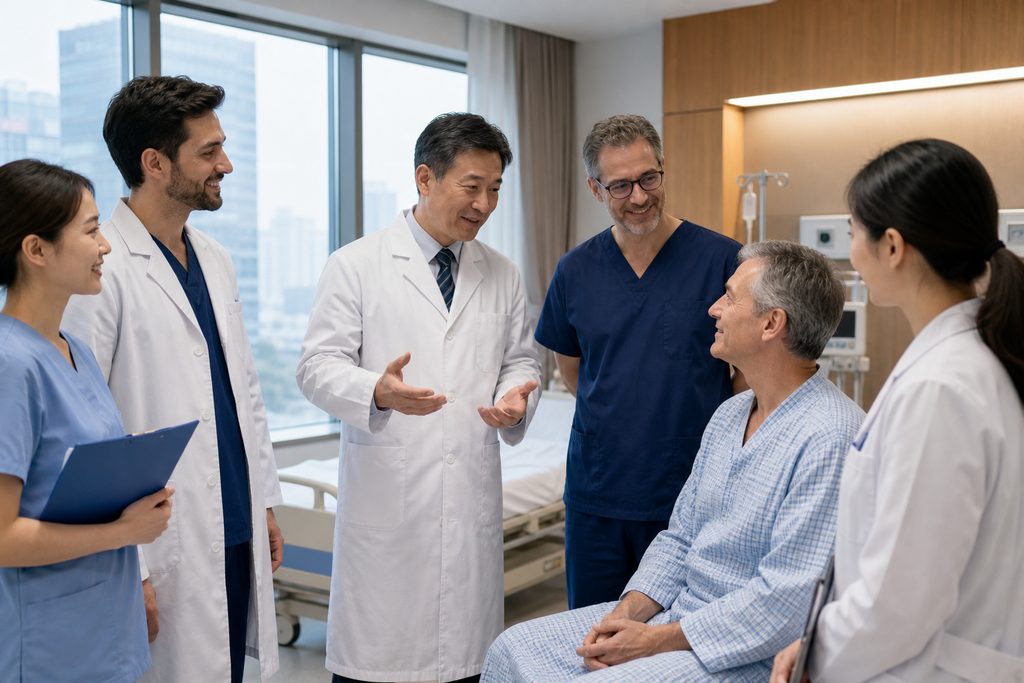
A patient in London waits 18 weeks for a hip replacement. A patient in Toronto waits 27.4 weeks just to see an orthopedic surgeon. At Shanghai Sixth People’s Hospital, surgeons complete over 300 joint replacements every month — with infection rates below 0.5%, a figure that rivals any Western center.
The gap is real. And it is widening.
Our team has spent years bridging this gap for patients worldwide. We are not a hospital. We do not provide medical treatment or clinical diagnoses. We are your logistical architects — we connect you with Shanghai’s 18 Fudan Top 100-ranked hospitals and handle every step in between.
Key Takeaways
- Shanghai hosts 18 hospitals ranked in the Fudan Top 100, the most authoritative hospital ranking in China — second only to Beijing nationally.
- Cancer surgery at a Fudan-ranked Shanghai hospital costs roughly $10,000-25,000, compared to $50,000-150,000 in the United States, with comparable five-year survival outcomes for many common cancers.
- Public hospital general outpatient departments are not accessible to overseas patients for advance booking — you must go through international medical centers or VIP channels, which is exactly where our team operates.
- You will need an S2 visa specifically endorsed for medical treatment. Standard tourist or business visas will not work and can result in denied care.
The Problem: When Your Home Country’s Healthcare System Says “Wait”
A 2023 survey by the Fraser Institute found that Canadian patients waited a median of 27.4 weeks between specialist referral and treatment — the longest recorded wait in the survey’s history. The UK’s NHS reported in early 2024 that over 7.6 million people sat on waiting lists in England alone. For a patient with a growing tumor or a deteriorating joint, these numbers are not statistics. They are a countdown.
And then there is cost. In the United States, a coronary artery bypass graft runs $120,000 to $180,000 at a major academic center. A hip replacement costs $40,000 to $60,000. For the 28 million Americans without health insurance — and millions more with high-deductible plans — these bills represent financial ruin. Even insured patients face crippling out-of-pocket costs.
Patients are caught in a vise. Wait too long in a public system. Or pay too much in a private one. Neither path feels safe.
Shanghai offers a third path. It is not perfect. It is not effortless. But for the right patient, it changes everything.
Who We Are
China Medical Services is a medical concierge organization based in China, serving international patients who seek treatment at the country’s top-ranked hospitals. We are not doctors. We do not offer medical opinions, make treatment recommendations, or promise outcomes. What we do is handle the complexity — hospital matching based on your diagnosis and the latest Fudan specialty rankings, appointment coordination through official international departments, bilingual medical companions who stay at your side throughout every visit, visa guidance, accommodation logistics, and post-operative recovery support. We serve as your single point of contact in a system that was not designed for foreign patients. Our database covers 340+ top-ranked hospitals across 37 cities, representing the top 5% of China’s 35,000+ hospitals as ranked by the Fudan University Hospital Ranking and JCI accreditation.
Why Shanghai’s Best Hospitals for Foreigners Deliver Results
Clinical Volume That Western Surgeons Cannot Match
A cardiac surgeon at Zhongshan Hospital, Fudan University performs more valve replacements in one year than many European surgeons complete in a decade. The hospital’s cardiac surgery department handles over 5,000 open-heart procedures annually. Fuwai Hospital in Beijing — often paired with Shanghai centers in second-opinion referrals — performs over 14,000 cardiac surgeries per year, the highest volume of any center globally.
Volume matters. A 2017 study in The Lancet analyzing over 1.2 million surgical cases found a direct inverse relationship between hospital procedure volume and patient mortality. Surgeons who perform a procedure 200 times per year simply have hands that know what to do when complications arise. Their teams have seen every variant. Their protocols are battle-tested.
Shanghai’s top hospitals operate at a scale that creates this expertise naturally. Shanghai Ninth People’s Hospital is globally recognized for craniofacial reconstruction and microsurgery. Renji Hospital’s urology department is ranked among China’s top 3, handling complex kidney and bladder cancer cases at volumes that few Western centers approach. For a foreign patient with a rare or advanced condition, these caseloads translate directly into safer surgery.
Technology Deployed at Scale, Not in Silos
Walk into the international medical center at Huashan Hospital, Fudan University and you will find robotic surgical systems, intraoperative MRI, and hybrid operating theaters — the same equipment found at Mayo Clinic or Charité Berlin. The difference is throughput. A Da Vinci robot at a major US hospital might perform 150 procedures per year. At a top Shanghai center, that same system handles 400 to 500 cases annually.
This is not about cutting corners. It is about operational efficiency that Western hospitals — constrained by OR scheduling politics, shorter staff hours, and higher administrative overhead — cannot replicate. Shanghai’s top-tier public hospitals run on a scale that keeps their teams sharp and their technology fully utilized.
For international patients, this means access to proton therapy for certain cancers at the Shanghai Proton and Heavy Ion Center, robotic-assisted surgery at Ruijin Hospital, and advanced interventional cardiology at Zhongshan Hospital — all at costs far below Western equivalents, without sacrificing the technology itself.
The Cost Reality: Structural Advantages, Not Corner-Cutting
Let us address the obvious question. Why is how much does cancer treatment cost in China so much lower than in the United States or Europe? The answer is structural, not qualitative.
A lung cancer lobectomy at a Fudan-ranked Shanghai hospital costs between $12,000 and $22,000. The same procedure in the United States averages $45,000 to $80,000. A total knee replacement in Shanghai runs $10,000 to $18,000 at a top public hospital’s international wing. In the US, the sticker price exceeds $35,000, often far more.
These differences exist because Chinese hospital systems operate with lower labor costs, higher patient volumes that spread fixed costs thinner, and far less administrative billing complexity. A Shanghai hospital does not employ armies of insurance coders fighting with hundreds of different payers. The result is a system where clinical quality — measured by infection rates, complication rates, and five-year survival for major cancers — is comparable to Western benchmarks, while the bill is 70% to 85% lower.
This is not always the right choice. For a patient whose condition is well-managed at home, travel may add unnecessary risk. But for a patient facing a $120,000 surgery they cannot afford, or a 12-month wait they cannot survive, Shanghai’s economics change the calculus entirely.
What You Need to Know Before Going Alone
We tell every patient the same thing upfront: China’s top hospitals are world-class. Their public-facing systems are not. The barriers are real and they are unforgiving if you arrive unprepared.
- Visa Requirements: You cannot enter China on a tourist visa and receive scheduled surgery at a public hospital. The correct visa is an S2 visa endorsed for medical treatment. Your accompanying family members also need S2 visas. The application requires an official invitation letter from the hospital — something our team arranges as part of coordination. The M visa is strictly for commercial business and will be rejected for medical purposes. Get this wrong and you risk being turned away at the hospital or even at the border.
- Appointment Reality: The general outpatient departments at Fudan University hospital international patient services are walk-in only. You cannot book a specialist from overseas through the public registration system. To secure a confirmed appointment with a senior specialist before you board a plane, you must go through the hospital’s official international medical center or VIP department. These channels exist specifically for cases like yours — but they require Chinese-language coordination, medical records pre-translated into Chinese, and an understanding of which department actually handles your condition.
- Language and Navigation: A top Shanghai hospital handles over 10,000 outpatient visits per day. Signage in English is limited. Registration kiosks operate in Chinese. Payment counters, pharmacy queues, blood draw stations — each requires interacting with staff who do not speak English and systems that do not accept foreign credit cards. Without a bilingual companion, a simple pre-surgery blood test can become a multi-hour ordeal.
- Payment Systems: Public hospitals in China require upfront payment. International medical centers may accept wire transfers or major credit cards, but standard hospital cashiers often only process Chinese UnionPay cards or WeChat Pay. Insurance direct billing is rare outside of private international hospitals. You pay first, then seek reimbursement from your insurer. This is a fundamental structural difference that surprises many patients.
How We Help You Navigate This
These barriers exist for structural reasons. Chinese public hospitals were built to serve a domestic population of 1.4 billion people. They were never designed for an English-speaking patient arriving from overseas with foreign medical records and a foreign insurance card. That is precisely the gap we fill.
Before you travel, we translate and format your medical records for Chinese hospital review. We identify the specific department and specialist group that handles your condition — not based on marketing relationships, but on the latest Fudan specialty rankings and our direct experience coordinating cases. We secure the official invitation letter required for your S2 visa application. We confirm your appointment through the hospital’s international medical center channel, with a date and time locked before you purchase your flight.
During your stay, a bilingual medical companion meets you at your hotel and stays with you throughout every hospital interaction — registration, specialist consultation, pre-operative testing, admission, discharge, and pharmacy. They translate in real time between you and your doctors. They handle payment at every counter. They know which floor does blood work and which building houses the MRI. They turn a disorienting experience into a manageable one.
After treatment, we coordinate follow-up consultations, medication refills, and recovery logistics. If your case requires a multi-disciplinary review — say, an oncologist, a surgeon, and a radiologist all weighing in — we arrange specialist-coordinated MDT sessions through the hospital’s official channels.
Everything we do is case management. We coordinate through hospital international departments and VIP channels. We do not promise to secure a specific named surgeon on a specific date — no ethical coordinator can make that guarantee in a public hospital system. What we promise is that we will use every official channel available to get you the right specialist for your condition, and if we cannot secure the appointment we have committed to, we refund our coordination fee in full.
Is Shanghai Safe for Medical Tourism? What Patients Need to Know
The short answer is yes. Shanghai is one of the safest major cities in the world by any standard metric. Violent crime rates are exceptionally low compared to cities of similar size — Shanghai’s homicide rate sits below 1 per 100,000 residents, compared to 6.5 in New York City and 13 in London. Walking through the city at night, using public transit, and navigating commercial areas all present minimal safety risk for foreign visitors.
The safety question that matters more for medical travelers is clinical safety. Is Shanghai safe for medical tourism in the sense that matters most — the operating room, the ICU, the post-surgical ward?
On this front, the data is reassuring. The 18 Fudan Top 100 hospitals in Shanghai all maintain rigorous accreditation standards. Several hold JCI accreditation — the same international healthcare quality standard applied to hospitals in the United States, Singapore, and Europe. Infection control protocols, surgical safety checklists, and ICU monitoring standards at these hospitals align with international norms. The international medical centers that serve foreign patients employ English-speaking staff and are accustomed to managing cross-cultural care expectations, dietary requirements, and communication with patients’ home-country physicians.
That said, patients should understand the differences. Private rooms are not guaranteed in public hospitals — even VIP wards may have shared spaces. Nursing ratios differ from Western hospitals, with families expected to provide more bedside support. Pain management philosophies can be more conservative than what American patients expect. None of these are safety issues, but they are comfort issues that patients should anticipate.
For those who prefer a fully Western-style environment, Shanghai also hosts several JCI-accredited private international hospitals, including Jiahui International Hospital and Shanghai United Family Hospital. These facilities offer English-speaking staff throughout, direct insurance billing, and care models familiar to Western patients — at costs higher than public hospital international wings, but still well below US prices.
Frequently Asked Questions
Hospital selection depends entirely on your specific diagnosis. The Fudan ranking has two components: a comprehensive hospital ranking (Top 100, grouped into tiers A++++ through A) and 45 specialty-specific reputation rankings. A hospital may rank in the top tier overall but not be a top-10 center for your particular condition. Our team cross-references your diagnosis with the latest Fudan specialty rankings — for example, matching a liver cancer patient to Zhongshan Hospital’s top-ranked oncology department, or a burn patient to Ruijin Hospital’s nationally renowned burn center. We do not recommend hospitals based on general prestige. We recommend based on specialty match.
Budgeting requires accounting for three categories. First, the hospital treatment itself — a surgery like a hip replacement at a public hospital international wing runs $10,000 to $18,000. Second, our coordination and companion services, which start from $300 for appointment coordination and from $200 per day for bilingual medical companions. Third, travel and living expenses — flights, a hotel or serviced apartment near the hospital for two to six weeks depending on recovery time, meals, and local transport. A realistic all-in budget for a major surgery with a two-week hospital stay and two weeks of local recovery typically falls between $20,000 and $40,000. Exact figures vary by hospital and case complexity.
Most international health insurance plans — including those from Bupa, Cigna, Aetna International, and Allianz — cover treatment at JCI-accredited hospitals in China, including several Fudan-ranked centers. However, the payment model differs from what many patients expect. At public hospitals, you pay upfront and then submit claims for reimbursement. Direct billing (where the hospital bills the insurer directly) is standard only at private international hospitals like Jiahui or United Family. We advise patients to contact their insurer before travel, confirm coverage for the specific hospital and procedure, and obtain pre-authorization in writing. Our team can provide the documentation your insurer requires.
Complications are a reality of any surgery, anywhere in the world. The question is what systems exist to manage them. Shanghai’s Fudan-ranked hospitals maintain ICU capabilities, emergency response teams, and specialist consultation networks that match major Western academic centers. Their complication management protocols are well-established. The international medical centers have experience coordinating with patients’ home-country physicians and arranging medical evacuation if clinically necessary. What patients should understand is that post-operative care in China involves more family participation than in Western hospitals — you should plan to have a companion with you throughout recovery, whether a family member or a hired caregiver arranged through our team.
Your Next Step
Eighteen of China’s top 100 hospitals sit within one city. Their surgeons operate at volumes that produce outcomes matching or exceeding Western benchmarks. Their prices run 70% to 85% below US equivalents. Getting access is not simple — but it is solvable for patients who work through the right channels.
If you are considering treatment in Shanghai, start with a conversation. Our team will review your diagnosis, identify the hospitals and departments best matched to your condition, and give you a clear picture of the process, timeline, and costs before you commit to anything. There is no charge for the initial consultation and no pressure to proceed. You deserve to know your options. Get a free consultation here.
Medical disclaimer: This article is for informational purposes only and does not constitute medical advice. Treatment decisions should be made in consultation with a qualified physician. China Medical Services does not provide medical treatment, clinical diagnoses, or guarantees of specific surgical outcomes.
For more medical information and treatment options in China, visit chinamedservices.com (China Medical Services).
