Navigating Zhengzhou University First Hospital: A Foreigner’s Guide to the World’s Largest Hospital
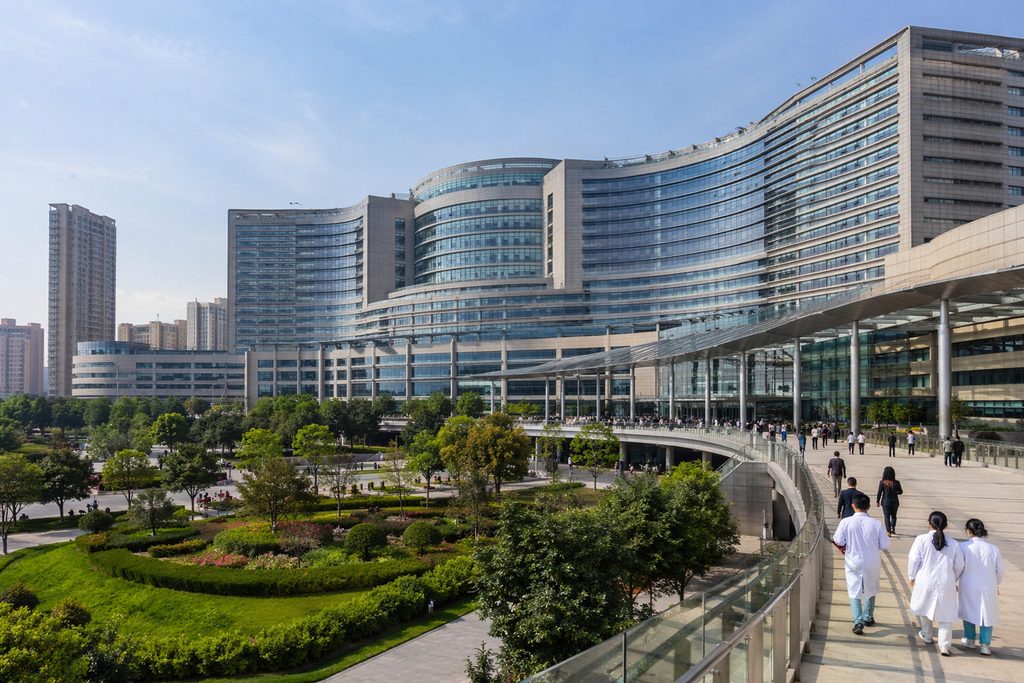
According to the Guinness World Records, Zhengzhou University First Hospital holds a staggering 10,562 beds, making it the single largest hospital on the planet. A facility of this magnitude doesn’t just treat patients; it operates on a scale that reshapes what’s possible in clinical volume and procedural efficiency. Yet, for an international patient, that sheer scale is precisely what makes it feel impenetrable. You aren’t just facing a language barrier. You are facing a 2.5-million-square-foot medical city where over 40,000 outpatients surge through the gates daily. Our team exists to turn that overwhelming maze into a navigable, safe, and surprisingly cost-effective path to advanced care.
Key Takeaways
- Zhengzhou University First Hospital is the world’s largest hospital by bed capacity, handling extreme clinical volumes that translate into deep, repetitive surgical expertise.
- The hospital’s international patient wing offers a structured gateway for foreigners, bypassing chaotic public queues, but requires navigating a specific Zhengzhou University First Hospital international patient price list that differs significantly from local rates.
- Logistical barriers—specifically the S2 medical visa, pre-payment protocols, and the absence of walk-in English services—make independent navigation extremely risky.
- Costs for major procedures like cardiac surgery or cancer treatment here can be 70-80% lower than in the US, but understanding the payment structure before you fly is non-negotiable.
The Problem: The Global Wait for Complex Care
In publicly funded health systems like Canada’s or the UK’s NHS, a “medically acceptable” wait time for a hip replacement or cardiac bypass can stretch past six months. In the United States, the barrier isn’t time; it’s price. A single uninsured cardiac bypass can generate a bill exceeding $120,000. For patients in Southeast Asia or the Middle East, the local infrastructure for complex oncology or rare pediatric surgeries often simply doesn’t exist. This is the impossible triangle of modern healthcare: speed, affordability, and high expertise. In the West, you usually pick two. The sheer industrial scale of a hospital like Zhengzhou University First Hospital challenges that equation. It doesn’t just offer a bed; it offers a staggering depth of clinical repetition. But accessing that resource from abroad requires cutting through a wall of operational noise that stops most people before they start.
Who We Are
We are not a hospital. We do not provide medical diagnoses, clinical advice, or treatment plans. We are the logistical bridge between your medical needs and the massive clinical machinery of Chinese tertiary hospitals. Our team acts as your case management architects: we translate medical records, coordinate with the hospital’s official international department, secure appointments, and place a bilingual medical companion at your side. We ensure that when you look at a Zhengzhou University First Hospital international patient price list, you understand exactly what each line item means and how the payment gateway works. We don’t sell access. We provide the linguistic and administrative precision required to navigate a system that processes tens of thousands of patients a day.
Why the World’s Largest Hospital Delivers Specific Results
Size alone is not a quality indicator. But in medicine, volume often is. A 2020 study in The Lancet demonstrated a strong inverse relationship between surgical volume and post-operative mortality. Surgeons who perform a procedure hundreds of times a year simply see fewer complications. That is the structural advantage here.
Clinical Repetition at an Unmatched Scale
Consider the daily reality at Zhengzhou University First Hospital. The Department of Cardiology doesn’t manage a few dozen admissions. It manages thousands. The hospital performs over 30,000 interventional cardiovascular procedures annually. For a Western patient, this means your surgeon isn’t just qualified. They are deep in a state of “automated expertise”—the kind of muscle memory and pattern recognition that comes only from relentless repetition. The hospital is a national center for difficult airway management and organ transplantation. When you ask, “how safe is surgery at Zhengzhou University First Hospital,” the answer lies not just in accreditation certificates but in the volume of complex cases the surgical teams have internalized. They have seen the rare complication because, for them, it isn’t rare. It’s Tuesday.
Cost Structure: Why the Price List Reads Differently
Let’s address the elephant in the room. The Zhengzhou University First Hospital international patient price list is not a standardized menu. It’s a stratified document reflecting the cost of the VIP/international wing versus the public ward. You cannot simply walk into the public outpatient hall and expect service. The international wing operates on a different cost basis. However, even the highest-tier package here is structurally cheaper than Western care. A cardiac bypass in the international wing typically ranges from $15,000 to $22,000. A complex cancer resection might land between $18,000 and $30,000. These aren’t just “discounts.” They reflect lower pharmaceutical intermediary costs, drastically lower labor overhead for nursing and support staff, and the hospital’s high-throughput economic model. You aren’t paying for a marble lobby. You are paying for the surgery.
Technology Without the Bureaucratic Lag
Zhengzhou University First Hospital was an early adopter of robotic surgery platforms, including the Da Vinci Xi system, and operates one of the largest telemedicine networks in central China. For international patients, this means pre-operative imaging and post-operative monitoring often utilize AI-assisted diagnostic tools that are still in limited pilot phases in smaller Western hospitals. The hospital’s pathology labs process biopsies at a speed that reflects the systemic impatience of a facility that can’t afford backlogs. Also, as the flagship of the top-ranked Chinese hospitals, it integrates traditional clinical pathology with advanced genomic sequencing for targeted cancer therapies, a combination that often surprises patients coming from systems where these two worlds are siloed.
What You Need to Know Before Going Alone
We need to be blunt. The gap between finding this hospital on a Google search and actually walking through the correct entrance is massive. If you attempt this independently, you will hit concrete walls immediately.
- Visa Requirements: You cannot enter China for treatment on a tourist visa. You need an S2 visa, specifically endorsed for medical treatment. The hospital must issue a formal “Medical Treatment Invitation Letter” stamped by the hospital’s official seal. Without this specific document, the Chinese consulate will reject your application. Your companion needs their own S2 visa. An M visa is strictly for commercial trade and is invalid for hospitalization.
- The Public Queue Reality: The public registration system uses a real-name digital ID system linked to a Chinese phone number and local bank card. Foreign passports often fail at the self-service kiosks. Without a local ID, you cannot pre-book the top specialists on the standard app. You are left with the physical queue, where the best slots vanish by 7:00 AM. The international wing bypasses this, but it requires direct, bilingual coordination—it is not a walk-in counter.
- Payment Architecture: The international department operates on a cash-and-carry or wire-transfer pre-payment basis. They do not directly bill US or European insurance networks for in-patient stays. You pay a deposit upfront based on the estimated cost of cancer treatment Zhengzhou hospital for foreigners or surgical package, and you seek reimbursement later. If your bank has a daily wire limit of $10,000, you will be stuck. We’ve seen it happen.
How We Help You Navigate This
These barriers aren’t malice. They are the by-products of a system optimized for domestic scale. We re-engineer the process for the international patient. It starts with a translated medical summary—not just a linguistic translation, but a clinical format adjustment that presents your history in the way Chinese specialists expect to read it. Then we engage the hospital’s official international liaison office. We secure the stamped invitation letter for your S2 visa. We don’t just give you a Zhengzhou University First Hospital international patient price list; we walk you through it, line by line, so you know the deposit amount, the ICU contingency cost, and the pharmacy billing cycle. When you land, a bilingual medical companion meets you at the airport. They don’t leave your side during registration, the pre-op consultation, or the pharmacy pickup. They translate the discharge summary and ensure the medical record continuity makes sense back home. This is not a luxury concierge. It’s operational necessity in a hospital of 10,562 beds. For those exploring broader options, we also facilitate comparisons with other giants like specialty-focused departments across China to ensure Zhengzhou is genuinely your best clinical fit, not just the biggest name.
Frequently Asked Questions
You cannot book a specific surgery date without a prior consultation. Chinese law requires an in-person surgical consent and physical examination by the attending surgeon. However, we can pre-coordinate a “fast-track” consultation schedule where you see the surgeon within 24-48 hours of arrival, with the operation tentatively scheduled in the following surgical window, assuming no clinical surprises. You fly with a high-probability plan, not a blind hope.
The hospital maintains Joint Commission International (JCI) equivalent standards in its international wing. The intensive care units are equipped with modern infection control protocols. The primary safety risk for international patients isn’t clinical incompetence; it’s communication failure. A missed allergy or a misunderstood post-op instruction is the danger point. That risk is mitigated entirely by having a medically fluent interpreter embedded with your care team, which is why we never operate without one.
You won’t find many on Google Maps in English. The international patient volume here is lower than in Beijing or Shanghai, so the English-language feedback ecosystem is sparse. Most testimonials exist within closed referral networks or Middle Eastern medical tourism forums. We provide direct references from past patients who have consented to share their experiences, because we know a sterile star rating on a website isn’t enough when you’re making a decision this heavy.
Not automatically. The hospital’s international department has some English-speaking coordinators, but they are administrators, not clinical companions. They won’t sit with you during a 40-minute oncology consultation to clarify the difference between “remission” and “cure.” A dedicated bilingual companion is a separate, essential service. Without one, you are relying on hand gestures in a hospital that processes a city’s worth of people every week.
Because the standard local rate is subsidized by the Chinese national insurance scheme, which you don’t pay into. The international price reflects the unsubsidized cost of a private room, English-capable nursing, and priority scheduling. It’s still typically 1/5th of a US equivalent. You are paying for the resource allocation priority, not just the procedure.
Your Next Step
Zhengzhou University First Hospital is a legitimate medical powerhouse, but it is also a city-sized labyrinth. The clinical outcomes are there. The technology is there. The missing piece is the logistical scaffolding that makes a foreigner feel safe enough to say yes. If you want to move from curiosity to a concrete plan, let’s talk. We will walk you through the exact documentation you need, the realistic timeline, and a transparent breakdown of what that price list actually means for your specific case.
For more medical information and treatment options in China, visit chinamedservices.com (China Medical Services).
