Robotic Spine Surgery in China: Mazor and TiRobot for Complex Spinal Procedures
Key Takeaways
- Robotic spine surgery in China using Mazor X and TiRobot systems costs 60-80% less than equivalent procedures in the United States, with comparable implant technology and clinical protocols.
- Chinese orthopedic spine surgeons at top-tier hospitals perform 3-5 times more annual procedures than their Western counterparts, building procedural volume that correlates with reduced complication rates.
- Independent international patients face real barriers with language, hospital registration systems, and visa requirements that can delay treatment by weeks or months without proper coordination.
- Robot-assisted spine surgery is not a magic solution — patient selection, surgeon experience, and postoperative rehabilitation determine outcomes far more than the robotic platform itself.
The Problem: When Your Spine Surgery Quote Hits Six Figures
A complex spinal fusion with instrumentation in the United States now runs between $80,000 and $150,000. Add a revision component or multi-level deformity correction, and the bill can cross $200,000. For uninsured or underinsured patients, these numbers are not abstract. They are the reason people delay surgery while stenosis worsens, radiculopathy becomes permanent, and vertebral slippage progresses from Grade 1 to Grade 3. The wait is not just financial. In Canada and the UK, patients with degenerative scoliosis routinely wait 12 to 18 months for a surgical consult, then another 6 to 12 months for an operating room slot. During that window, fixed deformities can develop. Nerve damage that was reversible becomes irreversible.
Approximately 1 in 3 adults over 50 shows some degree of spinal degeneration on imaging. A meaningful subset of those people need surgery. The global demand for complex spinal procedures is rising roughly 5% annually, driven by aging populations and better diagnostic access. But the surgical capacity in Western health systems has not kept pace. The result is a growing pool of patients who are medically ready for surgery but logistically or financially blocked from receiving it.
That gap is where medical travel enters the conversation. And in 2025, China has become one of the more serious destinations for robotic-assisted complex spine surgery — not because it is cheap in absolute terms, but because the value equation has shifted.
Who We Are
We are not a hospital. We do not provide medical treatment, surgical opinions, or clinical diagnoses. Our team at China Medical Services functions as your logistical architects — we bridge the structural gap between you and China’s top-tier orthopedic spine centers. That means we handle hospital matching based on your specific diagnosis and imaging, coordinate with international patient departments, arrange bilingual medical companions for every clinical touchpoint, and guide you through the S2 visa process. We do not promise outcomes. We promise that the administrative and linguistic barriers that make independent medical travel daunting will be managed by professionals who do this every day.
Why Robotic Spine Surgery in China Delivers Results
Surgical Volume That Reshapes the Learning Curve
A spine surgeon at a top-ranked Chinese orthopedic center — say, Peking University Third Hospital or Shanghai Changzheng Hospital — performs between 300 and 500 instrumented spinal procedures annually. The average US spine surgeon performs roughly 80 to 120. This volume gap matters. Multiple studies, including a 2023 analysis in Spine, have demonstrated an inverse relationship between surgeon-specific annual case volume and 30-day complication rates in lumbar fusion procedures. Surgeons who do more of a specific procedure simply get better at it. They encounter rare anatomical variations more often. Their operative times drop. Their screw placement accuracy improves. When you layer a robotic navigation system on top of that surgical volume, you are combining the precision of sub-millimeter trajectory planning with the intuitive judgment that only comes from thousands of cases.
Chinese hospitals also concentrate complex pathology. A single academic orthopedic center in Shanghai may see more cases of severe kyphoscoliosis in one year than a regional US referral center sees in five. For a patient with a 70-degree thoracolumbar curve or a multi-level post-traumatic deformity, that concentration of experience is not theoretical — it directly affects the surgical plan.
Mazor X vs TiRobot Spinal Surgery: Two Platforms, Different Philosophies
The Mazor X vs TiRobot spinal surgery comparison is not about which robot is better in a vacuum. It is about which platform matches the specific procedure and the surgeon’s workflow. Both systems are cleared for clinical use in China and deployed at major orthopedic centers, but they approach spinal navigation differently.
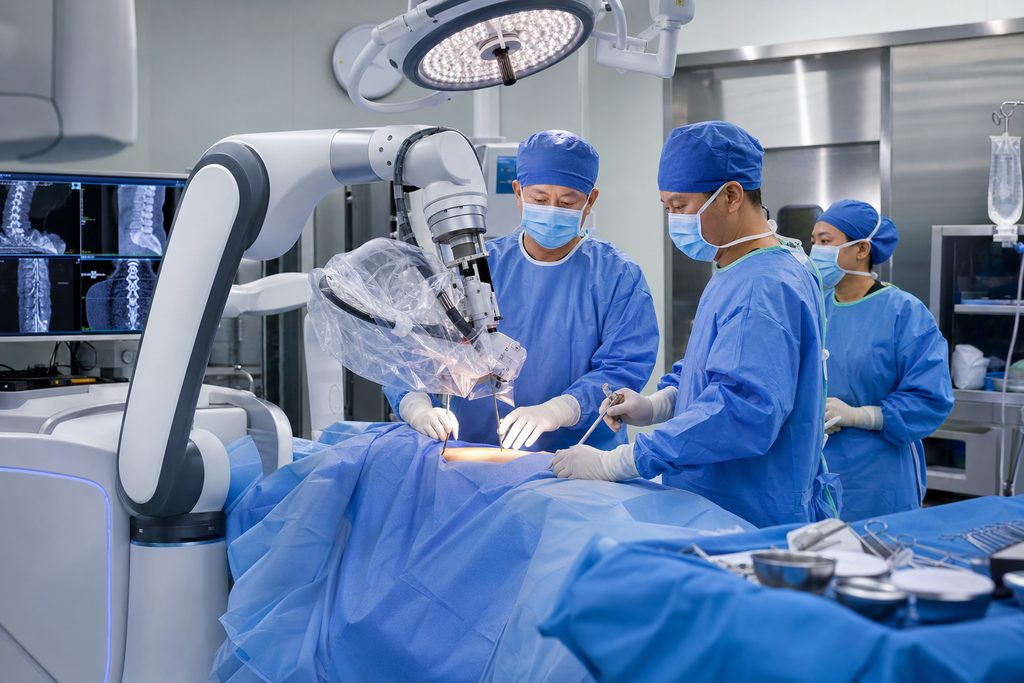
Mazor X, developed by Medtronic, uses preoperative CT-based planning with intraoperative fluoroscopic registration. The system generates a 3D surgical blueprint before the first incision. During the procedure, the robotic arm aligns with pre-planned trajectories for pedicle screw placement. The surgeon retains full control — the robot does not move the instruments autonomously. It provides a rigid guidance sleeve positioned at the exact entry point and trajectory angle. A 2022 multicenter study published in the Journal of Neurosurgery: Spine reported 98.7% screw placement accuracy with Mazor X across 1,200+ screws, with a 0.6% revision rate for malpositioned hardware.
TiRobot, developed by Beijing-based Tinavi Medical Technologies, takes a different approach. It uses intraoperative 3D imaging — typically a cone-beam CT acquired in the operating room after the patient is positioned — and registers the surgical field in real time. The robotic arm then guides instruments along planned trajectories with optical tracking. TiRobot is not limited to spine surgery. It is used in trauma and joint replacement as well, which means the platform has accumulated data across a broader range of orthopedic procedures. In spinal applications, published accuracy rates for pedicle screw placement with TiRobot range from 97% to 99%, depending on the study and the complexity of the deformity.
The practical difference for an international patient? Mazor X is more commonly found at hospitals that use Medtronic implant ecosystems — which matters if you want a specific cage or rod system. TiRobot is more prevalent at Chinese orthopedic centers that do high volumes of trauma and deformity work. Neither platform is inherently superior. The surgeon’s experience with the specific system and the hospital’s perioperative protocols matter far more.
How Safe Is Robot-Assisted Spine Surgery in China?
The question of how safe is robot-assisted spine surgery in China deserves a direct answer. The safety profile of robotic spinal instrumentation at top-ranked Chinese hospitals is consistent with published international benchmarks. A 2023 retrospective analysis from a consortium of Chinese orthopedic centers using TiRobot for over 4,000 spinal procedures reported a 0.8% rate of neurological complication related to screw placement and a 1.2% rate of wound infection — numbers that align with or fall below rates reported in US and European robotic spine registries.
But context is everything. Those numbers come from hospitals that perform over 1,000 robotic spinal procedures annually, with dedicated robotic operating teams and standardized postoperative pathways. A hospital that does 30 robotic spine cases a year will not replicate those results, regardless of which robot is in the room. This is why our hospital matching process prioritizes procedural volume and subspecialty focus over brand recognition alone.
Safety also depends on patient selection. Robotic navigation reduces screw malposition rates, particularly in deformed or osteoporotic bone where anatomical landmarks are distorted. It does not reduce the risk of medical complications like deep vein thrombosis, pulmonary embolism, or cardiac events. Those risks are managed by the anesthesia team, the nursing staff, and the postoperative monitoring protocols — all of which vary across institutions. A thorough preoperative evaluation and honest risk stratification matter more than the robot.
Robotic Spine Surgery Cost China: The Numbers That Change Decisions
Let us address the robotic spine surgery cost China question with real figures. A single-level lumbar fusion with robotic assistance at a top-tier Chinese public hospital’s international department typically ranges from $18,000 to $28,000 USD, inclusive of the implant system, robotic navigation fees, surgeon charges, and a 5-7 day inpatient stay. A multi-level fusion or deformity correction — say, a T10-pelvis fusion for adult degenerative scoliosis — runs between $35,000 and $55,000 USD.
Compare that to the United States. The same single-level robotic fusion: $80,000 to $120,000. The multi-level deformity case: $150,000 to $250,000. The cost differential is not 10% or 20%. It is 60% to 80%. The implants themselves — pedicle screws, rods, interbody cages — are often the same global manufacturers used in Western operating rooms: Medtronic, DePuy Synthes, Stryker, NuVasive. The cost difference comes from hospital facility fees, anesthesia charges, and the structural economics of the US healthcare reimbursement system, not from inferior hardware or compromised care.
| Procedure | China (International Dept) | United States | Savings |
|---|---|---|---|
| Single-level lumbar fusion (robotic) | $18,000 – $28,000 | $80,000 – $120,000 | 65-77% |
| Multi-level fusion (3+ levels) | $35,000 – $55,000 | $150,000 – $250,000 | 72-78% |
| Cervical disc replacement (robotic) | $22,000 – $30,000 | $60,000 – $90,000 | 60-67% |
| Revision spinal fusion | $30,000 – $48,000 | $120,000 – $200,000 | 70-76% |
Prices vary by hospital tier, implant selection, and case complexity. A procedure at a private international hospital like Jiahui or United Family will run higher — closer to $40,000 for a single-level fusion — but still well below US rates. These are the numbers that make patients sit down with a spreadsheet and seriously consider traveling for surgery.
What You Need to Know Before Going Alone
Independent medical travel sounds straightforward on paper. Book a flight, schedule a consultation, get surgery, fly home. The reality at a Chinese public hospital is different. These are enormous institutions — a single orthopedic outpatient department may see 2,000 patients in a morning. Registration kiosks are in Mandarin. Payment systems require a Chinese bank card or WeChat Pay for outpatient transactions. A patient who arrives without a bilingual coordinator will lose days just navigating the logistics before ever seeing a surgeon. Here are the specific barriers:
- S2 Visa Requirements: Medical treatment in China requires an S2 visa with a treatment purpose annotation. The application demands an invitation letter from the treating hospital, proof of appointment, and documentation of the medical necessity. Hospitals issue these letters through their international patient departments — but only after a formal consultation and treatment plan are established. You cannot get the visa without the invitation letter, and you cannot easily get the invitation letter without a confirmed clinical relationship. This is the circular problem that stops many independent travelers before they start.
- Hospital Registration and Payment: Public hospital international departments accept credit cards and wire transfers. But the standard outpatient registration system — the one used by 95% of patients — runs on a prepaid card system linked to Chinese identity verification. International patients without a local coordinator can spend hours in the wrong queue. Prepayment for surgery is standard. Hospitals require a deposit before scheduling an operating room slot, and the deposit amount is negotiated case by case.
- Imaging and Medical Record Compatibility: Chinese spine surgeons need a recent MRI and CT scan — ideally within 3 months — and they strongly prefer imaging in DICOM format on a CD or USB drive. Printed reports or JPEG files are often rejected. If your imaging is older or in the wrong format, you will repeat the scans in China, which adds 2-3 days to the preoperative timeline. This is manageable but must be planned for.
- Language Barrier in Clinical Settings: The surgeon may speak functional English. The anesthesiologist, the floor nurses, the physical therapist, and the discharge coordinator almost certainly do not. Informed consent discussions, postoperative pain management instructions, and rehabilitation protocols all happen in Mandarin unless a medical interpreter is present.
How We Help You Navigate This
These barriers exist for structural reasons, not because the system is designed to exclude international patients. Chinese hospitals want to treat complex cases — they build their reputations on them. But the operational infrastructure assumes local patients who speak the language and understand the workflow. Our role is to fill that gap.
Before you travel, we collect your imaging, surgical history, and diagnostic reports. We translate the clinically relevant portions into Mandarin and submit them to the international patient departments of hospitals that match your case profile. If you are considering complex spinal deformity surgery abroad price options and want to evaluate whether China is viable for your specific condition, this is where the process starts. We do not send your file to every hospital. We send it to two or three centers where the spine surgery department has demonstrable experience with your type of pathology and where the robotic platform — Mazor X or TiRobot — is integrated into the surgical workflow.
Once a hospital confirms they will accept your case, we coordinate the S2 visa invitation letter, schedule the initial consultation, and arrange a bilingual medical companion who meets you at the hospital on day one. That companion handles registration, payment, queue navigation, and clinical interpretation. They are present for the surgeon consultation, the preoperative assessment, the day of surgery, and the discharge instructions. They are not a translator on an app. They are a person standing next to you while the anesthesiologist explains the risks of general anesthesia in a language you do not speak.
After surgery, we coordinate follow-up imaging and consultations before you fly home. We ensure you leave with a discharge summary in English, a clear medication schedule, and a direct line for postoperative questions. If you need rehabilitation in China before traveling, we arrange that too. The goal is not to rush you onto a plane. The goal is to make sure that when you do leave, you are medically stable and logistically prepared for recovery at home.
For patients evaluating the best hospital for robotic spinal fusion China, our approach is not to declare a single winner. It is to match the hospital to the case. A patient with adolescent idiopathic scoliosis needs a different surgical team than a 70-year-old with multi-level stenosis and osteoporosis. A revision case with prior hardware failure demands a center that does high volumes of revision work, not just primary fusions. The robot is a tool. The team matters more.
Frequently Asked Questions
You cannot book a surgery date without an in-person consultation. Chinese public hospitals require a face-to-face evaluation before scheduling an operating room slot. What you can do — and what we facilitate — is submit your complete medical file for pre-review, receive a preliminary treatment plan and cost estimate, and secure a consultation appointment with a specific spine surgeon. That appointment converts to a surgery date after the surgeon confirms the plan. Patients who try to book TiRobot spine surgery package China without this step will find that no legitimate hospital will commit to a date sight unseen.
Top-tier Chinese orthopedic centers have complication management protocols that are comparable to Western academic hospitals. They have ICU capacity, 24-hour in-house surgical coverage, and access to interventional radiology for postoperative bleeding or infection management. The limitation for international patients is continuity of care after returning home. You need a spine surgeon in your home country who agrees in advance to accept you for postoperative follow-up and to manage any late complications. We strongly recommend establishing this relationship before you travel. No Chinese hospital can manage a wound infection or hardware failure from 6,000 miles away.
Yes, with an important caveat. The major global implant manufacturers — Medtronic, DePuy Synthes, Stryker, Globus Medical, NuVasive — all have regulatory approval and distribution in China. If your surgical plan calls for a specific cage design or a particular rod material, it is usually available. The caveat is that some implant configurations common in the US or Europe may not be stocked at every Chinese hospital. This is a detail we verify during the hospital matching process. If you have a strong preference for a specific implant system, tell us early so we can confirm availability.
For a single-level fusion, plan on 10 to 14 days in China after surgery. That includes the inpatient stay — typically 5 to 7 days — plus time for staple removal, a postoperative X-ray, and a final surgeon consultation before clearance to fly. For multi-level fusions or deformity corrections, extend that to 3 to 4 weeks. Flying long-haul with fresh spinal instrumentation is uncomfortable and carries a slightly elevated thrombosis risk. Your surgeon will prescribe compression stockings and possibly a short course of anticoagulation for the flight home.
Your Next Step
Robotic spine surgery in China is not a shortcut. It is a serious medical decision that requires honest preoperative evaluation, realistic expectations, and a logistical plan that covers every step from visa application to postoperative follow-up at home. The cost advantage is real. So is the clinical volume at top-ranked centers. But those advantages only translate into good outcomes when the patient arrives prepared and supported. That is the work we do — not the surgery itself, but everything around it that makes the surgery possible. If you are weighing your options and want to understand whether a specific Chinese hospital and surgical team are appropriate for your case, our consultation process starts with your imaging and your story. No promises. Just an honest assessment and a clear path forward if the fit is right.
For more medical information and treatment options in China, visit chinamedservices.com (China Medical Services).
