Longhua Hospital Shanghai TCM: Oncology and Internal Medicine for International Patients
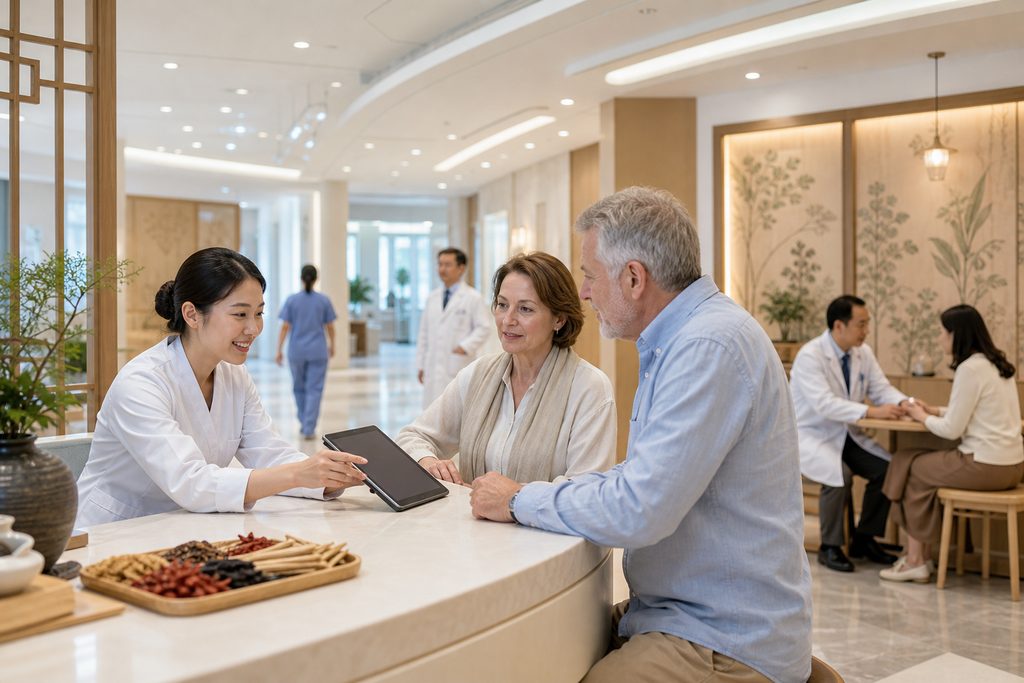
A patient in the United States facing a stage IV lung cancer diagnosis might be quoted over $200,000 for a first year of immunotherapy alone. At Longhua Hospital in Shanghai, a full integrative oncology protocol—combining modern diagnostics with a tailored Traditional Chinese Medicine regimen—may cost a fraction of that, often ranging from $15,000 to $40,000 for a comparable treatment period. The gap isn’t just financial. It reflects a fundamentally different clinical philosophy, one where an herbal decoction is prescribed with the same rigor as a targeted therapy.
This isn’t about replacing your oncologist. It’s about understanding a parallel system of medicine that China has integrated into its top-tier cancer centers. For many of our clients, the question isn’t “does TCM work?” but rather “how do I access the real thing safely and affordably?” We are here to answer exactly that.
Key Takeaways
- Longhua Hospital, affiliated with Shanghai University of TCM, is consistently ranked among China’s top 5 TCM hospitals and houses a nationally designated TCM Oncology Center treating over 300,000 outpatients annually.
- The cost structure for TCM oncology at Longhua—often 70-90% lower than comparable Western biologic or immunotherapy protocols—makes long-term integrative cancer management financially viable for international patients.
- Navigating a pure TCM hospital as a foreigner presents a unique barrier: almost zero English-language infrastructure exists on the general wards, making a bilingual medical companion a non-negotiable operational requirement, not a luxury.
- Real TCM oncology is not a gentle “alternative” for the worried well; it is a rigorous, evidence-based discipline using pharmacologically active compounds that require expert management to avoid herb-drug interactions with your existing chemotherapy.
The Problem: Cancer Care Is Becoming Financially Toxic
A 2023 study in the *Journal of the American Medical Association* found that 73% of cancer patients in the US report significant financial hardship within two years of diagnosis. We see this every day. Patients liquidate retirement accounts. They choose between mortgage payments and a fourth line of chemo. The system forces a brutal calculus, and the emotional toll of that financial distress actually correlates with worse clinical outcomes. This is not merely an inconvenience. It’s a second pathology layered on top of the first.
The search for a solution often leads patients down a rabbit hole of unregulated supplements and miracle cures. That’s dangerous. But ignoring a 2,000-year-old medical tradition that has been systematized, subjected to modern clinical trials, and integrated into a hospital ranked by the Fudan University Hospital Ranking as a top-tier institution? That’s a missed opportunity. Longhua Hospital represents the institutional apex of this tradition. It’s not a wellness spa. It’s a 1,250-bed behemoth with a dedicated oncology research institute, and it operates on a scale that most Western academic centers would envy.
Who We Are
We are China Medical Services. We are not a hospital, and we do not provide medical treatment or clinical diagnoses. You won’t find a single herbal prescription on our website. What we do is dismantle the logistical wall that stands between you and a hospital like Longhua. Our team acts as your architectural support—we translate your medical records into clinical Chinese, coordinate with the hospital’s international department to secure a confirmed outpatient slot, and place a bilingual medical companion at your side from the moment you land in Shanghai. We bridge the gap. No magic, just operational competence.
Why Longhua Hospital’s TCM Oncology Delivers Results
The Clinical Philosophy: Treating the “Soil,” Not Just the “Seed”
Western oncology primarily targets the tumor directly—surgery, radiation, cytotoxic chemotherapy. The “seed.” TCM oncology at Longhua operates on a parallel track by focusing on the “soil”—your body’s internal environment. The theory posits that cancer thrives in a state of specific imbalance: Qi stagnation, blood stasis, phlegm-dampness accumulation, or underlying deficiency. By using complex herbal formulas—often 15-20 ingredients combined in a single decoction—the goal is to restore homeostasis, strengthen the immune system’s ability to surveil and suppress malignant cells, and directly induce apoptosis in tumors.
This isn’t a metaphor. The active compounds in herbs like *Huang Qi* (Astragalus) and *Bai Hua She She Cao* (Hedyotis diffusa) are studied extensively at Longhua’s oncology institute for their immunomodulatory and anti-angiogenic effects. The hospital doesn’t ask you to choose between chemo and herbs. Their standard of care is integrative: they use TCM to mitigate the toxicity of chemotherapy, reduce nausea and myelosuppression, and potentially increase the tumor’s sensitivity to the drug. You get the full force of a modern oncology department with an additional layer of supportive biology.
Volume and Specialization: The 300,000-Patient Advantage
Longhua’s oncology department isn’t a small adjunct clinic. It handles a staggering volume of cases. With over 300,000 annual outpatient visits specifically for oncology and a dedicated inpatient ward, the clinical team sees more presentations of specific cancer types in a month than a community oncologist in the West might see in a year. This pattern recognition matters. Their specialists—many of whom hold dual qualifications in Western and Chinese medicine—can identify subtle patterns of drug toxicity or disease progression with remarkable speed because they have seen it thousands of times. When you’re dealing with a recalcitrant case of hepatocellular carcinoma, you want a team that has managed ten thousand similar livers.
Understanding the Longhua Hospital TCM Oncology Treatment Cost
Let’s talk numbers, because this is where the cognitive dissonance hits hardest. A standard two-week inpatient integrative oncology stay at Longhua’s international or VIP ward, including daily herbal decoctions, acupuncture, moxibustion, and modern imaging, typically ranges from $8,000 to $15,000. An extended month-long intensive protocol might reach $25,000 to $40,000. Compare that to the $10,000-$30,000 per dose for some immunotherapies in the US. The structural reasons for this are simple: China’s labor costs for skilled nursing and pharmacy staff are vastly lower, the hospital manufactures its own herbal preparations on-site, and the institution operates on a high-volume, low-margin public service model. The low cost does not signal low quality. It signals a different economic model entirely.
For those exploring the best TCM cancer hospital Shanghai price, Longhua consistently emerges as the most academically rigorous option. Private TCM clinics in Shanghai might charge more for a luxury environment but lack the clinical research depth. Longhua offers the real thing: a price grounded in public hospital rates, even for international patients accessing the VIP channel.
What Exactly Is Traditional Chinese Medicine for Cancer Treatment?
Many Western patients ask us: what is traditional Chinese medicine for cancer treatment actually doing at a molecular level? It’s not one thing. It’s a multi-modal intervention. The core is a personalized herbal formula, typically taken as a bitter liquid decoction twice daily. This formula changes. As your tumor evolves or your chemotherapy regimen shifts, the TCM oncologist adjusts the herb composition weekly or bi-weekly. It’s a dynamic prescription, not a static supplement bottle. Alongside the herbs, you’ll likely receive acupuncture to manage pain and neuropathy, and possibly moxibustion to boost white blood cell counts during myelosuppressive phases of chemo.
The mechanism of action that gets the most research attention is the multi-target effect. A single chemotherapy drug hits one receptor. A 15-herb formula contains hundreds of active phytochemicals. Some induce apoptosis, some inhibit angiogenesis, some modulate the tumor microenvironment, and some upregulate the body’s own natural killer cells. The complexity is staggering, and it’s why a proper traditional Chinese medicine oncology consultation abroad requires a clinician who is also a research scientist—exactly the profile of a senior attending at Longhua.
How TCM Internal Medicine Works for Oncology Patients
People often think of internal medicine as just pills for blood pressure. So how does TCM internal medicine work for oncology? In this context, it’s the engine of the entire treatment. The “internal medicine” department at Longhua is where they formulate the systemic herbal therapy that targets the internal organ systems. An oncologist here might diagnose you with “Spleen and Kidney Yang deficiency with Blood Stasis” as the underlying pattern driving your colon cancer. The herbs are then selected to warm the Yang, tonify the Qi, and invigorate the blood. It sounds abstract, but the clinical endpoints are concrete: improved appetite, weight gain, reduced ascites, and stable tumor markers. The internal medicine framework provides the diagnostic logic that ties your symptoms to a treatment strategy.
What You Need to Know Before Going Alone
We need to be blunt here. Walking into Longhua Hospital’s general outpatient hall alone, with no Mandarin, is a recipe for failure. This is not a United Family Hospital with English-speaking receptionists. It’s a bustling public institution serving thousands of local patients daily. The barriers are real and they are structural.
- Language and Clinical Nuance: Describing the precise quality of your cancer-related fatigue or the specific character of your chemotherapy-induced nausea requires a high level of bilingual fluency. A general translator won’t know the difference between “Qi deficiency fatigue” and “Dampness encumbering fatigue.” The clinical outcome depends entirely on the precision of this translation. A wrong word leads to a wrong formula.
- The Registration Gauntlet: You cannot book a top TCM oncology professor online from overseas using a passport. The hospital’s public system requires a Chinese ID or a physical presence to queue for a limited number of daily slots. Specialist appointments with the department heads are released in batches and disappear within minutes. Without a local coordinator physically present, you will be stuck in a queue that might take weeks to clear.
- Herb-Drug Interactions: This is the most dangerous pitfall. The active compounds in TCM herbs are pharmacologically potent. *Gan Cao* (Licorice) can potentiate the toxicity of certain chemotherapies. *Dan Shen* (Salvia) is an anticoagulant. If you try to book TCM cancer treatment Longhua Hospital Shanghai independently and fail to provide a complete, translated pharmaceutical history, the interaction risk is unacceptably high. The hospital’s pharmacy needs a flawless medication reconciliation.
How We Help You Navigate This
These barriers exist because the system was built for a domestic population, not for international patients. That’s not a flaw—it’s just a fact. Our process is designed to bridge that gap without pretending the gap doesn’t exist. We start with a remote case review: you send us your latest PET-CT scans, pathology reports, and current medication list. We have these translated into clinical Chinese by a medical translator who specializes in oncology, ensuring “ground-glass opacity” and “PD-L1 expression” retain their precise meaning. This translated package is hand-delivered to the international liaison office at Longhua.
We then coordinate a confirmed appointment with a senior TCM oncologist—not a junior resident—and we do this before you book a flight. This is the critical step that solo travelers miss. When you arrive, a bilingual medical companion meets you at the hospital entrance with your pre-registered paperwork. During the consultation, the companion translates not just the words but the clinical intent, clarifying the TCM diagnosis in terms you can understand. After the visit, we manage the herbal pharmacy queue, ensure your decoctions are correctly labeled, and coordinate follow-up telemedicine sessions once you return home. You focus on your treatment. We handle the friction.
Frequently Asked Questions
No. Longhua Hospital does not position TCM as a replacement for standard Western oncology protocols. It is used as an integrative modality. The goal is to enhance the efficacy of conventional treatment, reduce side effects, and manage the disease during periods where cytotoxic therapy is paused. Abandoning a proven chemotherapy regimen for unproven herbal therapy is dangerous. The physicians at Longhua will not recommend this.
Longhua Hospital operates its own GMP-certified (Good Manufacturing Practice) pharmacy and herbal processing center. All raw herbs undergo rigorous quality control testing for pesticides, sulfur dioxide residues, and heavy metals like lead and mercury. This is a critical distinction from buying unregulated patent medicines online. The hospital’s internal quality assurance is tied to its academic reputation and government licensing. Ask for the batch testing certificate; they can provide it.
This is a legitimate concern. Before you leave Shanghai, our team ensures that your local oncologist at home receives a fully translated summary of your TCM prescription, including the Latin pharmacological names of each herb and known interaction warnings. We also facilitate a direct telemedicine follow-up with your Longhua physician within 30 days. If an adverse reaction occurs, you must report it to both your local doctor and the TCM team immediately. Do not stop the herbs abruptly without consultation, as the formula may be titrating down a steroid-sparing effect.
Yes. Many of our patients begin with a single comprehensive consultation. This is often the smartest way to start. The TCM oncologist reviews your entire case and provides a written report outlining their pattern diagnosis and a proposed integrative strategy. This gives you and your home oncologist concrete data to discuss before you invest in a full treatment trip. A traditional Chinese medicine oncology consultation abroad is a low-risk entry point to see if the approach resonates with your specific pathology.
Your Next Step
Cancer forces decisions under pressure, and the global landscape of treatment options is wider than most patients realize. The integrative model at Longhua Hospital isn’t a fringe alternative; it’s a state-sanctioned, research-backed discipline practiced at a scale that is hard to find outside of China. The cost structure makes long-term management feasible, and the clinical depth offers a genuine adjunct to your existing care. The hardest part is simply the distance and the language. We’ve spent years turning that hard part into a smooth, predictable process. If you want to understand whether your specific diagnosis fits this model, let’s start with a conversation. No commitment, just clarity.
For more medical information and treatment options in China, visit chinamedservices.com (China Medical Services).
