Interventional Radiology China: Catheter-Based Tumor Embolization and Ablation Without Surgery
What if the most advanced cancer treatment you could access didn’t require a single incision?
It’s a fair question. For many patients facing liver, kidney, or lung tumors, the immediate assumption is that treatment must involve a scalpel, a long hospital stay, and a grueling recovery. That assumption is outdated. Our team at China Medical Services connects international patients with a different reality: precisely targeted, catheter-based procedures that destroy tumors from the inside, often with the patient going home the next day. The interventional radiology tumor ablation cost in China is a major driver of this medical travel, but it’s the clinical sophistication that seals the decision.
Key Takeaways
- China’s leading interventional radiology departments perform thousands of tumor embolization and ablation procedures annually, achieving technical success rates above 90% for suitable liver cancers.
- The all-in cost for complex catheter-based liver cancer treatment in a top Shanghai hospital can be 70-80% less than comparable US hospital charges, often falling between $8,000 and $15,000.
- Navigating China’s public hospital system independently is notoriously difficult for foreign patients; specialist appointments are rarely bookable from overseas without a local intermediary.
- Before committing, understand that “non-surgical” doesn’t mean “non-medical”—you still need a confirmed diagnosis, a visa, and a clear post-procedure monitoring plan.
The Problem: When Surgery Is Off the Table, But the Tumor Remains
A diagnosis of hepatocellular carcinoma (HCC)—the most common form of primary liver cancer—carries a heavy weight. The disease affects approximately 900,000 new patients globally each year. For many, the first blow is the diagnosis itself. The second blow comes when a surgical oncologist reviews the scans and delivers the news: the tumor’s location, the patient’s liver function, or the presence of multiple lesions makes surgical resection too risky. Suddenly, a patient who braced for an operation is left feeling there’s no clear path forward.
This happens more often than most realize. Only about 20-30% of liver tumors are resectable at diagnosis. The rest require alternative strategies. In the US and Europe, waiting times to see an interventional radiologist can stretch for weeks. And the cost of a transarterial chemoembolization (TACE) procedure can exceed $30,000 to $50,000 when billed through a Western hospital system. For uninsured or underinsured patients, that number is a wall. These patients aren’t looking for a miracle. They’re looking for a minimally invasive option that doesn’t bankrupt their family. They’re searching for a way to fight the tumor without the trauma of open surgery. And increasingly, they’re looking toward Asia.
Who We Are
We are not a hospital. We do not provide medical treatment, clinical diagnoses, or radiology interpretations. We are your logistical architects. China Medical Services bridges the gap between you and the expertise housed within China’s 340+ top-ranked hospitals across 37 cities. Our job is to transform a daunting, opaque process—finding the right interventional radiologist, securing a visa, translating medical records, scheduling the procedure—into a clear, manageable sequence. We handle the coordination so you can focus on what matters.
Why China’s Interventional Oncology Approach Delivers Results
China’s interventional radiology community didn’t just adopt Western techniques. They refined them at a scale that generates deep, practical expertise. When a single department handles thousands of catheter-based interventions per year, the procedural fluency gained is substantial. We see this reflected in outcomes data and in the growing number of international patients making the journey. Let’s break down the structural advantages.
The Volume-to-Outcome Relationship in Tumor Ablation
There’s a well-documented correlation in medicine: higher procedural volume often predicts better outcomes. This is especially true in interventional oncology. A 2019 study in the *Journal of Vascular and Interventional Radiology* found that high-volume centers had significantly lower complication rates for complex liver embolizations. Chinese hospitals on the Fudan University rankings list—institutions like Zhongshan Hospital in Shanghai and Peking Union Medical College Hospital in Beijing—operate interventional suites at a pace that dwarfs many Western centers. A senior interventionalist at a top-tier Chinese hospital might perform over 400 tumor ablation procedures in a year. That’s not a typo. The average interventional radiologist in the US performs far fewer. This repetition isn’t about speed. It’s about encountering and managing a wider spectrum of anatomical variations and intra-procedural challenges. When we connect you with a department that has this level of focused experience, you benefit from a team that has seen your clinical scenario many times before.
Catheter-Based Embolization and Ablation: The Technology Is Standardized, the Execution Is Scaled
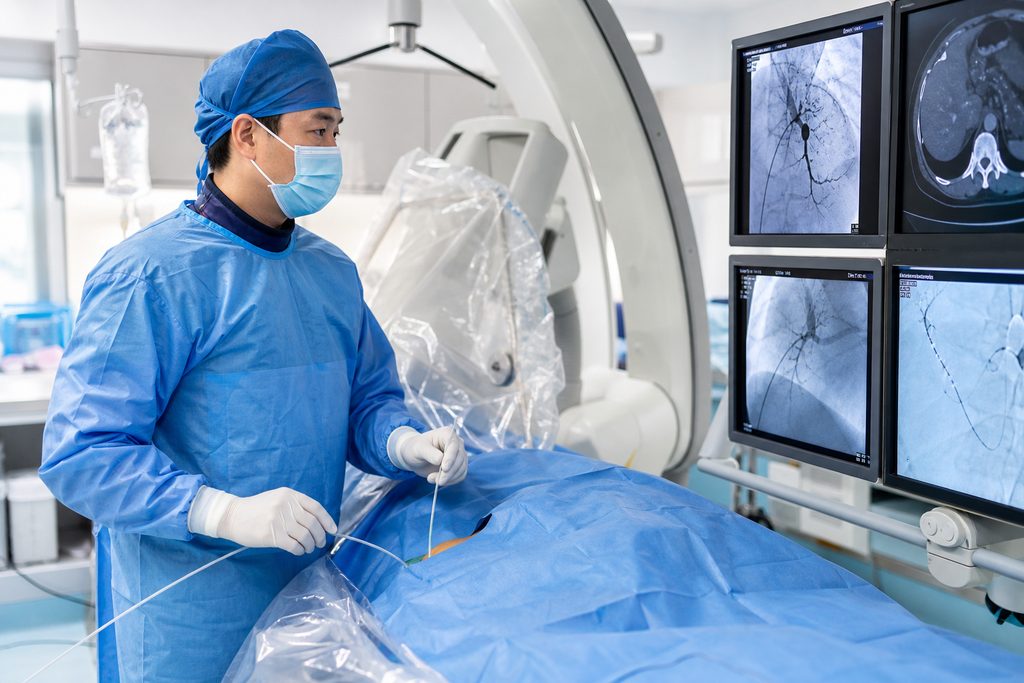
Let’s clarify the techniques. How does catheter based embolization work for tumors? The principle is elegant. A tiny catheter is threaded through the femoral artery in the groin and guided under real-time imaging to the artery feeding the tumor. Once positioned, the interventionalist delivers one of two payloads: embolic particles to block blood flow (starving the tumor, known as TAE), or particles loaded with a high-concentration chemotherapy agent (TACE). Sometimes, tiny radioactive spheres are used instead (TARE). Ablation takes a different route. A needle is guided through the skin directly into the tumor, and then radiofrequency or microwave energy is applied to cook the cancerous cells until they’re non-viable.
These are not experimental techniques. They’re standard of care globally. The equipment—Siemens or Philips angiography systems, Covidien or Medtronic ablation generators—is the same hardware used in Boston or Berlin. But in China, the sheer volume of hepatocellular carcinoma, driven by historically high hepatitis B rates, forced the healthcare system to build massive capacity for these procedures. The result is a clinical ecosystem where TACE and microwave ablation are extremely routine for the treating teams. That routineness translates to efficiency and safety.
The Economics of Catheter Embolization Liver Cancer Price Shanghai
Now, the question that brings most patients to our door. The catheter embolization liver cancer price Shanghai is not a fixed number, but it operates within a range that fundamentally changes the accessibility of care. A full course of TACE at a public hospital’s international medical center in Shanghai—including the procedure, the chemotherapy agent, imaging, and a short inpatient stay—typically runs between $8,000 and $15,000 USD. A more complex TARE procedure with Y90 microspheres might push toward $18,000 to $22,000. Microwave ablation of a single small liver tumor can cost as little as $5,000 to $8,000.
Compare this to US hospital charges, where a single TACE can generate a bill of $40,000 to $60,000. The difference isn’t a reflection of lower quality. It’s a reflection of different economic structures. Chinese public hospitals operate with lower labor costs, higher patient throughput, and a pricing system that isn’t built on the same insurance-negotiated charge-master framework. For a patient paying out-of-pocket, the math is compelling. You can fly to Shanghai, have the procedure, recover in a serviced apartment, and fly home for less than the cost of the US hospital bill alone.
Is Tumor Ablation Without Surgery Safe in China?
This is the question that keeps people up at night. Is tumor ablation without surgery safe in China? The short answer is yes, when performed at an accredited, high-volume center. But let’s not gloss over the nuance. Safety in interventional radiology is a function of three things: the operator’s skill, the sterility and quality of the angiography suite, and the patient selection process. A poorly selected patient—for example, someone with severely decompensated liver cirrhosis—can suffer liver failure after a technically perfect TACE. That’s not a procedural failure. It’s a clinical judgment failure.
Our role is to ensure you’re evaluated by a team that takes patient selection seriously. The hospitals we work with follow international guidelines set by bodies like the Barcelona Clinic Liver Cancer (BCLC) staging system. They don’t treat everyone who walks in the door. They review your CT and MRI, assess your liver function, and make a recommendation based on evidence, not revenue targets. The major complication rate for percutaneous liver ablation in experienced hands is below 3%. That includes bleeding, infection, and injury to adjacent organs. It’s not zero—no medical procedure is—but it’s a risk profile that compares favorably with open surgery, which carries a morbidity rate easily exceeding 20% for liver resection.
What You Need to Know Before Going Alone
The clinical case for coming to China is strong. The logistical reality of doing it alone is brutal. We’ve seen intelligent, resourceful people get stuck. Here’s why.
- Visa Requirements: Medical treatment in China requires an S2 visa, specifically endorsed for medical purposes. You cannot legally enter on a tourist (L) visa for a planned hospital procedure. The application demands an invitation letter from the hospital, a detailed treatment plan, and proof of financial means. A public hospital’s general outpatient department will not issue this letter for an overseas patient they haven’t seen. You need the international medical department to engage before you travel. Getting that engagement without a local contact is extremely time-consuming.
- Payment Systems: Chinese public hospitals operate on a prepaid, cash-based or domestic card system. Your international Visa or Mastercard will likely be rejected at the hospital cashier. WeChat Pay and Alipay dominate, and linking a foreign card to these platforms is still inconsistent. You’ll need to fund a hospital deposit account with a significant amount—often the full estimated cost of the procedure—before the catheter touches your artery. Moving that much money across borders into a Chinese bank account without local help is a multi-day headache.
- Medical Records and Language: An interventional radiologist needs your triphasic CT or contrast-enhanced MRI, preferably in DICOM format, plus a detailed clinical history. If these records are in English or another language, they need precise translation into clinical Chinese. Not conversational Chinese. Clinical terminology that accurately describes the tumor’s location, size, and vascular involvement. A mistranslation here can lead to a wrong treatment plan.
How We Help You Navigate This
These barriers are real, but they’re not permanent. They exist because China’s healthcare system evolved to serve a domestic population of 1.4 billion, not to cater to international patients. Our process dismantles these barriers step by step. It starts with a free consultation where we review your existing scans and clinical summary. We’re not doctors, so we don’t give medical opinions. We assess logistical viability. If your case is suitable, we translate and format your records and submit them to the international departments of hospitals that match your clinical needs—often focusing on centers ranked among the best interventional radiology hospitals China for cancer on the Fudan specialty reputation list.
Once a hospital confirms they can treat you and provides a tentative treatment plan and cost estimate, we pivot to logistics. We guide you through the S2 visa application, ensuring the hospital’s invitation letter is correctly formatted for the Chinese embassy in your country. We arrange bilingual medical companion services for the day of your procedure—someone who stands with you at registration, translates the pre-procedure consent discussion with the interventionalist, and ensures you understand every step. After discharge, we coordinate follow-up imaging and can arrange a remote video consultation with the treating team to review your one-month post-procedure scan. The goal is to make a complex international medical journey feel as straightforward as a well-planned business trip.
If you’re ready to explore whether this path fits your diagnosis, the most efficient way to start is to visit our patient coordination page. From there, you can submit your case details and begin a conversation with our team. There’s no cost for the initial consultation, and no pressure to commit. We’ll simply tell you what’s possible.
Frequently Asked Questions
You can self-refer, but you cannot bypass the clinical review. To book tumor embolization treatment abroad China, you must first submit your diagnostic imaging and medical history for evaluation by a Chinese interventional radiology team. They will determine if you’re a candidate. We facilitate this submission and the subsequent scheduling, but we cannot override a hospital’s clinical judgment. No legitimate hospital will book a procedure without first reviewing your scans.
For a single microwave ablation session, expect to pay between $5,000 and $8,000 USD at a public hospital’s international wing. This usually bundles the procedure, the ablation probe, anesthesia, one night of inpatient observation, and basic imaging. TACE is higher, typically $8,000 to $15,000, depending on the number of drug-eluting beads used. These are all-inclusive estimates for the hospital portion. They do not include flights, accommodation, or our coordination fee, which starts from $300 for appointment scheduling. Always budget an extra 15-20% for unforeseen imaging or lab tests.
Interventional oncology is often a course of treatment, not a one-time cure. Many patients require repeat TACE or ablation sessions spaced weeks or months apart. During your initial workup, the treating team will outline the expected number of sessions. If you return for a second procedure, we can coordinate the follow-up, and any prior coordination fees are credited toward the new service. The clinical reality is that liver tumors can recur, and the interventional approach is designed to be repeatable precisely for this reason.
Yes, and this is a significant advantage of seeking care at a comprehensive cancer center. Many of the hospitals in our network, which you can explore on our top hospitals directory, house interventional radiology, medical oncology, and radiation oncology under one roof. It’s common for a patient to receive TACE followed by systemic targeted therapy or immunotherapy. The interventionalist and oncologist collaborate directly, often in the same building, which streamlines what would otherwise be a fragmented treatment plan across different countries.
Your Next Step
Choosing a non-surgical path for a tumor is a significant decision, layered with hope and uncertainty. The technology exists. The expertise exists. The missing piece for most international patients is simply a reliable bridge to access it. We provide that bridge. If you have confirmed imaging showing a liver, kidney, or lung tumor and want to understand your options in China’s top-tier hospitals, start a conversation with us. There’s no obligation—just clarity on whether this route makes sense for you. Take a moment to review how our coordination works on our patient services page. We’re here when you’re ready.
For more medical information and treatment options in China, visit chinamedservices.com (China Medical Services).
