West China Hospital Chengdu Rehab: Your Post-Surgery Recovery Path
Key Takeaways
- West China Hospital handles over 200,000 inpatient surgeries annually, driving a rehabilitation volume that most Western centers see in a decade.
- Post-surgery recovery packages in China can run 60-80% less than equivalent US programs, without sacrificing clinical outcomes.
- Language barriers and visa logistics remain the biggest hurdles for international patients — not medical quality.
- You cannot simply book a bed online. Coordinated entry through the hospital’s international channel is the only reliable path.
A patient in the United Kingdom waits an average of 18 weeks just for physiotherapy after a knee replacement. In Canada, the queue for post-operative occupational therapy stretches months. Meanwhile, at West China Hospital in Chengdu, the rehabilitation medicine department sees over 400,000 outpatient visits a year. The system moves. It has to. That volume creates a clinical engine that international patients can tap into — if they know how to navigate it.
The question is not whether the expertise exists. It does. The question is how a foreign patient accesses it without getting lost in the machinery of the world’s largest single-campus hospital.
Who We Are
We are not a hospital. We do not provide medical treatment, clinical diagnoses, or rehabilitation therapy. We are your logistical architects. Our team connects international patients with China’s top-tier hospitals — including West China Hospital — by handling the coordination layer that sits between you and the care you need. We translate medical records, schedule appointments through official international department channels, arrange bilingual medical companions, and guide your visa process. We bridge the gap. Nothing more, nothing less.
What West China Hospital’s Rehabilitation Department Actually Offers
The Rehabilitation Medicine Center at West China Hospital is not a small physiotherapy unit tucked away in a basement. It is one of the largest and most influential rehabilitation departments in China, designated as a national key clinical specialty. The center operates across multiple campuses and integrates early intervention teams that start working with patients within 24 hours of surgery. For international patients considering west china hospital international patient service options, the scope matters.
They treat post-operative recovery from orthopedic procedures, neurological surgeries, cardiac interventions, and complex trauma cases. The department runs specialized programs for spinal cord injury rehabilitation, stroke recovery, and post-joint replacement mobilization. In 2023, the center published over 60 research papers in indexed journals and maintains active clinical collaborations with rehabilitation institutes in the United States, Australia, and Europe. This is not a facility learning on the job. This is a facility defining the protocols.
Clinical Volume Drives Better Outcomes
Here is a number that matters. West China Hospital performs approximately 200,000 surgeries annually across all departments. That surgical volume feeds directly into the rehabilitation pipeline. A therapist here sees more post-operative knee patients in a month than a therapist in a mid-sized European hospital sees in a year. Volume alone does not guarantee quality — but when paired with rigorous outcome tracking and academic oversight, it creates a feedback loop that sharpens clinical judgment.
Research published in medical journals has repeatedly shown that higher surgical and rehabilitation volumes correlate with lower complication rates and faster functional recovery. A 2022 study in a leading orthopedics journal found that patients treated at high-volume rehabilitation centers regained independent mobility an average of 4.7 days faster than those at low-volume facilities. West China Hospital operates at the extreme end of that volume curve.
Technology Integration Across the Recovery Timeline
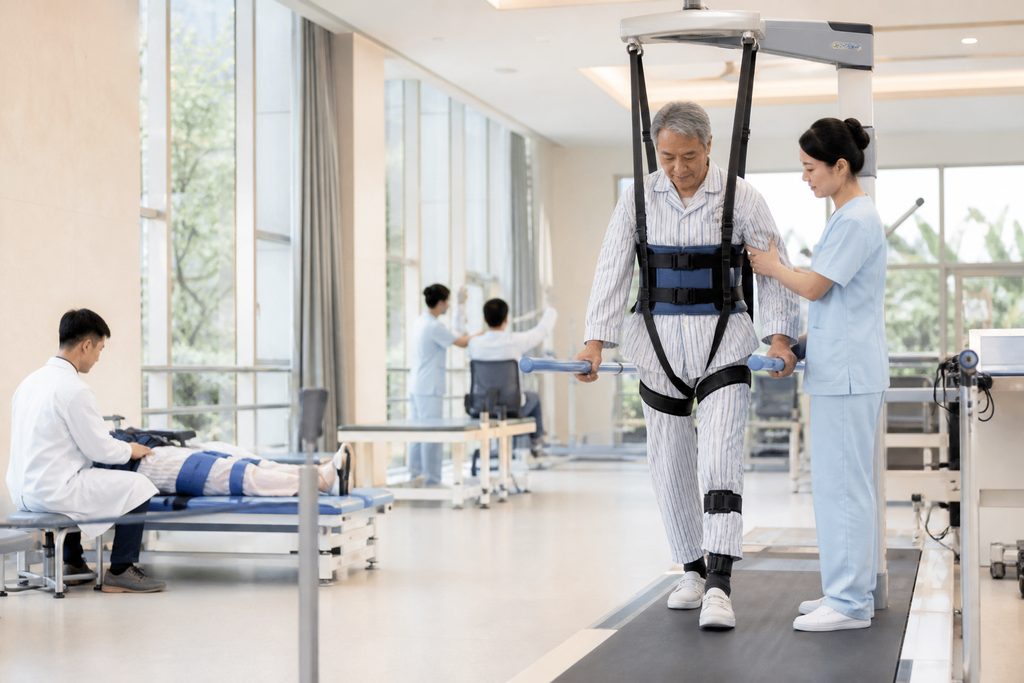
The rehabilitation center deploys robotic-assisted gait training systems, virtual reality balance platforms, and real-time motion analysis labs. But the technology is not the headline. The headline is how it gets integrated. Patients move through a protocolized pathway where objective data — gait symmetry percentages, force plate measurements, range-of-motion metrics — informs every adjustment to the therapy plan. No guesswork. No “let us try this and see.”
For international patients weighing post surgery recovery packages china against options at home, this data-driven approach offers something concrete to evaluate. You can track progress against baseline measurements taken on day one. You can see the numbers move.
Cost Structure Without the Obscurity
Let us address the west china hospital rehabilitation cost directly. Inpatient rehabilitation at West China Hospital’s international department typically ranges from $400 to $900 per day, depending on room category and therapy intensity. Outpatient physiotherapy sessions run $80 to $200 per visit. A comprehensive two-week post-surgery recovery package — including daily therapy, accommodation in the international ward, nursing care, and meals — generally falls between $6,000 and $14,000.
Compare that to the United States, where a similar inpatient rehabilitation stay costs $1,500 to $3,000 per day. A two-week program at a major American rehabilitation hospital easily reaches $30,000 to $50,000. The differential is structural, not qualitative. Labor costs in China are lower. Hospital operational overhead is leaner. The clinical protocols are drawn from the same evidence base.
| Service | West China Hospital (USD) | United States (USD) |
|---|---|---|
| Inpatient Rehab (per day) | $400 – $900 | $1,500 – $3,000 |
| Outpatient Physiotherapy (per session) | $80 – $200 | $150 – $400 |
| 2-Week Post-Surgery Recovery Package | $6,000 – $14,000 | $30,000 – $50,000 |
| Initial Specialist Consultation | $100 – $300 | $250 – $600 |
These figures vary by case complexity and specific therapy requirements. A patient recovering from a complex spinal fusion will pay more than someone rehabbing a straightforward hip replacement. The numbers above represent the range most international patients encounter.
What You Need to Know Before Going Alone
West China Hospital is a public institution first. It serves a domestic patient population of millions. The international department exists and functions well — but it operates on its own logic. Walking in unprepared wastes time and money.
- Visa Requirements Are Specific: Medical treatment in China requires an S2 visa with a clear treatment purpose noted in the application. Your accompanying family member also needs an S2. The consulate will want a formal invitation letter from the hospital, a treatment plan summary, and proof of financial means. Processing takes two to four weeks in most jurisdictions. An M visa — the business visa — is not valid for medical treatment and will be rejected if the purpose is clearly medical.
- Payment Happens Upfront: Chinese public hospitals, including West China Hospital, operate on a prepayment model. You deposit funds at admission. Treatment draws down the balance. International insurance is rarely accepted for direct billing at public hospitals — you pay first and seek reimbursement from your insurer afterward. Private international hospitals in China handle direct billing. West China Hospital’s international department can provide detailed invoices and medical reports for insurance claims, but the cash flow sits with you initially.
- Language Is the Real Gatekeeper: The rehabilitation therapists and nurses at West China Hospital are clinically excellent. Most have limited English proficiency. Informed consent discussions, therapy instructions, pain assessments — these happen in Mandarin. Without a bilingual companion, you risk misunderstanding your recovery protocol. That is not a minor inconvenience. That is a clinical risk.
How We Help You Navigate This
These barriers are real. They are also solvable. Our team has coordinated rehabilitation placements at West China Hospital for patients from over a dozen countries. The process follows a clear sequence.
Before you travel, we collect your surgical records, imaging studies, and referring physician notes. We translate everything into clinical Chinese — not machine translation, but medically precise translation handled by bilingual clinicians. We submit your case through the hospital’s official international patient channel and secure a preliminary treatment plan and cost estimate. We generate the invitation letter required for your S2 visa application.
During your stay, a bilingual medical companion accompanies you to every therapy session, every consultation, every discharge planning meeting. This person handles registration queues, payment processing, pharmacy runs, and real-time interpretation. You focus on recovery. They handle the friction.
After discharge, we coordinate follow-up telehealth consultations with your rehabilitation team and ensure your medical records are translated back into English for your home physician. The consultation process starts with understanding your case — no generic packages, no one-size-fits-all quotes.
If you want to book rehabilitation at west china hospital chengdu with confidence, the path runs through the international department. We open that door and walk you through it.
How Long Is Rehab After Surgery in China?
The question how long is rehab after surgery in china has no single answer. But patterns exist. For a total knee replacement, inpatient rehabilitation at West China Hospital typically spans 7 to 14 days, followed by outpatient physiotherapy two to three times per week for six to eight weeks. A spinal fusion patient might stay inpatient for 14 to 21 days, with outpatient follow-up extending three to six months. Stroke rehabilitation is measured in months, not weeks.
Chinese rehabilitation physicians tend to favor slightly longer inpatient stays than their American counterparts. The system does not discharge patients to home care as aggressively. That can work in the international patient’s favor — more supervised therapy hours before returning home. But it also means planning for a longer stay than you might expect from a US or European facility.
Is West China Hospital the Best Hospital for Post Op Recovery Abroad?
Rankings are a blunt instrument. But when patients ask about the best hospital for post op recovery abroad, West China Hospital belongs in the conversation for specific reasons. It consistently ranks in the top tier of Chinese hospitals in the Fudan University hospital rankings, placing in the A++++ category for general hospital strength. Its rehabilitation medicine department is ranked among China’s top five nationally.
More relevant than rankings: the hospital is a designated World Health Organization collaborating center for rehabilitation. It trains rehabilitation specialists from across Asia. It publishes protocols that other hospitals adopt. For post-operative recovery, you want a center where rehabilitation is not an afterthought bolted onto the surgical department — you want a center where rehabilitation is a core clinical discipline with institutional power. West China Hospital is that center.
But it is not the right choice for everyone. If you need a fully English-speaking environment with Western-style nursing ratios and direct insurance billing, a private international hospital like United Family may suit you better. Our database of top-ranked hospitals includes both public giants like West China and private international facilities — the right answer depends on your priorities.
Frequently Asked Questions
Yes, through the international department channel. You cannot book a specific bed or therapist through the public registration system, but the international patient service can reserve a rehabilitation admission slot based on your medical records and surgical history. This requires a formal case submission and deposit. Walk-in attempts without prior coordination almost never succeed for international patients.
West China Hospital is a full-spectrum tertiary hospital. If a post-surgical infection, implant failure, or unexpected complication arises during your rehabilitation stay, the relevant surgical team is in the same building — often on the same floor. You do not need to be transferred to another facility. The rehabilitation physicians consult directly with the surgeons who performed your procedure. This co-location of surgical and rehabilitation expertise is a structural advantage of recovering at a major academic medical center.
Most international insurance plans that cover treatment abroad will reimburse rehabilitation at West China Hospital — but almost none will pay the hospital directly. You pay upfront, receive detailed English-language invoices and medical reports, and submit claims to your insurer. We strongly recommend obtaining pre-authorization from your insurance carrier before traveling. Some patients use medical tourism facilitators who bundle payment processing with insurance liaison services.
The international department assigns English-speaking coordinators, but the frontline rehabilitation therapists primarily work in Mandarin. A bilingual medical companion bridges this gap in real time during every session. Some senior rehabilitation physicians speak functional medical English. Relying on this alone for nuanced discussions about pain thresholds, movement restrictions, or recovery milestones is risky. Professional interpretation protects your clinical outcomes.
Your Next Step
Recovery after surgery is not a passive process. Where you do it, who guides it, and how well the logistics hold together — these factors shape whether you return to full function or settle for less. West China Hospital offers world-class rehabilitation volume and expertise at a fraction of Western costs. Accessing it requires navigating a system built for domestic patients, with language and administrative barriers that are real but manageable with the right support.
If you are considering post-operative recovery in Chengdu, start with a free consultation. We will review your surgical history, explain what a realistic rehabilitation timeline looks like, and give you a clear cost picture before you commit to anything. No pressure. Just clarity.
For more medical information and treatment options in China, visit chinamedservices.com (China Medical Services).
