ZJU Women’s Hospital Hangzhou: IVF Cost, Success Rates & How to Book
Key Takeaways
- ZJU Women’s Hospital operates one of China’s highest-volume reproductive medicine centers, completing over 10,000 IVF cycles annually — a scale that directly correlates with lab stability and embryologist expertise.
- For international patients, the true barrier is not clinical quality but logistics: this is a public hospital where outpatient registration operates on a same-day queuing system, and English-speaking administrative staff are scarce.
- IVF costs at ZJU Women’s Hospital typically range from $4,000 to $7,000 per cycle — roughly one-third to one-fifth of what a comparable cycle costs in the United States.
- You cannot simply email the hospital and book a delivery date or an IVF cycle from overseas. Access requires navigating a specific pathway, which we explain below.
The Problem: When Cost Blocks the Path to Parenthood
In the United States, a single standard IVF cycle now averages $12,000 to $17,000. Add genetic testing, and that number jumps past $20,000. Medication alone can run $3,000 to $6,000 per cycle. For the roughly 1 in 8 couples who struggle with infertility, these figures are not abstract — they are the difference between trying again and stopping treatment altogether. A 2022 study published in Fertility and Sterility found that nearly 40% of US patients who discontinue IVF cite financial pressure as the primary reason, not medical futility.
That statistic should stop you cold.
It means thousands of people walk away from a viable chance at pregnancy not because the science failed them, but because the arithmetic did. And the pattern repeats across Canada, the UK, Australia — anywhere private fertility care dominates. Public funding exists in some systems, but waitlists stretch for months. Age does not wait for bureaucracy. So patients start looking across borders. They search terms like “ZJU Women’s Hospital IVF cost” not out of idle curiosity, but because they have done the math at home and need a different equation.
Who We Are
We are not a hospital. We do not provide medical treatment, make clinical diagnoses, or promise specific outcomes. What we do is remove every logistical obstacle between you and China’s top-tier medical institutions. Our team handles hospital matching, appointment coordination through official international channels, bilingual medical companionship on the ground, and visa guidance — so that when you arrive at a facility like ZJU Women’s Hospital, you are not standing alone at a registration counter holding a phone with Google Translate. We bridge the gap between your need and China’s clinical capacity. That is our entire job.
ZJU Women’s Hospital Hangzhou: Obstetrics Gynecology and Reproductive Medicine Center — What Makes It Different
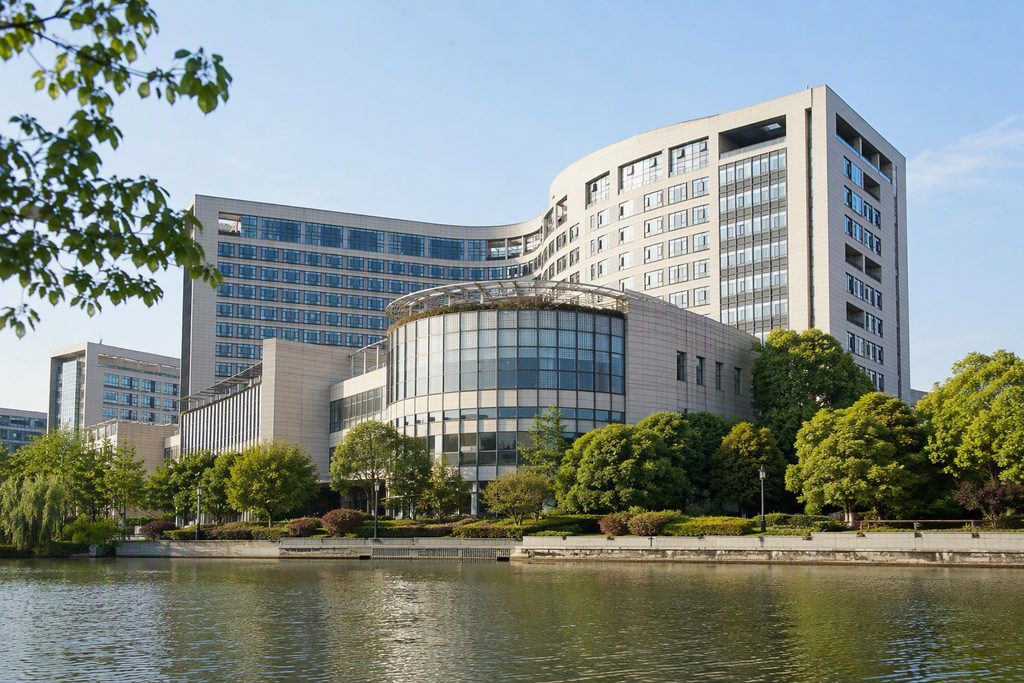
The Women’s Hospital, Zhejiang University School of Medicine — commonly referred to as ZJU Women’s Hospital — is not a boutique private clinic. It is a high-volume, research-driven public institution. Its Reproductive Medicine Center was among the first in China to achieve a live birth through IVF, and it now functions as both a provincial and national referral hub for complex infertility cases. For international patients researching the best obstetrics hospital Hangzhou has to offer, this institution consistently appears at the top of the list — but understanding why requires looking past the rankings.
Volume Shapes Competence
The center runs more than 10,000 fresh and frozen embryo transfer cycles each year. That volume is not a marketing number — it is a clinical reality that shapes everything. Embryologists here see more unusual cases in a month than a mid-sized Western clinic might encounter in a year. The lab protocol is stress-tested daily across hundreds of procedures. When you ask how successful is IVF in China, the honest answer is that it varies enormously by center — but at high-volume university-affiliated hospitals like ZJU, live birth rates per embryo transfer for women under 35 consistently fall in the 50-60% range, which is fully competitive with top US and European clinics.
That statistic comes with a caveat: Chinese clinics often report success rates differently than Western ones. Some report clinical pregnancy rates; others report live birth rates. You must ask the right question. We help you ask it.
Reproductive Immunology: A Different Clinical Lens
One area where Chinese reproductive medicine diverges from standard Western protocols is the aggressive investigation of immunological factors in recurrent implantation failure. At centers like ZJU, it is common to screen for antiphospholipid antibodies, natural killer cell activity, and endometrial immune profiles in patients who have failed multiple transfers elsewhere. This approach is not universally accepted in Western reproductive endocrinology — the data is mixed, and some guidelines consider it investigational. But for a specific subset of patients, it has been the variable that changed the outcome. If you have been told your embryos are “good quality” and your lining is “textbook” but transfers keep failing, this is a conversation worth having.
Obstetrics: What “Good for Delivery” Actually Means
Patients often ask is ZJU Women’s Hospital good for delivery. The short answer is yes — but define “good.” If you mean clinical safety, the hospital’s obstetric department handles over 20,000 deliveries annually with maternal and neonatal outcomes that meet international benchmarks. The neonatal intensive care unit is equipped to manage extreme prematurity. The obstetrics team manages high-risk pregnancies — placenta accreta, multiple gestations, severe preeclampsia — at a volume that builds genuine expertise.
If “good” means a private suite, an English-speaking midwife, a birth plan with dim lighting and a birthing ball, and your partner cutting the cord while a doula takes photos — then no, a Chinese public hospital is not that. Not even close. Labor and delivery wards in Chinese public hospitals are efficient, clinical, and often crowded. Epidural rates are lower than in the West. C-section rates are higher — sometimes significantly so — though this varies by provider and hospital policy. You need to know this before you go. We tell you this because trust is built on honesty, not curation.
What You Need to Know Before Going Alone
Attempting to navigate ZJU Women’s Hospital independently as a non-Chinese speaker is not impossible. But it is punishingly difficult. Here is what you will face:
- Outpatient Registration: The public outpatient system does not accept overseas pre-booking for initial consultations. You register the same day, in person, often via a WeChat mini-program that requires a Chinese phone number and ID. Slots for senior specialists vanish within minutes of release.
- Language Barrier: The hospital has an international department, but it is not staffed to handle walk-in foreign patients in English across all departments. Most clinical staff speak only Mandarin. Medical records, consent forms, and discharge instructions are in Chinese.
- Payment and Insurance: The hospital operates on a prepaid deposit system. You load funds onto a hospital card before any procedure. International insurance is generally not directly billed — you pay first and seek reimbursement later. WeChat Pay and Alipay dominate; foreign credit cards are often useless at the hospital counter.
- Visa Requirements: Medical treatment in China requires an S2 visa with a specific annotation for medical purposes. Family members accompanying you also need S2 visas. This is not an M visa — M is for commercial business. Getting the invitation letter from the hospital to support your visa application is a bureaucratic process that requires a local contact point.
ZJU Women’s Hospital IVF Cost: A Clear Breakdown
Now to the question that brings most readers here. The ZJU Women’s Hospital IVF cost for a standard antagonist or agonist protocol cycle — including monitoring, egg retrieval under sedation, ICSI if indicated, embryo culture, and fresh transfer — typically ranges from ¥28,000 to ¥50,000 RMB. At current exchange rates, that is approximately $4,000 to $7,000 USD. Medication costs are additional and vary widely by protocol and patient response, generally adding $1,500 to $3,000 USD.
Frozen embryo transfer cycles cost significantly less — typically $1,500 to $2,500 USD. Preimplantation genetic testing for aneuploidy adds roughly $2,000 to $4,000 depending on the number of embryos biopsied and the testing platform used.
These are the prices at a top-tier university hospital reproductive medicine center China price benchmarks. Compare this to the US average of $15,000+ per fresh cycle plus medications, or the UK where private cycles run £5,000-£8,000, and the structural advantage becomes clear. The cost difference is not a reflection of lower quality — it is driven by radically different labor costs, hospital operational models, and the sheer volume that amortizes expensive laboratory equipment across thousands of cycles annually.
| IVF Cost Component | ZJU Women’s Hospital (USD) | Average US Clinic (USD) |
|---|---|---|
| Fresh IVF cycle (standard) | $4,000 – $7,000 | $12,000 – $17,000 |
| Medications per cycle | $1,500 – $3,000 | $3,000 – $6,000 |
| Frozen embryo transfer | $1,500 – $2,500 | $3,500 – $5,000 |
| PGT-A genetic testing | $2,000 – $4,000 | $4,000 – $7,000 |
How We Help You Navigate This
The barriers above are real and structural. But they are also solvable — if you have the right coordination on the ground. Here is how the process works when you work with us.
Before you travel, we obtain a formal medical invitation letter from the hospital’s international department — the document your S2 visa application requires. We translate your existing medical records into Chinese, ensuring that your full fertility history, prior cycle data, and relevant test results are presented in a format Chinese physicians can immediately read and act on. We coordinate directly with the hospital’s international patient channel to schedule your initial consultation — not through the public queuing system, but through the VIP international pathway where appointments are confirmed in advance.
When you arrive in Hangzhou, a bilingual medical companion meets you at the hospital. This person handles registration, payment deposit, and navigation — physically walking you from the consultation room to the ultrasound suite to the phlebotomy station. They sit with you during the doctor’s consultation and translate in real time, ensuring you understand every recommendation, every risk, and every cost before you consent. They are not clinical staff. They are your logistical anchor in a system that was not designed for foreigners.
If your treatment plan involves a frozen cycle or requires a return visit for embryo transfer, we coordinate the timing and the appointments. If you are coming to book delivery at ZJU Hospital Hangzhou, we manage the obstetric registration, the prenatal visit schedule, and the admission process when labor begins. We do not deliver your baby. We make sure you are in the right place, with the right team, without language friction, when it matters most.
Frequently Asked Questions
Not directly. The hospital requires an in-person consultation before any treatment plan is confirmed. What we can do is secure a confirmed appointment slot through the international channel, arrange all pre-consultation record translation, and ensure that when you arrive, the physician already has your full history and you move straight to the clinical discussion — no wasted trips, no registration chaos.
No fertility clinic anywhere offers a guarantee of success, and ZJU Women’s Hospital is no exception. You pay for the medical service — the cycle itself — not for a pregnancy. If a cycle fails, the clinical team will review what happened and recommend next steps. Unused frozen embryos remain stored. A subsequent frozen transfer or new stimulation cycle would be priced separately. We strongly recommend all international patients carry medical travel insurance, though note that most such policies exclude IVF complications unless specifically underwritten.
Our bilingual companions are available for labor and delivery support, but they are not midwives or doulas — they are there to translate between you and the clinical team. The obstetricians and nurses will speak Mandarin. Your companion ensures you understand what is being recommended, what medications are being administered, and what is happening at each stage. If you require an English-speaking obstetrician specifically, we can coordinate with the hospital’s international department, but availability is limited and must be arranged well in advance.
The S2 visa itself is straightforward once you have the proper documentation — specifically, an invitation letter from the hospital confirming your treatment purpose. The difficulty lies in obtaining that letter from a public hospital without a local intermediary. We handle this as part of our coordination service. Processing times vary by consulate, but plan for 2-4 weeks minimum.
ZJU Women’s Hospital is a full-service tertiary hospital with 24/7 emergency gynecology coverage. Ovarian hyperstimulation syndrome, post-retrieval bleeding, and infection are all manageable on-site. Your bilingual companion can accompany you to the emergency department and facilitate communication. This is not a standalone fertility clinic that closes at 5 PM and refers emergencies elsewhere — it is a major hospital with the infrastructure to handle complications.
Your Next Step
The decision to pursue fertility treatment abroad is never just about cost. It is about access, timing, and the quiet calculation of how many more cycles you are willing to endure — emotionally and financially. ZJU Women’s Hospital offers clinical capability at a price point that changes that calculation for many families. The obstacle is not the medicine. It is the maze around it.
If you want to understand whether this path fits your specific situation — your diagnosis, your timeline, your budget — start with a free consultation. We will ask about your case, explain what is realistic, and give you a clear picture of the costs and timeline before you commit to anything. No pressure. Just clarity.
For more medical information and treatment options in China, visit chinamedservices.com (China Medical Services).
