Proton Therapy China Pakistan: When Cancer Radiation Isn’t Available at Home
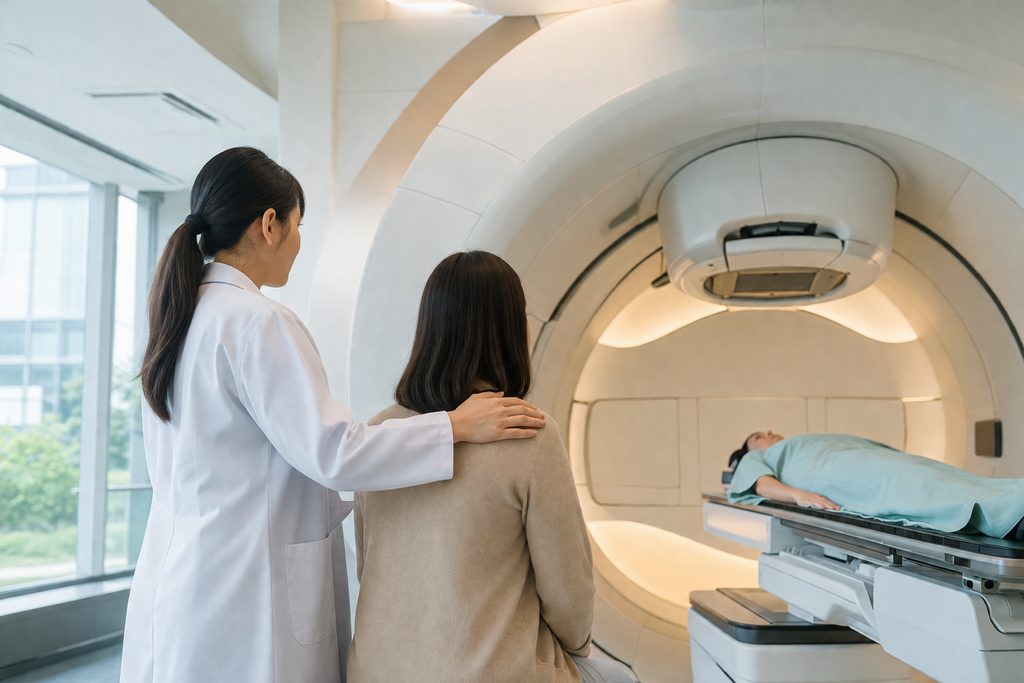
When 42-year-old Fatima from Lahore received her diagnosis of a chordoma at the base of her skull, her oncologist was direct. Surgery was risky. Conventional radiation would scatter dose through healthy brain tissue. Proton therapy was the precise tool her case demanded. And Pakistan, despite its growing medical infrastructure, does not yet have an operational proton therapy center. Her family started searching for options abroad. They found themselves looking at the usual destinations—the United States, Germany—and then at a closer, cost-differentiated option they had not considered: China.
We hear versions of Fatima’s story regularly. A rare pediatric tumor. A recurrent head and neck cancer. A localized prostate cancer where sparing surrounding organs matters enormously. The clinical need for proton beam therapy is clear, but the geography of access is cruel. As of early 2026, fewer than 140 proton therapy centers operate worldwide. None are in Pakistan. The nearest options are in India, China, and farther afield. For Pakistani families weighing treatment abroad, the conversation inevitably turns to two questions: where can we get the best treatment, and what will it cost?
Key Takeaways
- China operates multiple full-scale proton therapy centers, with Shanghai and Beijing housing internationally accredited facilities that treat complex cancers.
- The proton therapy cost China for international patients typically ranges from $40,000 to $70,000 for a full treatment course, roughly one-third of the U.S. price.
- Pakistani patients can access Chinese proton centers using an S2 visa for medical treatment, with documentation support from the treating hospital.
- No proton center can guarantee outcomes, and patient selection matters—proton therapy is not suitable for every cancer type or stage.
The Problem: Cancer Radiation Options That Do Not Exist at Home
Pakistan’s cancer burden is substantial and rising. The International Agency for Research on Cancer estimates that Pakistan recorded approximately 178,000 new cancer cases in 2022. Radiation therapy is a core treatment modality for roughly half of these patients. But the country’s radiation infrastructure leans heavily on conventional linear accelerators. Proton therapy—which uses charged particles to deposit energy with far greater precision—remains unavailable.
The clinical difference matters. A conventional photon beam enters the body, deposits dose along its entire path, and exits the other side. A proton beam enters, travels to a specific depth determined by its energy, and releases the bulk of its energy at the tumor site in what physicists call the Bragg peak. Beyond that point, dose falls to near zero. For tumors adjacent to the spinal cord, optic nerves, or brainstem, that physical advantage translates into less collateral radiation. For children, whose developing tissues are exquisitely sensitive to radiation, the reduction in integral dose can mean fewer secondary cancers decades later.
None of this helps a patient in Karachi or Islamabad who needs the treatment today. The machine is not there. So families travel.
Where do they go? Some head to India, where the Apollo Proton Cancer Centre in Chennai and a handful of other facilities treat international patients. Others look to Germany or the United States. And increasingly, Pakistani families are evaluating China.
Why Chinese Proton Centers Are Drawing International Attention
Clinical Scale That Builds Technical Proficiency
China’s proton therapy rollout has been deliberate and rapid. The Shanghai Proton and Heavy Ion Center (SPHIC) opened in 2015 as the country’s first particle therapy facility. Since then, multiple centers have come online in Beijing, Hebei, and other cities. By mid-2025, China was operating at least eight proton or heavy ion centers, with more in commissioning.
Volume follows infrastructure. SPHIC alone has treated over 6,500 patients since opening, with annual throughput exceeding 900 patients. That case volume concentrates clinical experience. A radiation oncology team that treats 200 skull-base tumors a year sees rare anatomical presentations that a team treating 20 a year may encounter only in textbooks. For international patients considering proton therapy, this matters—you are not just buying access to a machine. You are buying the judgment that comes from seeing thousands of cases.
The best proton therapy centers in Shanghai for cancer treatment are concentrated in two facilities: SPHIC in Pudong and the Ruijin Hospital Proton Center, which began treating patients in 2023. Both accept international patients through their respective international medical departments.
Technology That Matches Any Western Center
The proton therapy systems installed in China are not domestic copies. They are the same platforms used in leading centers globally. SPHIC uses a synchrotron-based system with pencil-beam scanning, the delivery technique that allows intensity-modulated proton therapy (IMPT). The Ruijin center uses a compact superconducting cyclotron system. Both offer image-guided patient positioning, respiratory motion management, and the full planning software ecosystem required for complex cases.
What does that mean for a patient? The treatment plan your Chinese radiation oncologist develops will use the same beam modeling algorithms, the same robustness analysis tools, and the same quality assurance protocols you would find at MD Anderson or the Paul Scherrer Institute. The physics does not change at the border.
The Cost Equation: Why the Numbers Work
Let’s address the question families ask first: how much does proton therapy cost in China compared to Pakistan? Since Pakistan has no proton center, the real comparison is China versus other international destinations.
A full course of proton therapy in the United States typically costs between $120,000 and $180,000, depending on the number of fractions and treatment complexity. In Germany, the range is roughly €65,000 to €95,000. The proton therapy cost China for international patients falls between $40,000 and $70,000 for most treatment courses. Some centers offer proton beam therapy China price packages that bundle treatment planning, delivery, and basic inpatient or accommodation support into a single figure.
| Country | Approximate Cost (USD) | Wait Time (Typical) | Notes |
|---|---|---|---|
| United States | $120,000 – $180,000 | 1–3 weeks | Highest cost; insurance-dependent |
| Germany | $70,000 – $100,000 | 2–4 weeks | Strong clinical reputation; high living costs |
| China | $40,000 – $70,000 | 2–6 weeks | Growing case volumes; lower ancillary costs |
| India | $35,000 – $55,000 | 2–4 weeks | Closest geographically to Pakistan |
These figures cover the radiation treatment itself—consultation, imaging, treatment planning, and delivery. They do not include international travel, accommodation for the 4 to 8 weeks most treatment courses require, or any additional medical care needed. Ancillary costs in China tend to be lower than in Western Europe or the United States, particularly for extended stays.
Why are Chinese costs lower? Not because the technology is inferior. The drivers are structural: lower physician and physicist salaries, higher patient throughput per machine, and a hospital economics model that does not carry the same administrative overhead as U.S. systems. Clinical outcomes data from SPHIC, published in peer-reviewed journals including the International Journal of Radiation Oncology, show local control and toxicity profiles comparable to international benchmarks for chordoma, nasopharyngeal carcinoma, and pediatric brain tumors.
Is Proton Therapy Available in China for Pakistani Patients? Eligibility and Access
The short answer is yes. Chinese proton centers accept international patients, and Pakistani nationals are eligible. But eligibility has two layers: medical and administrative.
Medical eligibility is determined by the treating center’s radiation oncology team. Proton therapy is not a universal cancer treatment. It is indicated for specific clinical scenarios where the physical properties of protons offer a meaningful advantage over photons. These include tumors in anatomically sensitive locations, pediatric cancers, and cases where re-irradiation is required after prior radiation treatment.
The centers will require complete medical records before accepting a case: pathology reports, imaging studies on CD in DICOM format, surgical notes if applicable, and a detailed treatment summary from the referring oncologist. Our team typically helps patients compile these documents and submit them for a preliminary review. A written second opinion from a Chinese proton center specialist costs $300 to $500 and provides an initial assessment of whether proton therapy is appropriate for the specific case.
Administratively, Pakistani patients need an S2 visa for medical treatment in China. The treating hospital provides an invitation letter and treatment confirmation document that supports the visa application. Processing times vary by Chinese embassy location—Islamabad, Karachi, and Lahore all have Chinese consular services—but typically run 1 to 4 weeks. The S2 visa is issued for short-term private affairs including medical treatment. Family members accompanying the patient apply under the same category.
How to Book Proton Therapy Treatment in Beijing Hospital and Shanghai Centers
The process to book proton therapy treatment in Beijing hospital or Shanghai facilities follows a structured pathway. It is not like booking an MRI. Proton therapy involves a multi-week commitment, and centers do not accept walk-in international patients.
The pathway typically runs like this. First, a remote case evaluation. You send your complete medical records—imaging, pathology, clinical history—to the center’s international patient office. A radiation oncologist reviews the case and determines whether proton therapy is indicated. This step can take 1 to 2 weeks.
Second, a treatment plan and cost estimate. If the case is accepted, the center provides a proposed fractionation schedule (how many treatment sessions), a preliminary treatment plan, and a cost breakdown. This is when you learn the total number of fractions, the estimated duration of your stay, and the financial commitment required.
Third, scheduling and travel coordination. Once you accept the plan, the center assigns a treatment slot. Wait times vary. Some centers can start within 2 weeks; others may have a 4 to 6 week queue. You then arrange your S2 visa, flights, and accommodation.
Fourth, arrival and treatment initiation. You will undergo a simulation session—a planning CT scan in the treatment position—followed by several days of treatment planning by the physics team. Actual proton beam delivery typically begins 5 to 10 days after your simulation.
The entire in-country stay usually spans 4 to 8 weeks, depending on the number of fractions. Some protocols deliver treatment 5 days a week for 6 to 7 weeks. Others use hypofractionated schedules that compress treatment into fewer sessions over a shorter period.
Practical Considerations: Travel, Language, and Follow-Up
Travel from Pakistan to China is straightforward. Direct flights connect Lahore, Islamabad, and Karachi to Beijing, Shanghai, and Guangzhou. Flight time is 5 to 6 hours. Shanghai Pudong International Airport and Beijing Capital International Airport are the primary gateways for the proton centers.
Accommodation requires planning. Proton therapy is outpatient in most cases—you do not stay in the hospital. You need a nearby apartment or hotel for 4 to 8 weeks. Shanghai and Beijing have extensive short-term rental markets. Budget roughly $1,500 to $3,000 per month for a comfortable serviced apartment near the treatment center. Some hospitals maintain relationships with nearby hotels and can recommend options.
Language is a real barrier. Chinese proton centers employ English-speaking staff in their international departments, but the broader hospital environment—signage, cafeteria, pharmacy—operates in Mandarin. We have found that international patients who bring a family member manage day-to-day logistics, but medical conversations require professional interpretation. Bilingual medical companion services, which provide an interpreter who accompanies you to appointments and handles hospital navigation, start from $200 per day.
Follow-up after returning to Pakistan requires coordination. Your Chinese radiation oncologist will provide a treatment summary and imaging on CD. You will need a local oncologist in Pakistan to manage long-term follow-up—surveillance imaging, side effect management, and coordination with other specialists. The Chinese center typically schedules remote follow-up consultations at 3, 6, and 12 months post-treatment. These can often be done via video consultation, with updated imaging sent electronically.
Frequently Asked Questions
Can Pakistani patients really get proton therapy in China, or are there restrictions?
There are no nationality-based restrictions. Chinese proton centers accept patients from Pakistan, and we have coordinated care for Pakistani families. The barrier is medical, not political—the center must determine that proton therapy is clinically appropriate for your specific case. Centers will decline cases where protons offer no advantage over conventional radiation.
What happens if the treatment does not work or I have complications?
Proton therapy, like all radiation, carries risks of acute and late side effects. The Chinese center manages acute toxicities during treatment. If a serious complication arises requiring hospitalization, you would be admitted through the center’s affiliated hospital. Medical evacuation insurance is worth considering—policies are available that cover transport back to Pakistan or to a third country if needed. This is not a common scenario, but families should understand the contingency.
How do I know which Chinese proton center is right for my case?
Centers differ in their clinical experience by tumor type. SPHIC in Shanghai has the longest track record and published outcomes data for chordoma, nasopharyngeal carcinoma, and pediatric tumors. The newer centers in Beijing and elsewhere have recruited experienced teams but have shorter institutional histories. The right choice depends on your diagnosis. A written second opinion process can help—send your records to more than one center and compare their assessments and proposed treatment approaches.
Is the cost really that much lower, or are there hidden fees?
The treatment cost quote you receive from the hospital typically covers the professional and technical components of proton therapy: consultation, simulation, treatment planning, physics quality assurance, and beam delivery. It does not cover pre-treatment diagnostic imaging if additional scans are needed, medications for side effect management, or hospital admission if required for non-radiation medical issues. Ask for a written breakdown of what is included and what is billed separately.
Can I combine proton therapy with other treatments in China?
Some patients require concurrent chemotherapy with proton radiation. Chinese centers can provide this, but it adds complexity and cost. If your treatment plan requires surgery before or after radiation, that must be coordinated with a surgical team at the same hospital or a partner institution. This is case-specific. The remote evaluation process is designed to identify these needs before you travel.
Your next step depends on where you are in the decision process. If you have a confirmed diagnosis and your oncologist has recommended proton therapy, the remote evaluation pathway is the logical starting point. You send records, receive an expert opinion on whether proton therapy is indicated for your case, and get a concrete cost estimate. That information lets you compare options across countries with real numbers rather than assumptions.
China Medical Services helps international patients navigate this process—from compiling and translating medical records to coordinating with the proton center’s international office to arranging on-the-ground support during treatment. We are not a hospital. We do not provide medical advice or make treatment decisions. What we do is reduce the logistical friction so families can focus on the clinical decision that matters.
If you are ready to explore whether proton therapy in China is a viable option for your case, start with a free consultation. We will help you understand the pathway, the costs, and the next step that makes sense for your situation.
For more medical information and treatment options in China, visit chinamedservices.com (China Medical Services).
