Pack for Your Caregiver: China Medical Trip Essentials
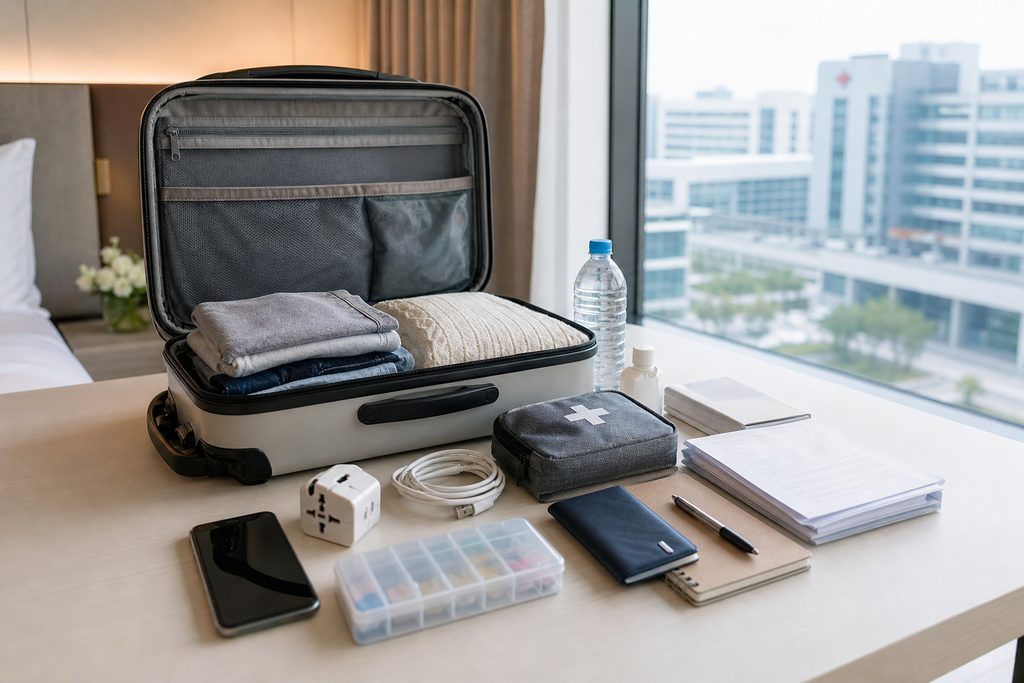
When 34-year-old Sarah and her husband Mark decided to pursue fertility treatment abroad, the spreadsheet they built was dizzying. Clinic success rates. Airline baggage policies. Hotel proximity to the hospital. But the column that stayed blank the longest was the one for Mark, her caregiver. What does the person who is supposed to hold everything together actually need to bring? It is a question that gets buried under medical records and flight confirmations. And it is the one that can quietly determine whether a weeks-long medical trip feels manageable or completely overwhelming.
A caregiver’s role on a medical trip to China is physically and emotionally demanding. You are the navigator, the translator of tone if not of language, the keeper of schedules, and the sole familiar face in an unfamiliar recovery room. Packing for that role is not just about stuffing a suitcase. It is about anticipating the friction points before you hit them. Our team has coordinated stays for patients in 37 cities, from the sprawling public hospital campuses in Beijing to the boutique private suites in Shanghai. We have seen what caregivers forget. And we have seen what saves a trip.
Key Takeaways
- A caregiver’s bag must prioritize legal documents, hospital communication tools, and personal comfort items for long waits — over 70% of logistical hiccups we see stem from missing paperwork, not missing clothes.
- China’s top-tier hospitals, like those in our Top 100 database, handle huge patient volumes. A well-packed caregiver acts as the patient’s continuity-of-care anchor in a fast-moving system.
- Language barriers in public hospitals remain the single biggest daily stressor. Your packing list must include offline translation tools, not just a phone app that needs data.
- Understanding the cost of IVF in China for foreigners or any major procedure should include budgeting for your caregiver’s needs — their wellbeing directly impacts patient outcomes.
The Problem: A Medical Trip Is a Marathon, and Most Caregivers Pack for a Sprint
Medical travel is not a vacation with a hospital cameo. A 2023 report from the Medical Tourism Association noted that the average inpatient stay for international patients seeking complex care ranges from 10 to 21 days. For a patient undergoing a procedure like a hip replacement, the initial surgery might take a few hours. But the caregiver’s real work starts after discharge, in a hotel room, where you are now responsible for wound monitoring, medication schedules, and mobility assistance. You are exhausted. You are jet-lagged. And you cannot find the extra phone charger.
That is the moment the trip cracks. We have spoken with families who spent more energy hunting for a specific brand of electrolyte drink in a foreign pharmacy than they did on the pre-op consultation. The stress compounds. The patient feels it. The caregiver burns out. The fix is not superhuman resilience. It is a bag packed with brutal honesty about what the next two to three weeks will actually demand of you.
Why a Structured Approach to Packing Delivers Better Outcomes
There is a direct line between a caregiver’s preparedness and a patient’s recovery trajectory. A 2019 study in the Journal of Clinical Nursing found that caregiver stress significantly correlates with patient-reported pain levels and complication rates post-surgery. When the caregiver is scrambling, the patient’s nervous system stays in high alert. When the caregiver is calm and equipped, rest happens. Healing accelerates. Packing is a clinical intervention in disguise.
Documentation: The Foundation You Cannot Rebuild Overseas
Imagine landing in Shanghai, reaching the hospital’s international department, and realizing you left the original imaging CD at home. It happens more often than you would think. Public hospitals in China, even the elite ones in the Fudan ranking system, rely on physical documentation. You need a dedicated, waterproof document folder containing: original passports with valid S2 visas, printed hospital invitation letters, complete medical records including original imaging and pathology slides, a notarized list of current medications with generic names, and multiple passport-sized photos for hospital registration cards. Do not digitize and discard. Bring the originals. Most top hospitals will want to run their own diagnostics, but your history shapes the baseline.
Communication Tools: When Your Phone Is Not Enough
Hospital Wi-Fi can be patchy. Translation apps that require a live connection fail exactly when you need them. Pack a fully charged power bank with enough capacity for three full phone charges. Download offline language packs for Mandarin Chinese on Google Translate or a dedicated medical translation app before you leave home. A small, laminated card with key phrases written in Chinese characters—”My husband is allergic to penicillin,” “Where is the billing department,” “She needs water”—is a low-tech lifeline. And a small notepad for writing down numbers: bed numbers, nurse station extensions, medication timings. The caregiver’s brain is a sieve under stress. The notepad is the backup.
How to Choose a Caregiver for Medical Trip to China
The person you bring matters more than any item in the suitcase. The best caregiver is not automatically the closest family member. It is the person who can stay calm when the plan changes, because the plan will change. We have seen appointment times shift by hours. We have seen discharge dates move forward or back with little notice. A caregiver who needs rigid structure will struggle. The ideal caregiver is physically strong enough to assist with mobility—helping a post-surgical patient out of bed or into a wheelchair is not trivial—and emotionally sturdy enough to be the sole support system in a foreign country. You are asking someone to be a medical advocate, a logistics coordinator, and a companion. Not everyone is built for all three.
Also consider the caregiver’s own health. A 14-hour flight followed by two weeks of hospital cafeteria food and interrupted sleep can trigger latent back pain, migraines, or digestive issues. The caregiver’s medical needs are part of the equation. Pack their prescription medications, their comfort items, their specific snacks. A depleted caregiver becomes a second patient.
Best Hospitals in Shanghai for International Patients: What the Caregiver Will Encounter
Shanghai is home to 18 hospitals on the prestigious Fudan Top 100 list. The environment varies dramatically between a public hospital’s general wing and its international VIP department. If you are heading to a facility like Zhongshan Hospital Fudan University or Ruijin Hospital, the international patient center will have English-speaking staff and a more navigable flow. But the moment you step into a general radiology corridor for a CT scan, the language shifts entirely to Mandarin. The caregiver is the bridge. Pack noise-canceling headphones for the patient during long waits in crowded hallways. Pack a lightweight foldable stool—public hospital hallways can have limited seating, and a post-surgical patient cannot stand for 45 minutes. These are not luxury items. They are practical tools for a system that serves massive volumes efficiently but without the spatial comforts of a Western private hospital.
Medical Tourism Packages China with Caregiver: What Is Really Included
The term “package” can be misleading. Most reputable medical coordination services, including ours, do not sell a fixed-price package with a caregiver included as a line item. Instead, the service is modular. You might arrange a bilingual medical companion for the critical appointment days—someone who handles registration, translates doctor’s instructions, and guides you through the payment and pharmacy queues. That service starts from $200 per day. But the family caregiver, the person sleeping in the hotel room and holding the patient’s hand at 3 a.m., is you. The “package” is a coordination layer: hospital matching, appointment scheduling, visa guidance, and on-ground support. It is not an all-inclusive resort. Packing for the reality means understanding that you, the family caregiver, are the primary care team outside of clinical hours. The coordinator is your backup, not your replacement.
Is It Safe to Have Surgery in China? The Caregiver’s Role in Risk Management
Safety is not a yes/no question. It is a function of hospital selection, surgeon volume, and postoperative vigilance. China’s top-tier hospitals operate at a scale that drives technical proficiency. Fuwai Hospital in Beijing performs over 14,000 cardiac surgeries annually, the highest volume of any cardiovascular center globally. High volume correlates with lower mortality rates for complex procedures—a relationship well-documented in surgical literature. But safety also depends on infection control protocols, blood supply management, and the handoff between inpatient care and hotel recovery. The caregiver is the sentinel. You watch for signs of infection. You enforce medication timing. You decide when a symptom warrants an emergency return to the hospital. Pack a basic medical kit: a digital thermometer, antiseptic wipes, sterile gauze, and a written list of emergency contacts including the hospital’s international department hotline and your home country’s embassy number. This is not paranoia. It is the practical application of the principle that postoperative safety is shared between the surgeon and the support system.
Book Hip Replacement Surgery Abroad: What the Caregiver Needs for Orthopedic Recovery
Orthopedic surgery abroad presents a specific physical challenge for the caregiver. A patient who has just undergone a hip replacement cannot bend past 90 degrees, cannot twist, and needs help with basic tasks like dressing and toileting. Your hotel room becomes a makeshift rehab unit. Pack a long-handled shoehorn and a dressing stick—small, lightweight tools that preserve the patient’s dignity and your back. Bring slip-on shoes for the patient; tying laces will be impossible. A raised toilet seat is not something you can pack, but you can research in advance whether your hotel or serviced apartment can provide one, or arrange a rental through your medical coordinator. The caregiver’s physical safety matters. Back injuries among family caregivers are common. Use proper body mechanics. Do not attempt to lift the patient alone if you are not trained. Ask for help. The hospital’s international department can often arrange a temporary nursing assistant for the first few days post-discharge.
Practical Considerations: Money, Connectivity, and the Unsexy Essentials
Cash is still king in many Chinese hospital settings. International credit cards work at the international department’s payment counter, but the hospital cafeteria, the pharmacy across the street, and the taxi driver may only accept WeChat Pay or Alipay. Set up one of these mobile payment platforms before you leave. Link it to your international card. Test it. The caregiver needs a functioning payment method that does not depend on finding an ATM that accepts foreign cards. Also, pack a VPN installed and tested on your phone and laptop. Many Western websites and apps, including Google services, are blocked in China. You will need access to your email, your medical portal, and possibly telehealth follow-ups with your home doctor. Do not wait until you land to figure this out.
Food is another underrated stressor. The patient may have dietary restrictions post-surgery. The caregiver needs to eat to stay functional. Pack familiar, non-perishable snacks—protein bars, instant oatmeal, electrolyte tablets. Hospital cafeterias in China serve local cuisine that may not align with a sensitive post-operative stomach. A small stash of comfort food is not indulgence; it is fuel for a body running on adrenaline and interrupted sleep.
Frequently Asked Questions
This is a real risk and one that deserves a plan. Identify the nearest international clinic or the international department of a major hospital before you travel. Keep a copy of the caregiver’s travel insurance policy and passport in a separate location from the originals. If the caregiver is incapacitated, the medical coordinator should have a protocol for stepping in with temporary support. Ask about this contingency before you commit to a service.
A bilingual family member is a gift. But medical translation is a specialized skill. A caregiver who speaks conversational Mandarin may not know the words for “epidural,” “biopsy,” or “informed consent.” For critical consultations, we recommend a professional bilingual medical companion who understands clinical terminology and hospital workflow. The family caregiver provides emotional continuity; the professional provides linguistic precision. They work as a team.
The caregiver applies for the same S2 short-stay visa as the patient, with the purpose of visit noted as accompanying a family member for medical treatment. The hospital’s invitation letter should include the caregiver’s name and relationship to the patient. Visa requirements can shift, so check with the nearest Chinese embassy or consulate for the most current application rules before booking flights.
Earplugs and a sleep mask. Hospitals are loud. Hotel rooms on busy streets are loud. The caregiver’s sleep is non-negotiable. Pack two pairs of high-quality earplugs and a contoured sleep mask. Also, comfortable shoes. You will walk miles in hospital corridors. Blisters on day two of a fourteen-day trip are a preventable misery.
Your Next Step
The caregiver’s bag is a reflection of the trip’s real demands: long waits, language gaps, physical strain, and the deep need for small comforts. Packing well is an act of love and a practical risk-reduction strategy. Our team at China Medical Services helps families prepare for these journeys by matching patients with suitable hospitals, coordinating appointments, and providing bilingual support on the ground. We do not provide medical treatment, and we do not make clinical decisions. We handle the logistics so you can focus on healing. If you are considering treatment in China and want to talk through what the process looks like—including how to prepare your caregiver—you can reach out for a free consultation. There is no cost and no pressure. Just a clear conversation about what you need and whether we can help.
For more medical information and treatment options in China, visit chinamedservices.com (China Medical Services).
