Why Chinese Patients Share Hospital Rooms: Understanding Ward Culture and Your Options
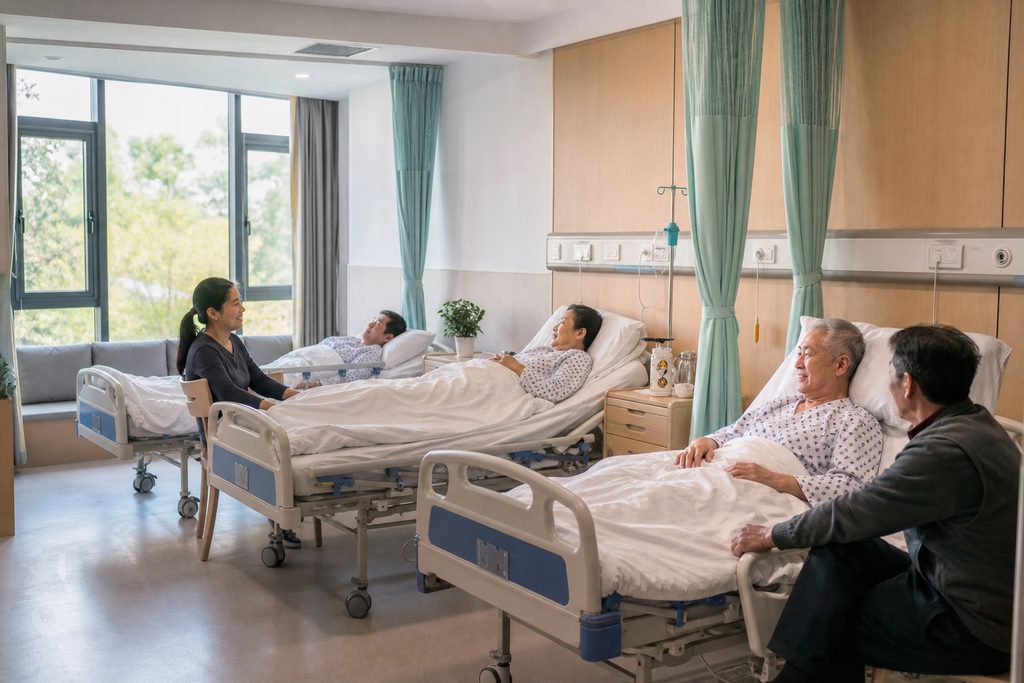
You have probably seen the images. A hospital room with four, six, even eight beds, curtains half-drawn, family members perched on stools, the hum of conversation filling the air. For a Western patient researching medical care abroad, that image can stop you cold. It looks chaotic. It looks like a compromise on dignity and infection control. The reality is more nuanced, and understanding the “why” behind the shared ward is the first step to making an informed choice about your own care in China. The shared hospital room cost China offers is undeniably low, but price is only one piece of a cultural and practical puzzle that shapes the entire inpatient experience.
Key Takeaways
- Multi-bed wards are the historical and economic backbone of Chinese public hospitals, where a shared room can cost as little as $15–40 USD per night.
- Ward culture is not a sign of poor quality; it reflects a community-oriented approach to healing and a practical solution to treating massive patient volumes in top-tier institutions.
- Language barriers and lack of privacy in a shared ward can be profoundly disorienting for international patients without proper preparation or support.
- Private rooms are increasingly available in international departments and VIP wings of public hospitals, offering a familiar standard of care at a fraction of Western private-room costs.
The Problem: When Healthcare Efficiency Clashes With Cultural Expectations
Walk into the inpatient tower of any major Chinese public hospital—say, Peking Union Medical College Hospital in Beijing or Huashan Hospital in Shanghai—and you will encounter a sheer scale that is difficult to overstate. These are not small facilities. A single top-tier hospital might manage over 10,000 outpatient visits and house over 4,000 inpatients on any given day. The demand is staggering, driven by a population of 1.4 billion people, many of whom travel from rural provinces specifically to access the best specialists concentrated in cities like Beijing, Shanghai, and Guangzhou. The structural answer to this volume has, for decades, been the multi-bed ward.
This isn’t a temporary overflow measure. It is the default. A standard room in a public hospital’s general ward typically holds three to six patients. The cost for a bed in this setting is regulated and kept intentionally low, making care accessible to a population with vastly diverse income levels. But for someone accustomed to the privacy-centric model of Western hospitals—where a single room is not just a preference but a clinical standard for dignity and infection control—this environment can trigger immediate anxiety. You are not just sharing a space. You are sharing a recovery journey with strangers, their families, and the constant, purposeful noise of a system operating at full capacity.
Why Chinese Patients Share Rooms: The Logic Behind the Ward System
The multi-bed ward is not a design flaw. It is a deliberate, culturally embedded model that solves several problems simultaneously. To understand it is to strip away the initial shock and see a system with its own internal logic—one that has delivered care to billions. The question “why do patients share rooms in Chinese hospitals” has answers rooted in economics, sociology, and clinical practice.
The Economics of Volume: How a $20 Bed Makes Heart Surgery Possible
The financial structure of a Chinese public hospital is unlike its Western counterparts. Government funding covers only a small fraction—often less than 10%—of a hospital’s operating budget. The rest must be generated through clinical services. To keep life-saving procedures accessible, the system cross-subsidizes. A complex cardiac surgery might be priced at a fraction of the US cost, and the hospital balances its books by maximizing bed occupancy in the general wards. A bed in a three-person room at a top-tier public hospital in Beijing might run between 80 and 200 RMB per night. That is roughly $11 to $28 USD. The shared hospital room cost China presents is a key reason a heart bypass surgery that costs $120,000 in the US can be performed here for $12,000–$20,000. The room charge is a minor line item, not a major revenue center.
Social Support as a Clinical Asset: The Role of the Family Caregiver
In a Chinese ward, the family is not a visitor. They are an essential part of the care team. You will see relatives feeding patients, helping them to the bathroom, monitoring IV drips, and even performing basic physiotherapy exercises. This is not because the nursing staff is negligent. It is because the healthcare system has evolved with this expectation. Nursing ratios in public wards are lower than in the West, and the family fills the gap. This arrangement provides emotional comfort to the patient and allows the hospital to direct professional nursing resources toward complex clinical tasks. For a local patient, having a daughter or spouse by the bedside 24/7 is a source of security. For an international patient without a local family network, this same environment can feel profoundly isolating, highlighting a gap that requires a different kind of support structure.
Clinical Density and Specialist Access
There is a counterintuitive clinical advantage to the ward system. In many top Chinese hospitals, the attending physician leads a team that does a formal ward round every single morning, often with the entire group of residents, fellows, and medical students. In a shared room, this round becomes a highly efficient, almost public consultation. Multiple patients with similar conditions are reviewed in sequence. Junior doctors are quizzed. Treatment plans are debated and adjusted on the spot. A patient in a shared ward at a hospital like Fuwai Hospital, which performs over 14,000 cardiac surgeries annually, is being cared for by a team whose clinical pattern recognition is honed by sheer repetitive volume. The density of the ward mirrors the density of expertise flowing through it.
Is It Safe to Share a Hospital Room in China? Addressing the Core Concern
The most visceral fear is about safety. “Is it safe to share a hospital room in China” is a question rooted in legitimate concerns about infection control, medical privacy, and medication errors. Let’s address the data directly.
Infection control in Chinese public hospitals has been a major national focus for over a decade. The Ministry of Health mandates strict nosocomial infection surveillance systems, particularly in tertiary (3A-grade) hospitals. Rates of surgical site infections and multidrug-resistant organisms are tracked, and while challenges exist—as they do in every healthcare system globally—the idea that a shared room is inherently a vector for unchecked transmission is an oversimplification. The real risk factor is not the number of beds in the room but the hospital’s adherence to hand hygiene protocols, sterilization procedures, and antibiotic stewardship. Top-tier hospitals on the Fudan ranking list, which form the core of our network at China’s top-ranked hospitals, are under intense regulatory and reputational pressure to meet international benchmarks.
Privacy is a different matter. A patient’s diagnosis, treatment plan, and physical condition are often discussed openly during rounds. This is not a violation of local norms; it is the local norm. For a Western patient, this can feel like a fundamental breach of dignity. It is a cultural friction point, not a clinical safety failure. The practical response is not to change the culture but to choose a care environment—such as an international medical center or VIP ward—where private rooms and confidential consultations are the standard. The safety of your clinical outcome depends on the skill of the surgeon and the hospital’s protocols; the safety of your emotional well-being depends on matching the environment to your expectations.
Your Options: From Shared Ward to Private Sanctuary
You are not stuck with the default. The Chinese healthcare market has evolved rapidly to accommodate international patients and domestic patients with higher expectations for comfort. The question of “how to get a private room in Shanghai hospital” or any other major city is really a question of which hospital channel you enter. There are distinct tiers, each with its own cost structure and experience.
The Public Hospital General Ward: The Baseline Experience
This is the multi-bed room described above. The daily bed charge is minimal, often between $15 and $40 USD. The clinical care is excellent if you are in a top-tier hospital, but the environment is entirely Chinese. All communication will be in Mandarin or a local dialect. Food is standard Chinese hospital fare. Your family is expected to assist. For a budget-conscious patient with a high tolerance for cultural immersion and a local friend or relative to act as a full-time interpreter, this is a viable, if intense, path.
The International Medical Center or VIP Wing: The Private Room Standard
Every major public hospital in a city like Beijing or Shanghai now operates a separate wing designed for a higher standard of hospitality. These go by different names—International Medical Center, Special Medical Service, VIP Clinic—but the concept is the same. You get a private room, often comparable to a standard private room in a Western hospital, with an ensuite bathroom, a sofa for a visitor, and sometimes English-speaking nursing staff. The doctors are the same senior specialists who work in the general wards. You are paying for the environment, the language access, and the coordination. The private room upgrade price Beijing hospital international wings charge typically ranges from $150 to $400 USD per night. This is a fraction of the $1,000+ per night a private room commands in a major US hospital, but it represents a significant premium over the local ward. This is the channel where most international patients find the right balance of clinical excellence and personal comfort.
The Private International Hospital: A Western Model in China
Facilities like United Family Healthcare, Jiahui Health, and ParkwayHealth operate entirely on a Western model. Private rooms are the default. English is the working language. Billing is transparent and often directly settled with international insurers. The clinical staff includes both Chinese-trained specialists and physicians from the US, UK, and Europe. The cost is higher, closer to mid-range private hospital pricing in Europe, but still well below US levels. For a patient who wants to book medical tourism package China private room and have a seamless, hotel-like experience with zero cultural friction, this is the answer.
| Room Type | Typical Nightly Cost (USD) | Privacy Level | Language Environment | Best For |
|---|---|---|---|---|
| Public General Ward (3-6 beds) | $15 – $40 | Shared, curtain dividers | Mandarin only | Budget-conscious with local support |
| Public VIP/International Ward | $150 – $400 | Private room, ensuite | English-speaking staff often available | Most international patients seeking top specialists |
| Private International Hospital | $300 – $800+ | Private room, hotel-like amenities | English as primary language | Patients prioritizing comfort, insurance billing, and a Western care model |
How to Secure a Private Room: The Practical Roadmap
Getting a private room in a top Chinese hospital is not as simple as checking a box on an admission form. The VIP and international wards have limited beds, and they are in high demand from both domestic and international patients. You cannot simply email the hospital and book a bed for next month. The system requires a strategic approach.
First, you need a confirmed clinical reason for admission. A senior specialist must review your medical records and agree that you require inpatient treatment or surgery. This typically starts with a remote consultation. We facilitate written second opinions from top specialists, where you send your existing imaging, pathology reports, and medical history for review. The specialist provides a treatment plan and confirms whether they will accept you as a patient. This written opinion costs from $300–$500 USD, but it is the document that unlocks the next steps. If you proceed with treatment in China within 90 days, that fee is credited in full toward your on-the-ground coordination service.
Once the specialist accepts your case, the international ward’s bed availability becomes the critical variable. This is where local coordination matters. A bed might open up with two days’ notice. The hospital will not hold it while you book flights. Your medical records must be translated, your admission deposit must be wired, and your visa must be ready. The S2 visa, which is the appropriate short-stay category for private medical treatment, requires a formal invitation letter from the hospital, a document the international ward will issue once your admission is confirmed. The sequence is: clinical acceptance, then bed booking, then visa finalization. Attempting this in reverse will fail.
Practical Considerations: Navigating the Inpatient Experience
Once you are admitted to a private room in a Chinese hospital’s international wing, the experience will feel familiar. But the hospital is still a Chinese institution, and certain practicalities require forethought.
Your medical records from home need professional translation. A summary in English is not sufficient. The Chinese specialist needs to see your full imaging on a CD or via a secure cloud link, not just the radiology report. Pathology slides may need to be physically sent for a second read. These logistical steps take time—often two to three weeks—and should be started well before you plan to travel.
Insurance and payment operate on a reimbursement model in public hospitals. You pay the hospital directly and then file a claim with your international insurer. Private international hospitals like United Family often offer direct billing, where the hospital settles with the insurer and you only pay your deductible or co-insurance. Verify which model applies to your chosen facility and ensure your policy covers treatment in China. Some policies have geographic exclusions or require pre-authorization.
After discharge, follow-up is a real consideration. Your Chinese surgeon will want to see you for a post-operative check, typically at the two-week and three-month marks. If you cannot stay in China, you need a plan. This might involve a telemedicine follow-up and coordination with your local physician, who must receive a translated discharge summary and operative report. The continuity of care does not end when you board the plane home.
Frequently Asked Questions
You are never forced into a shared ward. When you are admitted through the international medical center or VIP department of a public hospital, a private room is the standard offering. The shared wards are for patients admitted through the general outpatient channel. The key is to enter the system through the right door from the very beginning. A direct admission to the international wing ensures your room assignment matches your expectations.
Not necessarily, but the model differs. A top public hospital like Fuwai or Peking Union has a depth of subspecialist expertise and case volume that a private hospital cannot match. For a highly complex, uncommon procedure, the public hospital’s specialist team is often the strongest choice. Private international hospitals excel at routine to moderately complex surgeries, obstetrics, and comprehensive health screenings, with a level of service and language access that is hard to beat. The right choice depends entirely on the complexity of your medical condition.
This is a legitimate concern that you must discuss with your treating surgeon before the operation. A responsible surgical team will provide a detailed discharge summary and operative note in English, and will typically offer a channel for follow-up questions—often through a coordinator or a secure messaging platform. However, the surgeon’s ability to manage a post-operative complication from across the world is limited. You must have a local physician back home who has agreed to take over your care and who receives your Chinese medical records before you return. This is a non-negotiable part of safe medical travel planning.
Your Next Step
The shared ward is a reality of Chinese healthcare, but it is not your only option. Understanding the system’s logic—its economic pressures, its cultural roots, and its tiered structure—gives you the power to navigate around it. You can access the same world-class surgical expertise that draws 1.4 billion people to these hospitals, while recovering in a private, quiet room that meets your standards for dignity and rest. Our team exists to build that bridge: we translate your records, connect you with the right specialist, secure the private room, and ensure you are not navigating the language and cultural gaps alone. If you are considering treatment in China, start with a conversation. We will help you understand the realistic options for your specific case, with no pressure and complete honesty about what to expect.
For more medical information and treatment options in China, visit chinamedservices.com (China Medical Services).
