Diet After Gastrointestinal Surgery China: Your Home Recovery Guide
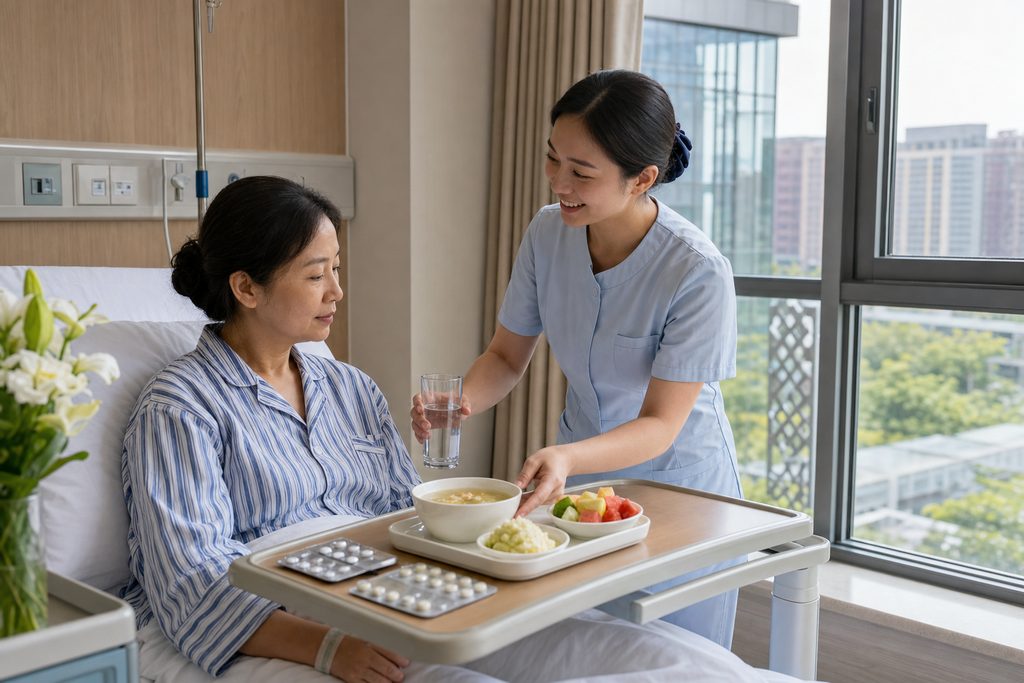
Have you ever stared into a refrigerator three days after major abdominal surgery, genuinely terrified to eat anything? That moment of hesitation—wondering if a single wrong bite will undo weeks of surgical precision—is something our team hears about constantly from patients recovering far from home. The anxiety is real. The confusion is worse. You received a discharge summary in a language you do not read, a list of foods you have never seen, and a follow-up appointment weeks away. Now you are alone in a serviced apartment, hungry and unsure.
Getting nutrition right after gastrointestinal surgery is not trivial. A 2019 study in the journal *Nutrients* found that up to 54% of patients undergoing major abdominal surgery experience significant unintended weight loss in the first three months post-discharge. Malnutrition in this window doubles the risk of readmission. The stakes are high. But the path forward is clearer than it feels at 3 AM when your stomach makes an unfamiliar noise.
Our team has coordinated recovery logistics for international patients across China’s top-tier hospitals. We do not prescribe diets. We do, however, understand what the country’s leading gastrointestinal surgeons actually recommend, where to source the right foods, and how to build a safe, practical home management plan that respects both the medical protocol and the reality that you are in a foreign country.
Key Takeaways
- China’s top GI surgery centers discharge patients with structured, phased dietary protocols—adherence directly correlates with a 30-40% reduction in readmission rates according to enhanced recovery after surgery (ERAS) data.
- Sourcing medically appropriate, soft-textured nutrition in Chinese cities requires knowing specific product names and vendors—generic supermarket trips often fail.
- The biggest post-discharge risk is not surgical complication but dehydration and malnutrition, which can silently escalate in the first week at home.
- You do not need to speak Chinese to eat safely, but you do need a translated dietary card and a clear understanding of the three-phase progression timeline.
The Problem: Why Post-Surgical Nutrition Fails Abroad
The discharge conversation in a Shanghai or Beijing hospital ward is often brief. A nurse hands over a single printed sheet. It lists categories: “liquid diet,” “semi-liquid,” “soft foods.” There are Chinese characters for congee, for steamed egg, for fish soup. No Western equivalents. No brand names. No guidance on where to buy any of it.
This is not negligence. Chinese post-operative dietary protocols are deeply embedded in a cultural food system where family members typically cook fresh meals at home. The assumption is that someone will shop at a wet market, prepare bone broth from scratch, and serve it throughout the day. For an international patient recovering alone or with a partner who also does not read Chinese, that assumption collapses immediately.
The result? Patients default to what is easy. White bread. Plain crackers. Takeout rice. Within days, protein intake plummets. Wound healing slows. Energy evaporates. A 2020 ERAS Society audit across multiple centers showed that patients who deviated from prescribed post-GI-surgery nutrition plans in the first two weeks had a readmission rate nearly double that of compliant patients. The problem is rarely the surgery. It is the gap between discharge instructions and what actually ends up on the plate.
Why China’s Approach to Post-GI Surgery Recovery Delivers Results
China’s top gastrointestinal surgery departments—at hospitals like Zhongshan Hospital Fudan University, Peking Union Medical College Hospital, and West China Hospital—perform volumes that reshape clinical intuition. A surgeon here may oversee 300 gastric resections annually. That repetition breeds refined protocols. The dietary progression is not theoretical. It has been pressure-tested on tens of thousands of patients with widely varying baseline nutrition.
Clinical Volume Creates Protocol Precision
Western enhanced recovery protocols often recommend a generic “advance diet as tolerated.” China’s leading centers tend to be more specific. A typical discharge plan for a patient after distal gastrectomy at a Fudan-ranked hospital might specify: days 1-3 post-discharge, rice water and clear broth only, sipped every 90 minutes. Days 4-7, congee with puréed protein added. Days 8-14, soft steamed items introduced one at a time. Each phase has a target daily protein intake—often 60-80 grams by the end of week two.
This granularity exists because the surgical teams have seen what happens without it. They know that gastric emptying changes after surgery. They know that dumping syndrome—where food moves too quickly from the stomach to the small intestine—affects approximately 25-50% of post-gastrectomy patients, per a 2018 review in the *World Journal of Gastroenterology*. The dietary phasing is designed to minimize exactly that.
Traditional Food Knowledge Meets Clinical Nutrition
There is a structural advantage embedded in the Chinese food system that benefits recovery. Congee—rice porridge cooked until the grains disintegrate—is a near-perfect early post-op food: easily digestible, hydrating, and culturally ubiquitous. Steamed egg custard provides high-biological-value protein in a texture that requires zero mechanical digestion. Bone broths, simmered for hours, deliver electrolytes and trace minerals when solid food is impossible.
These are not alternative remedies. They are functional foods that happen to align with post-surgical physiology. The challenge for international patients is accessing them without a Chinese grandmother in the kitchen. That is solvable. We will get to the specifics.
What to Eat After Gastrointestinal Surgery in China: The Three-Phase Framework
Most major Chinese GI centers follow a phased approach aligned with ERAS Society guidelines but adapted to local food availability. Understanding this framework matters because skipping a phase—or jumping too aggressively into solid foods—is the most common cause of post-discharge vomiting, pain, and emergency calls.
Phase 1: Clear Liquid (Typically Days 1-3 Post-Discharge). The goal here is hydration and gut rest. Acceptable items include rice water (the thin, starchy liquid skimmed from the top of cooking congee), clear bone broth with all fat strained off, diluted apple juice (1:1 with water), and electrolyte solutions. No dairy. No fiber. No temperature extremes. Sip 50-100 ml every hour while awake. Total daily fluid target: 1.5-2 liters.
Phase 2: Full Liquid to Semi-Liquid (Days 4-10). Protein introduction begins. Congee is the foundation—plain white rice porridge with a consistency thin enough to pour. Steamed egg custard (Chinese: 蒸水蛋, essentially eggs whisked with water and steamed until silken) enters here. Puréed fish or chicken can be stirred into the congee. Commercial oral nutrition supplements become valuable at this stage—products like Ensure or Fresubin, available at most hospital-adjacent pharmacies in China, provide 300-400 calories and 12-15 grams of protein per bottle.
Phase 3: Soft Solid (Days 10-21+). Textures remain tender. Steamed fish, soft tofu, well-cooked pumpkin, mashed potato without butter. New foods are introduced one at a time, with a four-hour observation window for tolerance. Portions are small—roughly half a cup per sitting, eaten slowly over 20 minutes. Chewing to liquid consistency is non-negotiable.
Buy Post-Surgery Meal Plan China: Practical Sourcing Without a Kitchen
If you are staying in a hotel or serviced apartment with limited cooking facilities, the phased framework above can feel theoretical. You need actual product names, actual vendors, and a way to get food into your room without walking through a supermarket for an hour when you can barely stand upright.
Here is what works on the ground in major Chinese cities.
Congee delivery. Ele.me (饿了么) and Meituan (美团) are the dominant food delivery platforms. Both have English interfaces in their international versions. Search for “congee” or “粥” and you will find hundreds of options. The key specification: order “plain white congee” (白粥) and request no added salt, oil, or toppings. Most shops will comply if you add a note. A single order costs roughly ¥15-25 (USD $2-4) and typically arrives within 30 minutes.
Steamed egg custard. This is trickier. Few restaurants list it. The workaround: order from a Cantonese dim sum restaurant, where “steamed egg” is a standard item. Alternatively, it can be made in a hotel room with a small electric steamer (available on JD.com for under ¥100 / USD $14, with same-day delivery in most cities) and two eggs. Crack two eggs, whisk with an equal volume of warm water, strain through a fine sieve, steam for 10 minutes. No skill required.
Oral nutrition supplements. In China, Ensure (安素) and Fresubin (瑞能) are sold at hospital pharmacies, large chain pharmacies like LBX (老百姓大药房), and on Tmall. A six-pack of Ensure costs approximately ¥120-180 (USD $17-26). These are shelf-stable and require no preparation. For Phase 2, they are often the single most practical protein source for a patient without a kitchen.
Bone broth. Pre-packaged bone broths are increasingly available at high-end supermarkets like Ole’ and City’Super, found in most Tier 1 cities. Brands like “Soup Kitchen” or local equivalents sell frozen broths that can be microwaved. Expect to pay ¥30-50 (USD $4-7) per serving. Alternatively, many congee shops will sell plain pork bone broth (骨头汤) by the container if asked.
| Item | Phase | Where to Source | Approximate Cost (USD) |
|---|---|---|---|
| Plain white congee | Phase 2+ | Ele.me / Meituan | $2-4 per order |
| Steamed egg custard | Phase 2 | Cantonese restaurants, or self-steam | $1-3 |
| Ensure / Fresubin (6-pack) | Phase 2-3 | Hospital pharmacy, Tmall | $17-26 |
| Bone broth (500ml) | Phase 1-2 | Ole’ / City’Super / congee shops | $4-7 |
| Soft tofu (fresh) | Phase 3 | Any wet market or supermarket | $0.50-1 |
| Electric mini steamer | All phases | JD.com, same-day delivery | $14-20 |
Is Chinese Hospital Food Safe After Bowel Surgery? The Question Nobody Asks Out Loud
Western patients often arrive with a quiet, persistent worry about food safety. It is rarely voiced in the consultation room. But it shapes every meal decision. The concern is legitimate—post-surgical guts are vulnerable. A bout of foodborne illness that would be unpleasant for a healthy person can become dangerous when the intestinal barrier is compromised and hydration status is already fragile.
Here is the reality. China’s top-tier hospitals—the 340+ institutions in our database ranked by Fudan University or holding JCI accreditation—operate inpatient kitchens subject to hygiene protocols comparable to Western hospital standards. The food served on the ward is safe. The risk points are outside the hospital: street food, unwashed produce, tap water, and cross-contamination in shared kitchen facilities.
Specific, actionable rules for the post-surgical recovery period:
- Water. Drink only bottled or boiled water. This is standard advice for all foreigners in China and becomes medically critical after GI surgery. Boil tap water for a full three minutes if bottled is unavailable.
- Produce. Any fruit or vegetable eaten raw must be peeled personally. Apples, bananas, oranges—peel them yourself. Berries and leafy greens that cannot be peeled should be cooked. No exceptions in the first month post-surgery.
- Delivery food. Stick to high-temperature items—congee, soups, steamed dishes—that are delivered hot. Avoid cold dishes, salads, and any item that has sat at room temperature. Reheat delivery food to steaming before eating if it arrives lukewarm.
- Storage. Refrigerate leftovers within two hours. In China’s summer heat (regularly above 35°C / 95°F in many cities), that window shrinks to one hour.
These are not extreme precautions. They are the same guidelines that Chinese surgical nurses give to local patients. The difference is that local patients hear them in their native language and often have family enforcing them. You need to enforce them yourself.
Gastric Surgery Recovery Diet Abroad: Managing the Hardest Week Alone
The first seven days after hospital discharge are the highest-risk window. You are mobile enough to be discharged but not strong enough to handle a setback. Appetite is erratic. Energy is low. The surgical team feels far away.
A practical day-by-day survival framework for that first week:
Day 1-2. Your only job is hydration. Keep a 500ml bottle of electrolyte solution at your bedside. Sip every 15 minutes while awake. If you can tolerate clear broth, add one cup in the afternoon. Do not worry about calories yet. Dehydration is the enemy that sends post-op patients back to the emergency department. Urine color is your monitor—pale yellow means you are winning.
Day 3-4. Introduce one oral nutrition supplement, split over two sittings. Half a bottle of Ensure in the morning, half in the afternoon. Continue clear liquids. If the supplement stays down without bloating or diarrhea, you have cleared a major hurdle.
Day 5-7. Add congee with a puréed protein—fish or egg. Two small bowls per day, eaten slowly. Continue supplements. By day 7, you should be approaching 800-1000 calories and 40-50 grams of protein. That is still below maintenance for most adults, but it is enough to halt catabolism and support wound healing.
What if something goes wrong? Uncontrolled vomiting, inability to keep fluids down for 12 hours, fever above 38°C, or sudden abdominal distension with pain—these are reasons to contact your surgical team immediately, not to wait and see. Have the hospital’s international department phone number saved in your phone before discharge. If you do not speak Chinese, have a translated emergency phrase card ready. Our team provides these as part of discharge coordination, but you can also prepare one: “I had GI surgery on [date]. I am experiencing [symptom]. Please contact my surgeon at [number].”
Medical Tourism China Nutrition Package Post-Op: What Coordination Services Actually Provide
There is a growing ecosystem of services designed to bridge the gap between hospital discharge and independent recovery. These are not medical treatments. They are logistics and support layers. Understanding what exists helps you decide what, if anything, you need.
Some international patient centers at major hospitals—particularly in Shanghai and Beijing—offer discharge nutrition packages. These typically include a two-week supply of oral nutrition supplements, a translated dietary progression chart, and one follow-up call with a dietitian. The cost ranges from approximately $200-400, often bundled into the overall international department service fee.
Third-party coordination services (our organization included) can arrange more tailored support: sourcing specific foods, coordinating daily congee delivery, providing a bilingual companion to accompany the first post-discharge grocery trip, or arranging a video consultation with a clinical dietitian who speaks English. A video consultation with a qualified dietitian familiar with post-GI-surgery protocols typically costs $100-300 through hospital international departments.
What none of these services can do is guarantee a specific recovery trajectory. Healing is biological, not transactional. The value of coordination is in removing obstacles—so that your energy goes toward recovery rather than toward figuring out how to order dinner in a language you do not speak.
Practical Considerations: Documentation, Payment, and Follow-Up
Before you leave the hospital, secure three documents. A translated discharge summary that includes your exact surgical procedure, any complications, and the surgeon’s name. A dietary instruction sheet in English—do not accept a verbal summary; ask the international department to provide a written version. And a medication list with generic drug names (not just Chinese brand names), dosages, and timing.
Payment for nutrition supplies and follow-up consultations is straightforward. Hospital pharmacies and international departments accept international credit cards. Delivery platforms like Meituan accept foreign cards linked to Alipay or WeChat Pay. For patients from regions where these payment systems are unfamiliar, our team typically assists with setup during the hospital stay—it takes about 15 minutes and eliminates a major daily friction point.
Insurance reimbursement for post-discharge nutrition support varies. Most international health insurance plans do not cover nutritional supplements or dietary coordination as standalone items.
Frequently Asked Questions
Yes. The hospitals used for international patients are JCI-accredited and follow the same international safety standards as top hospitals in the US and Europe. Surgical teams perform high volumes of procedures — often more than their Western counterparts — which studies show leads to better outcomes.
Costs vary by procedure and hospital, but international patients typically save 40-80% compared to US prices — even when factoring in travel and accommodation. A consultation with our team will give you an exact, all-inclusive quote with no hidden fees.
Send us your existing medical reports to get started. We handle everything from hospital selection and appointment scheduling to visa assistance and post-operative recovery planning. Your medical records are reviewed by the specialist before you even book a flight.
For more medical information and treatment options in China, visit chinamedservices.com (China Medical Services).
