In-Room Nursing China: Extra Support for Elderly Patients Explained
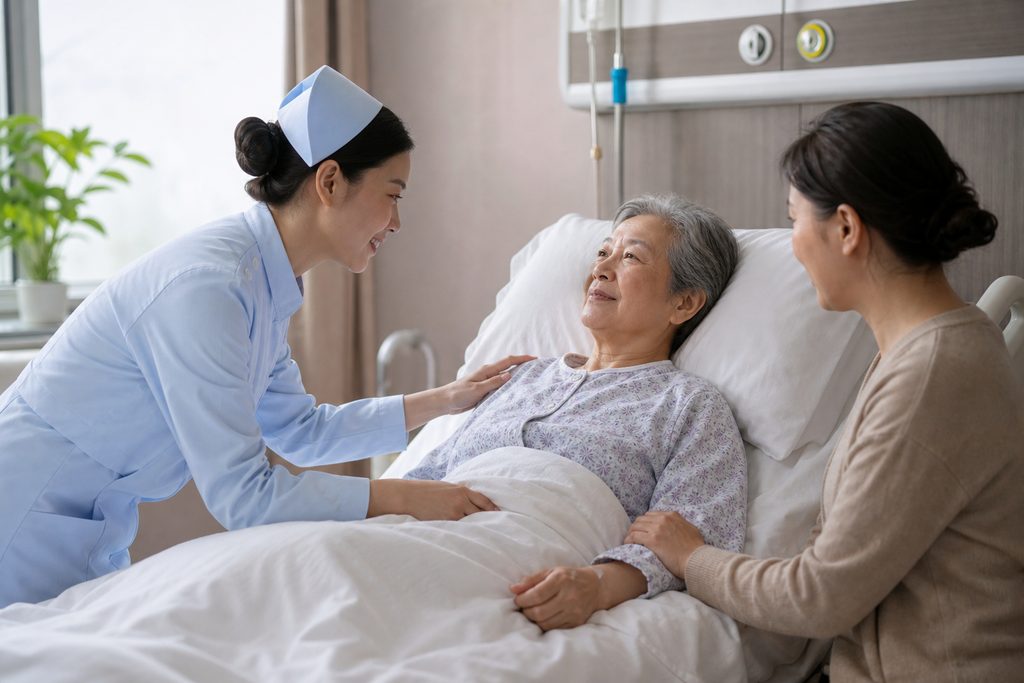
When a family member is hospitalized abroad, the standard ward routine can feel jarring. You picture attentive, round-the-clock care. Instead, you find nurses managing 15 to 20 patients at once. That’s where private nursing care for elderly in China hospital settings comes in. It is not a luxury add-on. It is a practical, paid layer of bedside support that handles feeding, hygiene, mobility, and translation when ward staff cannot. This article explains exactly what that support looks like, what it costs, and how families arrange it before their loved one ever boards a plane.
What In-Room Nursing Actually Means in a Chinese Hospital
A nurse on a public ward in a top-tier Chinese hospital might oversee a dozen or more patients during a shift. Their focus is clinical: medications, IVs, wound checks, vital signs. The moments that terrify an elderly patient alone in a foreign country — getting to the bathroom at 2 a.m., understanding what the doctor just said in rapid Mandarin, knowing whether the meal tray is safe for their dietary restriction — those moments fall through the cracks.
That gap is filled by a hired bedside attendant. In Chinese, the role is often called a *hugong* (护工). We describe it to our international families as a private bedside nursing aide. This person stays in the room. They do not administer medications or make clinical decisions. They handle personal care, repositioning, feeding, communication assistance, and they alert the duty nurse when something changes.
For a family that cannot be at the bedside 24/7 — and for most international families, that is the reality — this person becomes the eyes, ears, and hands you cannot be.
Who This Is Right For — and Who It Isn’t
This type of support is not for every patient. We are direct with families about when it makes sense and when it does not.
A dedicated bedside aide is typically the right choice when:
- The patient is over 70 and has limited mobility, even if cognitively sharp.
- There is a language barrier that causes anxiety or genuine risk (misunderstanding discharge instructions, for example).
- The procedure involves a multi-day ICU step-down where the patient is conscious but very weak.
- The accompanying family member cannot stay overnight due to hospital rules or their own health limits.
It is often unnecessary when:
- The patient is admitted to a private international hospital ward with a mandated low patient-to-nurse ratio. Some JCI-accredited facilities already provide near one-on-one attention as part of the room rate.
- The patient is fully independent, speaks fluent Mandarin, and is admitted for a short, low-acuity stay like a 24-hour observation.
- A family member is physically present and capable of providing all personal care. In that case, you are paying for a sitter, not a necessity.
Being clear about who should skip this service builds trust. We would rather a family save the money than feel pushed into something they do not need.
The Options, Compared
Not all bedside support looks the same. The table below lays out the real choices facing an international family. Prices are in USD and reflect the typical range we see when coordinating care through hospital international departments or trusted third-party agencies.
| Option | Who Provides It | Typical Cost (Per 24 Hours) | English Ability | Best For |
|---|---|---|---|---|
| Hospital-Arranged Aide | Ward-contracted *hugong* pool | $40 – $80 | Rarely any | Physical care only; family handles all communication |
| Agency Private Nurse | Third-party nursing agency, vetted by our team | $100 – $180 | Basic to moderate | Bridging the language gap; companion-level English |
| Bilingual Medical Companion | Our coordination service | $200 – $300 | Fluent medical English | Full interpretation, doctor rounds, family updates, care coordination |
| International Hospital Inclusive | In-house nursing staff | Built into room rate ($500 – $1,500/night) | Fluent | All-in-one; no separate hire needed |
The hospital-arranged aide is the most affordable path but leaves a communication void. The bilingual companion is the premium option that families choose when they cannot be at the bedside and need daily, detailed updates in English. Most of our families land somewhere in the middle: an agency private nurse with enough English to handle basic needs and summon help.
How Does In-Room Nursing Work for Seniors in China? A Day in the Life
A question we hear constantly: “What does this person actually do all day?” The answer matters because it determines whether you are buying peace of mind or just a warm body in a chair.
A typical 24-hour shift for an elderly patient recovering from, say, a knee replacement at a Shanghai orthopedic hospital might look like this:
6:30 a.m. — Help the patient sit up, assist with morning hygiene, change the gown if needed. The ward nurse handles the surgical dressing; the aide steadies the patient during the process.
8:00 a.m. — Doctor rounds. This is where a bilingual companion proves their worth. They record the doctor’s assessment, translate questions, and send a voice-note summary to the family abroad via WhatsApp before the family wakes up in their time zone.
10:00 a.m. — Physiotherapy. The aide walks with the patient to the rehab room and stays through the session, helping the therapist communicate movements.
12:30 p.m. — Lunch. The aide fetches the tray, checks it against dietary notes, and helps the patient eat if hand tremors or weakness make it difficult.
3:00 p.m. — Bathroom assistance, repositioning to prevent bedsores, a short walk in the corridor if cleared.
9:00 p.m. — Settle the patient for the night. The aide sleeps on a fold-out cot in the room, waking every few hours to help with bathroom trips or pain management requests.
The clinical nursing — medications, IV adjustments, wound care — remains with the hospital staff. The aide never crosses that line. But for an elderly patient, the clinical tasks are only 20% of the experience. The other 80% is everything the aide handles.
Extra Bedside Nursing Support Cost China: What You Actually Pay
Let’s get specific. The extra bedside nursing support cost China families encounter breaks into three buckets: the aide’s daily rate, an agency coordination fee, and incidental costs.
The daily rate for a private aide runs from $40 for a hospital-pool worker with no English to $300 for a bilingual companion with medical vocabulary. Most families budget $120 to $180 per day for a competent agency nurse with basic English. That is roughly $840 to $1,260 for a one-week stay.
Agency coordination fees vary. Some agencies charge a flat placement fee of $100 to $200. Others build it into the daily rate. We always clarify this upfront because a low daily rate with a hidden $300 “mobilization fee” is not a deal.
Incidental costs include the aide’s meals. Hospital cafeterias are cheap — budget $10 to $15 per day. If the hospital requires the aide to pay for their own COVID or health screening before entering the ward, that is another $20 to $50.
What is not included: the hospital room charge, any clinical nursing fee, medications, or procedure costs. The aide’s pay covers their labor only.
Payment is almost always cash or WeChat/Alipay. International credit cards are rarely accepted for this type of service. We help families set up the right payment method before arrival so there is no scramble at the hospital entrance.
How to Book a Private Nurse for an Elderly Parent in a Shanghai Hospital
Shanghai has the highest concentration of international patients in mainland China. The process of arranging bedside support there is well-established, but it still requires lead time.
Here is the sequence that works:
First, confirm the admitting hospital and department. The hospital’s international medical center — if it has one — is your first call. Some can arrange an in-house aide. More often, they provide a list of approved third-party agencies. You want someone from that approved list, because the hospital will issue the aide a facility access card and they already know the ward layout and protocols.
Second, specify the exact needs. Do not just say “a nurse.” Say: “My mother is 78, post-hip replacement, speaks only English and basic French. She needs help with toileting, meal assistance, and we need a daily English update by 8 a.m. Eastern Time.” The more precise you are, the better the match.
Third, arrange a video call before the admission date. A 15-minute call between the aide, the patient, and the family confirms English level and personal rapport. If the aide cannot hold a basic conversation about pain levels and bathroom needs, you keep looking.
Fourth, confirm payment terms in writing. Who pays the aide directly? What is the cancellation policy if the patient is discharged early? We handle this negotiation for our families, but if you are doing it yourself, get everything in a simple WeChat message or email.
Book a private nurse for elderly parent in Shanghai hospital situations typically require five to seven days of lead time. Last-minute requests on the day of admission can work, but the quality of the match drops sharply. Plan ahead.
Practical Considerations: Documentation, Visas, and Follow-Up
The aide is one piece of a larger puzzle. A few logistics that trip up families:
Visa category matters. The patient travels on an S2 visa for medical treatment. The accompanying family member also needs an S2. We have seen families mistakenly apply for an M visa, which is for commercial trade and will not be accepted for medical purposes. The hospital’s invitation letter must state the need for a family escort if one is coming.
Medical records should be translated before arrival. The aide can interpret conversations, but they should not be translating a 40-page medical history on the fly. A professional written translation of the patient’s key records — diagnoses, current medications, allergies, surgical history — ensures the Chinese medical team has accurate baseline data. Our written second opinion service includes this translation step, and many families use it to bridge the information gap before travel.
Insurance and payment. Chinese public hospitals require a deposit upfront, typically calculated based on the estimated procedure cost. International insurance may reimburse later, but the hospital expects payment first. The aide does not handle this. The family or our coordination team manages the financial side separately.
Post-discharge follow-up. When the patient returns home, the Chinese surgeon often wants follow-up imaging or lab work at specific intervals. We help families set up a remote follow-up channel so the aide’s work does not end with a cliffhanger. The patient’s local doctor receives translated discharge instructions and a timeline for what comes next.
Frequently Asked Questions
Is one-on-one nursing available for seniors in Chinese hospitals, or is it only group ward care?
One-on-one bedside support is available in virtually every major Chinese hospital, but it is almost never provided by the hospital’s own nursing staff as part of the room rate. It is a separate, privately paid arrangement. In public hospitals, the ward nurses handle clinical duties for many patients. The one-on-one role is filled by a hired aide — either through the hospital’s own *hugong* department or an external agency. In private international hospitals, higher nurse-to-patient ratios are standard, but even there, a dedicated private companion can be added if the family wants constant presence and language support.
What happens if the private aide does not show up or is a bad fit?
This happens. An aide gets sick, or their English turns out to be much weaker than described. If you booked through an agency, a replacement should arrive within hours — we push for a four-hour replacement window in Shanghai and Beijing. If you booked directly with a hospital-pool worker, replacement is less certain and may depend on who is available that shift. Always have a backup contact. Our team maintains a shortlist of vetted aides in every major medical city for exactly this reason. A bad fit mid-stay is stressful, but it is solvable if you have an agency or coordinator who can advocate for you in Chinese at 10 p.m.
Do international patient elder care nursing packages China hospitals offer include post-surgical rehabilitation?
Some do, but most do not — at least not in the way Western families expect. A private aide provides basic mobility assistance: walking the patient to the bathroom, helping them sit up, encouraging light corridor walks. Actual physical therapy and occupational therapy are delivered by the hospital’s rehab department, billed separately. A few high-end international hospitals in Shanghai and Beijing offer bundled “elder care recovery packages” that combine a private room, daily physio sessions, and a dedicated nursing aide. These packages start around $800 per day and can run significantly higher. They are convenient but expensive. We help families compare the bundled option against paying à la carte, because sometimes the bundle includes services the patient does not need.
Can the private aide administer medication or make medical decisions?
No. This is a hard line. In China, only licensed nurses and doctors can administer medications, adjust IVs, or make clinical judgments. A private bedside aide who crosses this line is practicing without a license and putting the patient at risk. The aide’s role is to observe, assist with personal care, and alert the clinical staff. If your parent needs a clinical intervention, the aide’s job is to walk to the nurse station and bring the duty nurse to the room. They do not touch the IV pump. They do not decide whether a pain level warrants medication. They report and facilitate. Families sometimes push for the aide to “just handle it,” but that expectation is dangerous and we correct it immediately.
Your Next Step
Arranging bedside support for an elderly parent in a foreign hospital is not a luxury — it is often the single factor that makes the whole trip feasible. Without it, a family member must be at the bedside around the clock, and that is not possible for everyone.
Our team at China Medical Services is not a hospital and we do not provide medical advice or diagnoses. What we do is handle the logistics that overwhelm international families: matching you with a vetted, English-capable bedside aide, coordinating with the hospital’s international department, and making sure someone competent is in that room before your loved one arrives. If you are considering treatment in China for an elderly family member and the bedside care question is keeping you up at night, reach out. We will walk through the options, the real costs, and a timeline that fits the procedure. No pressure. Just the practical help you need to make a clear decision. Visit our patient support page to start a conversation.
For more medical information and treatment options in China, visit chinamedservices.com (China Medical Services).
