Teaching vs Private Hospitals in China: Why Costs, Quality, and Access Differ So Much
Key Takeaways
- China’s top teaching hospitals handle surgical volumes that dwarf Western centers—Fuwai Hospital alone performs over 14,000 cardiac surgeries annually, driving expertise that is hard to match.
- The cost difference between a public teaching hospital and a private international clinic can reach 70-90% for major procedures, but the patient experience is radically different.
- A teaching hospital delivers world-class clinical outcomes but with chaotic crowds and minimal English support; a private hospital offers hotel-like comfort and direct insurance billing at a premium.
- For complex surgery, the surgeon’s annual case volume matters more than the lobby’s marble floors; for diagnostics or chronic management, the private sector’s speed and language support often justify the price.
The Problem: You Are Comparing Two Completely Different Worlds
A patient from London or Los Angeles searching for “teaching hospital vs private hospital cost China” usually pictures a simple comparison: two buildings, two price tags, same service. That assumption breaks down the moment you walk through the door. China’s public teaching hospitals—the ones that top the Fudan rankings and publish in The Lancet—are not just cheaper versions of a private clinic. They are high-volume, high-acuity machines that process 10,000 outpatient visits a day. The private international wings are designed to feel like a Western hospital, with English-speaking staff, appointment-based scheduling, and direct billing to insurers like Cigna or Bupa. The gap is not just about money. It is about language, logistics, and what you are willing to trade off.
A coronary artery bypass graft at a top-tier Chinese teaching hospital runs from $12,000 to $20,000. The same procedure at a JCI-accredited private international hospital in Shanghai can exceed $50,000. In the United States, the average is north of $120,000. The numbers are real. But so is the chaos of a public hospital registration hall at 7 a.m. Understanding why that price gap exists—and what it buys you—is the difference between a successful medical journey and a costly misunderstanding.
Why the Teaching Hospital vs Private Hospital Cost China Gap Is So Extreme
The structural reasons behind this price gap are not mysterious. They are built into how each system is funded, staffed, and operated. A public teaching hospital affiliated with a major university—think Peking Union Medical College Hospital or West China Hospital—is a state-owned, nonprofit institution. Its mission is clinical service, medical education, and research. It receives government subsidies, owns its land, and pays its senior physicians fixed academic salaries that bear no resemblance to US physician compensation. A private international hospital is a for-profit or break-even business. It must recover its real estate, imported equipment, and bilingual staff costs entirely through patient fees.
Volume Creates a Different Economic Model
A top Chinese orthopedic surgeon in a teaching hospital may perform 300 to 500 joint replacements per year. The average US surgeon does roughly 65. That volume is not just a bragging right. It means the hospital’s fixed costs—the da Vinci surgical robot, the laminar flow operating theater, the sterilization infrastructure—are spread across vastly more cases. The per-case cost of the robot drops to a fraction of what a private hospital with lower volume must charge.
Teaching hospitals also benefit from a tiered staffing model. Attending physicians oversee teams of residents, fellows, and junior doctors. This pyramid structure allows the hospital to manage high patient loads while the most experienced hands focus on the critical steps of a procedure. Private hospitals, by contrast, run leaner teams of senior doctors and must price accordingly.
The Hidden Cost of Language and Infrastructure
Walk into the international wing of Shanghai’s Huashan Hospital or the United Family Healthcare network, and you will find English-speaking receptionists, bilingual medical records, and appointment systems that do not require a 5 a.m. queue. That infrastructure is expensive to build and maintain. It is also absent from the standard public teaching hospital pathway. The standard public ward operates in Mandarin. Registration slips, consent forms, and discharge summaries are in Chinese. If you arrive without a bilingual companion, you are functionally illiterate inside the system. That is not a criticism. It is a fact of how China’s public hospitals serve a domestic population of 1.4 billion people.
This explains a large slice of the teaching hospital vs private hospital cost China differential. You are not paying for better surgical hands in the private sector. You are paying for the environment around the surgery—the communication, the privacy, the scheduling certainty, and the insurance paperwork.
Is It Safe to Have Surgery in a Chinese Teaching Hospital?
This question surfaces in nearly every consultation our team handles. A Western patient reads about crowded corridors, hears stories of patients sleeping on hallway trolleys, and wonders whether the clinical care itself is compromised. The data says otherwise.
China’s top 100 hospitals, as ranked by the Fudan University Hospital Ranking, sit within the top 5% of the country’s 35,000+ hospitals. Many hold JCI accreditation. Their departments publish in peer-reviewed international journals. Fuwai Hospital’s cardiac surgery unit reports a 30-day post-operative mortality rate for isolated coronary bypass grafting consistently below 1%, a figure competitive with the best centers in the world. The hospital performs over 14,000 cardiac surgeries annually—more than any other center globally. Surgeons who do the same complex procedure several times a week, week after week, develop a procedural fluency that is difficult to replicate in lower-volume settings.
Safety, in this context, is not about the lobby. It is about the surgeon’s hands, the anesthesiology team’s experience with that specific patient profile, and the ICU’s nurse-to-patient ratio in the first 24 hours post-op. Teaching hospitals excel on all three measures for high-acuity surgery. Where they fall short is in the soft tissue of care: communication, privacy, and the non-clinical patient experience.
Best Teaching Hospital for Surgery in Shanghai: A Real-World Look
When a patient asks for the best teaching hospital for surgery in Shanghai, the answer depends on the specialty. Shanghai is home to 18 of the Fudan Top 100 hospitals, more than any city except Beijing. For cardiac surgery, Zhongshan Hospital Fudan University is the reference point. For oncology, Fudan University Shanghai Cancer Center ranks among China’s top 10 for the specialty. For orthopedics, Shanghai Sixth People’s Hospital is known internationally for microsurgery and limb replantation. Huashan Hospital Fudan University dominates in neurosurgery and dermatology.
These are not secret institutions. They are massive, publicly funded centers with international departments designed specifically for foreign patients. The international wing of Zhongshan Hospital, for example, offers senior attending physicians, English-capable coordination staff, and a separate billing counter. The cost runs roughly 1.5 to 2 times the standard public pathway rate—still a fraction of what a private international hospital charges.
A patient seeking the best teaching hospital for surgery in Shanghai should start with the specialty, not the brand. A hospital ranked first in cardiac surgery may not be the right choice for a spinal fusion. The Fudan specialty reputation rankings, updated annually across 45 specialties, provide a transparent, publicly available benchmark. Our specialty-specific hospital directory maps these rankings for international patients.
Cost Difference Between Public and Private Hospitals in China: A Procedure-Level Breakdown
Numbers make the abstract concrete. The table below compares estimated all-in costs for common procedures across three settings: a top-tier public teaching hospital standard pathway, the same hospital’s international VIP wing, and a JCI-accredited private international hospital. All figures are in USD and represent a range that varies by hospital, case complexity, and length of stay. These are not quotes. They are benchmarks drawn from publicly available hospital pricing schedules and patient-reported data.
| Procedure | Public Teaching Hospital (Standard) | Teaching Hospital International Wing | Private International Hospital |
|---|---|---|---|
| Coronary Artery Bypass Graft | $12,000 – $20,000 | $22,000 – $35,000 | $45,000 – $65,000 |
| Total Hip Replacement | $8,000 – $15,000 | $15,000 – $25,000 | $30,000 – $45,000 |
| Laparoscopic Cholecystectomy | $1,500 – $3,000 | $3,000 – $5,500 | $6,000 – $10,000 |
| MRI (Single Region, No Contrast) | $80 – $150 | $150 – $300 | $400 – $800 |
| Specialist Outpatient Consultation | $8 – $30 | $80 – $200 | $150 – $350 |
The pattern is unmistakable. The cost difference between public and private hospitals in China is not linear. It is a step function. The jump from the standard public pathway to the international wing of the same hospital roughly doubles the price. The jump from that international wing to a fully private international hospital doubles it again. What changes between these tiers is not primarily the surgeon’s skill. It is the scheduling flexibility, the language environment, the privacy of the recovery room, and whether your insurer pays the hospital directly or you pay upfront and seek reimbursement later.
Why Are Chinese Teaching Hospitals Cheaper? The Structural Answer
Searching for “why are Chinese teaching hospitals cheaper” leads most patients to a surface-level answer about lower labor costs. That is part of it. But it misses the bigger picture. Physician compensation in China’s public system is a fraction of US levels—a senior professor at a top teaching hospital might earn $50,000 to $80,000 annually, compared to $400,000+ for a US cardiac surgeon. Hospital land is state-allocated. Medical device pricing, while rising, remains below Western levels due to domestic manufacturing scale and different regulatory cost structures.
There is something else at work. Chinese teaching hospitals operate on a razor-thin margin model. They are not designed to generate profit. They are designed to process volume. A hospital that sees 10,000 outpatient visits daily can charge $15 for a specialist consultation and still cover its costs because the sheer throughput dilutes fixed overhead. A private hospital seeing 200 patients a day cannot do that. Its price per consultation must carry the full weight of its infrastructure.
Medical treatment in China teaching hospital vs private clinic settings also differs in how care is delivered. In a teaching hospital, you may see a junior doctor for the initial consult, with the senior attending reviewing the case and stepping in for the critical intervention. In a private clinic, you see the senior doctor from the first minute. Both models can produce excellent outcomes. The teaching hospital model simply costs less to run because it leverages a training hierarchy that the private sector cannot replicate at the same scale.
Medical Treatment in China Teaching Hospital vs Private Clinic: The Daily Experience
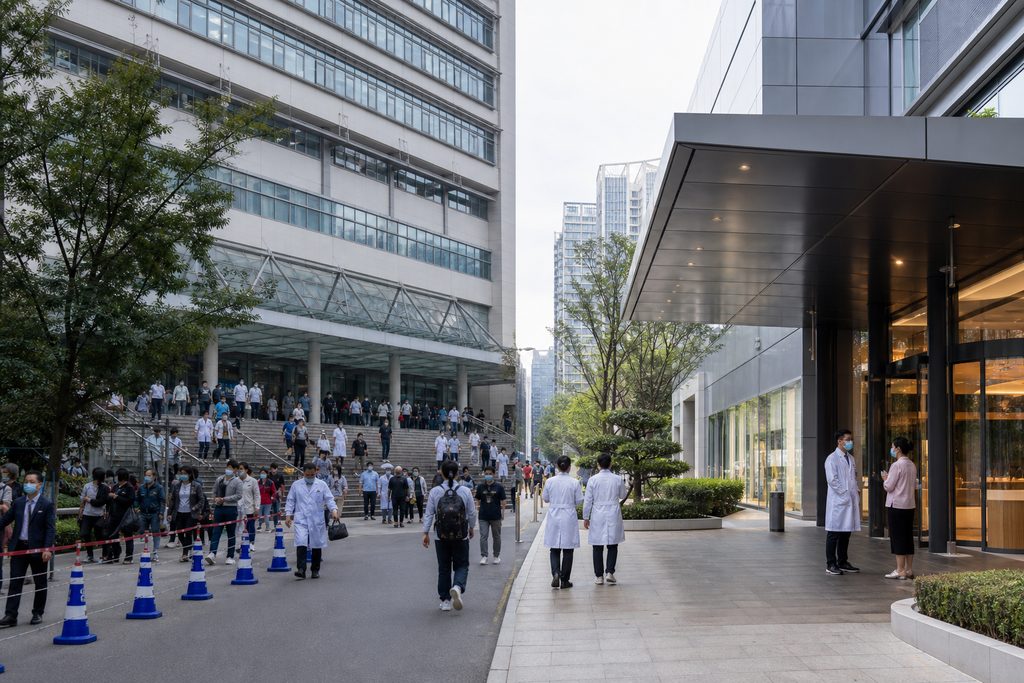
Cost and safety dominate the initial search. But the daily experience of receiving care in these two settings is where most patients form their lasting impression. A teaching hospital outpatient department at 8 a.m. on a Monday is overwhelming. Hundreds of patients crowd the registration hall. Queues snake from the payment counters. A consultation that took weeks to schedule may last five minutes—the attending physician, brilliant as they are, has 80 more patients to see before lunch. Your follow-up questions go unanswered because the next patient is already in the room.
A private international clinic operates on a different rhythm. You arrive at a scheduled time. The waiting area has seating, Wi-Fi, and coffee. The consultation runs 20 to 30 minutes. The doctor speaks English. Your test results are explained. A patient coordinator handles registration, payment, and pharmacy pickup. The experience feels familiar if you come from a Western healthcare system. It also costs five to ten times more for the same clinical interaction.
Neither model is inherently superior. They serve different needs. A patient needing a complex cardiac procedure where surgical volume directly correlates with outcomes should prioritize the teaching hospital. The chaotic lobby is irrelevant once you are under anesthesia in an operating theater that runs 20 heart surgeries a day. A patient needing a diagnostic workup, chronic disease management, or a procedure where communication and follow-up matter more than raw surgical volume may find the private clinic’s premium entirely justified.
Practical Considerations: Navigating Both Systems as a Foreign Patient
At private international hospitals, often yes. Many have direct billing agreements with major international insurers. At public teaching hospitals, almost never on the standard pathway. You pay out of pocket and submit claims for reimbursement. The international wing of a teaching hospital may offer direct billing—check with the specific hospital’s international department before committing. Always confirm with your insurer that overseas inpatient care is covered and under what conditions.
Chinese teaching hospitals carry medical liability insurance and have established protocols for adverse events. The clinical standards in top-ranked centers are internationally benchmarked. However, the legal recourse pathway for a foreign patient differs from what you may expect at home. Medical malpractice litigation in China follows Chinese law, and damages awards are generally lower than in the US or Europe. This is a real consideration. It is also why selecting a hospital with strong international accreditation and a documented safety record matters more than the price tag.
Start with the procedure. If it is high-acuity surgery where annual case volume correlates with outcomes—cardiac bypass, complex spine surgery, major cancer resection—lean toward a top teaching hospital, ideally through its international wing to preserve communication and coordination. If it is a diagnostic workup, elective minor surgery, or chronic condition management where the doctor-patient relationship and clear communication drive results, a private international hospital often delivers better value despite the higher price. The best medical treatment in China teaching hospital vs private clinic decision is not universal. It is specific to your diagnosis, your language ability, and your tolerance for chaos in exchange for clinical firepower.
Your Next Step
The teaching hospital vs private hospital cost China equation is not just about money. It is about matching the right clinical environment to your specific needs. Our team at China Medical Services works with over 340 top-ranked hospitals across 37 cities to help international patients understand their options before they book a flight. We do not provide medical advice or diagnoses. What we do is translate the complexity—hospital selection, appointment coordination, visa documentation, and on-the-ground bilingual support—so you can make an informed decision. If you are weighing a procedure in China and want to understand which pathway fits your case, start with a free consultation. No pressure. Just clarity.
Frequently Asked Questions
Yes. The hospitals used for international patients are JCI-accredited and follow the same international safety standards as top hospitals in the US and Europe. Surgical teams perform high volumes of procedures — often more than their Western counterparts — which studies show leads to better outcomes.
Costs vary by procedure and hospital, but international patients typically save 40-80% compared to US prices — even when factoring in travel and accommodation. A consultation with our team will give you an exact, all-inclusive quote with no hidden fees.
Send us your existing medical reports to get started. We handle everything from hospital selection and appointment scheduling to visa assistance and post-operative recovery planning. Your medical records are reviewed by the specialist before you even book a flight.
For more medical information and treatment options in China, visit chinamedservices.com (China Medical Services).
