Keep Kids Busy During Two Week Recovery China Hotel: A Parent’s Practical Survival Guide
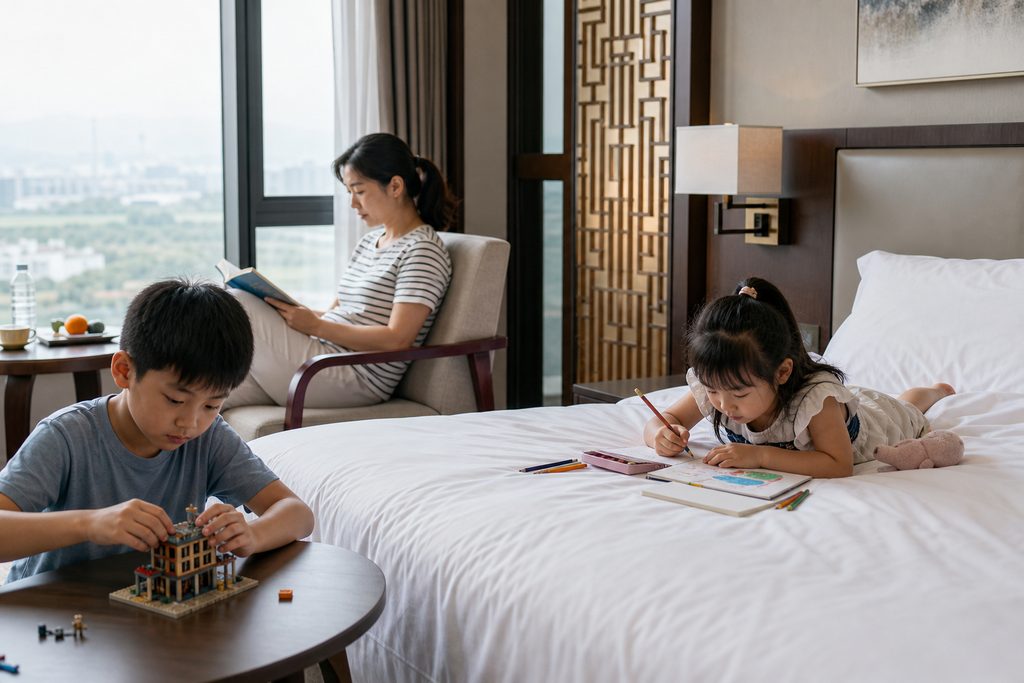
How to Entertain Kids After Surgery in China Hotel: The Short Answer
You need a layered strategy. Not one activity. A rotation. The core of how to entertain kids after surgery in China hotel settings is blending predictable routines with novel sensory experiences you can create inside four walls. A child recovering from a procedure has limited physical capacity, and a hotel room in a foreign city can feel like a cage by day three. Your plan must respect medical restrictions, work within a compact space, and require only items you can find locally or pack in a suitcase. The challenge is real: a 2023 study in the Journal of Child Health Care found that pediatric patients on restricted activity during medical travel showed elevated stress markers by the 72-hour mark when environmental stimulation was lacking. You are not just fighting boredom. You are managing cortisol levels and emotional regulation in a child who may be in discomfort, far from home, and unable to understand why they cannot go outside.
Who This Is Right For — and Who It Isn’t
This guide is written for a parent or guardian accompanying a child through a post-operative or post-procedure recovery window in China. The child is stable, mobile enough to sit up and use their hands, and the medical team has cleared them for quiet, seated activities. You are staying in a hotel near the hospital, not an inpatient ward. You have access to delivery services and can step out briefly for supplies while another adult stays with the child.
This approach is not right for a child in the first 48 hours after major surgery, when pain management and sleep are the only priorities. It is not designed for children who require strict bedrest in a supine position with limited arm movement. And it will not work if you are alone with the child and have no ability whatsoever to leave the room — some of these strategies require a quick run to a nearby store or receiving a delivery. If you are in that absolute lockdown scenario, your focus should be entirely on comfort, hydration, and video calls with family back home. Do not pressure yourself to entertain. Survival is enough.
The Options, Compared
Parents facing a long stay hotel for children recovery Shanghai or Beijing quickly discover that not all in-room activities are equal when a child is medically fragile. The table below breaks down the main categories by energy demand, parent involvement required, and how well they hold attention across days.
| Activity Category | Child Energy Level | Parent Involvement | Attention Span | Best For Day |
|---|---|---|---|---|
| Screen-based (tablet, streaming) | Very low | Minimal | 30-60 min | 1-3 (acute recovery) |
| Hands-on creative (drawing, clay, origami) | Low | Moderate | 20-45 min | 4-7 |
| Sensory play (water beads, kinetic sand, texture bins) | Low-moderate | Setup only | 30-90 min | 5-10 |
| Board/card games | Low | High | 20-40 min | 3-14 |
| Language & culture exploration | Low | Moderate | 15-30 min | 3-14 |
| Virtual tours & museum apps | Very low | Low | 20-40 min | 2-14 |
| Video calls with family/friends | Low | Low | 10-25 min | 1-14 |
Screen-based activities dominate the first three days. That is expected. Do not guilt yourself over tablet time when your child is in pain and needs distraction. But by day four, most children become irritable with passive screen consumption. That is your signal to introduce hands-on creative work. Sensory play — water beads, kinetic sand, texture sorting — is the unsung hero of the two-week recovery. It engages a child for longer stretches than almost anything else and requires only initial setup from you. The downside is cleanup. A small plastic mat or shower curtain liner from a local store solves this. Board games demand the most from you but provide the highest quality connection. Rotate these categories in three-hour blocks and you can stretch a single set of supplies across the full two weeks.
Building a Two-Week Activity Rotation Without Leaving the Hotel
This is the section no generic parenting blog can write for you. You are not on vacation. You are in a medical holding pattern in a Chinese city, possibly dealing with wound care, medication schedules, and follow-up appointments. The child is not at full strength. The room is not childproofed. You cannot drive to a craft store. So here is the exact framework we have seen work for dozens of families navigating things to do with kids during medical trip China scenarios.
Days 1-3: The Cocoon Phase
Do not plan activities. Plan comfort. The child needs sleep, hydration, and low-stimulation distraction. Pre-download shows and movies before you travel — Chinese hotel WiFi can be unpredictable with international streaming services. A VPN installed and tested before departure is non-negotiable if you want access to your home country’s content libraries. Keep the room dim. Use a white noise app to mask hallway sounds. Your only “activity” is a simple sticker book or a favorite stuffed animal. That is it. You are managing pain and anxiety, not boredom.
Days 4-7: The Engagement Window
The child is more alert but still restricted. This is when you introduce the rotation. Mornings work best for focused activities; afternoons are for rest and screens. A sample morning block: 30 minutes of drawing or coloring, 20 minutes of a card game, 30 minutes of sensory play. Then lunch. Then a nap or quiet tablet time. Afternoons can include a virtual museum tour — the Palace Museum in Beijing and the Shanghai Museum both offer excellent online exhibitions that work on a tablet. This also subtly connects the child to the country they are in, which can reduce the sense of dislocation. One parent told us their seven-year-old became fascinated with Chinese bronze vessels after a virtual tour and spent two days drawing “dragon pots.” That is a win.
Days 8-14: The Rhythm Holds
By the second week, the novelty of your supplies will wear thin. You need a refresh. This is where delivery apps in China become your lifeline. Ele.me and Meituan can deliver craft supplies, new books in English, puzzles, and even small toys within 30-60 minutes in major cities. You do not need to read Chinese — the apps support photo-based search and some English interface. Order a new sensory material, a different type of building block, or a science kit with simple experiments that can be done at a desk. The arrival of a package itself becomes an event. Also, if the child is medically cleared for short walks, a 15-minute stroll in the hotel hallway or garden counts as a major outing. Do not underestimate it.
What It Costs: Supplies, Services, and Sanity
Keeping a child occupied for two weeks in a hotel room does not need to be expensive, but it does require some spending. Here is a realistic breakdown based on costs in Shanghai and Beijing as of mid-2025.
| Item/Service | Estimated Cost (USD) | Notes |
|---|---|---|
| Basic craft kit (paper, markers, glue, scissors, clay) | $15-30 | Available at Miniso, stationery shops, or via delivery |
| Sensory play materials (kinetic sand, water beads, texture bin items) | $10-25 | Order online or find at larger toy stores |
| Board games and card games | $10-20 per game | Pack 2-3 compact games in luggage |
| Delivery app orders for new supplies mid-stay | $20-50 total | Ele.me, Meituan; delivery fees are typically under $2 |
| VPN subscription (monthly) | $5-15 | Install before departure; essential for streaming |
| Portable white noise machine | $20-40 | Pack it; hotel rooms are noisy |
| Child-sized lap desk or bed tray | $15-25 | Buy locally; invaluable for in-bed activities |
Total supply cost for the two weeks typically runs between $100 and $200. That assumes you packed some items and supplement with local purchases. The bigger cost is accommodation — you need a room that supports this. A standard 25-square-meter hotel room with two twin beds and no table is going to break you by day five. If you are searching for a best recovery hotel for families near Beijing hospital or a similar setup in Shanghai, prioritize rooms with a separate sitting area, a desk or dining table, and preferably a kitchenette. Residence-style hotels and serviced apartments are ideal. They cost more per night — expect $120-250 in Beijing or Shanghai for a proper one-bedroom suite with a kitchen — but the space is not a luxury. It is a necessity for mental health. Some families book a medical trip China with family activities bundled through a coordinator who can secure extended-stay rates at partner hotels, which can bring the nightly cost down 15-25%.
Practical Considerations: Space, Language, and Medical Boundaries
The hotel room is not your home. You cannot rearrange furniture, hang heavy decorations, or make noise that disturbs neighboring rooms. Chinese hotel walls can be thin. Avoid activities that involve running, jumping, or loud music. If the child needs to move, hallway walks are better than in-room bouncing.
Language barriers affect everything. The front desk may not understand “kinetic sand” or “water beads.” Use photo-based translation apps like Google Lens or Pleco to show a picture of what you need. Delivery apps accept photos for search. For medical supplies — dressings, antiseptic, prescribed medications — do not improvise with local purchases. Your coordinating hospital or medical concierge team should provide everything required for wound care and follow-up. If you run low, contact them, not a pharmacy. Chinese pharmacies may not carry the exact equivalent of what was prescribed.
Payment for supplies is straightforward. Alipay and WeChat Pay dominate China. Set these up before travel and link an international card. Cash is rarely accepted. If you cannot get Alipay working, your hotel concierge or medical coordinator can often place delivery orders on your behalf and add the cost to your room bill. Ask about this at check-in.
Insurance does not cover activity supplies. It does not cover the larger hotel room. These are out-of-pocket costs. Budget for them. Some families seeking family medical tourism China packages with childcare support find that an all-inclusive coordination service — which bundles accommodation, local logistics, and even a bilingual companion who can sit with the child for a few hours — ultimately costs less than piecing everything together under stress. A bilingual medical companion service starts from $200 per day. That person can handle pharmacy runs, delivery orders, and translation while you rest or attend to your own needs. For a single parent traveling alone with a child, this can be the difference between coping and collapsing.
Frequently Asked Questions
Let them have screens. A child in recovery is not a child on a normal schedule. Pain, medication, and disrupted sleep destroy attention span and emotional tolerance. If a tablet buys two hours of calm, take it. The concern about screen time is valid in normal life. Recovery is not normal life. You can reintroduce limits when the child is healed and home. For now, screen time is a medical tool for distraction and emotional regulation. Use it without guilt and supplement with one short non-screen activity per day when the child seems receptive. If they are not receptive, try again tomorrow.
Search for serviced apartments or residence-style hotels within a 15-minute walk or short taxi ride of the hospital. In Beijing, the area around Peking Union Medical College Hospital has several options; in Shanghai, the neighborhoods near Zhongshan Hospital and Ruijin Hospital are well-served. Look for properties that explicitly list kitchenettes, separate living areas, and in-room washing machines. These are not luxury amenities — they are functional necessities for a two-week medical stay with a child. A medical concierge team can often secure better rates at partner properties than you will find on international booking sites. They also know which buildings have reliable elevators, quiet floors, and proximity to pharmacies. Do not book blind based on photos alone.
This happens. Recovery timelines are estimates, not guarantees. If the medical team extends the stay, you need to shift into a more sustainable mode. Ask your hospital coordinator or concierge about moving to a long-stay serviced apartment with a proper kitchen and more space. The daily rate is often lower for extended bookings. You will also need to refresh your activity supplies more substantially — consider ordering a larger construction set, a new series of chapter books, or a tablet-based learning app that tracks progress. A child who can see they are advancing through levels in a math or language app often stays engaged longer than with passive content. And if you are truly stuck, a bilingual companion for even four hours twice a week gives you a break and brings a new face into the child’s world, which breaks the monotony for both of you.
Ask the surgeon. Not the internet. The answer depends entirely on the procedure, the child’s age, the wound healing status, and the local environment. A child recovering from an orthopedic procedure may be cleared for short wheelchair outings to a quiet park. A child recovering from abdominal surgery may have strict lifting and movement restrictions that make any outing risky. Air quality in Chinese cities also matters — a child with fresh incisions or respiratory sensitivity should not be outside on high-pollution days. Your medical team will give you a clearance threshold. Do not push past it. If the answer is no, use virtual tours and window views to connect the child to the outside world. Even opening the window for five minutes of fresh air and city sounds can reset a child’s mood.
Your Next Step
Two weeks in a hotel room with a recovering child is not a vacation. It is a logistical and emotional challenge that most parents face with no preparation and no support. The families who manage it best are the ones who plan the activity rotation before they travel, book a room with enough square footage to breathe, and accept that screen time limits do not apply in a medical recovery context. Our team at China Medical Services connects international families with the hospitals, accommodations, and on-the-ground support that make a two-week pediatric recovery stay feasible rather than overwhelming. We do not provide medical care or make clinical decisions — we handle the logistics so you can focus on your child. If you are considering a medical trip to China and want to understand how accommodation, local coordination, and bilingual support fit together, request a free consultation through our patient coordination page. We will help you build a plan that accounts for the medical requirements and the human reality of keeping a child calm, occupied, and healing in an unfamiliar city.
For more medical information and treatment options in China, visit chinamedservices.com (China Medical Services).
