Chinese Hospital Records: The Paper vs Digital Reality for International Patients
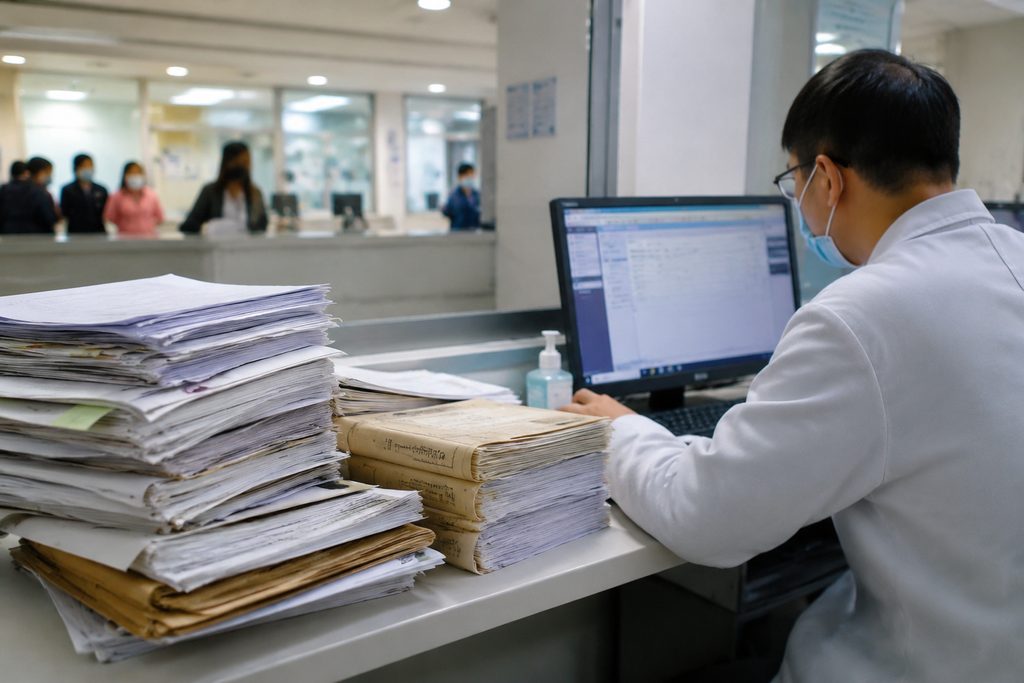
When you search “can foreigner get medical records China,” you’re probably picturing a sleek digital portal. A patient app. Something you can access from your couch in London or Los Angeles. The reality is more complicated. Some of China’s top-tier hospitals do use electronic health record systems. Others still hand you a worn paper booklet held together by a rubber band. Most operate somewhere in between.
Our team has walked international patients through this process hundreds of times. We’ve seen the confusion firsthand. A patient arrives expecting a unified digital file. Instead, they receive a stack of thermal-printed lab stickers, handwritten doctor’s notes, and a CD-ROM of CT scans that their laptop can’t open. Understanding the landscape before you need your records is the difference between a smooth transfer and weeks of frustration.
How This Actually Works, Step by Step
Getting your records after treatment in China follows a path that surprises most Western patients. There’s no central patient portal. No single login where your entire medical history lives.
Here’s the real sequence.
You start at the hospital’s medical records department. Every public hospital has one. It’s usually in the basement or a separate administrative building. You’ll need your passport, your hospital registration card, and often a copy of your discharge summary. The records staff verifies your identity. Then they pull your file.
What they pull depends on the hospital. At a large teaching hospital like Peking Union Medical College Hospital, portions of your record may already be digitized. Lab results, radiology reports, and discharge summaries often exist in the hospital’s internal system. But physician progress notes? Those might still be handwritten in your physical chart. At smaller city-level hospitals, nearly everything remains on paper.
You request copies. The hospital stamps each page with an official red seal. That stamp matters enormously. Without it, your records aren’t considered legal documents outside China. You pay a copying fee. It’s nominal — usually a few yuan per page. Then you walk out with a folder.
If you’ve already left China, the process shifts. You or a representative must submit a written request. Some hospitals accept email. Others require a physical letter with a copy of your passport and a signed authorization form. A few top international departments have started offering secure digital transfer. Most haven’t.
Digital vs Paper Medical Records in Chinese Hospitals: The Real Divide
China’s hospital system is not monolithic. Talking about “Chinese hospital records” as one thing misses the point entirely. The digital vs paper divide runs deep, and it tracks closely with hospital tier and patient volume.
At the very top, hospitals like Fuwai Hospital and Zhongshan Hospital Fudan University have invested heavily in health IT infrastructure. Fuwai, which performs over 14,000 cardiac surgeries annually, simply cannot manage that volume on paper. Their internal systems capture structured data — lab values, imaging results, operative notes, medication records — in digital format. Doctors enter orders electronically. Nurses scan patient wristbands. The data lives on secure servers.
But here’s the catch. Internal digital records don’t automatically mean patient-facing digital access. The hospital’s doctors can see your data on their workstations. You can’t log in from home. The system was built for clinical workflow, not patient convenience.
Step down one tier. A well-regarded provincial hospital in a city like Wuhan or Xi’an. You’ll find a hybrid. Lab results come from automated analyzers and feed into a database. Radiology departments use PACS systems to store images. But the patient’s core chart — the admission note, the daily progress notes, the consultation reports — often remains a physical folder that travels with the patient from ward to ward.
At county-level hospitals and smaller facilities, paper dominates. Patients carry their own booklets. Doctors write by hand. Test results get glued onto pages. When a patient is discharged, the booklet goes home with them. The hospital may keep a summary, but the detailed record is that booklet.
This fragmentation creates a practical problem for anyone trying to do medical records transfer from China hospital abroad. You can’t assume anything. You have to know which hospital you’re dealing with and what their specific system looks like.
A Realistic Timeline
The calendar matters. If you’re coordinating follow-up care back home, you need to know when those records will actually arrive. Here’s what we tell our patients.
| Stage | What Happens | Typical Duration |
|---|---|---|
| Day 1-3 | Submit records request to hospital medical records department. Requires passport copy, signed authorization, hospital registration number. | 1-3 business days just to confirm they received the request |
| Week 1-2 | Hospital processes request. Locates physical file, makes copies, applies official stamps. Digital portions extracted from internal system. | 5-10 business days |
| Week 2-4 | Translation. Most hospitals issue records in Chinese only. Certified medical translation into English takes time. | 5-15 business days depending on volume |
| Week 3-5 | Notarization (if required by receiving hospital). Records must be notarized for legal validity in some countries. | 3-7 business days |
| Week 4-6 | Secure delivery. Physical copies shipped via international courier. Digital copies sent via encrypted email or secure portal. | 3-7 business days for physical delivery |
That’s the optimistic timeline. It assumes the hospital responds promptly, your request is complete, and no one loses your file. Real delays happen. A doctor’s handwriting needs clarification. The records department is understaffed during a holiday period. The translation requires a specialist familiar with oncology or cardiology terminology. We’ve seen the process take two months when multiple departments are involved.
If you need records for an upcoming appointment back home, start the process the day you’re discharged. Not the week before your appointment.
What Can Go Wrong — and What Happens Then
Let’s be direct about the failure modes. They’re not rare.
The most common problem: you’ve left China and the hospital won’t release records without an in-person request. This happens at smaller hospitals that lack established procedures for international patients. Their policy manual says the patient or a family member must appear at the records window with original ID. They don’t have a workflow for overseas requests.
The fix is a medical records authorization letter, notarized and translated into Chinese, appointing a representative to act on your behalf. Some hospitals accept this. Some still push back. In those cases, persistence through the hospital’s international department — if one exists — can break the deadlock.
Another common failure: the records you receive are incomplete. You get the discharge summary but not the daily progress notes. You get lab printouts but not the imaging reports. Chinese hospitals don’t always compile a comprehensive discharge packet the way Western hospitals do. Different departments hold different pieces of your record.
The fix is knowing exactly what to ask for. A complete request should specify: admission note, discharge summary, all lab results, all imaging reports, operative notes if surgery was performed, pathology reports if applicable, medication administration records, and nursing notes. Ask for the list by name. Don’t assume “my records” means the same thing in every hospital.
A third problem: the records exist, but they’re fragmented across systems. A patient who saw an outpatient specialist, then got admitted, then had follow-up imaging — those encounters may live in three separate databases. The records department may only pull the inpatient file. The outpatient specialist’s notes stay in the clinic system. The imaging sits on the radiology server.
The fix here is to request records from each department separately if the hospital’s central records office can’t aggregate everything. It’s tedious. It’s necessary.
Do Chinese Hospitals Keep Electronic Health Records? What International Patients Should Know
The short answer is yes, many do — but not in the way you’re probably imagining. If you’re coming from a country with a national electronic health record system, you’ll need to recalibrate your expectations.
China has no national EHR platform. There’s no equivalent of the NHS Spine or Australia’s My Health Record. Each hospital builds or buys its own system. A patient treated at three different hospitals in Shanghai will have three separate electronic records, none of which talk to each other.
Within a single hospital, the digitization can be impressive. Large hospitals use comprehensive hospital information systems that integrate lab, pharmacy, radiology, and clinical documentation. Doctors at Peking Union Medical College Hospital can pull up years of a patient’s internal lab history with a few clicks. The data is structured, searchable, and useful for clinical decision-making.
But that data stays inside the hospital’s firewall. Interoperability between hospitals is minimal. If you transfer from one hospital to another in the same city, your new doctor probably can’t access your old records electronically. You’ll carry paper copies. Or a CD. Or both.
For international patients, this has a specific implication. When you ask how to obtain hospital records from China as international patient, you’re really asking two questions. First, does the hospital maintain electronic records internally? Second, can those records be exported in a format your home doctor can use?
The answer to the first question is increasingly yes. The answer to the second is still often no. The export format might be a PDF scan of a paper document. It might be a proprietary file type that requires special software. It might be a CD of DICOM images that your local hospital’s PACS can import, or it might be a viewer program that only runs on an old version of Windows.
We always recommend requesting records in multiple formats. Get the official stamped paper copies for legal purposes. Get digital files on a USB drive or via secure download for clinical review. And get the raw DICOM files for imaging, not just the viewer software.
This dual approach covers your bases. The paper copies satisfy legal and administrative requirements. The digital files let your doctor actually read and use the clinical information.
Practical Considerations: Translation, Certification, and Follow-Up Care
A stack of Chinese-language medical records means nothing to a doctor in Manchester or Melbourne. Translation is not optional. It’s also not simple.
Medical translation requires subject-matter knowledge. A general translator can handle demographic information and basic lab ranges. But an operative note from a complex orthopedic procedure? A pathology report with immunohistochemistry markers? Those need a translator who understands the specialty. Terminology errors can change clinical meaning.
Certified translation adds another layer. Some receiving hospitals and insurance companies require a statement of accuracy from the translator or translation agency. Others want notarization. Requirements vary by country and institution.
We’ve found that patients consistently underestimate both the time and cost of medical translation. A thick inpatient chart can run to dozens of pages. Rush translation services charge premium rates. Planning ahead saves money and stress.
Then there’s the question of what happens after your records arrive. Your home doctor reviews them. They may have questions. They may want to speak with the treating physician in China. This is where having a contact at the original hospital becomes valuable. The international department at major hospitals like West China Hospital or Ruijin Hospital can sometimes facilitate physician-to-physician communication. At smaller hospitals, it’s much harder.
One practical step that helps: before you leave the hospital in China, ask your attending physician if they’re willing to be contacted by your home doctor. Get their professional email or WeChat. Many Chinese doctors use WeChat for professional communication. Having that direct line can resolve questions that would otherwise take weeks of formal correspondence.
Also, understand what Chinese hospital records typically include — and what they don’t. You’ll get objective data: lab values, imaging findings, medication lists, procedure notes. You probably won’t get the kind of narrative clinical reasoning that appears in Western-style progress notes. Chinese physician notes tend to be brief, focused on physical exam findings and treatment decisions. The thought process behind those decisions often isn’t documented in the same detail.
This isn’t a flaw. It’s a different documentation culture. But it can frustrate a Western doctor who’s used to reading lengthy assessment and plan sections. Setting that expectation upfront prevents misunderstandings.
Frequently Asked Questions
Yes. The process requires a written request with a copy of your passport, your hospital registration number, and a signed authorization. Some hospitals process these by email. Others require a physical letter. Having a representative in China dramatically speeds things up. Without one, expect 4-8 weeks from request to receipt.
Almost never. Public hospitals in China generate records in Chinese. A few international departments at top-tier hospitals provide English discharge summaries, but this is the exception. You’ll need professional medical translation. Budget $300-800 for a complete inpatient record translation, depending on volume and complexity.
Generally yes, once translated. The key is the official hospital stamp. Chinese medical records derive their legal validity from the red hospital seal, not from being electronic or paper. Your home doctor may also want raw imaging files in DICOM format, not just the radiology report. Always request both.
This happens. Hospitals are required to retain inpatient records for at least 30 years, but outpatient records have shorter retention periods. If records are genuinely lost, you can request a medical summary letter from the treating department. It’s not a full record, but it documents your diagnosis and treatment for continuity of care purposes.
Most Chinese hospitals don’t initiate international transfers. You’ll need to obtain the records yourself, have them translated, and then submit them to your receiving hospital. Some international departments at major hospitals can send records directly to foreign institutions upon your written authorization, but this is not standard practice. Always confirm before relying on it.
Your Next Step
Medical records are the bridge between your treatment in China and your ongoing care at home. Getting them right matters. The system isn’t built for international patients. It’s built for a domestic population that carries paper booklets and speaks the language. Navigating it from abroad requires knowing exactly what to ask for, how to ask for it, and what to do when the process stalls.
Our team handles this every day. We know which hospitals require in-person requests and which accept digital authorization. We work with certified medical translators who understand specialty terminology. We’re not doctors. We’re the operational layer between you and the Chinese healthcare system — the people who make sure your records follow you home.
If you’re facing this process, start early. And if you’d rather not manage it alone, reach out for a free consultation. We’ll walk you through what’s needed for your specific situation, no obligation.
For more medical information and treatment options in China, visit chinamedservices.com (China Medical Services).
