Why Chinese Hospitals Ask Payment Before Treatment: The Real System Explained
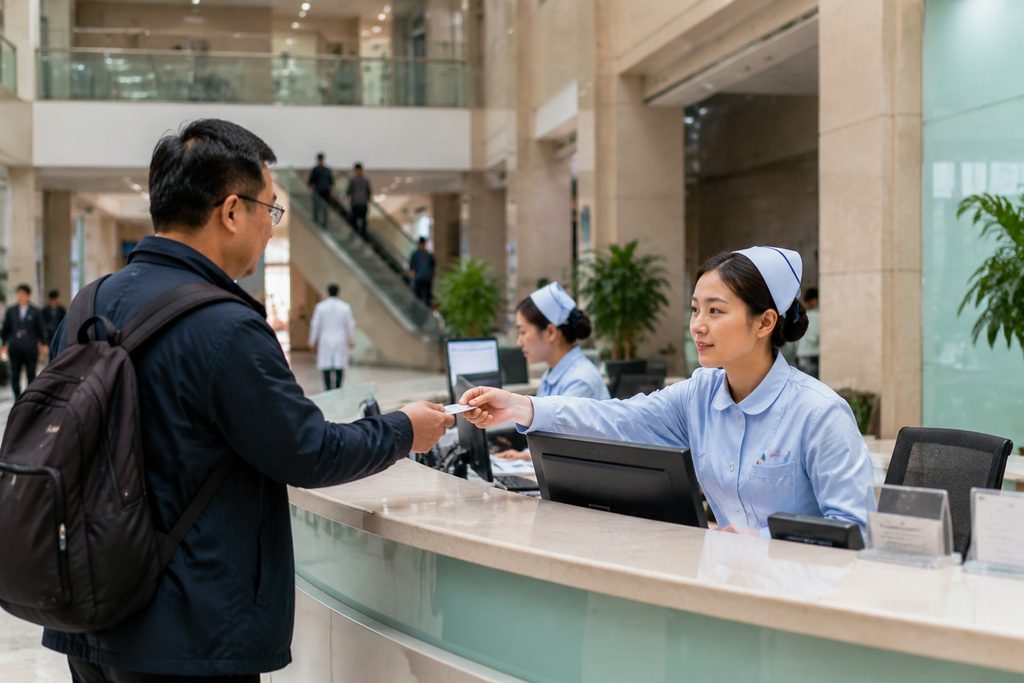
According to China’s National Health Commission, public hospitals handled over 8 billion patient visits in 2023. That staggering volume shapes every financial policy inside those walls. And the one that catches Western patients off guard every time is the prepayment requirement. You walk into a world-class facility like Peking Union Medical College Hospital or Ruijin Hospital, expecting to receive care first and sort out the bill later. Instead, the admissions desk asks for a deposit before you even change into a hospital gown.
It feels jarring. It can even feel suspicious. But the system exists for reasons rooted in how China’s healthcare infrastructure actually operates—not because anyone doubts your ability to pay.
Our team has guided patients from over 40 countries through this exact moment. We have seen the confusion firsthand. And we can explain exactly what is happening, why it happens, and how to navigate it without stress.
How This Actually Works, Step by Step
You do not simply show up at a Chinese public hospital and get admitted. There is a sequence. Understanding it removes the shock.
First, you register. This means creating a hospital medical record and obtaining a patient ID card. For international patients, this step requires your passport and visa. Our team typically handles this before you arrive, saving you from navigating a crowded registration hall with zero Chinese language support.
Second, you see the specialist. The doctor evaluates your condition, reviews your existing medical records, and determines whether hospitalization or surgery is appropriate. No deposit is required at this stage—just the consultation fee, which ranges from $50 to $300 depending on whether you use the standard outpatient clinic or the international VIP department.
Third, if admission is recommended, the hospital issues a preliminary cost estimate. This estimate covers the anticipated bed charges, surgical fees, anesthesia, nursing care, medications, and basic consumables. The estimate is not a final bill. It is a floor, not a ceiling.
Fourth, you pay the deposit. This is the moment that surprises Western patients. The hospital requires you to prepay a significant portion of the estimated cost before your surgery is scheduled or your hospital bed is assigned. The deposit amount varies. For a cardiac procedure at Fuwai Hospital, expect $15,000 to $25,000 upfront. For a less complex orthopedic surgery, $8,000 to $12,000.
Fifth, treatment proceeds. As your care unfolds, the hospital deducts from your deposit balance in real time. Daily statements are available. If your balance runs low, the hospital notifies you to top up. If you overpay, the surplus is refunded at discharge.
This is the standard workflow across China’s 35,000+ hospitals. It is not unique to foreigners. Chinese citizens follow the same prepayment model. The difference is that they expect it, and you probably do not.
The Prepayment System: Why It Exists and What It Protects
The question we hear most often is blunt: why do Chinese hospitals ask for payment upfront rather than billing after treatment like Western institutions? The answer sits at the intersection of patient volume, regulatory structure, and historical experience.
China’s top-tier public hospitals are enormous. West China Hospital in Chengdu sees over 20,000 outpatient visits in a single day. Zhongshan Hospital in Shanghai performs more than 100,000 surgeries annually. At this scale, extending credit to every patient would be administratively impossible. The prepayment model is a throughput mechanism. It ensures that when a bed is assigned and a surgical team is booked, the financial side is already settled. The hospital can focus on medicine, not collections.
There is also a regulatory layer. Chinese public hospitals operate under government pricing controls. They cannot arbitrarily inflate charges to cover bad debt the way a private Western hospital might. If a patient receives treatment and then cannot or will not pay, the hospital absorbs a loss it has no mechanism to recover. Over decades, the system evolved to eliminate that risk at the point of entry.
Does this mean the hospital does not trust you? No. It means the hospital has built a system that does not require trust. It functions the same way for everyone. This is actually a form of fairness—no patient gets special treatment, and no patient gets to skip the rules.
For international patients, the China hospital prepayment policy for foreigners is identical to the policy for locals. There is no separate track. What differs is the logistics: you will likely need to wire funds internationally before arrival, coordinate with the hospital’s international department to confirm receipt, and ensure your deposit is properly credited to your patient file. Our team handles this reconciliation as part of our standard coordination service.
A Realistic Timeline
Patients often underestimate the waiting steps. Here is what a typical timeline looks like when you are traveling to China for a planned surgery—not an emergency.
| Stage | What Happens | Typical Duration |
|---|---|---|
| Week 1–2 | Medical records translated into Chinese; specialist selected; initial remote consultation scheduled | 7–14 days |
| Week 3–4 | Remote video consultation with Chinese specialist; treatment plan confirmed; preliminary cost estimate issued | 5–10 days from consult to estimate |
| Week 5–6 | Deposit wired to hospital; funds verified; admission date confirmed | 5–10 business days for international wire clearance |
| Week 6–7 | S2 visa application with hospital invitation letter; visa processing | 5–15 business days depending on embassy |
| Week 8 | Travel to China; pre-admission testing; hospital admission; surgery | 2–5 days pre-op; procedure as scheduled |
| Week 9–12 | Post-operative recovery in hospital; discharge; follow-up; balance settlement | Varies by procedure complexity |
Two months from initial contact to surgery is a realistic minimum for a planned procedure. Emergency cases move faster, but international travel for emergency care is rare and complicated. Most patients we work with are pursuing planned treatments—joint replacements, cardiac procedures, cancer surgeries, spinal corrections.
The deposit step is the one that causes the most friction. International wire transfers take time. Banks ask questions. Exchange rates fluctuate. We recommend initiating the transfer the same day you receive the hospital’s estimate, not the day before you fly. Delays here push everything else back.
What Can Go Wrong — and What Happens Then
This is a real constraint. The hospital will not admit you for a planned procedure without the deposit cleared. Partial payments are generally not accepted for initial admission. If the deposit amount is beyond your immediate liquidity, options include medical financing through third-party lenders, bridge loans, or negotiating a phased treatment plan that spreads the cost across multiple smaller admissions. Some patients also explore treatment at private international hospitals in China, where direct insurance billing may reduce the upfront cash requirement—though the total cost is typically higher.
China’s public hospitals operate under government-regulated pricing. Every procedure, medication, and consumable has a fixed price schedule set by provincial health authorities. The hospital cannot arbitrarily inflate charges. Your daily statement shows every deduction against your deposit. At discharge, you receive a final reconciliation. Disputes are rare, but if one arises, the hospital’s international department is the first point of resolution. For serious billing disputes, the local health commission provides an escalation path. In practice, overcharging is uncommon. Underestimation—where the deposit runs out because treatment was more extensive than anticipated—is the more frequent issue.
At most Chinese public hospitals, no. Even if your insurer has a relationship with the hospital, the prepayment requirement stands. The hospital treats you, you pay the hospital, your insurer reimburses you. The exception is private international hospitals like United Family or Jiahui, which often have direct billing agreements with major international insurers. If avoiding a large upfront deposit is your priority, a private international hospital may be the better choice—but verify their clinical capabilities for your specific condition before choosing based on payment convenience alone.
Refunds are processed at discharge, but the funds take 5 to 15 business days to appear in your account due to international banking timelines. The refund goes back to the same account from which the deposit originated. If you used a third-party wire service, the refund path may be slower. We recommend keeping your deposit account open and active until the refund clears. Closing it prematurely creates a bureaucratic headache that can take months to untangle.
Your Next Step
The prepayment system is not a barrier. It is a process. Once you understand it, you can plan for it—and once you plan for it, you can access some of the world’s highest-volume, most experienced surgical teams at a fraction of Western costs. A cardiac bypass at Fuwai Hospital runs $15,000 to $20,000. The same procedure in the United States averages over $120,000. The prepayment is the same mechanism that makes that cost structure possible.
Our team at China Medical Services exists to handle the logistics that surround the medicine. We translate records, coordinate with hospital international departments, reconcile deposits, arrange S2 visa support, and provide bilingual companions who ensure you never face a language barrier at a billing counter or a pre-op consultation. We do not practice medicine. We connect you with the hospitals and specialists who do, and we make sure the administrative side never derails the clinical side. If you are considering treatment in China, start with a conversation. It costs nothing, and it clarifies everything.
Frequently Asked Questions
Yes. The hospitals used for international patients are JCI-accredited and follow the same international safety standards as top hospitals in the US and Europe. Surgical teams perform high volumes of procedures — often more than their Western counterparts — which studies show leads to better outcomes.
Costs vary by procedure and hospital, but international patients typically save 40-80% compared to US prices — even when factoring in travel and accommodation. A consultation with our team will give you an exact, all-inclusive quote with no hidden fees.
Send us your existing medical reports to get started. We handle everything from hospital selection and appointment scheduling to visa assistance and post-operative recovery planning. Your medical records are reviewed by the specialist before you even book a flight.
For more medical information and treatment options in China, visit chinamedservices.com (China Medical Services).
