Healthcare in China for Foreign Patients: Your Full Medical Tourism Service and Support Guide
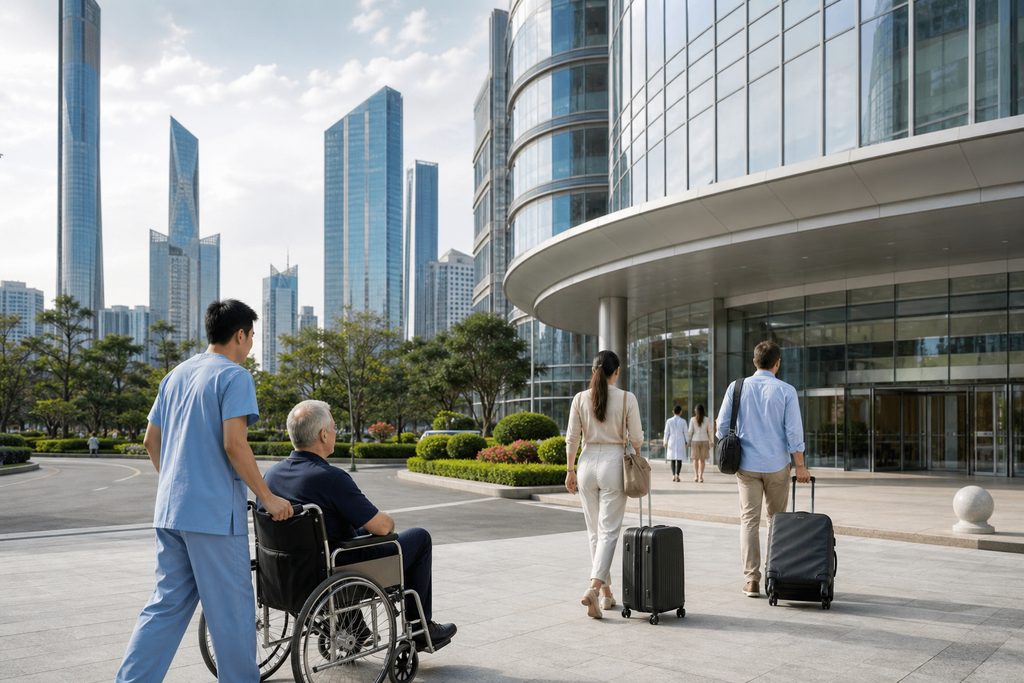
When 42-year-old Michael first heard the diagnosis, he had no idea where to start looking for treatment. Degenerative disc disease. The surgeon back home in Texas recommended a two-level spinal fusion. The quote came back at $110,000. His insurance would cover half. Michael spent three weeks on Google at 2 a.m., searching for alternatives. That is how he ended up on our site, asking the same question we hear every week: is healthcare in China for foreign patients actually viable, or just another internet promise?
It is a fair question. The short answer is that China has built a parallel medical infrastructure that treats over 500,000 international patients annually, according to data from the National Health Commission. The longer answer involves understanding which hospitals genuinely serve foreign patients, what the real costs look like, and how to avoid the mistakes that turn a medical trip into a logistical nightmare. We have coordinated care for patients from 40 countries. This guide covers what we have learned.
How This Actually Works, Step by Step
The process is not complicated, but it is also not what most people imagine. You cannot simply email a top surgeon and book a surgery date. Chinese public hospitals run on a system designed for domestic patients. The international pathway exists alongside it, not within it.
Here is the real sequence:
Step 1: You send us your medical records. This means your imaging files on a CD or USB, your doctor’s notes, your pathology report if relevant, and a brief summary of what you have been told so far. We need the raw data, not just the conclusions.
Step 2: Our team translates everything into clinical Chinese. This is not Google Translate. Medical translation requires bilingual clinicians who understand both the terminology and the diagnostic context. A mistranslated MRI finding can send a consultation in the wrong direction entirely.
Step 3: We match your case to the right department. China’s hospital ranking system, the Fudan Hospital Rankings, evaluates 45 specialties separately. A hospital ranked A++++ overall might not be the best hospital for foreign patients China has for your specific condition. We cross-reference your diagnosis with the Fudan specialty reputation rankings and the international department’s experience with overseas cases.
Step 4: You receive a written second opinion or schedule a video consultation. The written opinion costs $300–500 and gives you a specialist’s analysis of your records, a proposed treatment direction, and a candid assessment of whether traveling to China makes clinical sense for your case. The video consultation at $100–800 lets you speak directly with the specialist and ask your own questions.
Step 5: If you decide to proceed, we coordinate the logistics. This includes the S2 visa invitation letter from the hospital, appointment scheduling through the international department, airport pickup, and a bilingual medical companion who stays with you through every registration, consultation, and payment counter.
Is It Safe for an American to Have Surgery in China?
Some international health insurance plans cover treatment in JCI-accredited hospitals worldwide, including those in China. Most domestic US plans do not. You need to check your policy’s out-of-network and international coverage provisions. We provide the hospital’s JCI certificate and procedure codes for you to submit for pre-authorization. We do not guarantee coverage. The hospital bill is your responsibility at discharge.
It happens. The in-person examination or additional testing may reveal contraindications that were not apparent in the remote records review. If surgery is cancelled, you are refunded the unused portion of your hospital deposit. Our coordination fee is non-refundable because the work — translation, scheduling, companion services up to that point — was performed. We help you understand the specialist’s reasoning and, if appropriate, explore alternative treatment options in China or back home.
No. That is the entire point of the international department pathway and the bilingual companion service. The companion handles registration, payment, pharmacy pickup, and translation during every clinical encounter. You speak English. The doctor speaks Chinese. The companion bridges it. Without this layer, navigating a Chinese public hospital as a non-Chinese speaker is not merely difficult. It is functionally impossible for anything beyond a simple outpatient visit.
Your Next Step
You have the information. You know the timeline, the costs, the risks, and the pathway. The decision to pursue treatment abroad is personal. It involves your health, your finances, and your family. We do not push.
Our team at China Medical Services has coordinated care for international patients at more than 340 top-ranked hospitals across 37 Chinese cities. We do not provide medical advice. We do not guarantee outcomes. What we do is remove the obstacles — language, logistics, hospital matching — so you can focus on the medicine. If you want to explore whether treatment in China makes sense for your case, send your records for a preliminary review. The initial consultation to discuss your situation is free. Visit our patient services page to start. No commitment. Just information.
Frequently Asked Questions
Yes. The hospitals used for international patients are JCI-accredited and follow the same international safety standards as top hospitals in the US and Europe. Surgical teams perform high volumes of procedures — often more than their Western counterparts — which studies show leads to better outcomes.
Costs vary by procedure and hospital, but international patients typically save 40-80% compared to US prices — even when factoring in travel and accommodation. A consultation with our team will give you an exact, all-inclusive quote with no hidden fees.
Send us your existing medical reports to get started. We handle everything from hospital selection and appointment scheduling to visa assistance and post-operative recovery planning. Your medical records are reviewed by the specialist before you even book a flight.
For more medical information and treatment options in China, visit chinamedservices.com (China Medical Services).
