Same-Day Blood Test Results in China: How We Coordinate Your Labs
Key Takeaways
- Most routine blood panels at top-tier Chinese hospitals return results within 2–6 hours, with same-day delivery standard for inpatients and early-morning outpatients.
- Blood test cost China for foreigners typically runs 60–80% lower than equivalent panels in the US, even at international departments with English-speaking staff.
- Language and navigation barriers — not laboratory quality — are the biggest obstacles foreign patients face when getting labs done in China.
- You cannot book most public hospital lab work online from overseas; you need an on-the-ground coordinator or in-person registration first.
The Problem: Waiting Weeks for Answers You Need Today
You have probably heard that getting medical tests done abroad means waiting. That is true in many systems. A standard metabolic panel in London can take 5–7 working days through the NHS. In parts of Canada, non-urgent blood work carries a 2–3 week turnaround. Even in the US, where Quest Diagnostics and Labcorp dominate, your doctor might not call you back for 3–5 business days after the draw.
Now imagine you are a foreigner in China for work, study, or medical treatment. You feel unwell. You need answers. The idea of navigating a Chinese public hospital — with its crowds, its ticketing machines, its Chinese-only signage — is overwhelming. But here is what most people do not realize: the actual laboratory testing in China is fast. Very fast. The bottleneck is rarely the lab. It is the registration, the queue, and the language barrier in front of it.
That is where coordination changes everything. We handle the logistics so you get the speed the system is already capable of delivering.
Why Chinese Hospital Labs Deliver Same-Day Blood Test Results
Volume Creates Speed
A single top-tier public hospital in Shanghai or Beijing may process 10,000–20,000 outpatient visits per day. That is not an exaggeration — it is the operational reality of hospitals like Huashan Hospital or Peking Union Medical College Hospital. To handle that volume, their central laboratories run continuously. Automated analyzers process chemistry panels, complete blood counts, and immunoassays in parallel, not in sequence.
Compare that to a mid-sized US community hospital lab, which might batch samples and run them twice daily. The Chinese model is built for throughput. A routine CBC and basic metabolic panel drawn at 8:00 AM is often ready by 11:30 AM. Lipid panels, liver function tests, thyroid panels — most come back the same afternoon.
And the machines are the same ones you would see in any Western lab. Roche, Abbott, Siemens, Beckman Coulter. The equipment is not the variable. The operational tempo is.
Reliability Matches International Standards
A common question we hear: is blood testing reliable in Chinese hospitals? The short answer is yes — at the hospitals we work with. The top 5% of China’s 35,000+ hospitals, ranked by Fudan University‘s hospital rankings and JCI accreditation, participate in external quality assessment programs. Many hold ISO 15189 accreditation for medical laboratories, which is the same international standard used in Europe and Australia.
What varies is not the analyzer but the pre-analytical process. Sample labeling, transport time, hemolysis rates. At a busy public hospital, a rushed phlebotomist drawing 300 patients a day might introduce errors a slower clinic would not. That is a real risk. But at international departments and VIP wings of the same hospitals, the draw-to-lab process is tighter. Fewer patients per phlebotomist. Better labeling protocols. The lab itself is identical — it is the handling that improves.
So when patients ask us whether they can trust the numbers, we tell them: trust the hospital tier, not the country. A Fudan-ranked top 100 hospital lab is as reliable as any Western academic medical center lab. A random county hospital? Less so. That is why hospital selection matters.
Cost Without the Catch
Blood test cost China for foreigners is consistently lower than in Western systems, even when you choose the international department. A standard comprehensive panel — CBC, liver function, kidney function, lipids, glucose, thyroid — might run $40–$80 at a top public hospital’s international wing. The same panel at a US hospital outpatient lab could easily exceed $300–$500 before insurance. At a private international hospital in Shanghai like Jiahui or United Family, expect $100–$200 for a similar panel. Still below Western cash prices, and with English reports included.
Lower cost does not mean lower quality. It reflects labor economics: a phlebotomist in Shanghai earns a fraction of what one earns in San Francisco. The reagent costs are similar. The machine costs are similar. The human labor is not. That is the structural reason the math works.
What “Same-Day” Actually Means: A Real Timeline
Let us walk through a realistic scenario. You arrive in Shanghai on a Monday. You contact us beforehand. We identify the right hospital for your needs — say, Ruijin Hospital’s international department or Huashan Hospital’s VIP wing. We confirm which panels you need based on your referring physician’s request or your own health concerns.
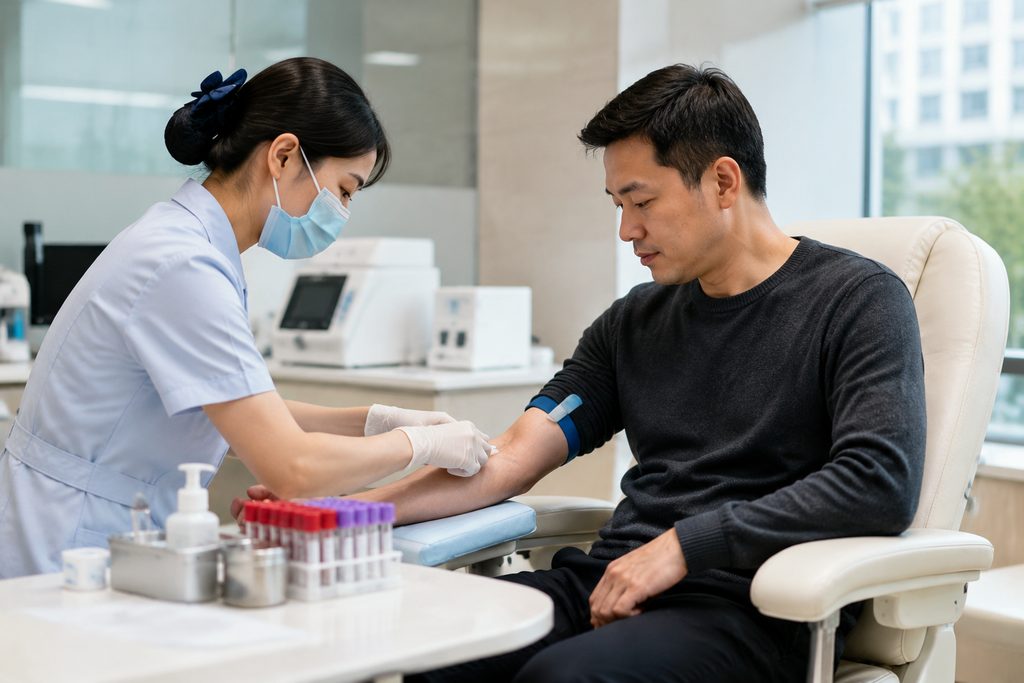
On Tuesday morning at 7:30 AM, our bilingual companion meets you at the hospital entrance. You skip the general registration line. We handle the hospital card, the registration fee, and the queue number. By 8:00 AM, a nurse draws your blood. You leave the hospital by 8:20 AM.
By 11:00 AM, the results are in the hospital’s digital system. Our companion retrieves them, translates the key values, and sends you a PDF with both the original Chinese report and an English summary. If you need a doctor to interpret them, we can arrange a video consultation the same afternoon. That is the full loop: draw at 8, results by noon, clinical context by evening.
Not every test is same-day, of course. Some specialized panels — certain tumor markers, autoimmune panels, genetic tests — take 2–7 days. But routine hematology and biochemistry? Same-day is the default, not the exception.
How Fast Can I Get Blood Test Results in China? A Test-by-Test Breakdown
Turnaround time depends on the specific assay, not just the hospital. Here is what our team typically observes at top-tier public and private international hospitals in Beijing and Shanghai:
| Test Type | Typical Turnaround (Top Public Hospital) | Typical Turnaround (Private International Hospital) |
|---|---|---|
| Complete Blood Count (CBC) | 1–3 hours | 1–2 hours |
| Basic Metabolic Panel | 2–4 hours | 2–3 hours |
| Liver Function Panel | 2–5 hours | 2–4 hours |
| Lipid Panel | 3–6 hours | 2–4 hours |
| Thyroid Panel (TSH, T3, T4) | 4–8 hours | 3–6 hours |
| HbA1c | 2–4 hours | 1–3 hours |
| Vitamin D (25-OH) | 4–24 hours | 4–12 hours |
| Common Tumor Markers (AFP, CEA, CA-125) | Same day to next day | Same day |
Lab test turnaround time Beijing hospital patterns are similar to Shanghai. The key variable is whether you go through the general outpatient route or the international/VIP route. The general route is cheaper but slower — you wait in the same queue as thousands of local patients. The international route costs more but moves faster, with dedicated phlebotomy stations and priority processing.
If you want same day blood test results Shanghai, book the earliest possible draw time. 7:00–8:00 AM draws almost always return same-day for routine panels. A 3:00 PM draw might push results to the next morning. Timing matters as much as location.
Practical Considerations: Documentation, Payment, and Follow-Up
You do not need a visa specifically for blood tests. But if you are traveling to China for medical purposes — even just a comprehensive health screening — the correct short-stay visa category is S2, which covers private affairs including medical treatment. Your family members accompanying you also apply for S2. The hospital can provide a supporting letter once you have a confirmed appointment. We help you request that letter and submit it with your visa application. Approval is never guaranteed, but a clear medical purpose with hospital documentation strengthens the application.
Payment is straightforward. Public hospital international departments accept cash, UnionPay, and major foreign credit cards. Private international hospitals like United Family and Jiahui accept international credit cards and often bill directly to insurers. If you have international health insurance, check whether your policy covers outpatient lab work in China. Many Cigna, Allianz, and Bupa plans do, but reimbursement requires itemized receipts and sometimes a claim form. We provide English-translated itemized invoices for exactly this purpose.
If you are uninsured or paying cash, the blood test cost China for foreigners remains manageable. A standard annual screening panel at a top public hospital’s international wing rarely exceeds $100. At a private international hospital, expect $150–$300. Either way, you pay upfront and seek reimbursement later if applicable.
After you return home, you will have a complete set of lab reports in English. Share them with your primary care physician. If any values are flagged, we can arrange a follow-up video consultation with the same Chinese specialist who reviewed your results. Continuity matters — you should not have to start from zero with a new doctor in your home country.
Practical tip: If you know you will need lab work in China, do it early in your trip. Results arrive fast, but if a follow-up test or imaging is needed, you want buffer days before your departure.
Frequently Asked Questions
Yes, through us. We coordinate with the hospital’s international department to pre-register you, confirm the test menu, and schedule your draw time. You still pay at the hospital on the day of service — we do not collect medical fees. What we provide is the coordination: the right hospital, the right department, the right time slot, and a companion to walk you through everything.
A comprehensive panel — CBC, metabolic panel, liver function, lipids, thyroid, HbA1c — typically runs $60–$120 at a top public hospital’s international department. Private international hospitals charge $150–$300 for the same panel. Prices vary by hospital and case complexity. You will always receive an itemized quote before any blood is drawn.
You are not left alone with a PDF. We connect you with a specialist at the same hospital for a same-day or next-day video consultation. The doctor interprets the results, explains what is clinically significant, and recommends next steps — which might be nothing, a repeat test, imaging, or a specialist referral. We never provide medical interpretations ourselves. That is the doctor’s role. Ours is making sure you get in front of the right one quickly.
At the hospitals we work with — Fudan-ranked top 100 and JCI-accredited institutions — yes. The analyzers are the same brands used in Western labs. The laboratories participate in international quality assurance programs. The variable is not the machine; it is the pre-analytical handling. That is why we steer patients toward international departments where phlebotomy and sample handling follow stricter protocols.
Your Next Step
You now know that same-day blood test results in China are not a luxury — they are the standard at top hospitals. The hard part is not the lab work. It is the registration, the language, and the navigation. That is what we handle. China Medical Services is not a hospital and we do not diagnose or interpret results. We are the coordination layer between you and China’s best laboratories. When you are ready, request a free consultation and tell us what tests you need. We will map out the hospital, the timing, and the cost — before you commit to anything.
For more medical information and treatment options in China, visit chinamedservices.com (China Medical Services).
