Long-Term Medical Stay in China: Extended Treatment and Recovery Accommodation Full Guide
What a Long-Term Medical Stay Actually Means
Most international patients picture a single surgery and a flight home. That works for a straightforward procedure. But what happens when your treatment plan spans months? Oncology protocols, complex orthopedic reconstructions, stem cell transplants, or traditional Chinese medicine regimens for chronic conditions don’t wrap up in two weeks. A long-term medical stay means settling into China for 8 weeks, 12 weeks, sometimes 6 months or longer. You’re not a tourist. You’re a patient with a calendar, a recovery timeline, and real logistical needs that go far beyond booking a hotel near the hospital.
Our team has coordinated extended stays for patients from over 20 countries. The pattern we see again and again: people underestimate the non-medical side. They research the surgeon but not the neighborhood. They budget for the procedure but not for 90 days of meals, laundry, and transport to follow-up appointments. The long-term medical stay China cost breaks into two distinct buckets — clinical expenses and living expenses — and you need a clear picture of both before you commit.
This guide walks through the full sequence. No sugarcoating. Real timelines, real price ranges, and the failure points nobody tells you about until you’re already in-country and scrambling.
How This Actually Works, Step by Step
The process starts long before you pack a suitcase. Here’s the sequence we guide patients through, based on years of coordinating extended treatments across China’s top hospitals.
Step 1: Remote evaluation. You send your existing medical records — imaging, pathology reports, treatment history, current medications. If the documents aren’t in English, they need certified translation. A relevant specialist at a partner hospital reviews everything. This typically takes 5 to 10 business days. You receive a written second opinion with a proposed treatment plan and estimated duration. A written second opinion from a top-tier specialist runs from $300 to $500.
Step 2: Video consultation. You speak directly with the medical team. You ask your questions. They explain the protocol, the expected recovery milestones, and what a realistic stay looks like. This step costs $500 to $800 for a top-specialist video consultation. It’s optional but strongly recommended. A 30-minute conversation often surfaces concerns that email never catches.
Step 3: Commitment and coordination. If you decide to proceed, we coordinate the hospital appointment, the visa support documents, and the arrival logistics. This is where the timeline solidifies. Hospital appointment coordination starts from $300. We don’t promise a specific surgery date — no legitimate service can — but we lock in the initial consultation and the diagnostic workup that precedes admission.
Step 4: Visa application. For medical treatment, you apply for an S2 visa, with supporting documentation from the hospital. Family members accompanying you apply for the same category. Processing times vary by embassy, but plan for 2 to 4 weeks. The visa is typically issued for a specific duration aligned with your treatment timeline.
Step 5: Arrival and settling in. You land. Someone meets you at the airport. You go to the hospital for your first face-to-face consultation. Tests get ordered. The treatment clock starts. And this is when the accommodation question becomes urgent — because you’re not leaving next week.
Understanding the Real Long-Term Medical Stay China Cost
Let’s break this into numbers. Not vague estimates — actual ranges based on cases we’ve coordinated.
| Cost Category | Range (USD) | Notes |
|---|---|---|
| Hospital treatment (surgery, chemotherapy, etc.) | $12,000 – $45,000 | Varies dramatically by procedure and hospital tier. Cardiac bypass at a top public hospital: $12,000–$20,000. Complex oncology protocol over 12 weeks: $30,000–$45,000. |
| Extended recovery accommodation (serviced apartment, 3 months) | $4,500 – $12,000 | $1,500–$4,000/month depending on city, proximity to hospital, and amenities. Shanghai and Beijing at the high end. |
| Bilingual medical companion (per day) | From $300 | Half-day or full-day. Covers hospital navigation, translation, appointment coordination. Essential for non-Mandarin speakers. |
| Daily living expenses (meals, transport, incidentals, 3 months) | $3,000 – $6,000 | Eating out modestly, using ride-hailing apps, basic necessities. Varies by lifestyle. |
| Visa and administrative fees | $300 – $600 | Visa application fees, document translation, notarization if required. |
| Follow-up diagnostics and consultations | $2,000 – $8,000 | Imaging, blood work, specialist reviews over the full treatment period. |
Add it up. A 12-week treatment stay in China typically lands between $22,000 and $72,000 all-in. The wide range reflects the difference between a straightforward orthopedic rehab in Guangzhou and a multi-cycle oncology protocol at a top-tier Shanghai hospital. The clinical portion is the biggest variable. But the accommodation and living costs are predictable — and they’re where smart planning saves thousands.
Compare this to equivalent care in the United States, where a 12-week oncology protocol with hospital stays can exceed $200,000 before accommodation. Even with insurance, the out-of-pocket delta often justifies the trip. That’s the math most of our patients do before they call us.
Extended Recovery Accommodation China: What Your Options Actually Look Like
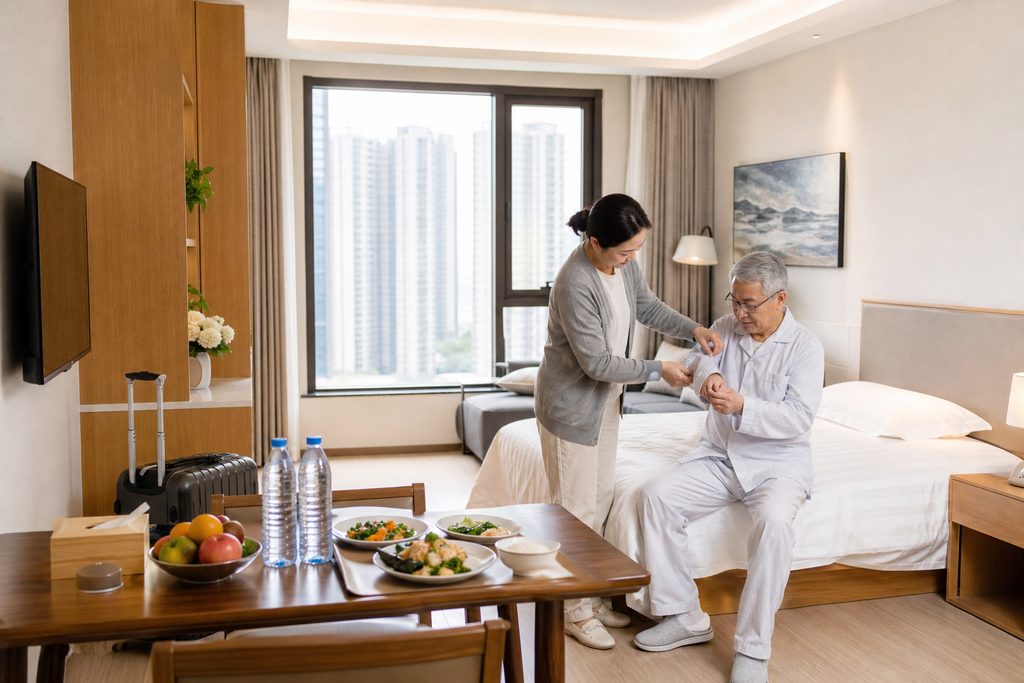
Hotels are a terrible idea for a 3-month stay. They’re expensive, they lack kitchens, and they’re isolating. The extended recovery accommodation China patients actually need falls into three practical categories.
Serviced apartments near the hospital. This is the most common choice. You get a furnished unit with a kitchenette, weekly housekeeping, and a front desk that can handle basic translation. In Shanghai, near Zhongshan Hospital or Ruijin Hospital, expect $2,500–$4,000 per month for a one-bedroom. In Chengdu near West China Hospital, the same setup runs $1,500–$2,500. Proximity matters. A 15-minute walk to the hospital versus a 45-minute taxi ride changes your daily experience of treatment.
Short-term rental apartments. Platforms like Ziroom and local agencies offer furnished rentals with 3-month minimums. These are cheaper — $1,200–$2,500 per month — but you handle your own utilities, repairs, and communication with landlords. If you don’t speak Mandarin, this gets difficult fast. We’ve seen patients lose deposits over miscommunication about lease terms they couldn’t read.
Hospital-affiliated recovery facilities. Some larger hospitals have attached rehabilitation centers or long-stay wards. These are clinical environments, not hotels. They’re appropriate for patients who need daily nursing or physiotherapy. Costs range from $150–$400 per day, including basic medical monitoring. Availability is limited, and you typically need the treating hospital to arrange the referral.
A Realistic Timeline
Here’s what an extended medical stay actually looks like on a calendar. This is based on a typical oncology or complex surgical case — adjust for your specific protocol.
| Phase | Duration | What Happens |
|---|---|---|
| Remote evaluation | 2–4 weeks | Records sent, translated, reviewed. Written second opinion delivered. Video consultation scheduled. |
| Visa processing | 2–4 weeks | S2 visa application with hospital invitation letter. Embassy processing times vary by country. |
| Arrival and initial consultation | Week 1 | In-person examination, diagnostic tests ordered (blood work, imaging, possibly biopsy). Treatment plan confirmed or adjusted. |
| Pre-treatment preparation | Week 2–3 | Additional diagnostics, specialist consults, pre-habilitation if needed. Hospital admission scheduled. |
| Active treatment phase | Weeks 3–10 | Surgery, chemotherapy cycles, or other primary intervention. Inpatient and outpatient mix. This is the core of your stay. |
| Early recovery and monitoring | Weeks 10–14 | Post-treatment observation, managing side effects, physiotherapy, follow-up imaging. |
| Discharge planning | Week 14–16 | Final assessment, home-going medication plan, referral letter for home-country physician, clearance to travel. |
Total: 16 to 20 weeks from first contact to departure. The active treatment portion might only be 6 to 8 weeks, but the surrounding logistics stretch the timeline considerably. The step most people underestimate is the gap between arrival and treatment start. Chinese hospitals run on their own diagnostic protocols. They will re-run tests. They will want their own imaging. This isn’t inefficiency — it’s standard practice at any responsible institution. Budget for it.
What Can Go Wrong — and What Happens Then
Extended stays multiply the number of things that can go sideways. Here are the failure modes we’ve seen, and what the actual recourse looks like.
Treatment complications extend the stay. A planned 8-week protocol becomes 14 weeks because of an infection, a poor response to medication, or a surgical revision. Your visa might not cover the extra time. Your accommodation lease might expire. Your insurance might balk. Recourse: S2 visas can be extended within China, but the process requires hospital documentation and takes 1 to 2 weeks. Accommodation can usually be extended month-to-month at a premium. Insurance pre-authorization for extended treatment needs to be initiated the moment the complication is identified, not after the fact.
The hospital changes the treatment plan. The initial remote evaluation suggested Protocol A. After in-person diagnostics, the team recommends Protocol B, which is longer and more expensive. This happens. Remote assessments are based on your existing records, which may be incomplete or outdated. Recourse: You’re not locked in. You can decline and return home. You can seek a second opinion at another Chinese hospital. Or you can proceed with the revised plan. The key is having financial buffer — we recommend budgeting 30% above the initial estimate for exactly this scenario.
Cultural and language isolation. Three months is a long time to be in a country where you can’t read menus, understand announcements, or chat with neighbors. The initial adrenaline of travel wears off around week 3. Recourse: A bilingual medical companion covers hospital days, but the rest of the time you’re on your own unless you arrange ongoing support. Some patients hire a part-time assistant for non-medical errands. Others connect with expat communities through platforms like WeChat groups. We can point you toward resources, but we can’t solve loneliness.
How to Arrange a Long-Term Hospital Stay in China Without Making Expensive Mistakes
Knowing how to arrange long-term hospital stay in China is less about the hospital itself — the institution handles admission — and more about the surrounding architecture of your stay. The mistakes we see patients make are predictable and avoidable.
Mistake 1: Choosing the hospital before understanding the protocol. Different hospitals have different strengths. Our specialist department rankings break down which institutions lead in specific fields. A hospital that’s excellent for liver surgery might be average for radiation oncology. Match the institution to the treatment, not the city you’d prefer to visit.
Mistake 2: Assuming public hospital international departments work like private clinics. They don’t. The international department of a top public hospital like Peking Union Medical College Hospital provides English-speaking coordination and a more comfortable environment, but you’re still inside a massive public institution. Wait times exist. Bureaucracy exists. The international department navigates it for you, but they don’t eliminate it. Expect the pace to be different from a private Western hospital.
Mistake 3: Not verifying insurance coverage for extended stays. Most international insurance policies cover acute care abroad but have exclusions or caps on “extended recuperation” or “maintenance therapy.” Read your policy’s definition of medical necessity. Call them. Get pre-authorization in writing for the full estimated duration, not just the procedure. If you’re paying out of pocket, get a detailed cost breakdown from the hospital before you commit. Public hospitals in China require pre-payment for international patients, typically in installments tied to treatment phases.
Mistake 4: Underestimating the visa timeline. The S2 visa is the correct category for medical treatment. It’s typically issued for 180 days or less. For stays longer than 180 days, you need an S1 visa. The hospital provides an invitation letter, but the embassy makes the decision. Processing times vary from 4 days to 4 weeks depending on your nationality and the specific embassy’s workload. Apply early. Don’t book non-refundable flights until the visa is in your passport.
Best Extended Stay Medical Facilities Shanghai and Beyond
Shanghai concentrates a significant portion of China’s top-tier medical resources, and the best extended stay medical facilities Shanghai offers tend to cluster around three hospital zones. But limiting your search to Shanghai misses excellent options in other cities where costs are lower and hospitals are equally distinguished.
Shanghai: Xuhui District near Zhongshan Hospital. Zhongshan Hospital, affiliated with Fudan University, ranks among China’s top institutions for cardiology, oncology, and hepatology. The surrounding neighborhood has the highest density of serviced apartments catering to medical travelers. Expect $3,000–$4,000 per month for a quality one-bedroom within walking distance. The area is well-served by international restaurants and has a sizable expat community, which matters when you’re staying for months.
Shanghai: Huangpu District near Ruijin Hospital. Ruijin is a comprehensive powerhouse with particular strength in hematology and endocrinology. Accommodation in central Huangpu is expensive — $3,500–$5,000 per month — but you’re in the heart of the city with easy access to everything. If your treatment allows you to be mobile and you want to actually experience Shanghai during your stay, this is the better location.
Beijing: Dongcheng District near Peking Union Medical College Hospital. PUMCH is arguably China’s most prestigious hospital. The Dongcheng area is central, historic, and expensive. Serviced apartments run $3,500–$5,000 per month. The hospital’s international department is well-established and accustomed to long-stay international patients.
Guangzhou: Yuexiu District near the First Affiliated Hospital of Sun Yat-sen University. Strong in oncology and organ transplantation. Accommodation costs drop noticeably: $1,800–$3,000 per month for a good serviced apartment. Guangzhou is a major international hub with direct flights to most continents, which simplifies travel logistics.
Chengdu: Wuhou District near West China Hospital. West China Hospital is one of China’s largest and handles enormous patient volumes. It’s particularly strong in respiratory medicine and orthopedics. Accommodation is the most affordable of the major medical cities: $1,500–$2,500 per month. The trade-off: fewer English-speaking amenities outside the hospital, and a smaller expat infrastructure.
For patients considering private international hospitals for long-term care, our directory of JCI-accredited private facilities includes options like United Family and Jiahui, which offer Western-style environments with English-speaking staff and direct insurance billing. These are more expensive — sometimes 2–3x the public hospital international department rates — but the experience is closer to what Western patients expect.
Medical Tourism Long Stay Packages China: What’s Actually Being Sold
The phrase “medical tourism long stay packages China” shows up in a lot of marketing.
Frequently Asked Questions
Yes. The hospitals used for international patients are JCI-accredited and follow the same international safety standards as top hospitals in the US and Europe. Surgical teams perform high volumes of procedures — often more than their Western counterparts — which studies show leads to better outcomes.
Costs vary by procedure and hospital, but international patients typically save 40-80% compared to US prices — even when factoring in travel and accommodation. A consultation with our team will give you an exact, all-inclusive quote with no hidden fees.
Send us your existing medical reports to get started. We handle everything from hospital selection and appointment scheduling to visa assistance and post-operative recovery planning. Your medical records are reviewed by the specialist before you even book a flight.
For more medical information and treatment options in China, visit chinamedservices.com (China Medical Services).
