Airport to Hospital Transfer Service China: Arrival Coordination Without the Chaos
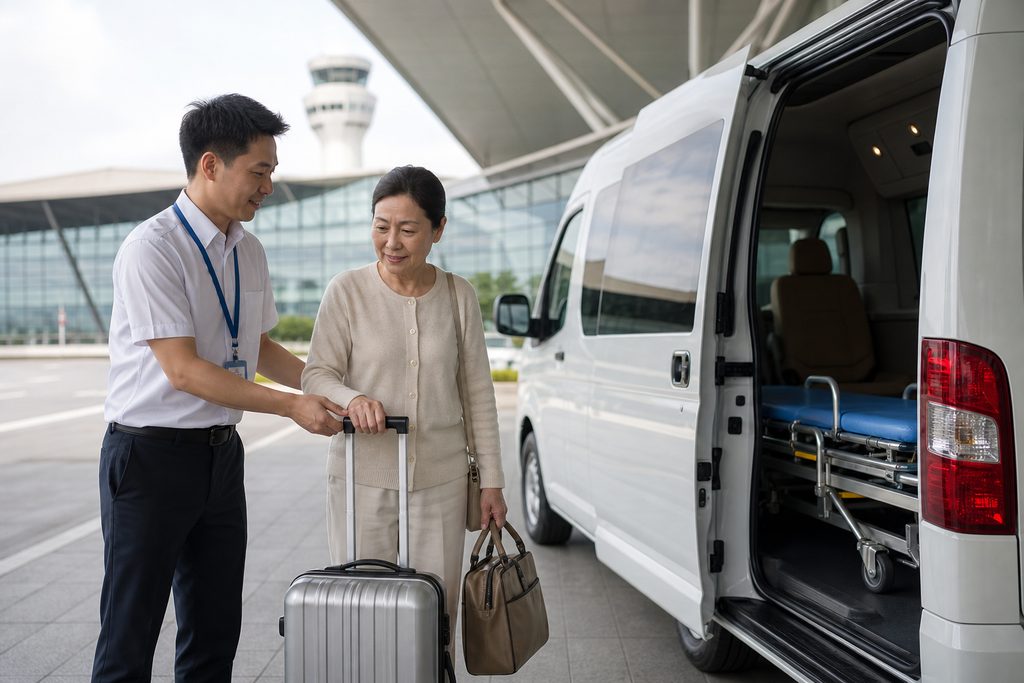
When 67-year-old Robert stepped out of Shanghai Pudong International Airport after a 14-hour flight from Houston, he was exhausted. His knee was throbbing. He had a surgery consultation scheduled at a major orthopedic center the next morning. But first, he had to figure out how to get from the arrivals gate to his hospital, navigate a language he did not speak, and check into accommodations he had only seen online. He stood in the terminal for twenty minutes, overwhelmed, before walking in the wrong direction toward the taxi queue.
That moment of arrival disorientation is the single most underestimated friction point in medical travel. Patients spend months researching surgeons and comparing procedure costs. They rarely think about the 90 minutes between the baggage carousel and the hospital lobby. Yet that window sets the tone for everything that follows.
An airport to hospital transfer service in China is not a luxury add-on. It is logistical infrastructure. For international patients arriving in cities like Beijing, Shanghai, or Guangzhou, a coordinated transfer bridges the gap between landing and treatment. It solves a problem that Google Maps and ride-hailing apps cannot fix alone: navigating a foreign healthcare system in a foreign language while physically depleted.
Key Takeaways
- A pre-arranged medical transfer eliminates the most common arrival failure point: language-barrier confusion at the airport that delays hospital check-in by hours or days.
- Shanghai Pudong Airport alone handled over 76 million passengers in 2023. Without a dedicated pickup, international patients face unstructured queues, unvetted drivers, and zero medical context support.
- Not all transfer services are equal. A driver with a sign is not the same as a bilingual coordinator who understands your hospital admission requirements, visa documentation, and medical timeline.
- Coordination means the transfer team communicates with your hospital’s international department before you land. Your arrival is expected, not a surprise.
The Problem: Your Flight Lands, and Then What?
Beijing Capital International Airport processes roughly 100 million passengers annually. Shanghai Pudong handles international arrivals across two massive terminals that span over 1.4 million square meters. These are not small regional airports. They are some of the busiest transit hubs on earth. For a patient who just spent 10 to 16 hours in the air, possibly in pain, possibly on medication, the sensory overload is real.
The default options look like this. Option one: join the taxi line. You will wait anywhere from 15 to 45 minutes. The driver will not speak English. You will show them a hospital address on your phone. They may or may not know the correct entrance. Many Chinese hospitals have multiple gates, separate buildings for international departments, and security checkpoints that standard taxis cannot pass. Option two: use a ride-hailing app like Didi. The app is in Mandarin. Payment requires a Chinese bank card or WeChat Pay linked to a mainland account. Your foreign SIM card may not have stable data. Option three: walk to the airport shuttle bus. These serve city-center routes, not specific hospital campuses. You will end up somewhere in the city with your luggage, still needing a second transfer.
None of these options account for what happens when you arrive at the hospital. The registration desk may not have English-speaking staff available at the hour you show up. Your appointment may require documents you did not know to bring. Your visa paperwork may need verification that only the international department can process during business hours. A bad arrival cascades into missed appointments, rescheduled consultations, and extended hotel stays you did not budget for.
This is not hypothetical. We see it regularly. Patients book their own logistics, save a few hundred dollars on the transfer, and lose two days of their medical itinerary untangling the mess.
Why a Coordinated Airport to Hospital Transfer Service in China Changes the Equation
A proper medical transfer is not transportation. It is arrival integration. The vehicle is the least important part. The value sits in the coordination layer that activates before your plane leaves the ground.
Pre-Arrival Hospital Liaison
Before you fly, your transfer coordinator confirms your admission or consultation details with the hospital’s international patient center. They verify which building you need, which entrance to use, what documents the registration desk requires, and whether any pre-admission tests are scheduled. This information shapes the transfer plan. If your hospital requires a COVID-era health declaration or a specific visa stamp page, the coordinator flags it before you board your flight. You do not discover the missing document at the check-in counter.
The coordinator also confirms your arrival flight number and monitors it in real time. Delays happen. A flight from Frankfurt that lands at 4:30 AM instead of 11:30 PM changes everything. The hospital may not have 24-hour international registration. The coordinator adjusts. They communicate with the hospital. They reschedule if needed. You land knowing someone on the ground already knows your situation.
Airport Meet-and-Greet: The First 15 Minutes
After clearing customs, you walk into the arrivals hall. A bilingual coordinator is waiting with your name on a sign. They speak English. They know your medical context. They help with your luggage. They guide you to a pre-vetted vehicle — not a random taxi, but a clean, air-conditioned car or van with a driver who knows the exact hospital destination and the fastest route at that time of day.
This sounds simple. It is not. The difference between a generic airport pickup sign and a medical transfer meet-and-greet is that the latter comes with situational awareness. The coordinator knows you are post-flight, possibly jet-lagged, possibly in discomfort. They do not rush you. They answer questions. They confirm the next day’s schedule. They hand you a local SIM card if you arranged one. They make sure you drink water.
Hospital Arrival and Handoff
The vehicle takes you directly to the correct hospital entrance. Not the main gate. Not the emergency department. The international patient entrance, if one exists, or the specific building where your department is located. The coordinator walks you to the registration area. They handle the initial check-in conversation in Mandarin. They ensure the hospital staff have your records. They stay until you are settled, whether that means admitted to a ward or confirmed at a nearby hotel with clear instructions for the following morning.
This handoff is where most self-arranged transfers fail. A taxi drops you at the main gate. You wander into a lobby with 5,000 people. You cannot read the signs. You cannot ask for directions. You waste an hour finding the right desk, only to learn it closed 30 minutes ago.
How to Get from Shanghai Airport to Hospital: The Two-Hub Reality
Shanghai has two international airports: Pudong International and Hongqiao International. They serve different flight routes and are 45 kilometers apart. If you search “how to get from Shanghai airport to hospital,” you need to know which airport you are flying into, because the logistics are not interchangeable.
Pudong is the primary long-haul hub. Most intercontinental flights from North America, Europe, and the Middle East land here. The airport sits about 30 kilometers east of the city center. Major hospital clusters — including those in Xuhui, Jing’an, and the Pudong New Area — are 40 to 60 minutes away by car, depending on traffic. The Maglev train runs from Pudong to Longyang Road station in about 8 minutes, but that still leaves you with a metro transfer or taxi ride to your hospital. For a patient with luggage and limited mobility, the Maglev is not practical.
Hongqiao handles domestic flights and shorter regional international routes from Japan, Korea, and parts of Southeast Asia. It is closer to the city center. Several top-ranked hospitals, including those near the former French Concession, are within a 20 to 30-minute drive. But Hongqiao is also integrated with a massive railway station. The pedestrian flow is dense. Finding your pickup point requires navigating multiple levels.
In both airports, a pre-arranged medical transfer eliminates the guesswork. The coordinator selects the optimal pickup zone based on your terminal and flight. They monitor your flight status. They adjust for early arrivals and late landings. You do not need to figure out which exit gate to use or whether your driver can access the arrivals level parking.
Shanghai’s top hospitals for international patients — including those listed in our Shanghai hospital directory — are spread across the city. A transfer that seems simple on a map can take 90 minutes in Friday evening traffic. Local knowledge matters.
Medical Transport from Airport to Hospital Beijing: Scale and Complexity
Beijing Capital International Airport is the busiest in China by international passenger volume. It is also 25 kilometers northeast of the city center, with hospital clusters concentrated in Dongcheng, Xicheng, Haidian, and Chaoyang districts. The drive from the airport to Peking Union Medical College Hospital, for example, takes 40 minutes without traffic and over an hour during peak times.
Beijing Daxing International Airport, opened in 2019, serves a growing share of international routes. It sits 46 kilometers south of the city. A transfer from Daxing to a hospital in Haidian district can take 90 minutes. If you booked your own flight and did not check which Beijing airport you were landing at, you might be in for a surprise.
Medical transport from airport to hospital Beijing requires more than a car and driver. Beijing’s traffic is unpredictable. The city has license-plate-based driving restrictions that change daily. Some vehicles cannot enter certain zones on specific weekdays. A professional transfer service uses drivers and vehicles that are compliant with these rules and experienced with hospital-area navigation. They know which hospital entrances are open at which hours. They know that some hospital campuses have internal shuttle buses because the distance between the gate and the correct building is half a kilometer.
Beijing’s top medical institutions — including those in our Beijing hospital listings — serve a high volume of international patients. Their international departments are accustomed to receiving patients who arrive via coordinated transfer. When the transfer coordinator calls ahead, the hospital knows to expect you. That small communication loop prevents the all-too-common scenario of a patient arriving at 2:00 PM for a consultation that was actually scheduled for 10:00 AM because of a time zone misunderstanding.
China Medical Tourism Airport Pickup Service: Beyond the Vehicle
The phrase “China medical tourism airport pickup service” suggests a simple transaction: someone picks you up. The reality is more layered. Medical travel to China is growing. The country’s top hospitals now treat hundreds of thousands of international patients annually across oncology, cardiology, orthopedics, and other specialties. These patients share a common need: they want the clinical expertise without the logistical friction.
A genuine medical pickup service includes several components that a standard airport transfer does not:
- Medical context awareness. The coordinator knows your diagnosis, your treatment plan, and your physical limitations. They do not need to be told why you cannot carry heavy luggage or why you need to stop for medication at a specific time.
- Hospital communication. Before you land, the service confirms your appointment, verifies required documents, and alerts the hospital to your arrival time. This prevents the “we did not know you were coming today” problem.
- Language bridging. The coordinator handles all Mandarin communication from the moment you exit customs. You do not fumble with translation apps at the registration desk.
- Contingency planning. If your flight diverts, if you feel unwell upon landing, if the hospital needs to reschedule — the coordinator manages the change. You focus on your health.
This level of service costs more than a taxi. Our airport transfer coordination starts from $200 round-trip. The price reflects the pre-arrival liaison, the bilingual meet-and-greet, the vetted vehicle, and the hospital handoff. It does not include the cost of the consultation or treatment itself. For patients who are already investing in international medical travel, this is typically a small fraction of the total trip cost — and it is the part that most directly determines whether the first 24 hours go smoothly or fall apart.
Best Airport Transfer for International Patients China: What to Look For
Not all transfer services are built for medical travelers. If you search for the best airport transfer for international patients in China, you will find everything from luxury hotel cars to budget shuttle vans. Here are the criteria that separate a medical-grade transfer from a generic ride.
First, bilingual coordination. The driver does not need to be a medical professional, but the coordinator who meets you should speak fluent English and understand medical terminology. They need to explain your symptoms to a registration nurse if required. They need to read a hospital admission form and confirm the details are correct before you sign.
Second, hospital-specific knowledge. The service should have direct experience with your destination hospital. They should know which entrance to use, where the international department is located, and what the check-in process looks like. A driver who has never been to West China Hospital in Chengdu will not know that the campus is essentially a small city with multiple internal roads and buildings spread across a vast area.
Third, real-time flight monitoring. Your transfer should not be based on your scheduled arrival time. It should be based on your actual landing time. The coordinator should track your flight and adjust pickup accordingly. If your flight is three hours late and you land at 2:00 AM, someone should still be there.
Fourth, vehicle quality and insurance. The car should be clean, air-conditioned, and properly insured for commercial passenger transport. This is not always the case with informal drivers who solicit passengers at the airport. Legitimate medical transfer services use licensed vehicles with proper insurance coverage.
Fifth, integration with the broader medical itinerary. The best airport transfer is one that connects to a coordinated medical visit. The same team that picks you up should be able to provide bilingual companionship for your hospital consultations the next day. Continuity matters. You do not want to explain your situation to a new person every time you need help.
For patients considering treatment at China’s top-ranked hospitals, the transfer is the first touchpoint in a longer care journey. It should feel like the beginning of a supported process, not an isolated transaction.
Hospital Shuttle Service for Foreign Patients China: The Inpatient and Follow-Up Phase
Arrival is one piece. Many international patients need ongoing transport during their stay. A hospital shuttle service for foreign patients in China covers the gaps: hotel-to-hospital transfers for daily consultations, post-procedure follow-ups, and discharge-day logistics.
After a procedure, you may not be in a condition to navigate public transport or hail a taxi. You may have mobility restrictions. You may be on pain medication. You may need to return to the hospital for wound checks or imaging every few days. A dedicated shuttle service with a familiar driver and coordinator removes the daily friction. You are picked up at a consistent time. You are taken to the correct department. You are accompanied through the check-in process. You are driven back to your accommodation afterward.
Discharge day deserves special attention. Patients often underestimate how much coordination is involved. You need to settle your hospital bill, collect your medical records, receive discharge instructions, fill prescriptions, and arrange transport to your hotel or airport. A bilingual coordinator on-site can compress what might take an unassisted patient four hours into about 90 minutes. They know which counters to visit, in which order, and what paperwork each requires.
For patients who are discharged directly to the airport for a return flight, the shuttle service handles the timeline. They coordinate with the hospital to ensure discharge happens with enough buffer for the drive to the airport, check-in, and security. They do not let you cut it too close. Missing a flight because discharge paperwork took longer than expected is an expensive mistake that happens more often than it should.
Practical Considerations: Documentation, Payment, and Communication
Arranging a medical transfer involves a few practical steps that are worth understanding before you book.
What you need to provide. Your flight number, arrival date and time, terminal information, and the name and address of your destination hospital. Also, a brief summary of your medical situation and any mobility limitations. If you use a wheelchair, the vehicle needs to accommodate that. If you are traveling with family members, the vehicle size needs to match the group.
Payment. Most coordinated transfer services accept international credit cards, wire transfers, or payment through platforms like PayPal. You typically pay in advance or provide a deposit. The price should be quoted clearly before you commit. Our airport transfer coordination starts from $200 round-trip, with the final quote confirmed based on distance, vehicle type, and any additional coordination requirements.
Visa documentation. For medical travel to China, you will be on an S2 visa (short-term private affairs, including medical treatment) or an S1 visa for stays exceeding 180 days. Your transfer coordinator does not handle visa issuance, but they can verify that your documentation matches what the hospital expects. Mismatched visa categories cause delays at hospital registration. We have seen patients arrive on L (tourist) visas and get turned away because the hospital’s international department requires the correct medical-purpose visa for certain procedures.
Communication during transfer. The coordinator carries a local phone with data. They can reach the hospital, your accommodation, and our coordination team. You should have a way to reach them as well — ideally through a messaging app that works on Wi-Fi, since your foreign SIM may not have reliable data upon landing.
Insurance and liability. Legitimate transfer services carry commercial
Frequently Asked Questions
Yes. The hospitals used for international patients are JCI-accredited and follow the same international safety standards as top hospitals in the US and Europe. Surgical teams perform high volumes of procedures — often more than their Western counterparts — which studies show leads to better outcomes.
Costs vary by procedure and hospital, but international patients typically save 40-80% compared to US prices — even when factoring in travel and accommodation. A consultation with our team will give you an exact, all-inclusive quote with no hidden fees.
Send us your existing medical reports to get started. We handle everything from hospital selection and appointment scheduling to visa assistance and post-operative recovery planning. Your medical records are reviewed by the specialist before you even book a flight.
For more medical information and treatment options in China, visit chinamedservices.com (China Medical Services).
