Adaptive Deep Brain Stimulation aDBS in China: Accessing Closed-Loop Tech for Parkinson’s
How This Actually Works, Step by Step
What if your brain implant could listen before it acts? That is the core promise of adaptive deep brain stimulation. It changes the calculus for Parkinson’s patients who have hit a wall with medication. But getting it across borders feels like navigating a maze blindfolded.
The process breaks down into clear stages. You are not just buying a device. You are orchestrating a complex clinical evaluation that starts long before you board a plane.
First, we need your current medical records. Not summaries. The raw data. A recent DaTscan or MRI, your UPDRS scores, a detailed medication diary showing your “on” and “off” states. Our team translates this into clinical Chinese and submits it to the neurology department at a top-tier hospital. This is not a casual email. It is a formal clinical packet prepared to the exact specifications of the receiving hospital’s international patient center.
What comes back is a preliminary assessment. Usually within 5 to 7 business days. The neurosurgeon and movement disorder specialist review your records together. They answer one question: are you a likely candidate for aDBS? If the answer is no, you have saved yourself a wasted trip. You get a detailed written explanation why. If the answer is yes, we move to the next stage.
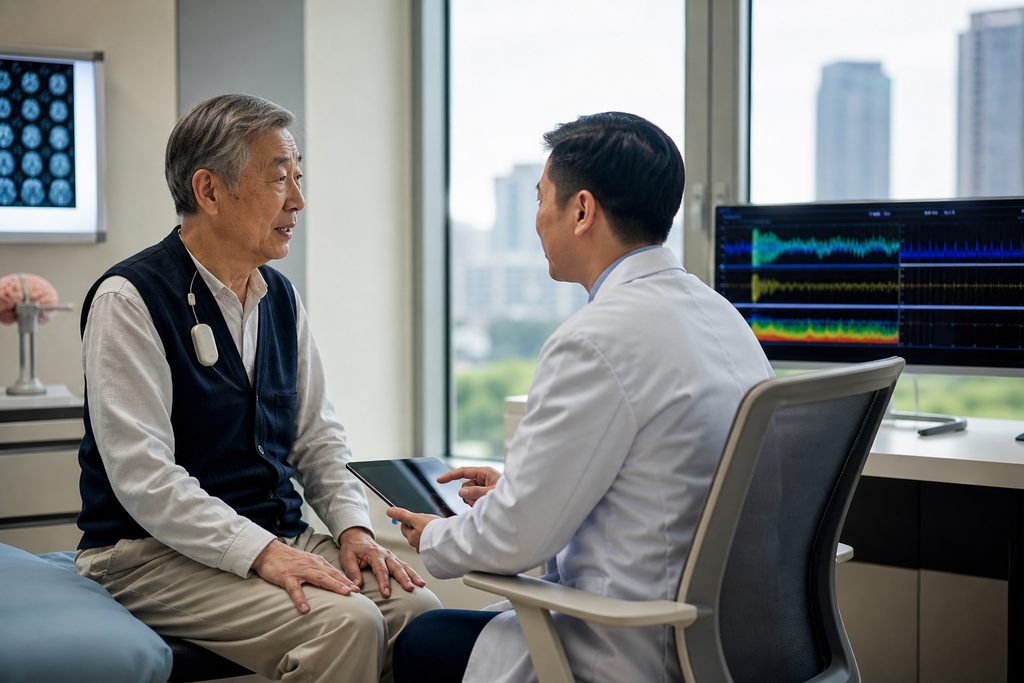
We schedule a video consultation. You speak directly with the team that would operate. They explain their approach to closed-loop programming. You ask every question. Only after both sides agree that proceeding makes sense do we coordinate dates, visas, and travel. The surgery itself requires a hospital stay of roughly two to three weeks, including the initial programming sessions. You go home with a system that learns your neural signatures and adjusts stimulation in real time.
How Does Closed-Loop DBS Work for Parkinson’s?
The standard DBS system your neurologist mentioned is open-loop. Think of it as a metronome. The surgeon implants an electrode in a deep brain structure—usually the subthalamic nucleus (STN) or globus pallidus internus (GPi). A pulse generator in your chest delivers constant, unchanging electrical stimulation. It does not matter if you are sleeping, shaking, or sitting still. The signal is the same.
Your brain does not work like a metronome. Parkinson’s symptoms fluctuate. Medication levels rise and fall. Stress, fatigue, and excitement all change your neural activity. A fixed stimulation setting is a blunt instrument. It often overtreats you when symptoms are mild, wasting battery life and causing side effects like slurred speech or dyskinesia. It undertreats you when symptoms surge.
Adaptive DBS closes the loop. The implanted electrode does not just stimulate. It also records. It senses local field potentials—specifically, beta-band oscillations in the STN that correlate tightly with your motor symptoms. When beta power spikes, the system increases stimulation. When beta power drops, it dials back. This happens automatically, hundreds of times per second.
Clinical evidence is building fast. A 2024 study published in Nature Medicine demonstrated that aDBS improved motor symptom control by approximately 50% compared to optimized continuous DBS, with significantly fewer stimulation-induced side effects. Another trial from UCSF showed the system could adapt not just to movement states but even to medication cycles. The technology is not theoretical. It is being implanted in patients right now.
This matters for a practical reason. Programming a traditional DBS system takes months of trial-and-error clinic visits. Each adjustment requires a specialist to manually tweak dozens of parameters. aDBS automates the hardest part of that process. It learns your brain’s patterns during the initial recording sessions and builds a personalized algorithm. The device becomes more tailored to you over time, not less.
Adaptive Deep Brain Stimulation Cost China: A Real Breakdown
Let us talk numbers. Not vague promises. Actual figures that let you compare.
The cash price for a complete aDBS system—including the sensing-enabled implantable pulse generator, directional leads, and surgical fees—runs between $38,000 and $55,000 at leading Chinese neurosurgery centers. This covers the device, the inpatient stay, the operating room, anesthesia, and the initial programming sessions. It does not include travel, accommodation, or post-operative rehabilitation. Those add another $5,000 to $8,000 depending on how long you stay.
Why such a wide range? The sensor-enabled generators from Medtronic (Percept™ RC with BrainSense™ technology) and Boston Scientific (Vercise™ Genus with Neural Navigator) carry different price tags. Hospitals in Beijing and Shanghai tend toward the higher end. Centers in cities like Chengdu or Guangzhou can be more economical. Your specific clinical needs—bilateral versus unilateral, the number of programming days required—shift the final number.
Context makes this clearer. The same procedure in the United States typically costs between $80,000 and $130,000 for the device and surgery alone. In Western Europe, expect €60,000 to €90,000. The gap is real and persistent. Even factoring in international flights, accommodation for a companion, and our coordination fees, the total cost of coming to China for aDBS often lands at 40-60% of the US sticker price.
| Cost Component | China (USD) | United States (USD) |
|---|---|---|
| aDBS Device & Implant | $30,000 – $42,000 | $55,000 – $85,000 |
| Surgical & Hospital Fees | $8,000 – $13,000 | $25,000 – $45,000 |
| Initial Programming (2 weeks) | Included | $5,000 – $10,000 |
| International Patient Coordination | $5,000 – $8,000 | N/A |
| Estimated Total Range | $43,000 – $63,000 | $85,000 – $140,000 |
A note on what “included” means here. Chinese hospitals typically bundle the initial inpatient programming sessions into the surgical package. You are not billed separately for each hour a neurologist spends adjusting your settings while you are admitted. This is different from some Western billing models where each programming session generates a separate charge.
Our video consultation fee—which ranges from $500 to $800 for a top-specialist session—is fully credited toward your coordination fee if you proceed with surgery within 90 days. We structure it this way to lower the barrier to getting expert input. You are not committing to surgery by doing a consultation. You are buying clarity.
A Realistic Timeline
This is not a fast process. Anyone promising you a surgical date in two weeks is not being honest about how Chinese hospitals work. The evaluation alone takes time. Here is what a realistic sequence looks like, based on cases we have coordinated.
| Stage | What Happens | Typical Duration |
|---|---|---|
| Week 1–2 | You gather and send us your medical records. We professionally translate them into clinical Chinese. This includes your MRI, DaTscan, medication diary, and neurologist’s referral letter. | 10–14 days |
| Week 3–4 | The hospital’s neurosurgery department reviews your file. A movement disorder specialist and functional neurosurgeon jointly assess candidacy. We receive a preliminary written opinion. | 7–14 days |
| Week 5–6 | If the opinion is positive, we schedule a video consultation. You speak directly with the surgical team. They explain their approach to closed-loop DBS, answer your questions, and confirm the treatment plan. | 7–14 days |
| Week 7–10 | Visa processing. You apply for an S2 visa with the hospital’s invitation letter and treatment confirmation. Processing times vary by country. We guide you through the documentation requirements. | 2–4 weeks |
| Week 11–12 | Travel to China. You arrive, settle into accommodation, and complete pre-operative tests (blood work, chest X-ray, ECG, a fresh brain MRI). These are done over 2–3 days. | 3–5 days |
| Week 13–14 | Surgery. The DBS leads are implanted, typically with you awake for part of the procedure to confirm lead placement. The pulse generator is placed under the skin in your chest. Hospital stay is 5–7 days post-op. | 5–7 days |
| Week 15–16 | Initial programming. The closed-loop system records your neural signals. The team sets the adaptive parameters. You return daily or every other day for adjustments. This phase determines how well the system learns your brain. | 10–14 days |
| Month 4–6 | Back home. You follow up with your local neurologist. The Chinese team is available for remote consultation if adjustments are needed. The system continues to refine its algorithm over months. | Ongoing |
The waiting step people underestimate is the visa. An S2 visa for medical treatment requires a formal invitation letter from the hospital, proof of treatment arrangement, and sometimes additional supporting documents depending on your country of residence. We handle this paperwork. But the processing time at the Chinese embassy or consulate is outside anyone’s control. Budget four weeks and hope for two.
What Can Go Wrong — and What Happens Then
Let us be direct about the risks. Adaptive DBS is a brain surgery. Things do not always go perfectly. The question is what recourse exists when they do not.
The most common complication is electrode placement that is slightly off-target. This happens in roughly 2-4% of cases even at excellent centers. The result is suboptimal symptom control or stimulation-induced side effects like speech difficulties or muscle pulling. The fix is usually a revision surgery to reposition the lead. Top Chinese neurosurgery departments have extensive experience with this—they perform hundreds of DBS implants annually and have established protocols for revision. The hospital typically covers the cost of a revision if the misplacement is determined to be surgical. We help you navigate that conversation and extend your visa if needed.
Infection at the surgical site or pulse generator pocket occurs in about 3-5% of cases. Chinese hospitals follow international sterile protocol. But the risk is never zero. If an infection develops after you return home, your local healthcare system manages it. The Chinese team provides your records and imaging to support that care. In rare cases where the hardware must be removed, the device manufacturer’s warranty typically covers replacement. We coordinate between you, the hospital, and the device representative.
What if the adaptive algorithm does not work well for you? This is a real possibility. Closed-loop systems rely on detecting a clear beta-band signal. In a minority of patients—estimates range from 10-15%—the signal is too weak or variable for reliable adaptive control. If this happens, the device can be switched to traditional open-loop mode. You still have a functional DBS system. It just operates continuously rather than adaptively. The Chinese team will work with you on programming in either mode. You have not lost the investment. You have simply ended up with the standard therapy you would have received anywhere, at a lower cost.
The hardest scenario is when a patient is deemed not a candidate after arriving in China. This is rare because of the rigorous remote screening. But it can happen if the pre-operative MRI reveals something missed on earlier scans. If surgery is cancelled for medical reasons, the hospital refunds the surgical and device fees. Our coordination fee is partially refundable on a prorated basis depending on how much service has been delivered. We carry professional indemnity insurance for exactly this situation.
Best aDBS Hospitals China for Parkinson’s: How to Evaluate Them
Not every hospital that offers DBS offers adaptive DBS. The technology requires specific hardware and specialized programming expertise. Asking the right questions separates centers that dabble from centers that excel.
The first filter is volume. A center performing fewer than 50 DBS implants per year lacks the case experience to handle the edge cases. The top functional neurosurgery centers in China perform 200-400 DBS surgeries annually. They have seen the anatomical variations, the tricky lead trajectories, the patients who do not respond typically. Volume is not a guarantee of quality. But it is a prerequisite.
Beijing hosts several of these high-volume centers. Xuanwu Hospital, affiliated with Capital Medical University, runs one of the largest movement disorder surgery programs in the world. Their team has been implanting sensing-enabled systems since they became available in China. Tiantan Hospital, another Beijing powerhouse, publishes extensively on DBS outcomes and has a dedicated international patient center accustomed to managing foreign cases from initial inquiry through follow-up. For patients specifically searching for adaptive deep brain stimulation available in Beijing, these are the names that appear repeatedly in both the medical literature and our referral patterns.
Shanghai offers strong alternatives. Ruijin Hospital, affiliated with Shanghai Jiao Tong University School of Medicine, has a functional neurosurgery department that was an early adopter of closed-loop technology. Their movement disorder team includes neurologists who specialize exclusively in DBS programming—a subspecialty that matters enormously for aDBS outcomes. The device is only as good as the programming. Huashan Hospital, also in Shanghai, runs a similarly large program with strong academic output.
Outside the two main hubs, West China Hospital in Chengdu and the First Affiliated Hospital of Sun Yat-sen University in Guangzhou both run substantial DBS programs with aDBS capability. These centers can be more accessible in terms of scheduling and sometimes offer lower overall costs. The trade-off is that their international patient infrastructure may be less developed. We help bridge that gap with bilingual coordination.
What should you ask in a consultation? First, how many adaptive DBS cases has the surgeon completed specifically—not total DBS cases. Second, what programming protocol do they use for the initial closed-loop calibration? Third, what is their protocol for patients whose beta signal is insufficient for adaptive control? Fourth, what remote follow-up do they offer after you return home? The answers reveal whether you are dealing with a team that has systematized aDBS or one that is still figuring it out.
Our hospital database covers 340+ top-ranked hospitals across 37 cities, including those with dedicated functional neurosurgery departments. We do not push patients toward any single institution. We match based on your specific clinical profile, budget, and timeline.
Practical Considerations: Records, Visas, and Follow-Up
You cannot just show up. The preparation determines the outcome.
Medical records. You need a complete set, in English, that we translate professionally. Minimum requirements: a neurological examination report from within the last six months, a brain MRI (preferably 3T) from within the last year, a DaTscan if available, a detailed medication and symptom diary covering at least one week, and a letter from your current neurologist supporting your candidacy for DBS. Missing any of these delays the process. We tell you exactly what is needed before we start.
Visa category. Medical treatment in China falls under the S2 visa, a short-stay category for private affairs including medical visits. The hospital issues a formal invitation letter and treatment confirmation that you submit with your application. Your companion applies under the same category. Processing takes two to four weeks depending on your jurisdiction. We provide a document checklist and review your application before submission. We do not guarantee approval—no one can—but we ensure your paperwork meets the current requirements of the Chinese embassy or consulate handling your case.
Payment. Chinese public hospitals require payment before treatment. The device cost and surgical deposit are typically due upon admission. International wire transfers are standard. Some hospitals accept major credit cards, but not all. We advise you on the payment mechanics for your specific hospital and help you avoid transfer delays that could postpone surgery. Private international hospitals in China, such as those in the United Family network, may offer direct insurance billing. But the high-volume DBS centers are almost all public institutions that operate on a fee-for-service basis with upfront payment.
Language. The surgeons at top Chinese hospitals often speak some English, especially those who have trained or published internationally. But the nursing staff, administrative personnel, and technicians generally do not. A bilingual medical companion is not a luxury. It is the difference between understanding your post-operative instructions and guessing. Our companion service provides a medically fluent translator who stays with you during consultations, pre-op testing, the hospital admission, and the critical programming sessions. They also handle the mundane but essential tasks—registering at each department, collecting results, scheduling follow-up appointments—that would otherwise consume your energy and patience.
Follow-up at home. Adaptive DBS systems allow for remote monitoring and adjustment. The Chinese team can review your device data and make programming changes via a secure patient programmer that connects to the internet. This is not as immediate as an in-person visit
Frequently Asked Questions
Yes. The hospitals used for international patients are JCI-accredited and follow the same international safety standards as top hospitals in the US and Europe. Surgical teams perform high volumes of procedures — often more than their Western counterparts — which studies show leads to better outcomes.
Costs vary by procedure and hospital, but international patients typically save 40-80% compared to US prices — even when factoring in travel and accommodation. A consultation with our team will give you an exact, all-inclusive quote with no hidden fees.
Send us your existing medical reports to get started. We handle everything from hospital selection and appointment scheduling to visa assistance and post-operative recovery planning. Your medical records are reviewed by the specialist before you even book a flight.
For more medical information and treatment options in China, visit chinamedservices.com (China Medical Services).
