Awake Craniotomy in China: Preserving Brain Function During Tumor Surgery
How This Actually Works, Step by Step
You’ve probably heard that brain surgery means a terrifying trade-off: remove the tumor, risk losing speech, movement, or memory. That belief is outdated. For the right patient, an awake craniotomy with brain mapping flips the script. The surgeon removes the tumor while you talk, move, and respond. The goal isn’t just survival. It’s survival with your identity intact.
Here’s the sequence if you’re considering this in China.
First, you send us your existing records. That means the MRI with contrast, the pathology report if you have one, and any neurological assessment notes. DICOM files are ideal. PDFs work. Our team translates everything into clinical Chinese. This step is unglamorous but non-negotiable. Chinese neurosurgery departments won’t schedule a video consultation without complete imaging.
Second, we route your case to a neurosurgery department with a dedicated awake craniotomy program. Not every hospital does these routinely. The ones that do perform hundreds annually. That volume matters. A team that does 200 awake craniotomies a year has muscle memory for the unexpected. A team that does 12 doesn’t.
Third, you get a written second opinion or a video consultation. The neurosurgeon reviews your films, explains what’s resectable, what’s near eloquent cortex, and what functional risks are real versus theoretical. You hear it directly. We translate. You ask every question that’s keeping you up at night.
Fourth, if you decide to proceed, we coordinate the S2 visa application with the hospital’s invitation letter, schedule the pre-operative workup, and arrange your arrival. The mapping happens in the OR. The surgery happens while you’re awake for the critical resection phase. You go home with a plan for follow-up imaging that your local neurologist can handle.
Why Brain Mapping During Tumor Surgery in China Changes the Risk Equation
Brain mapping during tumor surgery China isn’t a niche experiment. It’s standard of care at major neurosurgery centers for gliomas near eloquent cortex. The principle is straightforward: electrical stimulation of the cortical surface temporarily disrupts function in the tissue beneath the probe. If stimulating a spot stops you from naming a picture, that spot isn’t safe to cut. If stimulation does nothing, the tissue is likely safe for resection.
The data backs this up. A 2012 meta-analysis published in the Journal of Clinical Oncology reviewed 8,091 patients who underwent glioma surgery. Patients who received intraoperative stimulation mapping had significantly fewer late severe neurological deficits (3.4%) compared to those who did not (8.2%). More importantly, gross total resection rates were higher in the mapping group. Surgeons removed more tumor because they knew where the boundaries were.
Chinese neurosurgery programs have adopted this technique aggressively. The volume is the differentiator. A single high-volume center in Beijing may perform more awake craniotomies in a year than many European centers do in five. That repetition breeds protocol refinement. The anesthesia team knows the exact sedation depth for each phase. The neuropsychologist knows which language tasks to run for a trilingual patient. The nursing team knows how to keep you calm when the drapes come down and you realize you’re mid-surgery, talking to a stranger.
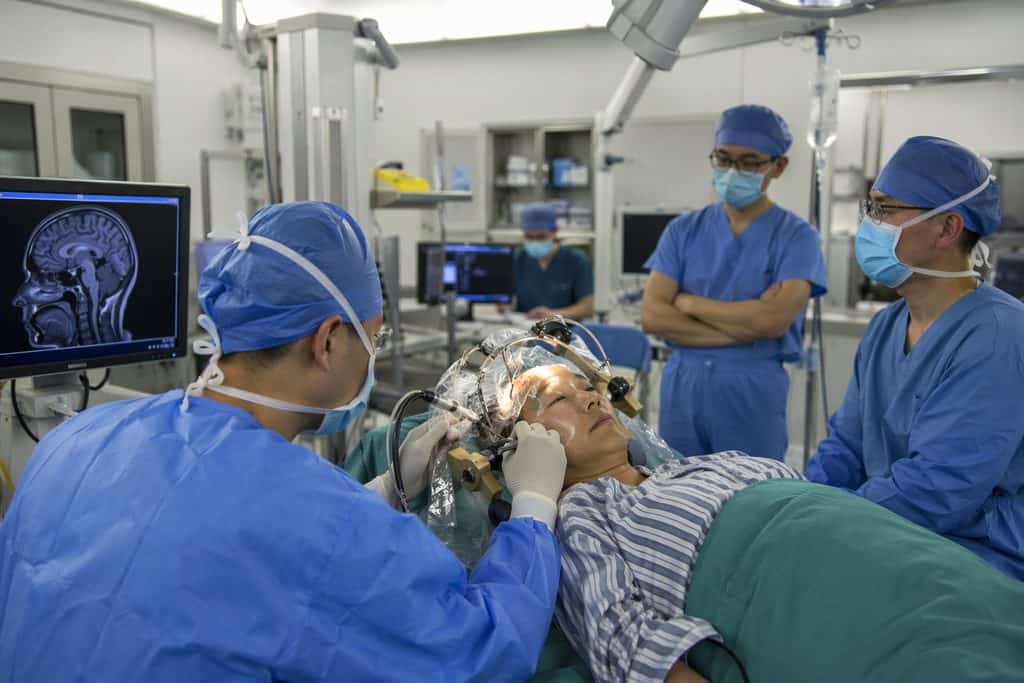
What is awake brain surgery like in China? The experience varies by hospital, but the clinical protocol is internationally standardized. You’re sedated for the opening and closing phases. During mapping and resection, you’re alert, responding to tasks on a screen. A speech therapist or neuropsychologist runs object-naming, verb-generation, or counting exercises. Your arm or leg might be asked to move. The surgeon maps, marks safe margins, and resects. You don’t feel pain. The brain has no pain receptors. The scalp and skull are fully anesthetized.
Our team has accompanied patients through this at hospitals listed in the Fudan ranking’s neurosurgery top 10. These are programs where awake craniotomy is Tuesday, not a special event. That normalcy is what you want.
A Realistic Timeline
This is not a fast process. Anyone promising a two-week turnaround from first contact to surgery is lying or dangerously optimistic. Here’s what to expect.
| Phase | What Happens | Typical Duration |
|---|---|---|
| Record collection and translation | You gather MRIs, reports, pathology. We translate into clinical Chinese. | 3–7 days |
| Department review and opinion | Your case goes to a neurosurgeon for written second opinion or video consult scheduling. | 5–14 days |
| Video consultation | You speak with the surgical team. Questions answered. Surgical candidacy confirmed or ruled out. | 1–2 days to schedule; 30–60 min call |
| Decision and deposit | You decide to proceed. Coordination fee paid. Hospital sends invitation letter for visa. | 2–5 days |
| S2 visa processing | Application, supporting documents, embassy/consulate processing time. | 1–4 weeks (varies by country) |
| Travel and pre-op workup | Arrival, hospital registration, repeat MRI, anesthesia clearance, surgical scheduling. | 3–7 days |
| Surgery and acute recovery | Awake craniotomy, ICU observation (usually 1 night), ward recovery. | 5–10 days in hospital |
| Post-discharge local stay | Stitch removal, early follow-up, clearance to fly. | 7–14 days |
Total realistic timeline from first contact to flying home: 6 to 12 weeks. The biggest variables are visa processing and the neurosurgeon’s schedule. Top surgeons book weeks out. That’s not a bug. It’s a signal that they’re in demand for a reason.
One step people consistently underestimate: the pre-operative repeat MRI. Even if you had an MRI last month at home, the surgical team will almost always want their own scan on their own machine with their own protocols. This isn’t redundant. It’s surgical planning precision. Budget 2-3 extra days for this.
What Can Go Wrong — and What Happens Then
The anesthesiologist is monitoring you continuously. If anxiety becomes unmanageable, sedation can be deepened. But this may end the mapping and limit the resection. The best prevention is a thorough pre-operative conversation with the team so you know exactly what to expect. Some patients find the experience strange but not terrifying. Others find it genuinely fascinating. The team’s job is to keep you in the zone where you can participate without distress.
You shouldn’t. Any reputable program will require a formal review of your imaging and a consultation — at minimum a video call — before scheduling surgery. This is a medical necessity, not bureaucratic friction. The surgeon needs to determine whether your tumor is actually suitable for awake craniotomy. Some tumors in eloquent areas are better approached with other techniques. Booking surgery sight-unseen is a red flag, not a convenience.
It goes to pathology. The full histopathological and molecular analysis — including IDH mutation status, 1p/19q codeletion, and MGMT promoter methylation for gliomas — typically takes 7–14 days. These results determine whether you need radiation, chemotherapy, or surveillance only. The pathology report will be translated into English for your home oncologist. Molecular testing standards at major Chinese academic centers are equivalent to Western labs.
Yes. The all-in cost at a top Chinese neurosurgery center’s international department typically ranges from $25,000 to $45,000 USD. The same procedure in the US often runs $120,000–$180,000. In Western Europe, $60,000–$90,000 is common. The cost difference reflects lower hospital operating costs and professional fees in China, not lower quality. The surgical technique, intraoperative monitoring equipment, and pathology standards are comparable to international norms at Fudan-ranked neurosurgery departments.
Your Next Step
An awake craniotomy is a serious decision. The information here gives you a framework for evaluating your options. It doesn’t replace a neurosurgeon’s assessment of your specific films and functional anatomy.
Our team at China Medical Services handles the logistics that make international neurosurgical care possible: record translation, hospital matching to high-volume awake craniotomy programs, video consultation coordination, visa invitation letters, and on-the-ground bilingual accompaniment. We do not perform surgery. We do not make medical recommendations. We connect you with surgical teams that do this work every week, and we make sure you understand every step in your own language. When you’re ready to explore whether this path makes sense for your case, reach out for a free initial consultation. No pressure. Just information.
Frequently Asked Questions
Yes. The hospitals used for international patients are JCI-accredited and follow the same international safety standards as top hospitals in the US and Europe. Surgical teams perform high volumes of procedures — often more than their Western counterparts — which studies show leads to better outcomes.
Costs vary by procedure and hospital, but international patients typically save 40-80% compared to US prices — even when factoring in travel and accommodation. A consultation with our team will give you an exact, all-inclusive quote with no hidden fees.
Send us your existing medical reports to get started. We handle everything from hospital selection and appointment scheduling to visa assistance and post-operative recovery planning. Your medical records are reviewed by the specialist before you even book a flight.
For more medical information and treatment options in China, visit chinamedservices.com (China Medical Services).
