Varicose Vein Treatment Cost China: Laser, RF, and Glue Ablation Pricing
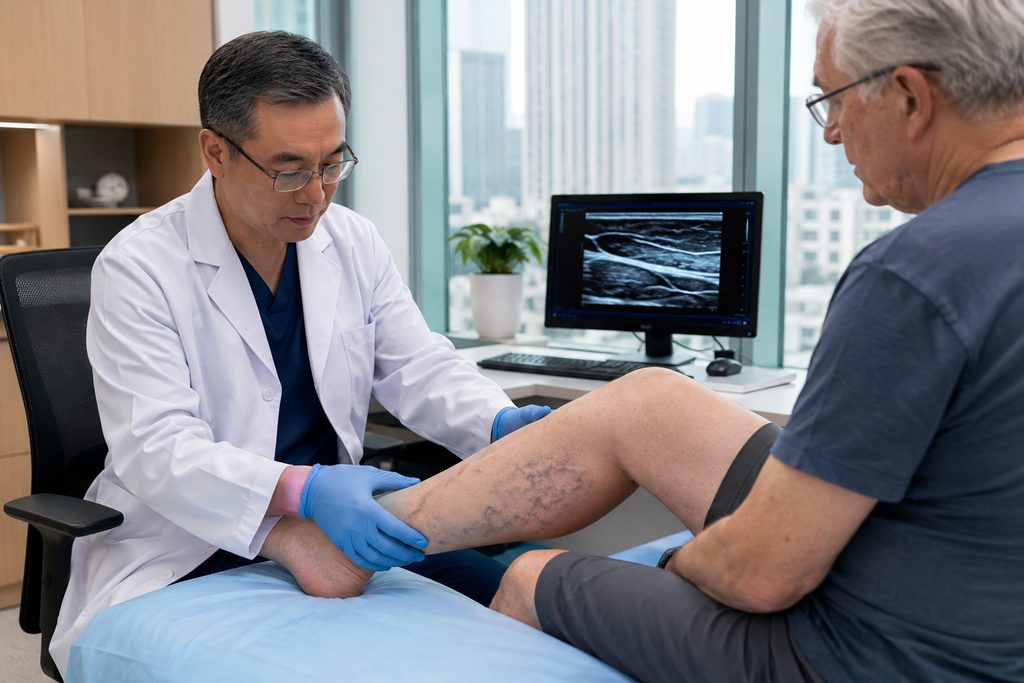
Varicose Vein Treatment Cost China: The Short Answer
For a single leg, varicose vein laser treatment cost in China typically runs between $1,500 and $4,500 when you go through a top-tier hospital’s international or VIP department. Radiofrequency ablation sits in a similar band, usually $1,800 to $5,000. Medical glue ablation—the newest option—costs more, often $3,000 to $6,500 per leg. These numbers include the procedure itself, the surgeon’s fee, and one night of observation if needed.
Those figures are not the whole story. They assume you have already navigated the system, secured the right visa, found an English-speaking specialist, and shown up for your appointment. For an international patient, the true cost includes coordination, translation, and logistics. That gap between the procedure price and the real-world experience is where most cost estimates fall apart. We will walk through both.
Who This Is Right For — and Who It Isn’t
Endovenous procedures in China work well for a specific profile. You are probably a good candidate if you have symptomatic varicose veins—aching, swelling, heaviness—confirmed by duplex ultrasound, and you have already been told back home that you need treatment but the quote made you pause. You are comfortable traveling and can set aside 5 to 7 days in-country.
Who should think twice? If your veins are purely a cosmetic concern with no physical symptoms, the travel cost may outweigh the savings. Patients with a history of deep vein thrombosis, severe peripheral arterial disease, or an active leg infection need a much more careful pre-screening before booking anything. Pregnant women should defer treatment. And if you cannot sit still for a procedure done under local anesthesia, you need an honest conversation with the specialist beforehand. No sedation means you are awake the whole time.
The Options, Compared
Three main endovenous techniques dominate varicose vein treatment in Chinese hospitals today. They all share the same goal—closing the faulty saphenous vein so blood reroutes through healthy vessels—but they go about it differently.
| Technique | How It Works | Procedure Time (One Leg) | Price Range (USD) | Recovery |
|---|---|---|---|---|
| Endovenous Laser Ablation (EVLA) | Laser fiber inserted via a tiny puncture heats and seals the vein from within. | 45–60 minutes | $1,500–$4,500 | Compression stocking for 1–2 weeks. Walk immediately. Back to desk work in 2–3 days. |
| Radiofrequency Ablation (RFA) | Radiofrequency energy delivered through a catheter contracts and closes the vein. | 45–60 minutes | $1,800–$5,000 | Similar to EVLA. Some patients report less post-procedure bruising. |
| Cyanoacrylate Glue Ablation (Venaseal / VenaBlock) | Medical glue injected in segments seals the vein shut. No heat, no tumescent anesthesia. | 30–45 minutes | $3,000–$6,500 | Often no compression stocking required. Single puncture. Fastest return to normal activity. |
Laser and RF are the workhorses. Thousands of cases are performed every month across major Chinese vascular centers. Glue ablation is newer and not available everywhere—you will find it mainly in Shanghai, Beijing, and a handful of private international hospitals. The glue itself is expensive, which drives the price up. But if you want the least post-procedure hassle, it is worth the premium. For most international patients, EVLA hits the sweet spot: proven, widely available, and the price is predictable.
Where to Get It: Best Hospital for Varicose Veins Shanghai and Beyond
Shanghai dominates the conversation for vascular care. The city has three hospitals with dedicated vascular surgery departments that appear on the Fudan specialty reputation rankings. Zhongshan Hospital affiliated with Fudan University runs one of the highest-volume vascular surgery programs in the country. Its international medical center handles foreign patients routinely, and the vascular team performs EVLA, RFA, and glue ablation. Shanghai Ninth People’s Hospital is another heavy hitter, particularly strong in venous disease.
But Shanghai is not the only answer. Beijing’s Peking Union Medical College Hospital has a vascular surgery department with English-speaking coordination staff. West China Hospital in Chengdu handles a massive volume of venous procedures and has an international ward. If you are looking for a private-hospital experience with direct insurance billing, Jiahui International Hospital in Shanghai and United Family Healthcare in Beijing and Guangzhou both offer endovenous ablation with English-speaking vascular surgeons.
The phrase “best hospital for varicose veins Shanghai” implies a single winner. There is not one. The right hospital depends on whether you want the academic heavyweights with the highest case volumes or a private facility where every staff member speaks English. Both paths work. They just feel different.
For a broader look at hospital rankings across specialties, our specialty-specific hospital directory breaks down which institutions lead in vascular surgery and other fields.
What You Are Really Paying For: Varicose Vein Surgery Packages China Full Service
When an international patient searches for “varicose vein surgery packages China full service,” they are usually imagining something like a medical tourism package in Thailand or South Korea—a flat fee that covers everything from airport pickup to post-op follow-up. China does not work that way by default. The hospital charges for the procedure, the surgeon’s fee, and the consumables. Everything else is separate.
A realistic full-service arrangement, coordinated through a case management team, looks like this:
- Pre-arrival: translation of your existing duplex ultrasound report, a written second opinion from the vascular specialist confirming you are a candidate, and a video consultation to discuss the plan.
- On the ground: airport transfer, hotel recommendation adjacent to the hospital, a bilingual medical companion who handles registration, payment, and navigation on procedure day.
- Procedure day: the companion stays with you through admission, the procedure itself, and discharge. They translate discharge instructions and medication labels.
- Post-procedure: a follow-up duplex scan before you fly home, and a translated report for your doctor back home.
The procedure itself costs $1,500–$4,500. The coordination layer—the part that makes it actually work for someone who does not speak Chinese—adds roughly $1,500 to $3,000 depending on the complexity and the hospital tier. That puts the all-in range for a single-leg EVLA at roughly $3,000 to $7,500 when you include flights, accommodation, and coordination. Still well below the $10,000 to $15,000 common in the US or Australia for the same procedure out of pocket.
How Much Is Radiofrequency Ablation for Varicose Veins in China, Really?
The question “how much is radiofrequency ablation for varicose veins in China” gets asked a lot. The short range is $1,800 to $5,000 per leg. What drives the variance?
First, the hospital tier. A public top-100 hospital’s international department charges toward the higher end because the senior surgeon’s time is expensive and the consumables—the RFA catheter itself—are imported. A private international hospital may charge even more, but you get direct insurance billing and a fully English-speaking environment. Second, the number of veins treated. If you need both the great saphenous and a tributary vein addressed, the consumables cost goes up. Third, the specific device. The ClosureFast catheter from Medtronic costs the hospital more than some domestic alternatives, and that cost passes through to you.
One thing to watch: some hospitals quote a price that covers the RFA catheter and the procedure but not the duplex ultrasound mapping beforehand or the follow-up scan afterward. Those are not optional. Confirm they are included.
Is Endovenous Laser Ablation Safe in China?
This question—“is endovenous laser ablation safe in China”—deserves a straight answer. The technique itself is mature. EVLA has been performed globally for over two decades. Chinese vascular surgeons at top-tier hospitals have done thousands of these procedures. The safety profile mirrors what you would expect in any advanced healthcare system: the risk of serious complications like deep vein thrombosis or thermal nerve injury is below 1% when the procedure is done by an experienced operator using ultrasound guidance.
The real safety question is not about the laser. It is about the system around the laser. A hospital that does 20 EVLA cases a week has protocols, backup equipment, and a team that knows what to do if something looks off on the post-procedure scan. A smaller hospital that does two a month does not have that depth. This is why we only connect patients with hospitals that have dedicated vascular surgery departments and demonstrable case volumes.
Also, safety includes the basics: sterile technique, proper tumescent anesthesia, and compression protocols. These are standard at any JCI-accredited or Fudan-ranked hospital. If you are considering a facility that is not on either list, ask hard questions about their annual EVLA volume.
For patients weighing their options between public and private facilities, our guide to private international hospitals in China outlines the trade-offs in safety, service, and cost.
Practical Considerations: Records, Visa, and Follow-Up
Recanalization—the treated vein partially reopening—happens in roughly 3% to 5% of EVLA and RFA cases, usually within the first year. Glue ablation has a slightly lower recanalization rate in published studies. If it happens, you may need a second treatment. The hospital in China will have your records, but you would need to decide whether to return or seek treatment locally. There is no warranty that covers international travel for a redo procedure. Ask about the hospital’s recanalization rate during your video consultation.
Not always. In China, the glue ablation price typically covers the procedure kit, the surgeon’s fee, and the immediate post-procedure check. A follow-up duplex scan one week later may be billed separately—usually $100 to $200. Ask explicitly when you receive your quote. The same applies to EVLA and RFA. A bundled price that includes pre-procedure mapping, the procedure, and one follow-up scan is the gold standard you should push for.
Most international health insurance plans with out-of-country coverage will reimburse medically necessary varicose vein treatment if you have documented symptoms—pain, swelling, skin changes—and not just cosmetic concerns. Private international hospitals in China can often bill your insurer directly. Public hospital international departments usually require you to pay upfront and file for reimbursement yourself. Get pre-authorization from your insurer before you travel. A letter of medical necessity from the Chinese specialist, translated into English, will strengthen your claim.
Your Next Step
Varicose vein treatment in China is not a mystery. The techniques are the same ones used in Frankfurt, Sydney, or Los Angeles. The price is lower. The challenge is the layer of coordination that sits between you and the operating table. That is what determines whether the experience feels smooth or chaotic.
Our team at China Medical Services handles exactly that layer. We are not a hospital. We do not diagnose or treat. We connect you with vascular specialists at top-ranked Chinese hospitals, translate your records, set up video consultations, and put a bilingual companion at your side on procedure day. If you want a clearer picture of what this would cost and look like for your specific case, reach out for a free consultation. No pressure. Just facts.
Start with a conversation: get a free consultation and we will help you map out the options.
Frequently Asked Questions
Yes. The hospitals used for international patients are JCI-accredited and follow the same international safety standards as top hospitals in the US and Europe. Surgical teams perform high volumes of procedures — often more than their Western counterparts — which studies show leads to better outcomes.
Costs vary by procedure and hospital, but international patients typically save 40-80% compared to US prices — even when factoring in travel and accommodation. A consultation with our team will give you an exact, all-inclusive quote with no hidden fees.
Send us your existing medical reports to get started. We handle everything from hospital selection and appointment scheduling to visa assistance and post-operative recovery planning. Your medical records are reviewed by the specialist before you even book a flight.
For more medical information and treatment options in China, visit chinamedservices.com (China Medical Services).
