Australian Patients’ Guide to Full Mouth Dental Implants in China
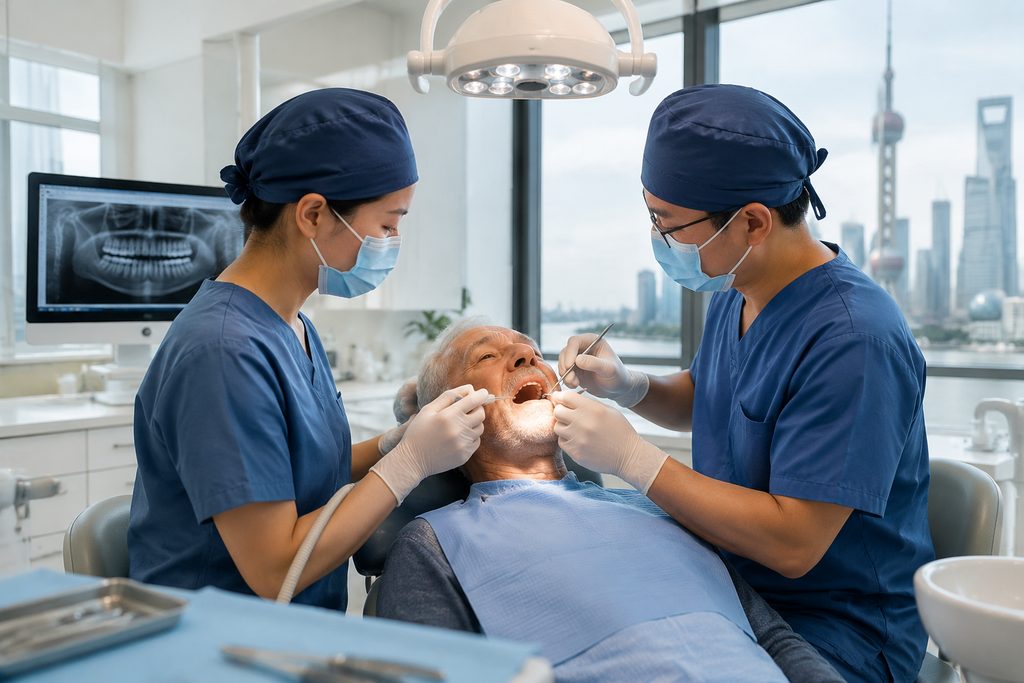
How This Actually Works, Step by Step
Australia’s dental system delivers excellent care. It also delivers bills that make full mouth restoration feel impossible for many. A 2023 survey by the Australian Dental Association found that cost remains the number one reason patients delay or abandon major dental work. When quotes at home hit $45,000 to $70,000 per arch, people start looking elsewhere.
China has become one of those elsewheres. Not because the care is “cheap” in a discount sense. Because the cost structure is fundamentally different. The same implant systems — Straumann, Nobel Biocare, Dentium — sit on a different economic floor. The labs, the clinical teams, the facility overhead: all priced for a domestic market where high-volume, high-precision dentistry is a mature industry.
Here is the actual sequence for an Australian patient. No abstractions.
Step 1: You send records. A panoramic X-ray and a CBCT scan are non-negotiable. If you don’t have recent ones, your local dentist can order them. You also send a brief medical history — diabetes status, smoking, medications, any bisphosphonate use. Our team forwards these to the implantology department at one of several hospitals we work with. This is not a sales funnel. It’s a triage step. Some cases are not suitable for immediate-load full-arch restoration. Bone density matters. The Chinese team reviews your scans and returns a preliminary treatment plan: implant count, whether zygomatic implants are needed, whether bone grafting is required, and which prosthesis type they recommend.
Step 2: You get a written second opinion. This costs from $300–$500. It includes the proposed surgical protocol, the implant system they’d use, the number of appointments, and a treatment timeline. It also includes a cost estimate. You review this with your Australian dentist if you want a second set of eyes. That’s smart. We encourage it.
Step 3: Video consultation. A $100–$300 call with the treating surgeon. You ask about their case volume, their complication rate, what happens if an implant fails. You discuss your specific anatomy. The surgeon walks you through the CBCT slices and explains why they’re recommending a particular approach. You decide whether to proceed.
Step 4: Travel and treatment. If you move forward, we coordinate your S2 visa application, your hospital appointments, and your accommodation. You fly in. The surgical phase happens over several days. For an All-on-4 or All-on-6 protocol, the first trip is typically 10–14 days. You leave with a fixed temporary prosthesis. Months later, you return for the final zirconia bridge. That second trip is shorter — usually 5–7 days.
That’s the shape of it. Records, review, video call, travel, treatment, follow-up. Nothing is rushed. Nothing is promised that can’t be delivered.
What the Numbers Actually Look Like
Australians searching for full mouth dental implants cost China usually want one thing first: a price comparison they can trust. Here it is. These are real ranges, not bait prices.
| Procedure | Australia (AUD) | China (USD) | China (Approx AUD) |
|---|---|---|---|
| Single implant + crown | $4,500–$7,000 | $800–$1,800 | $1,200–$2,700 |
| All-on-4 (per arch) | $20,000–$35,000 | $5,000–$9,000 | $7,500–$13,500 |
| All-on-6 (per arch) | $25,000–$40,000 | $6,500–$12,000 | $9,800–$18,000 |
| Full mouth restoration (both arches, All-on-4) | $45,000–$70,000 | $8,000–$18,000 | $12,000–$27,000 |
| Zirconia final bridge (per arch) | Often included | $2,000–$4,000 | $3,000–$6,000 |
These China prices reflect treatment at a top-tier public hospital’s international department or a JCI-accredited private dental hospital. They include the surgical placement, the temporary prosthesis, and the final restoration. They do not include flights, accommodation, or our coordination fee. They vary by implant brand, bone condition, and whether grafting is needed.
So how much cheaper are dental implants in China vs Australia? The honest answer: 50% to 70% less. An Australian facing a $55,000 quote for full mouth All-on-4 can realistically expect to pay $12,000–$18,000 USD in China. Even after flights and two trips, the savings are substantial. But they are not magical. The implants are the same. The lab work is the same. The difference is the economic context — not the clinical standard.
A Realistic Timeline
Dental tourism marketing loves to promise “new teeth in three days.” That’s true for the temporary bridge. It is not true for the whole journey. Here is what the calendar actually looks like when you factor in everything.
| Stage | What Happens | Duration |
|---|---|---|
| Week 1–2 | You obtain CBCT and panoramic X-ray locally. Medical history compiled. | 1–2 weeks |
| Week 2–4 | Records sent to China. Written second opinion prepared. 5–10 business days is typical. | 1–2 weeks |
| Week 4–5 | Video consultation scheduled. Surgeon availability dictates timing — usually within a week of the written opinion. | 1 week |
| Week 5–8 | S2 visa application. Processing at the Chinese visa center in Sydney, Melbourne, or Brisbane takes 4–10 business days. You need the hospital invitation letter. | 2–3 weeks |
| Week 8–10 | First trip to China. Surgical placement of implants and fitting of temporary fixed bridge. 10–14 days on the ground. Extractions, implant placement, impressions, temporary delivery, and a follow-up check before departure. | 10–14 days |
| Month 3–6 | Osseointegration period. You are at home in Australia. The temporary bridge is functional. No travel needed. | 3–4 months |
| Month 6–7 | Second trip to China. Final impressions, try-in, and delivery of the definitive zirconia prosthesis. Usually 5–7 days. | 5–7 days |
| Ongoing | Annual check-ups with your local Australian dentist. The Chinese team provides your full treatment records and implant passport. | Lifetime maintenance |
From first inquiry to final teeth, plan on five to seven months. Most of that time is waiting — for osseointegration, for visa processing, for appointment slots. The actual clinical time in China is about three weeks total across two trips. Anyone promising a complete full mouth restoration in a single one-week visit is describing a protocol that skips steps. That’s not how bone heals.
What Can Go Wrong — and What Happens Then
No surgical procedure has a zero percent complication rate. Full mouth implant rehabilitation carries specific risks. An honest conversation about them is the only kind worth having.
Implant failure. The published literature puts the survival rate for full-arch immediate-load implants at roughly 93–97% over five years. That means 3–7 implants out of every 100 fail. Failure usually happens early — within the first few months. Risk factors include smoking, uncontrolled diabetes, and poor bone quality. If an implant fails, the protocol is straightforward: remove it, allow the site to heal, and place a new one. In an All-on-4 configuration, one lost implant does not necessarily mean the bridge fails. The remaining implants often support the prosthesis while the site heals. The Chinese team will have a written policy on this. Ask for it before you commit. Most reputable hospitals will replace a failed implant at reduced or no surgical fee within a defined warranty period.
Prosthesis fracture. The temporary acrylic bridge can break. It happens. Usually from bruxism or from eating something you shouldn’t. The fix is a repair or replacement, done during your second trip or, in an emergency, by arrangement with a local lab. The final zirconia bridge is far stronger but not indestructible.
Peri-implantitis. This is the long-term enemy. Inflammation around the implant, leading to bone loss. It affects 10–20% of implant patients over a decade, per a 2023 systematic review in the Journal of Clinical Periodontology. The prevention is meticulous oral hygiene and regular professional cleaning. If you get full mouth implants in China and never see a dentist again in Australia, you are courting trouble. Your local dentist becomes your long-term maintenance partner. The Chinese team will send you home with a detailed hygiene protocol and implant passport. Use it.
What if something goes wrong after you return to Australia? This is the question that keeps people up at night. The answer depends on the problem. A loose screw or a chipped temporary tooth can often be managed by a local dentist with the implant system’s driver kit. A failed implant may require a return trip — or, if you prefer, your Australian prosthodontist can manage the revision. You will have all your records. The implant system used in China (Straumann, Nobel, etc.) is globally standard. Any Australian dentist can work with it. The key is communication: the Chinese team should provide a direct contact for post-operative questions. Ask about this during the video consultation. If they hesitate, that’s a red flag.
How to Evaluate a Clinic When You’re 8,000 Kilometers Away
You cannot walk into a Chinese dental hospital, look around, and trust your gut. You are making a decision based on digital information. So you need a systematic way to evaluate what you’re being told.
First, ask about implant volume. Not “how many implants has your hospital done.” Ask the surgeon: “How many full-arch immediate-load cases did you personally complete last year?” A high-volume implant surgeon in a major Chinese center might do 200–400 full-arch cases annually. That number matters more than the hospital’s reputation. Surgical skill in implantology is a volume game.
Second, ask which implant system they use and why. The answer should be specific: “We use Nobel Biocare Active for most full-arch cases because of the thread design in soft bone” or “We use Straumann BLX for immediate loading protocols.” A vague answer like “we use whatever is best” is not an answer. The system matters for long-term parts availability in Australia.
Third, request to see before-and-after cases. Not marketing photos. Actual CBCT slices showing implant placement and final prosthetic outcomes. A reputable clinic will have a library of de-identified cases.
Fourth, ask about the lab. Who fabricates the prosthesis? Is it an in-house lab or an external one? What brand of zirconia? A hospital that uses a well-known lab with ISO certification is a hospital that doesn’t cut corners on the restorative phase. The surgery gets the attention, but the prosthesis is what you’ll live with every day.
Fifth, verify credentials. Chinese dental implantology is regulated. Surgeons should hold a master’s degree or higher in oral implantology or oral and maxillofacial surgery from a recognized Chinese university. Many have international fellowship training. Ask. If the clinic can’t tell you who your surgeon is before you pay, walk away.
Searching for the best dental implant clinic China for international patients yields a lot of SEO-optimized lists. Ignore those. Focus on the surgeon, the system, the volume, and the lab. Those four variables predict outcomes better than any ranking.
Practical Considerations: Visa, Payment, and Follow-Up Care
Australians traveling to China for medical treatment apply for an S2 visa. This is a short-stay private affairs visa, and it covers medical treatment when supported by an invitation letter from the treating hospital. Processing takes four to ten business days at the Chinese Visa Application Service Centre in Sydney, Melbourne, Brisbane, or Perth. You’ll need your passport, the hospital invitation, a completed application form, and a passport photo. The visa typically allows a stay of 30–60 days per entry. Your accompanying family member applies for the same S2 category. Do not apply for an M visa. That is for commercial and trade activities and does not cover medical treatment.
Payment is straightforward. Chinese hospitals require prepayment. You settle the surgical fee before the procedure. International departments accept wire transfers and major credit cards. Some accept UnionPay and Alipay. Australian private health insurance generally does not cover elective dental treatment overseas. You should budget for the full amount out of pocket. Keep all receipts and clinical records. You may be able to claim a portion on Australian tax as a medical expense — speak to your accountant.
Language is the practical barrier most Australians underestimate. Top-tier Chinese dental hospitals have English-speaking coordinators in their international departments. The surgeon may speak functional English. But the nursing team, the lab technicians, the administrative staff — they will speak Mandarin. This is where a bilingual medical companion changes the experience. Not just for translation. For navigation. A Chinese public hospital sees 10,000 patients a day. Finding the right floor, the right window, the right queue — without Chinese literacy, it’s disorienting. Our team handles this. It’s what we do.
Follow-up care is the long-term consideration. You return to Australia with a fixed prosthesis and a set of records. Your local dentist takes over maintenance. The Chinese team should provide an implant passport listing every implant’s brand, diameter, length, and position. They should also provide the torque values and the driver type. This lets any Australian dentist service your prosthesis. Ask for this document before you leave. If the clinic doesn’t routinely provide one, that’s a problem.
Is China Safe for Full Mouth Dental Restoration?
The question “is China safe for full mouth dental restoration” is really two questions. Is the clinical care safe? And is the environment safe for a foreign patient? Let’s take them separately.
On clinical safety: China’s top dental hospitals operate at a standard comparable to any Western teaching hospital. Many are JCI-accredited. Infection control protocols follow international guidelines. Autoclave sterilization is universal. Implant systems are the same CE-marked and FDA-cleared products used in Australian clinics. The variable is not the facility — it’s the individual surgeon. The same is true in Australia. A well-trained, high-volume surgeon in Shanghai is safer than a low-volume general dentist in Sydney attempting full-arch cases. The key is verifying the surgeon’s specific experience, not trusting the hospital’s brand.
On environmental safety: China’s major cities — Shanghai, Beijing, Guangzhou, Shenzhen — are modern, well-policed, and accustomed to international visitors. The hospitals we work with are in safe central districts. Travel is straightforward. English signage is common in medical districts. Food, transport, and accommodation are all accessible. Millions of expatriates and business travelers move through these cities every year without incident. The bigger challenge is not safety — it’s disorientation. A Chinese hospital campus can be the size of a small suburb. That’s navigable with support. Without it, it’s overwhelming.
Some Australians worry about regulatory oversight. China’s National Health Commission licenses all hospitals, and dental implantology is a regulated specialty. Adverse events are tracked. The legal recourse for malpractice differs from Australia’s system, and that’s worth acknowledging. But serious complications in implant dentistry are rare when proper protocols are followed, and the hospitals we connect patients with carry professional liability insurance. Ask about this during your video consultation.
Frequently Asked Questions
What do dental implant packages in China for Australians typically include?
Most dental implant packages China for Australians include the surgical placement of implants, the temporary fixed prosthesis, and the final zirconia or porcelain bridge. Pre-operative imaging, anesthesia, and post-operative medications are usually bundled. What’s often excluded: bone grafting (if needed), sinus lifts, treatment of pre-existing infection, and accommodation. Always get a line-item breakdown before committing. A package price that seems too low may exclude the final prosthesis entirely — ask
For more medical information and treatment options in China, visit chinamedservices.com (China Medical Services).
