Shanghai Renji Hospital IVF: Costs, Success Rates & Process for Foreigners
Have you been quoted a price for IVF that feels less like a medical treatment and more like a mortgage down payment? That shock is a starting point for many couples who end up searching for “Shanghai Renji Hospital IVF cost for foreigners.” The numbers you see can be disorienting. One clinic quotes $25,000 for a single cycle. Another mentions $12,000 but excludes medication. A third package looks cheap until you read the fine print on genetic testing.
The data is stark. The average cost of a single conventional IVF cycle in the United States now hovers between $15,000 and $30,000, depending on the state and protocol. Medication adds another $3,000 to $7,000. For many, that is not a one-time expense. The Society for Assisted Reproductive Technology reports that the live birth rate per cycle for women under 35 is around 47%, meaning more than half of patients need at least two cycles. The math is unforgiving. A couple can burn through $50,000 before seeing a positive test.
That financial pressure is what drives a growing number of Western patients to look at Asia. Not for cheaper care in the sense of cutting corners, but for a structural cost difference that does not sacrifice clinical quality. Shanghai Renji Hospital sits at the center of that conversation. Its Reproductive Medicine Center is not just another fertility clinic. It is one of the largest and most academically cited reproductive medicine units in China, and its outcomes are tracked, published, and scrutinized.
Key Takeaways
- Shanghai Renji Hospital’s Reproductive Medicine Center is consistently ranked among China’s top three for IVF volume and clinical pregnancy rates, with published live birth rates above 55% per embryo transfer in favorable prognosis patients.
- A full IVF cycle at Renji for international patients typically costs between $5,500 and $8,500, excluding medication — roughly one-third of the average US price before any insurance adjustment.
- Language and logistics are the real barriers. The hospital’s public-facing registration system is entirely in Mandarin, and walk-in access to senior specialists is not possible without an internal referral or a coordinated international patient pathway.
- Understanding the exact cost structure — what is included, what is billed separately, and how donor egg or genetic testing surcharges work — is the difference between a smooth experience and a financial surprise.
The Problem: Western IVF Costs Are Breaking the Logic of Family Planning
Fertility treatment in the United States, Canada, and much of Western Europe has become a financial triage exercise. Patients are not just asking whether a treatment will work. They are asking how many cycles they can afford before they must stop. A 2023 FertilityIQ survey of over 10,000 patients found that 72% of respondents financed their IVF through a combination of savings, credit cards, and family loans. Only 19% had employer-provided fertility coverage that covered more than one cycle.
That is not a healthcare system. That is a lottery.
The wait times compound the stress. In the UK, National Health Service eligibility for IVF is determined by local integrated care boards, and in some regions, the wait for a funded cycle now exceeds 18 months. For a woman over 35, that delay is clinically significant. Ovarian reserve does not pause for bureaucracy. The result is a two-tier reality: those who can pay go private, and those who cannot wait — and age — in a queue.
This is the context in which a hospital like Renji enters the frame. Not as a discount option, but as a high-volume, research-driven center that operates in a different cost environment. The question patients should be asking is not “is it cheaper” but “what am I paying for in the US or Europe that is absent here, and what am I getting in return?”
Why Shanghai Renji Hospital’s Reproductive Medicine Center Delivers Results
Renji Hospital, affiliated with Shanghai Jiao Tong University School of Medicine, is not a boutique fertility startup. It is a 1,700-bed academic medical center founded in 1844. Its Reproductive Medicine Center, established in 2001, now performs over 15,000 IVF and ICSI cycles annually. To put that in perspective: the average US fertility clinic performs fewer than 500 cycles per year. Volume on this scale is not just a statistic. It is a clinical asset.
Clinical Volume Drives Embryology Lab Consistency
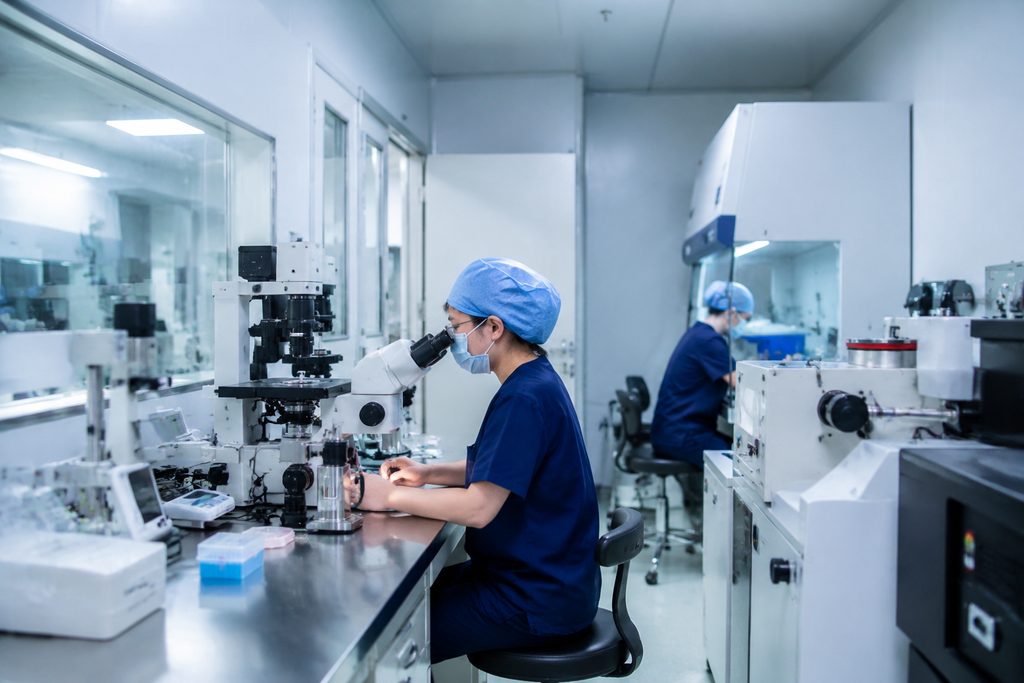
In IVF, the embryology laboratory is the single most important variable that patients never see. Fertilization, embryo culture, vitrification, and biopsy all happen in a controlled environment where small deviations — temperature fluctuation, pH drift, volatile organic compound exposure — can collapse a cycle’s outcome. Labs that process thousands of cases per year develop standardized workflows, equipment redundancy, and quality control protocols that are impossible to replicate at low volume.
Renji’s embryology team handles more blastocyst-stage cultures in a month than many Western clinics do in a year. The center’s published data shows a blastocyst formation rate above 60% for patients under 35, which is competitive with the best US academic centers. The difference is that Renji achieves this at a cost structure that reflects Chinese hospital economics, not American insurance-driven pricing.
Research Integration Means Faster Protocol Adaptation
Renji’s Reproductive Medicine Center is also a major research unit. It has contributed to studies on preimplantation genetic testing, recurrent implantation failure, and endometrial receptivity that are published in journals like Human Reproduction and Fertility and Sterility. This is not abstract. When a new protocol shows promise — for example, a modified natural cycle frozen embryo transfer in patients with thin endometrium — Renji clinicians are often among the first to evaluate and adopt it.
For international patients, this means access to protocols that may not yet be standard in their home country. It also means that clinical decisions are informed by the center’s own data, not just by manufacturer guidelines or US-centric clinical trial populations.
Cost Advantage Without Quality Compromise
Let us address the obvious question directly. If Shanghai Renji Hospital IVF cost for foreigners is roughly one-third of the US price, what is being sacrificed?
The answer is structural, not clinical. Chinese academic hospitals operate on a high-volume, low-margin model. Physician salaries are a fraction of US equivalents — not because of lower skill, but because of different labor market economics. Hospital infrastructure is amortized across massive patient volumes. Pharmaceutical costs for gonadotropins and other IVF medications are lower in China due to local manufacturing and government price regulation. The embryology lab uses the same equipment — Vitrolife culture media, RI Witness monitoring systems, Hamilton Thorne lasers — but the per-cycle cost allocation is spread across 15,000 annual cases instead of 500.
What you lose is the concierge-style experience of a US private clinic. You will not get a dedicated fertility coach, a spa-like waiting room, or a guarantee of same-day email responses. What you get is a clinically rigorous, data-driven program at a price that resets the financial calculus of multiple cycles.
Understanding Shanghai Renji Hospital IVF Cost for Foreigners: A Line-by-Line Breakdown
This is the section most readers search for. The numbers below are based on the hospital’s published fee schedule for its international department, adjusted for the typical protocols used in foreign patient cases. They are accurate as of mid-2025 but always subject to change based on individual treatment plans.
| Cost Component | Estimated Range (USD) | Notes |
|---|---|---|
| Initial consultation & baseline workup | $300 – $500 | Includes ultrasound, hormone panel, semen analysis. May be partially credited toward a cycle if booked within 30 days. |
| Conventional IVF cycle (monitoring, retrieval, fertilization, culture, transfer) | $4,500 – $6,800 | Covers all clinical procedures, embryology lab fees, and one fresh embryo transfer. Excludes medication and any add-on procedures. |
| IVF medications (gonadotropins, antagonist, trigger) | $1,000 – $2,200 | Varies significantly by protocol, age, and ovarian reserve. Antagonist protocols are typically less expensive than long agonist protocols. |
| ICSI (intracytoplasmic sperm injection) | $600 – $900 | Added when male factor infertility is present or when prior fertilization rates were low. |
| Preimplantation genetic testing for aneuploidy (PGT-A), per embryo | $350 – $500 | Biopsy and testing fee. Usually applied to 2–6 embryos per cycle. Not always necessary; discussed case by case. |
| Frozen embryo transfer (FET) cycle | $1,200 – $1,800 | Includes monitoring, endometrial preparation, and transfer. Medication is additional. |
| Embryo cryopreservation (first year) | $400 – $600 | Annual storage fee after the first year is approximately $300–$400. |
A typical first-cycle international patient doing conventional IVF with ICSI, a fresh transfer, and no genetic testing should budget between $5,500 and $8,500 for the clinical and lab components, plus medication. A cycle that goes straight to a freeze-all with a subsequent FET will add the FET cost but may improve the endometrial environment and pregnancy rate.
For comparison, the same protocol at a US academic center typically runs $18,000 to $25,000. The gap widens further when donor eggs or surrogacy are involved, though surrogacy is legally restricted in China and is not available to foreign patients through Renji.
How Much Does IVF Cost in China with Donor Eggs: The Separate Path
Donor egg IVF in China operates under a different regulatory framework than in the US or Spain. Chinese law permits oocyte donation only from other IVF patients who have surplus eggs after their own retrieval and who voluntarily consent to donation. There is no commercial egg donor market. Compensation is limited to a modest reimbursement for medical expenses, not payment for gametes. This means wait times for donor eggs can be unpredictable — sometimes a few months, sometimes over a year — and the donor’s identity is anonymous by law.
When donor eggs are available, the cost structure changes. The recipient pays the donor’s stimulation and retrieval costs, plus the standard IVF and FET fees. All in, a donor egg cycle at Renji typically ranges from $8,000 to $12,000, including medication and one embryo transfer. That compares to $35,000 to $60,000 in the US for a single donor egg cycle through an agency or egg bank.
The limitation is availability, not price. Patients considering this route should have a candid discussion with the Renji international patient coordinator about current waitlist estimates before committing to travel.
Is Shanghai Renji Hospital Reproductive Medicine Center Good? Reading the Data
Yes — and the evidence is public. Renji’s Reproductive Medicine Center has been ranked in the top three nationally in the Fudan University China Hospital Specialty Reputation Rankings for reproductive medicine for multiple consecutive years. This is the most authoritative hospital ranking system in China, based on peer assessment by clinical specialists and supplemented by research output metrics.
But rankings tell only part of the story. The clinical pregnancy rate per embryo transfer for patients under 35 at Renji has been reported above 55% in recent published cohorts. For frozen-thawed single blastocyst transfers in good-prognosis patients, the live birth rate exceeds 50%. These numbers are in line with top-quartile US clinics reporting to SART.
One area where Renji stands out is its management of complex cases. The center runs dedicated clinical pathways for recurrent implantation failure, advanced maternal age, and severe male factor infertility. Its andrology lab is one of the few in China equipped to perform microsurgical epididymal sperm aspiration and testicular sperm extraction with same-day ICSI. For couples who have failed multiple cycles elsewhere, this is often the reason they end up in Shanghai.
Book IVF Treatment Shanghai Renji Hospital International Patient: The Exact Process
This is where the reality of Chinese public hospital logistics meets the expectations of Western patients. You cannot book IVF treatment at Shanghai Renji Hospital by calling a central scheduling line or filling out an online form in English. The hospital’s outpatient system is designed for domestic patients who register in person, queue with a physical card, and speak Mandarin. For international patients, there is a separate pathway, but it requires coordination before you arrive.
The workflow typically follows these steps:
Step 1: Remote pre-screening. You send your existing medical records — recent hormone panels, semen analysis, HSG or SIS reports, prior IVF cycle summaries if applicable — for review by the international department. This is not a formal second opinion. It is a feasibility assessment. The team needs to confirm that your case is appropriate for treatment at Renji and that no obvious contraindications exist before you book flights.
Step 2: Initial consultation and workup in Shanghai. Once pre-screened, you travel to Shanghai for a face-to-face consultation. This is mandatory. Chinese regulations require in-person evaluation before any ART cycle can begin. The workup includes a repeat ultrasound, infectious disease screening (required by Chinese law for all ART patients), and a protocol planning session. Expect to be in Shanghai for at least 3–5 days for this first visit.
Step 3: Protocol start and monitoring. Depending on your protocol, you may start stimulation during the same trip or return home and begin on a scheduled cycle day. Some international patients do their early monitoring locally and fly to Shanghai for the final 5–7 days of stimulation, retrieval, and transfer. Others stay for the full 2–3 week cycle. The decision depends on your schedule, budget, and how comfortable you are with fragmented care.
Step 4: Retrieval, fertilization, and transfer. These are done at Renji. The retrieval is typically under conscious sedation. The embryo transfer is ultrasound-guided and does not require anesthesia. If a freeze-all strategy is used, you return home after retrieval and come back for a frozen transfer in a subsequent cycle.
Fertility Treatment Packages China with Accommodation: What Is Actually Offered
Some international patient services market “all-inclusive fertility packages” that bundle treatment, hotel, airport transfers, and translation. Renji Hospital itself does not sell such packages. The hospital is a clinical institution, not a hospitality provider. Its international department coordinates the medical side: appointments, billing, report translation, and in-hospital interpretation.
Accommodation and logistics are handled separately. Most international patients stay in serviced apartments or hotels within a 15-minute walk of Renji’s main campus in Pudong. The area is well-developed, with options ranging from budget business hotels at $60 per night to international chains at $150–$200 per night. A 2–3 week stay for a full IVF cycle, including a comfortable apartment and meals, typically adds $2,000 to $4,000 to the total cost — still far below the US price gap.
What a coordination service can do is stitch these pieces together: book the apartment, arrange the airport pickup, schedule the appointments, and provide a bilingual companion who explains every lab result and medication instruction in English. That is not a package. It is logistics. But it is the difference between a stressful solo journey and a controlled medical trip.
Practical Considerations: Documentation, Visas, and Payment
The logistics are manageable, but they require planning. The first and most important document is your visa. Foreign nationals traveling to China for medical treatment apply for an S2 short-stay visa, not an M visa. The S2 visa is designed for private affairs, including medical visits. You will need an invitation letter from the hospital or a medical coordination entity confirming your appointment. Processing typically takes 5–10 business days, and you should budget at least 3–4 weeks from application to departure.
Medical records must be translated into Chinese or English before submission. If your records are in German, French, Arabic, or another language, you will need certified translations. This is a non-negotiable step. The clinical team cannot evaluate records they cannot read.
Payment is another area where expectations need to be reset. Chinese public hospitals, including Renji’s international department, operate on a pay-as-you-go basis. You pay for each consultation, each test, and each procedure as it occurs. There is no billing cycle, no insurance pre-authorization, and no deferred payment. You should bring a credit card with a high daily transaction limit or be prepared to make multiple wire transfers. Some
Frequently Asked Questions
Yes. The hospitals used for international patients are JCI-accredited and follow the same international safety standards as top hospitals in the US and Europe. Surgical teams perform high volumes of procedures — often more than their Western counterparts — which studies show leads to better outcomes.
Costs vary by procedure and hospital, but international patients typically save 40-80% compared to US prices — even when factoring in travel and accommodation. A consultation with our team will give you an exact, all-inclusive quote with no hidden fees.
Send us your existing medical reports to get started. We handle everything from hospital selection and appointment scheduling to visa assistance and post-operative recovery planning. Your medical records are reviewed by the specialist before you even book a flight.
For more medical information and treatment options in China, visit chinamedservices.com (China Medical Services).
