Pediatric Heart Surgery in Shanghai: Fudan Center Costs, Safety & Real Pathways for International Families
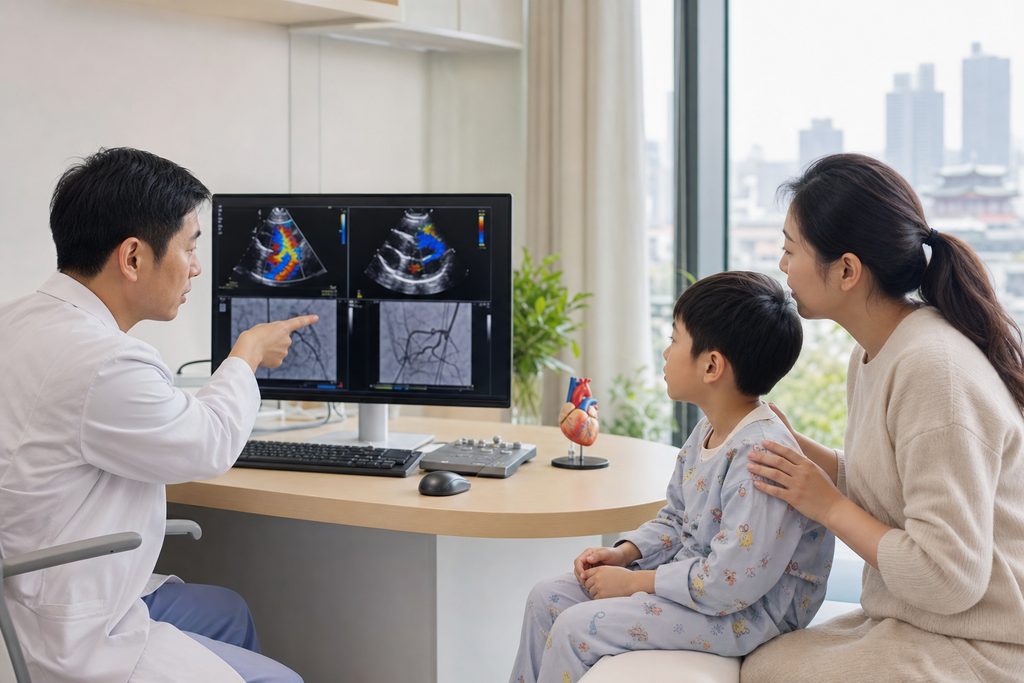
When 38-year-old Sarah in Manchester first saw her newborn’s echocardiogram, the term “Tetralogy of Fallot” meant nothing. Within 48 hours, it meant everything. Her local NHS trust was excellent, but the waiting list for the specific surgeon stretched past four months. Her daughter turned blue during feeding. Four months felt like a gamble she couldn’t take. She started typing phrases she never imagined: pediatric cardiac surgery abroad, best pediatric cardiac surgeon China, congenital heart surgery cost Shanghai.
Our team hears variations of Sarah’s story every week. Parents don’t plan to travel 6,000 miles for their child’s open-heart surgery. They explore it because the math of time, money, and expertise suddenly shifts. This article doesn’t sell a destination. It answers the five or six questions that keep parents awake: what this actually costs, how safe it really is, who performs the surgery, and what the physical process looks like from your living room to the recovery ward and back.
How This Actually Works, Step by Step
The sequence surprises most families. It doesn’t start with booking flights.
You send us the existing diagnostic materials. Echo reports, cath lab images, clinical summaries. Not summaries you write yourself — the actual files from your home cardiologist. Our team translates them into clinical Chinese. This step alone takes 2–3 business days if the documents are complete.
We route the translated file to the relevant department at the Children’s Hospital of Fudan University. Their pediatric cardiac team reviews it. Sometimes a single surgeon reviews it. For complex cases — single ventricle pathways, heterotaxy, multiple prior palliations — a small multidisciplinary group looks at it together. This remote review typically returns a written opinion within 5–7 working days. That opinion covers whether they believe they can help, what approach they would consider, and what additional imaging or tests they need before a final surgical plan.
You read that opinion. You ask questions. We arrange a video consultation with the surgical team. You see their faces. You hear their assessment directly. The video consultation runs $500–800.
Only after that call — only if you decide to proceed — do we move to the logistics phase. Visa documentation, surgical scheduling, arrival coordination.
No one should board a plane without this sequence. The remote evaluation is not a formality. It protects you from arriving with a child who turns out to be a poor candidate for the specific approach available, or whose anatomy requires a staged strategy the home team didn’t fully map.
Congenital Heart Surgery Cost Shanghai: What Families Actually Pay
Let’s address the number parents search for first. The congenital heart surgery cost Shanghai hospitals charge international patients varies by lesion complexity, length of ICU stay, and whether the case goes through the public international department or the private VIP wing.
For a straightforward ASD or VSD closure in a stable toddler, total hospital charges typically fall between $18,000 and $28,000. That’s the all-in number: surgeon fees, anesthesiologist, perfusionist, 3–5 days of ICU, step-down ward, and basic medications.
Tetralogy of Fallot repair — the surgery Sarah’s daughter needed — runs $25,000 to $40,000. The range widens because some children need a transannular patch and longer ventilation, while others sail through.
Complex single-ventricle reconstructions — the Norwood, the Glenn, the Fontan completion — land between $35,000 and $60,000. These are long bypass runs, extended ICU stays, and significant blood product use.
Compare these numbers to the U.S. where a Tetralogy repair frequently exceeds $150,000, and a Norwood can cross $400,000 before the child leaves the hospital. Even families with insurance face deductibles and out-of-network charges that eclipse the entire Shanghai bill.
But the price isn’t just the hospital invoice. You also need to budget for flights, a long-stay apartment or serviced apartment near the hospital, food, and our coordination services. A realistic all-in budget for a 4-to-6-week stay in Shanghai — surgery, accommodation, flights for two adults, coordination — starts around $35,000 for a moderate-complexity case and reaches $70,000+ for the most complex single-ventricle pathways.
We never quote a fixed price before the remote evaluation. The hospital’s international department provides a formal cost estimate only after reviewing the child’s specific anatomy and clinical history. Anyone who quotes you a firm price sight-unseen is guessing.
A Realistic Timeline
Parents want the surgery date. Here is what the calendar actually looks like.
| Phase | What Happens | Typical Duration |
|---|---|---|
| Document collection | You gather echo reports, cath data, clinical letters from your home cardiologist | 3–7 days |
| Translation and clinical summary | Our team converts records into Chinese clinical format | 2–3 business days |
| Department review | Fudan pediatric cardiac team evaluates the case remotely | 5–7 business days |
| Written opinion delivered | You receive a written assessment and preliminary surgical recommendation | Day 10–17 from start |
| Video consultation | Live discussion with the surgical team, translator present | Scheduled within 3–5 days of opinion |
| Decision and financial estimate | Hospital international department issues formal cost estimate | 3–5 days after consultation |
| Visa processing | S2 visa application with hospital invitation letter | 2–4 weeks depending on embassy |
| Travel and admission | Arrive Shanghai, pre-op testing, surgery scheduling | Usually 3–5 days after arrival |
| Hospital stay | Surgery, ICU, step-down ward | 10–21 days depending on complexity |
| Local recovery before flying | Child must be stable for long-haul flight; surgical team clears departure | 1–3 weeks post-discharge |
From first contact to surgery day, plan on 6–10 weeks. Faster is sometimes possible. Slower is common if the home team is slow to release records or if the embassy queue is long. The surgical team will not rush a complex single-ventricle case just because your visa is expiring. They operate on the child’s readiness, not your calendar.
What Can Go Wrong — and What Happens Then
Things go wrong in pediatric cardiac surgery everywhere. The question is what happens next.
Infection happens. The sternal wound, the urinary tract, the lungs. Fudan’s pediatric cardiac ICU runs the same infection-control protocols you would find in Boston or London. They culture immediately. They start targeted antibiotics. They do not wait and see.
Bleeding happens. The team has a dedicated blood bank and a perfusion team that manages post-bypass coagulopathy. Re-exploration in the first 24 hours, while frightening, is a known pathway with a clear protocol.
A longer-than-expected ICU stay happens. Some children struggle to wean from the ventilator. Some develop chylothorax and need a low-fat diet or TPN for weeks. The hospital does not discharge a child who cannot feed or breathe comfortably. That means your 3-week plan can become 6 weeks. Budget and visa flexibility matter.
The specific failure mode that worries international families most is: what if my child deteriorates and I don’t speak the language? Our bilingual medical companion is in the ICU family waiting area, on the ward, at every critical handoff. You are never alone trying to decode a doctor’s expression through a translation app. That person costs from $300 per day and changes the entire experience.
The honest truth: the worst outcomes — mortality — occur at roughly the same rate as at any major Western center for comparable lesion complexity. The Fudan team performs over 1,000 pediatric cardiac surgeries annually. Volume confers competence. But volume does not confer zero risk. No honest surgeon promises zero risk for a Norwood.
Evaluating Safety and Surgical Volume Honestly
Parents search “how safe is heart surgery for children in China” and “what is success rate of congenital heart surgery abroad” because they need a number. We understand the impulse. Here is what the numbers actually mean.
The Children’s Hospital of Fudan University runs one of the highest-volume pediatric cardiac programs in Asia. In congenital heart surgery, volume correlates with outcomes — especially for high-complexity cases. A center doing 30 Norwoods a year has better survival than one doing 3. Fudan does significantly more than 30.
Overall surgical survival for congenital heart repairs at the center exceeds 97%. That number includes straightforward ASD closures that pull the average up. For a Stage 1 Norwood in a syndromic neonate, the honest survival figure is lower — in the 75–85% range, which aligns with published international benchmarks from the Society of Thoracic Surgeons database.
The team includes surgeons who trained or observed at major North American and European centers. They publish in international journals. They participate in multi-center research collaborations. These are not isolated practitioners.
Post-operative care is the harder part to evaluate from abroad. The ICU nursing ratios, the respiratory therapy protocols, the pain management approach — these are what determine whether a child sails through or struggles. Based on our observation across dozens of cases, the Fudan pediatric cardiac ICU operates at a standard comparable to a busy Western academic children’s hospital. It is not a boutique private wing with one nurse per patient. It is a high-acuity unit with experienced staff who have seen the complications before and know the algorithms.
What about language during the actual hospital stay? The senior surgeons and cardiologists speak functional medical English. Nursing staff generally do not. Our bilingual companion bridges the gap. For families who choose the VIP international wing, English-speaking nursing coverage is better but still not universal at 3 a.m.
Practical Considerations: Visas, Records, and Follow-Up at Home
The S2 visa is the correct category for a child traveling to China for medical treatment. It is a short-term private affairs visa. Both parents can apply for S2 visas as accompanying family members. The hospital’s international department issues an official invitation letter and treatment confirmation that you submit with the application. Processing times vary by embassy. Budget four weeks. You cannot apply six days before your intended travel date and expect it to work.
Medical records must arrive in English or be professionally translated. The reviewing team needs the original echo images — not just the report — if the anatomy is complex. DICOM files on a CD or uploaded to a secure portal. A written report that says “TOF with severe pulmonary stenosis” is not enough; the surgeon needs to see the annular size, the branch pulmonary artery diameters, the coronary anatomy.
Payment is upfront. The hospital’s international department will quote a deposit amount. You wire the funds before admission. Any unused balance is refunded at discharge. This is standard practice for international patients across all Chinese public hospitals. Insurance reimbursement is your responsibility. We provide the itemized invoices and medical abstracts you need to file a claim. We do not do direct billing for public hospitals. Some private international hospitals in Shanghai do direct billing; Fudan’s public system does not.
And then there is follow-up at home. This matters enormously. Before you leave Shanghai, the surgical team provides a detailed discharge summary in English, a medication schedule, and echo images on a CD. You need a home cardiologist who agrees in advance to receive your child back. Do not surprise your local team. Tell them before you travel. Send them the remote opinion. Get their buy-in. The best outcomes happen when the Shanghai team and the home team communicate — even if it’s just a one-page summary and a phone call.
Frequently Asked Questions
For international patients, total hospital charges typically range from $25,000 to $40,000. The exact figure depends on the child’s anatomy, bypass time, ICU length of stay, and whether the case routes through the public international department or the VIP wing. A formal estimate comes only after the remote case review.
You don’t book surgery directly. You start with a remote evaluation: send records, receive a written opinion, have a video consultation with the surgeon. Only after the team confirms the case is appropriate do you schedule. This sequence protects your child from unnecessary travel and protects the surgical team from operating on a case they cannot properly assess remotely.
Overall surgical survival exceeds 97% across all pediatric congenital cases. For high-complexity lesions like hypoplastic left heart syndrome, survival aligns with international benchmarks — roughly 75–85% for the Norwood procedure. The center’s annual volume exceeds 1,000 pediatric cardiac surgeries, and volume is strongly correlated with outcomes in this field.
Success rates for a given lesion at a high-volume center are broadly similar across developed healthcare systems. The decision to travel is usually driven by wait times, cost, or access to a specific surgical approach — not by a large difference in raw survival statistics. A center doing 100 Tetralogy repairs a year will have outcomes similar to another center doing 100, whether in Shanghai, London, or Toronto.
No. Surgeons are assigned by the department based on the child’s anatomy, the surgeon’s sub-specialty within congenital heart surgery, and scheduling. You cannot pick a name from a menu. The department head ensures the right surgeon handles the right lesion. For families who want a named senior surgeon guaranteed, the hospital’s VIP international pathway can sometimes accommodate this — at a higher cost and with a longer wait for that specific surgeon’s availability.
Your Next Step
You have probably read enough articles and forum threads to feel overwhelmed. That’s normal. The next step is not a commitment. It’s a conversation.
Our team at China Medical Services has coordinated pediatric cardiac cases at Fudan and other top-tier centers for years. We do not perform surgery. We do not give medical advice. We translate records, arrange remote evaluations, stand beside you in the ICU waiting room, and make sure nothing gets lost between languages or cultures.
If you want to know whether your child’s specific case is one the Fudan team would consider — and what the real cost and timeline would look like — send us the records. We’ll take it from there. The remote evaluation is the only way to get an honest answer. Everything else is speculation.
You can start that process through our patient coordination page. There is no charge for the initial conversation about whether your case fits.
For more medical information and treatment options in China, visit chinamedservices.com (China Medical Services).
