Dental Implant for Seniors in China: Our Companion Service Explained
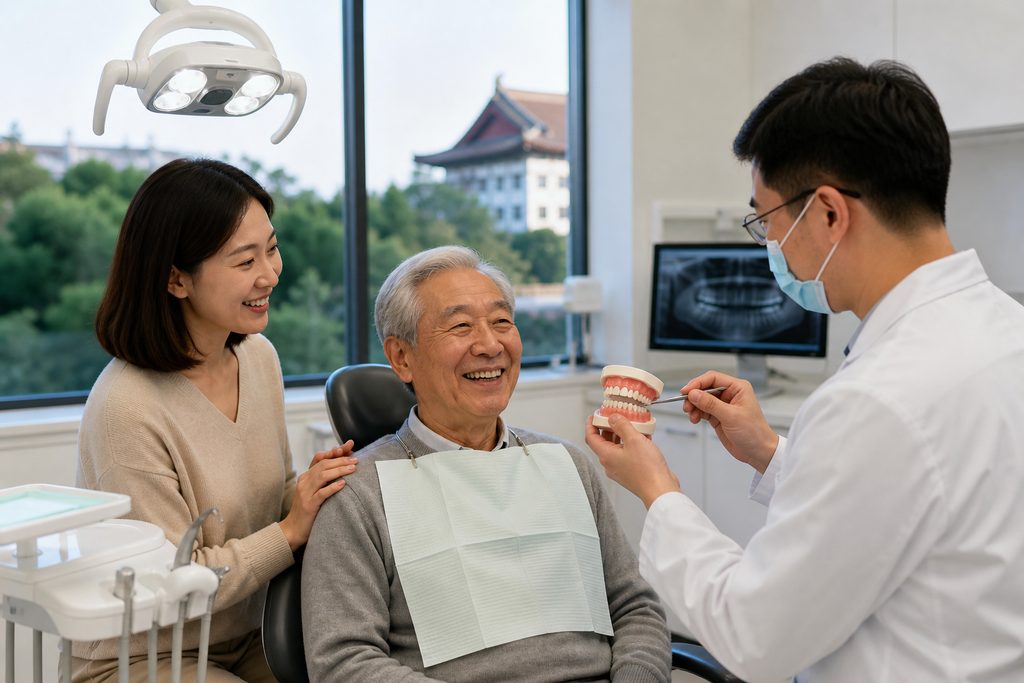
You’ve probably heard that traveling abroad for dental work means gambling on quality. The reality with modern Chinese dental implant programs is different. A 2023 review in the *Journal of Prosthodontic Research* found cumulative implant survival rates above 95% over ten years in well-maintained Chinese hospital cohorts. The challenge for seniors isn’t the clinical work. It’s the logistics. Getting from the airport to the right specialist. Understanding a treatment plan in a language you don’t speak. Knowing whether the dental implant cost China seniors actually pay reflects real value or hidden shortcuts. That’s where a companion service changes the equation.
How This Actually Works, Step by Step
The process starts before you book a flight. You send us recent panoramic X-rays, a cone-beam CT scan if you have one, and a list of current medications. Our team translates these records into Chinese and forwards them to the implantology department at two or three hospitals matched to your case complexity. A specialist reviews the files and returns a written assessment: bone volume, sinus proximity, whether grafting is likely, and a provisional treatment plan.
Then you speak with the specialist by video. Not a sales representative. The actual clinician who would perform or supervise the procedure. You discuss your medical history, your expectations, and the timeline. After that call, you receive a formal cost estimate broken into line items: implant hardware, abutment, crown, any grafting, anesthesia, and hospital facility fees.
If you decide to proceed, we coordinate the S2 visa paperwork, book your initial consultation, and arrange a bilingual companion to meet you at the hospital. You don’t navigate registration queues alone. You don’t guess which floor has the imaging center. The companion handles payment deposits, translates every question you ask, and stays with you through the surgical appointment and follow-up visits.
What Seniors Actually Pay for Dental Implants in China
The dental implant cost China seniors face depends heavily on the implant system and hospital tier. In top public hospitals and reputable private international clinics, a single titanium implant with abutment and porcelain crown typically ranges from $1,500 to $3,500. The same procedure in the United States averages $3,000 to $6,000 per tooth, with premium systems pushing toward $7,000.
Full-arch restoration is where the savings compound. All-on-4 or All-on-6 full mouth rehabilitation in China generally costs between $12,000 and $25,000 per arch, depending on whether you choose Korean systems like Osstem, European systems like Straumann or Nobel Biocare, and whether immediate loading is required. In the U.S., that same treatment commonly runs $25,000 to $45,000 per arch. The gap is real, but it’s not magic. Lower facility overhead, competitive implant pricing, and high procedure volume drive the difference.
| Procedure | China Range (USD) | U.S. Average (USD) |
|---|---|---|
| Single implant + crown | $1,500 – $3,500 | $3,000 – $6,000 |
| Full arch (All-on-4, per arch) | $12,000 – $25,000 | $25,000 – $45,000 |
| Sinus lift / bone graft | $400 – $1,500 | $1,500 – $3,000 |
| Consultation + imaging | $50 – $200 | $150 – $400 |
Prices vary by hospital and case complexity. A straightforward single implant in a tier-1 city public hospital sits at the lower end. A complex full-arch case with grafting at a private international clinic in Shanghai lands at the upper end. Always request a line-item quote before committing.
Is Dental Implant Safe for Elderly in China?
Is dental implant safe for elderly in China? The short answer: yes, with proper screening. Age alone is not a contraindication. A 2022 systematic review in *Clinical Oral Implants Research* concluded that implant survival in patients over 70 was statistically equivalent to younger cohorts when systemic conditions were controlled.
The real risk factors are uncontrolled diabetes, heavy smoking, bisphosphonate use, and poor oral hygiene. Reputable Chinese hospital departments screen for all of these before scheduling surgery. They run blood panels, review bone density scans, and sometimes require a cardiology clearance for patients with significant heart history.
What seniors should not accept is a clinic that skips the screening step. If a provider quotes you a price before seeing your CT scan, walk away. That’s a red flag anywhere in the world, including China. Our companion service works exclusively with hospital departments that follow standard pre-surgical protocols. We don’t book you into a strip-mall clinic that promises same-day implants without medical review.
A Realistic Timeline
| Stage | Duration | What Happens |
|---|---|---|
| Record submission & translation | 2–4 days | We translate X-rays, CT scans, and medication lists into Chinese |
| Specialist review | 3–7 days | Implantology department evaluates bone quality and medical history |
| Video consultation | 1–2 weeks from start | You speak directly with the clinician, discuss options and timeline |
| Visa processing (S2) | 1–4 weeks | Embassy processing varies by country; hospital invitation letter helps |
| Arrival & first in-person exam | Day 1–2 in China | Companion meets you, handles registration, interprets during exam |
| Surgery (single implant) | Day 3–7 in China | Placement takes 1–2 hours; local anesthesia standard |
| Osseointegration waiting | 3–6 months | Implant fuses with bone; you return home during this period |
| Crown placement | Second trip or extended stay | Abutment and crown fitted; typically 1–2 weeks |
The waiting step people forget is osseointegration. A dental implant is not a one-visit procedure. The titanium post must fuse with your jawbone for three to six months before the crown can be attached. Some clinics offer immediate-loading protocols for full-arch cases, but even those require careful case selection. Plan for either a second trip or an extended stay if you want the entire process completed in China.
What Can Go Wrong — and What Happens Then
Peri-implantitis is the most common long-term complication. It’s an infection around the implant, similar to gum disease, and it affects roughly 10–20% of implants over a decade. If it develops after you return home, you’ll need a local periodontist to manage it. Chinese hospitals provide post-operative instructions and sometimes coordinate with your home dentist, but they can’t perform remote cleanings.
Nerve damage is rare but possible, particularly in the lower jaw. A competent surgeon uses CT-guided planning to avoid the inferior alveolar nerve. If numbness persists beyond a few weeks, the implant may need removal. This is why we emphasize hospital-based departments with cone-beam CT capability, not clinics that plan from a 2D X-ray alone.
Implant failure happens in about 2–5% of cases. The causes vary: poor bone integration, overloading, infection. If a Chinese hospital places an implant that fails within the warranty period, most reputable departments will replace it at reduced or no cost. But you’ll need to return to China for that replacement. Your home dentist may be reluctant to touch another provider’s work. Factor that into your decision.
Sinus complications during upper-jaw implants can occur if the sinus membrane is perforated. Experienced surgeons manage this intraoperatively, but it may extend healing time. Ask about the surgeon’s specific experience with your implant site before agreeing to surgery.
Choosing the Right Clinic: What the Numbers Don’t Tell You
The best dental implant clinic Shanghai for seniors isn’t necessarily the one with the shiniest website. Look for three things. First, hospital affiliation. Departments attached to major teaching hospitals — those affiliated with Fudan University, Shanghai Jiao Tong University, or Peking University — maintain peer-reviewed quality standards and are subject to government oversight. Private chains can be excellent, but you need to verify credentials more carefully.
Second, implant system transparency. The clinic should tell you exactly which implant brand and model they’re using, with the catalog number. Osstem, Dentium, Straumann, Nobel Biocare, and Astra Tech all have solid track records. If a clinic won’t name the system, that’s a problem.
Third, surgeon volume. Ask how many implant procedures the surgeon performs monthly. A specialist placing 50 or more implants per month has seen complications and knows how to avoid them. A general dentist doing five a month is a different risk profile.
For seniors specifically, how much are full mouth dental implants in China depends on whether you choose a public hospital international department or a private clinic. Public hospital international departments offer senior specialists and English-speaking coordination, typically at 1.5 to 2 times the standard public fee. Private international clinics like United Family or Jiahui offer Western-style environments and direct insurance billing, but their implant fees run higher — often $2,500 to $4,000 per tooth.
Practical Considerations: Records, Visa, Payment, and Follow-Up
Bring every relevant record. Panoramic X-rays, cone-beam CT scans, a list of current medications with dosages, and any recent blood work. If you have diabetes, bring your HbA1c results. If you take blood thinners, your cardiologist’s clearance is essential. The more complete your file, the faster the specialist review moves.
Visa category matters. Medical treatment in China uses the S2 visa, not the M visa. M is for commercial and trade activities. For dental implant treatment, you’ll apply for an S2 visa with supporting documents from the hospital — usually an invitation letter and treatment confirmation. Processing times vary by country, so start this at least a month before your planned travel date.
Payment is upfront. Chinese public hospitals require deposits before surgery, and you settle the balance as you go. Bring a credit card that works internationally and notify your bank of travel. Some private international clinics accept direct insurance billing; public hospitals generally do not.
Language is the biggest practical barrier. Top Chinese hospitals handle enormous patient volumes — a single day can see thousands of outpatients. Signage is often bilingual in international departments, but the flow of registration, payment, imaging, and pharmacy pickup assumes Chinese fluency. A bilingual companion eliminates that friction. It’s not a luxury. It’s the difference between a smooth appointment and a lost afternoon.
Follow-up after you return home requires planning. Your local dentist should receive a complete treatment summary in English, including implant system details, torque values, and recommended maintenance intervals. We arrange for this documentation before you leave China. Most home dentists are willing to handle routine cleanings and annual X-rays once they have proper records.
Frequently Asked Questions
Full-arch rehabilitation in China typically ranges from $12,000 to $25,000 per arch, versus $25,000 to $45,000 in the United States. The final dental implant cost China seniors pay depends on implant system, bone grafting needs, and whether you choose a public hospital international department or a private clinic.
Yes, when properly screened. Age alone doesn’t disqualify you. The key is controlling systemic conditions — diabetes, smoking, bisphosphonate use — and getting a thorough pre-surgical workup. Hospital-based departments in China follow standard protocols that mirror international guidelines.
Book dental implant Beijing senior patient coordination through a companion service that handles translation, registration, and in-person support. The hospital appointment itself must be made through official channels — you can’t bypass the system — but a bilingual companion makes the process navigable and significantly less stressful.
Most reputable Chinese hospital departments offer a warranty period during which they’ll replace a failed implant at reduced or no cost. But you’ll need to travel back for that replacement. Your home dentist may be unwilling to manage another provider’s complications, so factor return travel into your risk calculation.
A dental tourism package China with companion care typically covers hospital coordination, bilingual accompaniment, and sometimes airport transfer. It does not include airfare, lodging, or the hospital’s own treatment fees. Always clarify what’s bundled and what’s separate before you book.
Your Next Step
The decision to get dental implants in China as a senior comes down to three questions: Can you save meaningfully? Can you trust the clinical quality? Can you handle the logistics? The savings are real. The quality at top hospital departments is excellent. The logistics are manageable — if you have someone on the ground who knows the system.
That’s what we do at China Medical Services. We connect you with vetted implantology departments, translate your records, coordinate your S2 visa paperwork, and provide a bilingual companion for every hospital visit. We don’t perform dental work. We don’t promise outcomes. We make the process legible.
If you’re considering implants and want a clear-eyed assessment of your options, start with a conversation. Visit our companion service page to tell us about your situation. We’ll review your records, connect you with a specialist, and give you honest guidance — whether or not you ultimately travel to China.
For more medical information and treatment options in China, visit chinamedservices.com (China Medical Services).
