Scoliosis Surgery in China: A Companion for Complex Spine Care
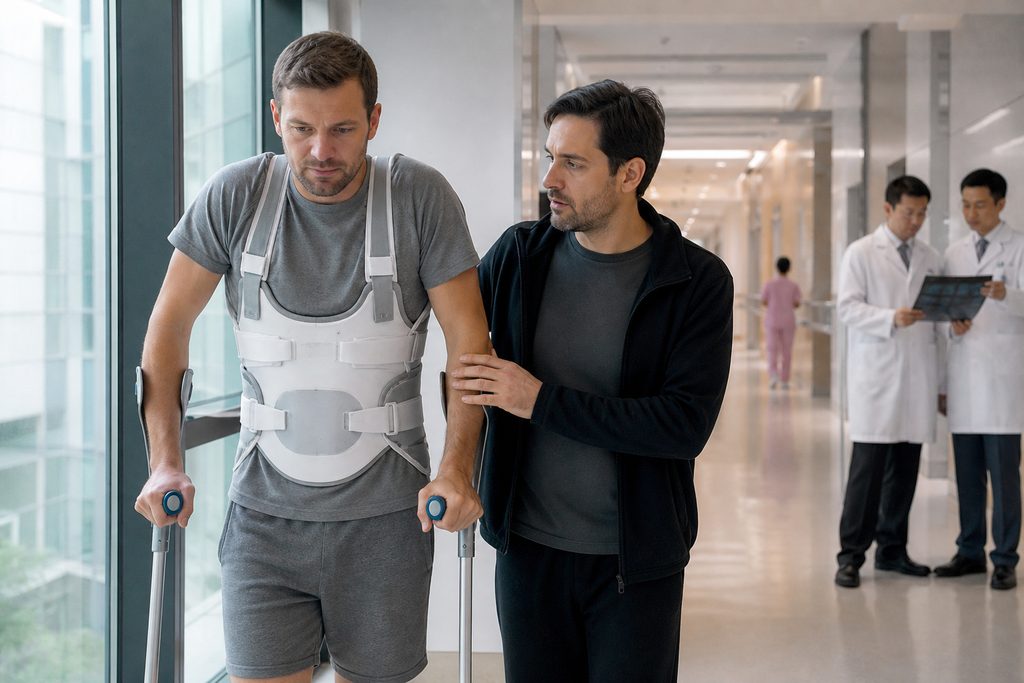
How This Actually Works, Step by Step
Scoliosis surgery sounds frightening when you first hear the words. But in plain terms, it means surgically straightening an abnormal sideways curve of the spine and fusing vertebrae so the curve cannot progress. It is major surgery. It is also one of the most common orthopedic procedures performed at high-volume spine centers worldwide. If you are reading this, you or someone you love is likely facing a decision that feels heavier than most. The thought of traveling abroad for it adds another layer of uncertainty. Let us walk through what actually happens when an international patient pursues scoliosis surgery in China.
The process starts with records, not travel. You send us the existing imaging — standing full-spine X-rays, MRI if available, any prior surgical notes, and a brief medical history. Our team translates these documents into Chinese and routes them to a spine surgery department at one of the hospitals in our database. A specialist reviews the films and returns a written assessment: whether surgery is indicated, what approach they would recommend, and what additional imaging might be needed. This written second opinion typically costs between $300 and $500, and it gives you a concrete starting point without flying anywhere.
If the remote review confirms that surgery is appropriate, the next step is a video consultation. You speak directly with the surgical team through a translator. You ask about fusion levels, instrumentation type, expected correction percentage, and what the surgeon sees on the films. You hear their reasoning. Only after this conversation do you decide whether to proceed with travel. No one should book an international flight for major spine surgery based on an email exchange alone.
Once you commit, we coordinate the hospital appointment through the international department or VIP channel. Public hospitals in China do not allow overseas patients to book surgery before an in-person consultation. The surgeon must see you, examine you, and confirm the plan. Our bilingual companion meets you at the hospital, handles registration, translates every conversation, and stays with you through admission. Surgery is scheduled after the face-to-face evaluation. That sequence — remote review, video consult, in-person evaluation, surgery — is the honest path. Anyone promising to lock a surgery date from abroad is not describing how Chinese public hospitals actually work.
What Scoliosis Surgery in China Actually Costs
The scoliosis surgery cost China patients encounter depends heavily on curve severity, fusion length, implant type, and hospital tier. A single-curve adolescent idiopathic scoliosis case requiring 8 to 12 fused levels at a top public hospital typically runs between $25,000 and $45,000 for the hospital portion alone. Complex adult deformity cases — revision surgeries, double major curves, cases requiring osteotomies — can reach $60,000 to $90,000. These figures exclude travel, lodging, and companion services.
| Procedure Type | China Public Hospital (USD) | US Reference Range (USD) | Typical Stay |
|---|---|---|---|
| Adolescent idiopathic scoliosis fusion (8–12 levels) | $25,000–$45,000 | $150,000–$250,000 | 7–10 days |
| Adult degenerative scoliosis (complex, multilevel) | $45,000–$75,000 | $200,000–$350,000 | 10–14 days |
| Revision scoliosis surgery | $60,000–$90,000 | $300,000+ | 14–21 days |
| Video consultation (spine specialist) | $100–$300 | $500–$1,000 | N/A |
These are honest ranges, not quotes. The final number depends on implant manufacturer, number of screws and rods, hospital tier, and whether you go through the international department. That last point matters. International and VIP channels at Chinese public hospitals cost roughly 1.5 to 2 times the standard rate. You pay for English-speaking coordination, shorter queues, and senior surgeon access. For a surgery this serious, most patients consider that premium worth it.
Insurance reimbursement is a separate conversation. Chinese public hospitals generally require prepayment. You settle the bill, then file with your insurer back home. Some private international hospitals in China offer direct billing, but very few perform complex scoliosis surgery at the volume of the major public orthopedic centers. If you are weighing the best spine hospital for scoliosis Shanghai offers against a private option, understand the trade-off: private gives you insurance convenience, public gives you surgical volume and subspecialist depth.
A Realistic Timeline
Medical travel for scoliosis surgery does not happen in two weeks. Here is what a realistic sequence looks like when nothing goes wrong.
| Stage | What Happens | Duration |
|---|---|---|
| Week 1–2 | You gather and send medical records; we translate and submit them | 5–14 days |
| Week 2–4 | Specialist reviews films; written second opinion returned | 5–10 business days |
| Week 4–6 | Video consultation scheduled and completed | 1–2 weeks lead time |
| Week 6–8 | Decision made; hospital appointment coordinated; visa application starts | 1–2 weeks |
| Week 8–10 | S2 visa processing (varies by embassy) | 5–15 business days |
| Week 10–11 | Travel to China; in-person surgical evaluation | 2–3 days |
| Week 11–12 | Surgery scheduled (typically 3–7 days after evaluation) | 3–7 days |
| Week 12–14 | Hospital stay and early mobilization | 7–14 days |
| Week 14–16 | Discharge; local recovery before flying home | 7–14 days |
| Month 3–6 | Continued recovery at home; remote follow-up imaging | Ongoing |
The steps people forget are document translation and visa processing. Neither can be rushed. If you are coming from a country where the Chinese embassy requires in-person visa interviews, add another week. If your imaging is incomplete — missing bending films, no MRI — the remote review stalls. Send everything the first time.
What Can Go Wrong — and What Happens Then
Let us be direct about failure modes, because this is where trust is built or broken.
The remote review says surgery is not indicated. This happens more often than patients expect. Some curves are stable, some are better managed with bracing or physical therapy, and some patients have been told they need surgery when they do not. If the Chinese specialist says no, you have paid a few hundred dollars to avoid an unnecessary operation. That is a good outcome, even if it feels disappointing.
You arrive and the surgeon changes the plan. After examining you in person, the surgeon may recommend a different fusion length, a staged procedure, or additional imaging. This is not bait-and-switch. It is what happens when a careful surgeon sees the whole patient instead of films alone. Your companion translates the reasoning. You make the call with full information.
Complications occur. Infection, implant prominence, nonunion, neurological symptoms — these are real risks in any country. Chinese top-tier spine centers manage these complications daily because their volume is enormous. Fuwai Hospital performs over 14,000 cardiac surgeries a year; the top orthopedic centers operate at similar scale for spine. Volume matters when something goes wrong. Ask any surgeon: complication management is where experience shows.
The visa is delayed. This is outside anyone’s control. We provide the hospital invitation letter and supporting documents, but embassy processing times vary. If your visa is delayed beyond the appointment window, we reschedule. It is inconvenient, not catastrophic. Build buffer into your timeline.
You do not speak a word of Mandarin. This is the most predictable challenge. Chinese public hospitals are vast — single-day outpatient volumes exceed 10,000 at major centers. Signage is often bilingual in international departments, but the moment you step outside that bubble, you are lost. A bilingual companion is not a luxury. It is the difference between a manageable experience and a terrifying one.
Is Scoliosis Surgery Safe in China? What the Numbers Actually Mean
The question “is scoliosis surgery safe in China” deserves a straight answer. Safety in complex spine surgery correlates with two things: surgeon experience and hospital volume. China’s top orthopedic hospitals operate on scoliosis cases weekly, not monthly. A surgeon at a high-volume center may perform 100 to 200 scoliosis fusions per year. Compare that to a Western surgeon who does 20 to 40. There is no substitute for repetition when you are placing pedicle screws into rotated vertebrae.
China’s hospital ranking system helps here. The Fudan University hospital rankings evaluate clinical reputation and specialty strength across 45 subspecialties. Orthopedics is one of them. When we say a hospital is “ranked among China’s top 10 for orthopedics,” that is a specific, verifiable claim from the Fudan specialty reputation list. It is not marketing language. You can look it up.
That said, safety is never guaranteed. Any honest provider will tell you that scoliosis surgery carries real risks regardless of geography. What changes in China is the depth of experience managing those risks. The best spine hospital for scoliosis Shanghai patients choose is typically a public tertiary center with a dedicated spinal deformity unit — not a general orthopedic department that occasionally does scoliosis cases. Ask about annual scoliosis case volume. Ask about revision rates. A good department will tell you.
Complex spine surgery medical tourism China offers works best for patients who have already been diagnosed and are seeking a second surgical opinion or a definitive procedure at a lower cost. It is not ideal for undiagnosed back pain. If you do not have a clear diagnosis and complete imaging, start there. No hospital in any country can evaluate a curve without standing full-spine films.
Practical Considerations: Records, Visa, Payment, and Recovery Abroad
Your medical records are the foundation. Bring everything: standing AP and lateral full-spine X-rays, side-bending films if done, MRI of the full spine, any CT, prior operative reports, and a list of current medications. Digital copies on a USB drive plus printed copies. Chinese hospitals will want their own imaging anyway, but your prior films let the surgeon assess curve progression over time.
The visa category for medical treatment in China is S2. It is a short-stay visa for private affairs, including medical treatment. Accompanying family members also apply for S2. The hospital provides an invitation letter and treatment confirmation documents. Processing takes 5 to 15 business days depending on your home country. If your treatment and recovery will exceed 180 days, you need an S1 visa. Most scoliosis patients use S2 — surgery plus initial recovery rarely exceeds three months in-country. Do not apply for an M visa. That is for commercial and trade activities, not medical care.
Payment is prepaid at public hospitals. Bring a credit card with a high limit, or arrange a wire transfer. Some international departments accept international insurance for direct billing, but most do not. Plan to pay out of pocket and seek reimbursement. Our coordination fee for hospital appointments starts at $300, and any consultation fee you paid is credited in full toward on-the-ground coordination services within 90 days. That credit applies to our service fee only — never to hospital treatment charges.
Recovery after scoliosis surgery abroad follows the same biological timeline as anywhere else. You will be walking within 2 to 3 days. Discharge happens at 7 to 14 days for uncomplicated cases. Flying home is generally safe 2 to 3 weeks after surgery, but long-haul flights increase clot risk — your surgeon will advise on timing and anticoagulation. Most patients stay in China for 2 to 4 weeks after discharge before flying. How long is recovery after scoliosis surgery abroad? Full fusion takes 6 to 12 months. You will need follow-up X-rays at 3, 6, and 12 months. Those can be done at home and sent back for remote review.
Frequently Asked Questions
You can book the coordination package — remote review, video consultation, hospital appointment, companion services — but not the surgery itself. Chinese public hospitals require an in-person evaluation before scheduling any operation. Anyone claiming to “book scoliosis surgery package China” with a locked date from overseas is not describing a legitimate process. What we do is coordinate everything up to the operating room door. The surgeon makes the final call after seeing you.
Then you have saved yourself from an unnecessary operation. You pay for the evaluation and consultation, not for surgery that never happens. This is rare for patients with clear surgical indications confirmed by remote review, but it does occur. The cost of finding out is a fraction of the cost of an unnecessary fusion.
Most will, but discuss it before you travel. Your Chinese surgeon will provide a detailed discharge summary in English upon request. Bring that to your home orthopedic surgeon and establish a follow-up plan before you leave. Some home doctors are hesitant to manage another surgeon’s complications. Find one who is willing, or plan for remote follow-up with the Chinese team.
Look at the Fudan specialty rankings for orthopedics, not just the overall hospital reputation. Beijing and Shanghai have the highest concentration of top-ranked orthopedic departments. But a top-10 orthopedic program in Chengdu or Guangzhou may be more convenient for you. The best spine hospital for scoliosis Shanghai offers is not automatically better than a top program elsewhere. Consider surgeon experience with your specific curve type, not just the city name.
The bilingual companion handles registration, payment queues, prescription pickup, translation during every doctor conversation, and communication with nurses. They do not make medical decisions. They do not guarantee access to a specific surgeon. They are your communication bridge in a system where nothing is in English outside the international department. For $300 per day, they turn a disorienting experience into a navigable one.
Your Next Step
Deciding where to have scoliosis surgery is one of the most consequential choices a family can make. China’s top spine centers offer world-class surgical volume at a fraction of Western prices, but the logistics are real, and the process is not designed for foreign patients who arrive unprepared. That is where we come in. China Medical Services maintains a database of 340+ top-ranked hospitals across 37 cities, and we connect international patients with the right spine teams through remote review, video consultation, and on-the-ground coordination. We do not perform surgery, we do not promise outcomes, and we do not sell access to specific surgeons. We translate, coordinate, and accompany — so you can focus on the decision that matters. If you are considering complex spine surgery in China, start with a conversation. Tell us about your case and we will help you figure out whether this path makes sense for you. No pressure. Just honest guidance from people who know the system.
For more medical information and treatment options in China, visit chinamedservices.com (China Medical Services).
