Proton Beam Therapy in China: How We Arrange Your Cancer Treatment
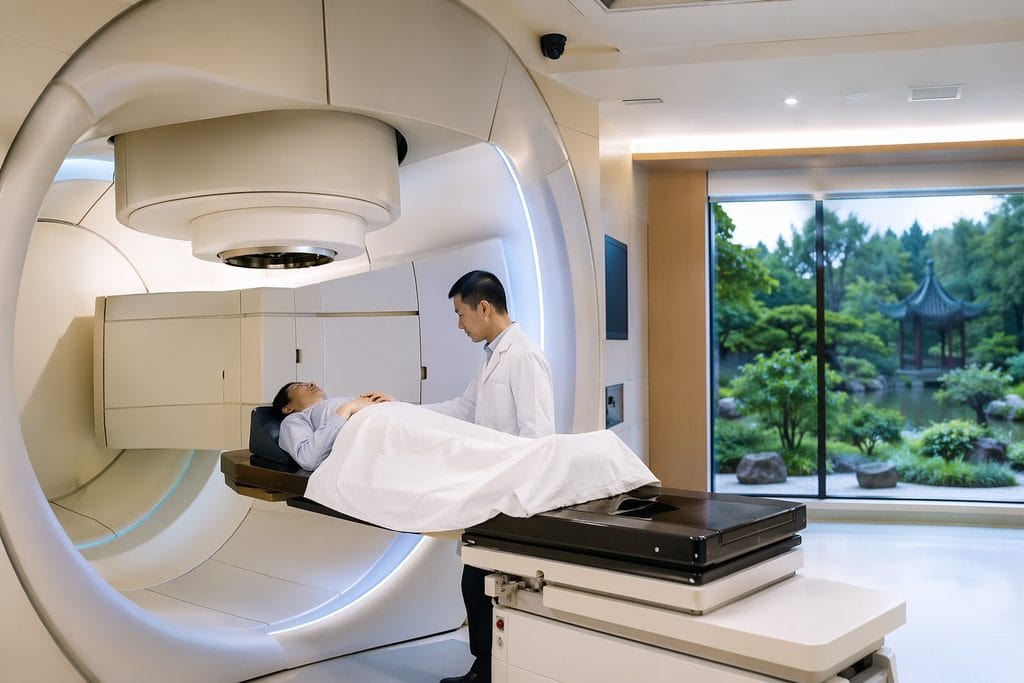
Proton Beam Therapy in China: The Short Answer
You’ve probably heard that advanced cancer care means flying to the United States, Japan, or Germany. The reality has shifted. China now operates a growing network of proton and heavy ion centers, and the proton therapy cost China patients actually pay runs between $30,000 and $70,000 per treatment course. That’s roughly one-third to one-half of the $100,000 to $180,000 billed at American centers for comparable protocols. The catch? Access isn’t as simple as booking a flight. Public hospital proton centers in Shanghai and elsewhere serve a patient volume that would surprise most Westerners, and international patients need structured coordination to get evaluated, scheduled, and treated without wasting weeks on logistics.
Our team at China Medical Services has spent years mapping exactly how this works. We’re not a hospital. We don’t diagnose or treat. What we do is connect you with the right proton center, prepare your records, arrange the S2 visa documentation, and put a bilingual companion beside you from arrival through discharge.
Before you commit to anything, here’s what you actually need to know.
Who This Is Right For — and Who It Isn’t
Proton therapy isn’t for every cancer. It delivers its dose at a precise depth, sparing tissue behind the tumor. That makes it genuinely valuable for tumors near critical structures — the brain, spine, eyes, and certain pediatric cancers. It’s also used for localized prostate cancer, some head and neck tumors, and selected liver and lung cases where conventional radiation would risk too much healthy tissue.
Typically good candidates:
- Patients with solid, localized tumors where radiation is already indicated but conventional photon therapy poses high risk to adjacent organs
- Pediatric patients, where reducing long-term radiation exposure to developing tissue matters enormously
- Prostate cancer patients seeking to minimize rectal and bladder toxicity
- Patients with recurrent tumors in previously irradiated areas
- Those who have already confirmed proton therapy is appropriate with their home oncologist and are seeking a more affordable treatment site
Who should not pursue this path:
- Patients with metastatic or widely disseminated disease — proton therapy treats localized targets, not systemic cancer
- Blood cancers like leukemia and most lymphomas, which require systemic therapy rather than localized radiation
- Patients medically unstable for international travel
- Anyone whose home oncologist has not yet confirmed radiation as part of the treatment plan
- Patients expecting a guaranteed treatment slot without a prior records review — Chinese proton centers require documented medical necessity before scheduling
Being honest about who shouldn’t come is part of what makes the rest of this guide trustworthy. If your case doesn’t fit, we’ll tell you that on the first call.
The Options, Compared
If you’re weighing proton therapy destinations, China isn’t your only choice. But the value equation has changed. Here’s how the genuine alternatives stack up as of 2026.
| Destination | Cost per Course (USD) | Wait Time After Acceptance | Language Support | Technology |
|---|---|---|---|---|
| United States | $100,000–$180,000 | 2–6 weeks | Native English | Pencil beam, IMPT |
| Japan | $60,000–$90,000 | 4–12 weeks | Limited English | Pencil beam, heavy ion |
| Germany | $70,000–$110,000 | 3–8 weeks | Good English | Pencil beam, carbon ion |
| China (Shanghai, Beijing, Guangzhou) | $30,000–$70,000 | 2–8 weeks after records review | Bilingual companion recommended | Pencil beam, heavy ion, carbon ion |
China’s cost advantage is real, but it comes with a trade-off: language and process complexity. That’s precisely the gap our coordination service fills. If you’re comfortable managing Japanese hospital bureaucracy in Japanese, Japan works. If you want American convenience, you pay American prices. China offers the technology at a fraction of the cost — if you have someone handling the friction.
Is Proton Therapy Available in China? The Center Landscape
Yes. The question patients actually ask — is proton therapy available in China — has a clear answer, but the details matter more than the yes. China’s proton and heavy ion capacity has expanded significantly since the first domestic proton center opened in Shanghai. The best proton beam center Shanghai patients frequently inquire about is the Shanghai Proton and Heavy Ion Center, which operates both proton and carbon ion treatment rooms and has treated thousands of patients since 2015. Beijing, Guangzhou, and several other cities have since added or are commissioning proton systems, including pencil-beam scanning technology comparable to what you’d find at MD Anderson or the Mayo Clinic.
But here’s what you won’t hear from a brochure: public proton centers in China operate on a different scheduling model than Western private centers. You cannot simply call from overseas and book a slot. A records review comes first. The center’s radiation oncology team evaluates your imaging, pathology, and treatment history. Only after they confirm proton therapy is appropriate do they assign a treatment window. Our role is to get your records in front of the right department, in the right format, with Chinese-language summaries attached, so that review happens efficiently.
For context on where these centers sit within China’s broader hospital system, our top-ranked hospitals database covers the Fudan-ranked institutions that operate or affiliate with proton facilities. Not every proton center is a Fudan Top 100 hospital, but several are directly affiliated with them.
How Much Is Proton Therapy for Prostate Cancer in China?
How much is proton therapy for prostate cancer specifically? For a standard course of 20 to 28 fractions, Chinese centers typically charge between $35,000 and $55,000. That includes treatment planning, CT simulation, the proton delivery sessions themselves, and routine on-treatment imaging. It does not include your travel, accommodation, visa fees, or our coordination service. It also doesn’t include any pre-treatment diagnostics you may need to repeat in China, which can add $2,000 to $5,000 depending on what your home hospital already performed.
Compare that to the $120,000 to $160,000 commonly billed for prostate proton therapy at U.S. centers. Even after adding $10,000 to $15,000 for international travel and lodging over eight weeks, the total cost in China lands well under half the American price. The variance depends on fraction count, whether the center uses pencil beam or passive scattering, and whether your case requires additional imaging like PSMA PET.
What drives the variance? Three things. First, fraction count — more fractions means higher cost. Second, technology — carbon ion therapy, available at select Chinese centers, costs more than proton alone. Third, hospital tier — private international hospitals with proton access charge more than public hospital proton centers. We walk through these options during the initial consultation so you understand exactly which column you’re being quoted from.
What It Costs: The Full Picture
Let’s be concrete about the total financial picture for an international patient pursuing proton therapy in China.
| Expense Category | Typical Range (USD) | Notes |
|---|---|---|
| Proton therapy course (20–30 fractions) | $30,000–$70,000 | Varies by center, technology, fraction count |
| Pre-treatment diagnostics | $2,000–$5,000 | Only if home records insufficient |
| S2 visa and documentation | $200–$500 | Per person, including family companion |
| Round-trip airfare | $1,500–$4,000 | Economy to business, varies by origin |
| Accommodation (8 weeks) | $3,000–$8,000 | Serviced apartment near hospital |
| Bilingual medical companion | from $300/day | Full-day or half-day, as needed |
| Airport transfer | $200 round-trip | Per vehicle |
Here’s what that table doesn’t show: the cost of getting it wrong. A patient who arrives without proper records review might spend two weeks in Shanghai only to learn the tumor board wants additional imaging or, worse, that proton therapy isn’t indicated. That’s why we insist on a written second opinion or video consultation before you book any flights. Our consultation service starts with a free conversation about your case. From there, a written second opinion from a top proton center specialist runs $300 to $500. A video consultation with a senior radiation oncologist runs $500 to $800. If you later proceed to on-the-ground coordination, those consultation fees are credited in full toward the coordination service — a one-time credit that applies only to our coordination fee, never to hospital treatment charges.
Practical Considerations: Records, Visa, Payment, and Follow-Up
Let’s talk about the logistics that actually determine whether this works for you.
Medical records. Chinese proton centers require your full oncology file: pathology report, surgical notes if applicable, all imaging (CT, MRI, PET) in DICOM format, and a summary from your treating oncologist stating the diagnosis, stage, prior treatments, and current status. We translate these into Chinese and format them according to each center’s intake requirements. A records review typically takes 5 to 10 business days after submission.
Visa. Medical treatment in China falls under the S2 visa category, not the M visa. The M visa is for commercial and trade activities — using it for medical care would be incorrect. S2 covers short-term private affairs, including medical treatment, and is the category we guide patients and accompanying family members through. You’ll need an invitation letter or supporting documentation from the treating hospital, which we help obtain after the records review confirms acceptance. S2 stays are typically limited to 180 days; for longer treatment courses, an extension or S1 visa may apply. Requirements change, so we verify current embassy or consulate rules at the time of your application. We never guarantee approval — that decision rests solely with Chinese immigration authorities.
Payment. Public hospital proton centers operate on a prepayment model. You pay for each phase of treatment before it begins — planning, then fractions in blocks. Insurance reimbursement is typically on a claims basis: you pay upfront, then submit to your insurer. Private international hospitals in China may offer direct billing with certain insurers, but proton therapy at public centers generally does not. Check your policy’s out-of-network and international treatment clauses before committing.
Language. Even at centers that treat international patients, day-to-day operations run in Mandarin. Registration desks, payment windows, imaging departments, and nursing stations rarely have English-speaking staff on hand. This is not a criticism — it’s simply how public hospitals operate in China, where daily patient volumes exceed 10,000 at major centers. A bilingual medical companion handles queueing, payment, translation, and navigation so you’re not trying to decode a hospital app in Chinese while managing treatment fatigue.
Follow-up after returning home. Proton therapy side effects evolve over weeks and months. Before you leave China, the treating radiation oncologist provides a written summary in English (we ensure this happens) with recommended follow-up imaging intervals. Your home oncologist takes over from there. Some centers offer remote follow-up consultations; we can coordinate those if your home team wants direct dialogue with the Chinese team.
Frequently Asked Questions
Technically, yes — if you read Chinese, understand the hospital’s intake process, and can manage the records submission yourself. In practice, most international patients cannot. Public proton centers don’t have English-language booking portals. Phone lines are answered in Mandarin. Records must be submitted in specific formats. You can attempt it, but expect significant friction. That’s the honest answer. A coordinator doesn’t change the medical outcome — we change how much of your energy goes into logistics instead of treatment.
The hardware is comparable. Chinese centers operate pencil-beam scanning proton systems from the same manufacturers that supply American and European centers — IBA, Varian, and Hitachi systems are all in use. The Shanghai Proton and Heavy Ion Center also operates carbon ion therapy, which is not available at most U.S. proton centers. What differs is the clinical workflow and the patient experience. Chinese centers treat far more patients per day, which means less hand-holding but also deep clinical experience. The technology isn’t the question. The process is.
This is why we don’t let patients travel before records review. The sequence is: submit records, receive written assessment, conduct video consultation if needed, then book travel. If the tumor board determines proton therapy isn’t appropriate, you’ve spent $300 to $800 on consultations instead of $5,000 on flights and housing. If rejection happens after arrival — rare but possible if new imaging reveals something the original records didn’t — our coordination team works with the hospital to understand the reason and, if appropriate, connect you with alternative treatment options in China. We don’t guarantee acceptance. We guarantee you won’t face a rejection alone, in a foreign hospital, without a translator.
Some international policies cover treatment abroad, including proton therapy. Most require pre-authorization and operate on a reimbursement basis. You pay the hospital upfront, then file claims. A few high-end insurers have direct billing arrangements with private international hospitals in China, but public proton centers generally don’t participate. Check your policy’s language on “experimental or emerging therapies” — some insurers still classify proton therapy this way for certain indications, though that’s changing. We provide itemized invoices and English-language medical documentation to support your claims, but we cannot influence your insurer’s decision.
Most proton courses run 4 to 8 weeks, with daily treatments Monday through Friday. Prostate cancer typically requires 20 to 28 fractions, so roughly 4 to 6 weeks. Head and neck or pediatric protocols can extend to 7 or 8 weeks. You’ll need to be in China for the entire treatment period — proton therapy isn’t something you can pause and resume. Plan for the full duration plus a few days before (for simulation and planning) and after (for final assessment and documentation).
Your Next Step
Proton therapy in China is real, affordable by Western standards, and delivered on equipment that matches anything in the United States or Europe. The barrier isn’t the medicine — it’s the process. Records, language, visa, scheduling, payment. That’s where we come in.
We are China Medical Services, a coordination team that connects international patients with top-ranked Chinese hospitals. We don’t treat cancer. We don’t make medical decisions. We handle the logistics so you and your family can focus on treatment. The next step is simple: request a free consultation and tell us about your case. We’ll tell you honestly whether proton therapy in China makes sense for you, and what the path forward looks like.
For more medical information and treatment options in China, visit chinamedservices.com (China Medical Services).
