Proton Therapy in Shanghai: Hospital Match and Full Care for Overseas Patients
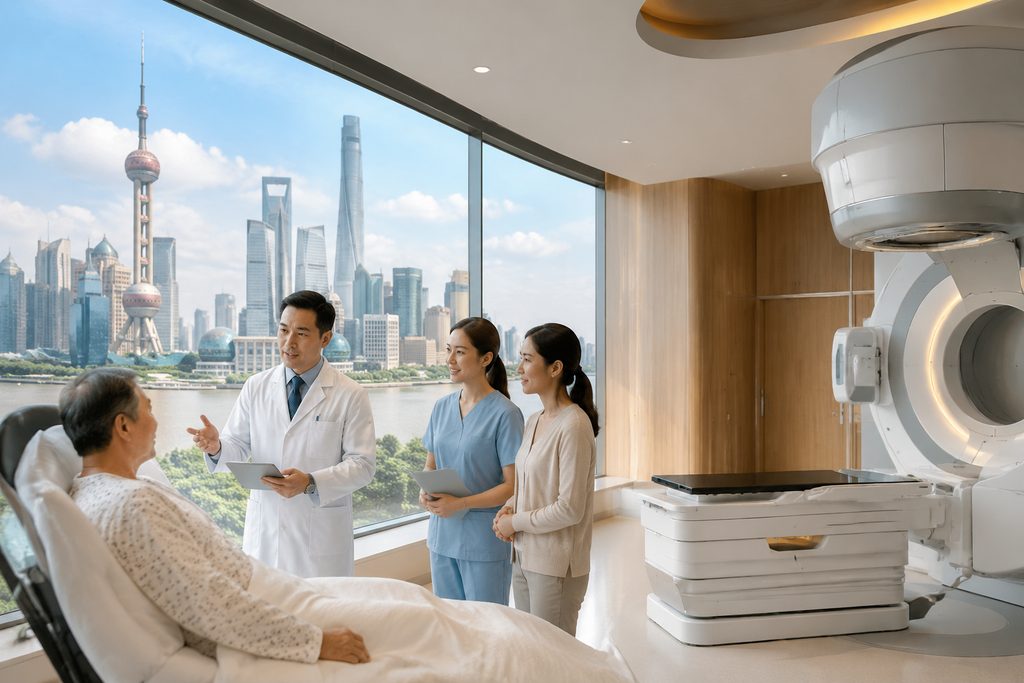
Have you been quoted a price for proton therapy that made you stop reading the email? You are not alone. For many Western patients, the gap between a clinical recommendation and an affordable treatment plan feels unbridgeable. But what if the hospital that can actually deliver the therapy is not in the United States or Germany — and what if getting there, getting matched, and getting through treatment is more structured than you assume?
Our team at China Medical Services works with international patients who ask exactly these questions. This article breaks down how proton therapy works in Shanghai, what it costs, which hospitals offer it, and how a foreign patient actually moves from “I have a diagnosis” to “I have a treatment date” — without the guesswork.
Key Takeaways
- Proton therapy in Shanghai typically costs $30,000–$70,000 for a full course, compared to $100,000–$200,000 in the United States.
- China operates several modern proton and heavy-ion centers; Shanghai hosts one of the most internationally experienced facilities.
- Language, hospital registration, and medical records translation are the biggest practical barriers — not clinical quality.
- Foreign patients cannot book treatment by email alone; a structured referral and in-person evaluation are required.
The Problem: Proton Therapy Is Clinically Promising but Financially Devastating
Proton therapy is not a luxury. For certain tumors — pediatric cancers, chordomas, chondrosarcomas, ocular melanomas, and some brain and spine tumors — proton beams deliver radiation with far less collateral damage to surrounding healthy tissue than conventional photon radiation. That matters when the tumor sits next to the optic nerve, the brainstem, or a growing child’s spine.
But the price tag in the United States is brutal. A standard course of proton therapy at a major American center runs between $100,000 and $200,000, depending on the number of fractions and the complexity of the case. Even with insurance, co-pays and out-of-network denials can leave patients with six-figure bills. Some insurers still classify proton therapy as “investigational” for certain indications, forcing appeals that take months patients do not have.
Wait times add another layer. A patient with a skull-base chordoma cannot wait six months for an insurance appeal. The tumor keeps growing. That is the quiet panic behind every international patient inquiry we receive.
Why Shanghai Has Become a Serious Proton Therapy Destination
Shanghai is not a discount medical tourism gimmick. The city hosts one of China’s most advanced particle therapy facilities — the Shanghai Proton and Heavy Ion Center (SPHIC). Since opening, SPHIC has treated thousands of patients with proton and carbon-ion beams, including a meaningful number of international cases. The center uses a 360-degree rotating gantry and pencil-beam scanning, the same technology class found at leading centers in the United States and Japan.
Clinical Volume Builds Technical Confidence
Chinese radiation oncology departments treat enormous patient volumes. A single top-tier center in Shanghai may treat more particle therapy cases in a year than many Western centers treat in five. That repetition matters. Proton therapy planning is highly technical — physicists and dosimetrists refine treatment plans daily. Teams that see complex cases week after week develop workflow efficiency that directly affects precision and safety.
Physicists at SPHIC publish peer-reviewed research on treatment planning for challenging indications. That is not marketing language; it is observable in the scientific literature. For a patient evaluating whether proton therapy in China is safe, the evidence sits in treatment protocols, published outcomes, and the technology itself — not in a brochure.
Cost Structure: Why the Numbers Are Different
The proton therapy cost Shanghai patients face is structurally lower than in the United States for reasons that have nothing to do with cutting corners. Labor costs for medical physicists, radiation therapists, and support staff are lower in China. Hospital administrative overhead is leaner. Equipment is the same — synchrotron or cyclotron-based systems from the same international manufacturers used in the US and Europe. The difference is not the machine. It is the operating economics around it.
A full proton therapy course in Shanghai typically ranges from $30,000 to $70,000. The exact number depends on the number of fractions, the treatment site, and whether the patient requires additional imaging or anesthesia. That is a fraction of the American price — but not a trivial amount. Patients should think of it as a serious medical investment, not a bargain-bin alternative.
Is Proton Therapy in China Safe? What the Evidence Shows
This is the question every patient asks, usually in the first call. The honest answer is that safety in particle therapy depends on three things: the technology, the treatment planning team, and the quality assurance protocols. All three are verifiable.
SPHIC operates under Chinese national medical device and radiation safety regulations. The facility uses pencil-beam scanning, which allows intensity-modulated proton therapy (IMPT) — the most precise delivery method currently available. The center has treated patients from Europe, Southeast Asia, and the Middle East. International patients are not an afterthought; the center has dedicated pathways for foreign cases.
But safety also means honest patient selection. Proton therapy is not appropriate for every cancer. For some tumors, conventional radiation or surgery is clinically better. A responsible center will tell a patient when proton therapy is not indicated. That is the kind of safety that matters most — and it is exactly what you should expect from any serious Shanghai facility.
How Much Is Proton Therapy in Shanghai? A Realistic Cost Breakdown
Let us put actual numbers on the table. The figures below reflect typical ranges based on published center fees and patient-reported costs. They are not quotes. Final pricing always depends on the specific treatment plan.
| Treatment Component | Typical Cost in Shanghai (USD) | Typical Cost in the United States (USD) |
|---|---|---|
| Full proton therapy course (20–35 fractions) | $30,000–$70,000 | $100,000–$200,000 |
| Initial consultation and treatment planning | $1,000–$3,000 | $5,000–$15,000 |
| Diagnostic imaging (MRI/CT/PET-CT) | $500–$2,000 | $3,000–$10,000 |
| Anesthesia support (if required) | $200–$800 per session | $1,000–$3,000 per session |
These numbers are not static. A complex head-and-neck case requiring 35 fractions will land at the upper end. A simpler prostate case might sit at the lower end. The only way to get a real number is to submit your medical records for a formal treatment plan review. That is also how you find out whether proton therapy is even the right modality for your diagnosis.
Best Proton Therapy Center China for International Patients: How to Choose
China has a handful of particle therapy facilities, but they are not interchangeable. The best proton therapy center China for international patients depends on your tumor type, your treatment history, and your tolerance for travel logistics. Shanghai is the most practical entry point for most Western patients because of its international airport, English-speaking medical infrastructure, and the maturity of SPHIC’s international patient pathway.
Other facilities exist — including heavy-ion centers in Gansu and a newer proton center in Hebei — but Shanghai’s combination of clinical experience, urban infrastructure, and international accessibility makes it the default recommendation for most foreign patients. That is not marketing. It is geography and operational reality.
When evaluating any center, ask these questions directly:
- How many cases of my specific tumor type has this center treated?
- Who performs the treatment planning — a dedicated medical physicist or a generalist?
- What quality assurance checks are performed before each fraction?
- What is the center’s protocol for treatment interruptions or machine downtime?
- Can the center provide a written treatment plan and cost estimate before I travel?
A center that answers these questions clearly and in writing is a center worth trusting. A center that deflects is a red flag.
International Patient Proton Therapy Shanghai Hospital: The Real Admission Process
No. You can complete the initial medical records review and video consultation remotely, but no reputable center will begin treatment without an in-person evaluation. The hospital needs its own imaging and a physical assessment before creating your treatment plan.
That happens, and it is a sign of a responsible center. If proton therapy is not clinically indicated, the hospital should tell you directly and may recommend alternative treatments. You are not obligated to proceed with any treatment you do not want. A written second opinion from a top specialist costs $300–$500 and can help you understand your options before you commit to travel.
Some international insurance plans cover treatment abroad, but most require pre-authorization and may reimburse rather than pay directly. Contact your insurer before you travel. Ask specifically about coverage for treatment at a foreign particle therapy center and request written confirmation of any approval.
Your Next Step
Proton therapy in Shanghai is a serious medical option for patients who need particle therapy and cannot afford Western prices. The clinical infrastructure is real, the cost advantage is significant, and the pathway for international patients exists. But it requires preparation, documentation, and patience. We help patients navigate exactly that — hospital matching, records translation, appointment coordination, and on-the-ground support. We are not a hospital, and we do not provide medical advice or diagnoses. If you want to understand whether Shanghai proton therapy is a realistic option for your case, start with a conversation.
Get a free consultation to discuss your diagnosis, your records, and whether a Shanghai proton therapy center is the right match for you. No pressure. Just clarity.
Frequently Asked Questions
Yes. The hospitals used for international patients are JCI-accredited and follow the same international safety standards as top hospitals in the US and Europe. Surgical teams perform high volumes of procedures — often more than their Western counterparts — which studies show leads to better outcomes.
Costs vary by procedure and hospital, but international patients typically save 40-80% compared to US prices — even when factoring in travel and accommodation. A consultation with our team will give you an exact, all-inclusive quote with no hidden fees.
Send us your existing medical reports to get started. We handle everything from hospital selection and appointment scheduling to visa assistance and post-operative recovery planning. Your medical records are reviewed by the specialist before you even book a flight.
For more medical information and treatment options in China, visit chinamedservices.com (China Medical Services).
