Adult CHD Surgery in China: Fuwai Hospital’s Volume, Costs & Outcomes
Key Takeaways
- Fuwai Hospital performs over 14,000 cardiac surgeries annually, making it the highest-volume heart center globally — volume that directly correlates with better outcomes for complex procedures.
- The Fuwai Hospital adult congenital heart surgery cost typically ranges from $25,000 to $45,000, roughly one-fifth to one-tenth of comparable US pricing, without sacrificing clinical quality.
- Navigating a Chinese public hospital independently is genuinely difficult. Language barriers, a complex registration system, and the inability to pre-book surgeries from abroad are real obstacles.
- Adult congenital heart disease (ACHD) requires a specialized team. Not every cardiac surgeon has deep experience with the anatomical complexities of a repaired or palliated adult heart.
The Problem: A Lifetime of Surveillance, a Shortage of Specialists
More than 1.4 million adults in the United States live with congenital heart disease. That number now surpasses the pediatric CHD population. Medical success created this reality. Children who would have died fifty years ago survived. They grew up. And their surgically modified hearts demand lifelong, expert surveillance. The problem is not the surgery they had as infants. The problem is finding a surgeon who understands what happened inside their chest in the decades since.
A 2020 study in the Journal of the American College of Cardiology found that fewer than 15% of ACHD patients in the US receive care at a specialized center. The reasons are brutal and practical. There are not enough ACHD-trained surgeons. Wait times for a complex reoperation can stretch past six months in publicly funded systems like Canada’s or the UK’s NHS. In the US, the financial toxicity of a repeat sternotomy — reopening a chest scarred from childhood — can exceed $200,000 at a major academic center. Patients fall through the cracks. They are too complex for a general cardiologist, too stable to jump the queue. And then they decompensate.
This is a structural gap, not a personal failing. You did not miss a checkup. The system was not built for you.
Who We Are
We are not a hospital. We do not provide medical treatment, clinical diagnoses, or surgical opinions. We are a medical concierge team based in Beijing. Our job is logistics. We bridge the gap between international patients and China’s top-tier hospitals. We handle hospital matching, appointment coordination through official international departments, bilingual medical interpretation, visa guidance, and local recovery logistics. Think of us as your local guides. We know the system, we speak the language, and we make sure you do not get lost in a hospital that sees 10,000 outpatients a day. Our database covers 340+ top-ranked hospitals across 37 cities, all ranked in the top 5% of China’s 35,000+ medical institutions.
Why Fuwai Hospital Delivers Results for Complex Adult CHD
You cannot hide from surgical volume data. In cardiac surgery, the link between how many procedures a center does and how well its patients do is one of the most replicated findings in healthcare. Fuwai Hospital sits at the extreme end of that curve. It is not just a high-volume center. It is the highest-volume cardiovascular center in the world. For an adult with a Fontan circulation, a tetralogy of Fallot repair gone wrong, or a failing Ross procedure, this is not a marketing point. It is a survival statistic.
Clinical Volume Drives Better Outcomes in Complex CHD Surgery
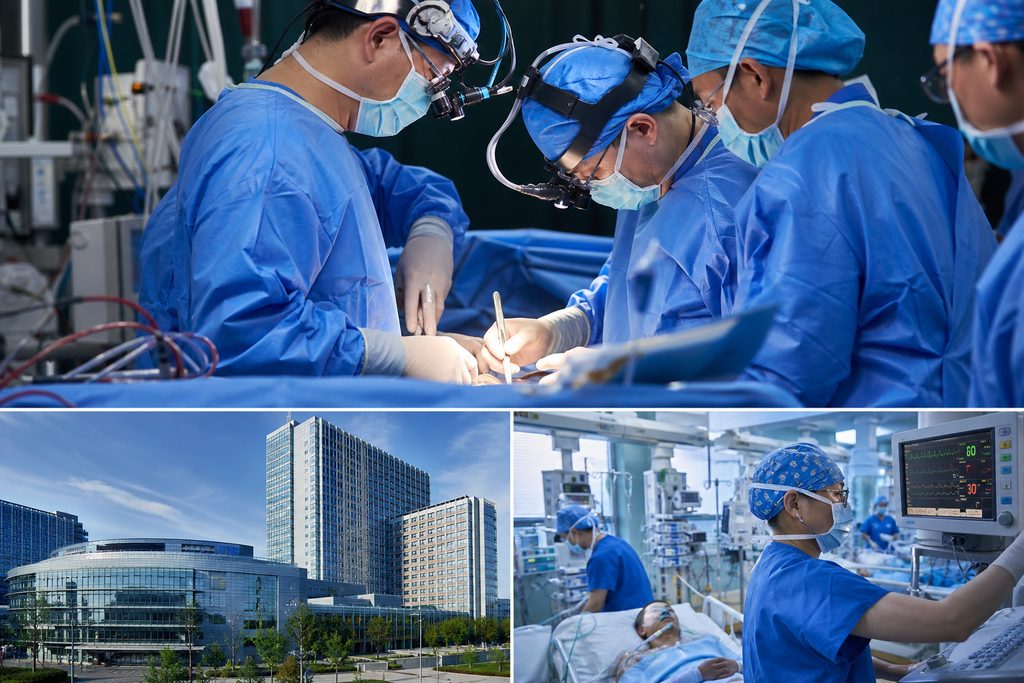
Fuwai Hospital completes over 14,000 cardiac surgeries annually. To put that in perspective, the Cleveland Clinic — widely considered the top US heart center — performs roughly 4,000 to 5,000 cardiac surgeries a year. The entire United Kingdom performs approximately 35,000. One hospital in Beijing does nearly half of what an entire G7 nation does. This matters most for rare, high-complexity cases. A surgeon who corrects an anomalous coronary artery once a year is operating on memory and textbooks. A surgeon who does it weekly has seen the anatomical variations, the unexpected scar tissue, the intraoperative surprises. They have a mental library of what works and what bleeds.
For adult congenital patients, the stakes are higher. You are almost certainly a reoperation. Your sternum is fused with scar. Your anatomy is unique. The top cardiac surgery departments in China, with Fuwai leading the list, publish volume-outcome data that consistently show lower mortality rates for complex procedures when annual surgical volume exceeds a certain threshold. Fuwai is well past that threshold.
Structural Efficiency and a Dedicated ACHD Program
Fuwai does not treat adult congenital heart disease as an afterthought. The hospital maintains a dedicated Adult Congenital Heart Disease Program. This is not a general cardiac surgeon who “also sees ACHD patients.” It is a multidisciplinary team of surgeons, cardiologists, imaging specialists, and intensivists who only work with structurally abnormal adult hearts. They understand the long-term sequelae of childhood repairs. They know what a failing Fontan looks like on cardiac MRI. They have seen pulmonary valve regurgitation in tetralogy patients progress to right heart failure, and they know when to intervene before it is irreversible.
The program’s efficiency is also structural. A patient can often complete preoperative diagnostics — echocardiography, cardiac MRI, CT angiography, and catheterization — within two to three days. In many Western systems, scheduling these studies sequentially can take weeks. This compressed timeline is not magic. It is a hospital designed around cardiovascular disease, with imaging suites and catheterization labs running continuously.
Cost Advantage Without Quality Compromise
And then there is the money. The Fuwai Hospital adult congenital heart surgery cost typically falls between $25,000 and $45,000 USD for a complex reoperation. This includes surgeon fees, hospital stay, ICU care, and standard diagnostics. A comparable procedure at a major US academic center routinely exceeds $150,000 and can reach $250,000. The gap is not explained by inferior care. It is explained by structural economics. Chinese hospital systems operate at enormous scale with lower labor costs and thinner administrative overhead. A cardiac surgeon’s salary in China, while high by local standards, is a fraction of a US surgeon’s compensation. The hospital negotiates device and valve prices at volumes that smaller centers cannot match.
This does not mean cheap. It means rationally priced. You are paying for clinical expertise and hospital infrastructure, not for a bloated billing system designed to offset uninsured care and administrative waste.
What You Need to Know Before Going Alone
We need to be direct about this. Walking into Fuwai Hospital as a foreign patient without preparation is a disorienting experience. The hospital is massive. The registration system is entirely in Chinese. The queues are long. You cannot simply email a surgeon’s office and book a surgery date from abroad. That is not how Chinese public hospitals work. Here is what you will face:
- Visa Requirements: Medical travel to China requires an S2 visa, specifically endorsed for medical treatment. Your accompanying family members also need S2 visas. This is not a tourist visa. You need formal documentation from the hospital — an invitation letter and treatment confirmation — to apply. Obtaining these documents from overseas without a local contact is slow and frustrating. The consulate will not accept a screenshot of an email. They want stamped, official paperwork.
- Payment Systems: Chinese public hospitals operate on a prepaid model. You deposit funds at admission, and the hospital draws down from that balance. International credit cards are often not accepted at the hospital cashier. WeChat Pay and Alipay dominate daily life in China, but linking a foreign bank card to these platforms is unreliable. You need a local payment solution or a service that handles this for you. Expect to pay the full estimated surgical fee upfront before the operation is scheduled.
- Medical Records and Language: The hospital will not accept your medical records in English alone. Everything must be translated into Chinese — operative notes from childhood, recent echocardiogram reports, catheterization data, imaging discs. An incomplete translation leads to an incomplete assessment. And during your stay, virtually no frontline staff speak English. Not the nurses, not the registration clerks, not the technicians in the echo lab. You need a bilingual medical interpreter who understands cardiac terminology, not just conversational Chinese.
How We Help You Navigate This
These barriers are real, but they are logistical, not clinical. They exist because the system was built for 1.4 billion Chinese citizens, not for international patients. Our team exists to solve exactly these problems.
Before you travel, we collect and translate your complete medical history. We present your case to the ACHD team at Fuwai through the official international department. We confirm that your case is appropriate for their program and that a surgeon has reviewed your file. We handle the hospital invitation letter so you can apply for your S2 visa with proper documentation. We do not promise a specific surgeon or an exact surgery date — no honest service can, because the final surgical plan depends on in-person evaluation. But we do promise that you will not arrive in Beijing with a stack of untranslated records and no appointment.
During your stay, a bilingual medical companion accompanies you. This person handles registration, queues, payment deposits, and real-time translation during consultations. When the surgeon explains why a mechanical valve might be preferable to a bioprosthetic in your specific anatomy, you understand every word. Not a summary. The full clinical reasoning.
After discharge, we coordinate follow-up imaging, medication refills, and clearance letters for your flight home. Recovery from a repeat sternotomy takes months. We make sure you leave with a clear plan and translated records for your cardiologist back home.
Frequently Asked Questions
Yes. This is exactly what Fuwai’s Adult CHD Program exists for. The team specializes in reoperations on hearts with complex surgical histories — tetralogy of Fallot repairs, Fontan circulations, Ross procedures, and more. They expect scar tissue. They expect anatomical distortions. Your prior surgeries are not a contraindication; they are the reason the program exists.
Recovery follows a predictable arc. Expect 2 to 3 days in the ICU immediately post-op. Total hospital stay for an uncomplicated reoperation is typically 10 to 14 days. After discharge, you should remain in Beijing for at least one additional week for a wound check and follow-up echocardiogram. Full functional recovery — returning to work, light exercise — takes 6 to 12 weeks. A repeat sternotomy means your sternum needs time to heal. You will have lifting restrictions. You will be tired. This is normal.
Fuwai Hospital’s surgical ICU is one of the most experienced cardiac intensive care units in the world. They manage post-operative complications — bleeding, arrhythmias, low cardiac output syndrome — at a volume that breeds clinical intuition. That said, no surgery is zero risk, and you are far from home. We strongly recommend that patients plan for an extended stay in Beijing post-discharge and purchase comprehensive medical travel insurance that covers complications and extended hospitalization. We help coordinate communication between the hospital and your insurer, and we can arrange extended accommodation if recovery takes longer than expected.
The process starts with a case review. You cannot book a surgery date from abroad without the hospital first reviewing your records and confirming surgical candidacy. We handle this through the hospital’s official international patient channel. Once the surgical team accepts your case and provides a treatment plan and cost estimate, we coordinate your admission timeline. The book adult CHD surgery Fuwai Hospital package process — from initial record submission to a confirmed admission window — typically takes 2 to 4 weeks, depending on the complexity of your case and the surgeon’s schedule.
Fuwai Hospital’s ACHD program is a team, not a single surgeon. The program includes several senior cardiac surgeons who have spent their careers operating on structurally abnormal hearts. We do not publicly name individual physicians — it would be inappropriate and, frankly, misleading, because the best surgeon for your specific anatomy may not be the most famous name. When we present your case, the program director assigns the surgeon whose subspecialty experience best matches your lesion. Trust the matching process. It is based on clinical fit, not public reputation.
Your Next Step
You have lived with a surgically modified heart for years or decades. You know your anatomy better than most cardiologists. What you need now is a surgical team that knows it too — and a logistics partner who can get you there without chaos. The complex CHD surgery price abroad does not have to be financially devastating, and the wait does not have to be indefinite. If you are considering a reoperation and want to understand whether Fuwai Hospital is a viable option for your specific case, start with a conversation. Our team reviews your records, provides an honest assessment of fit, and explains the full pathway — costs, timeline, visa process, recovery logistics — before you commit to anything. Request a free consultation and we will walk you through the process, step by step.
For more medical information and treatment options in China, visit chinamedservices.com (China Medical Services).
