Atrial Fibrillation Ablation in China: Catheter Maze & Surgical AFib Treatment
Key Takeaways
- Catheter ablation for AFib in China’s top cardiac centers costs $15,000–$25,000 — roughly 70–85% less than the $80,000–$120,000 typical in the United States, with published success rates above 80% for paroxysmal AF.
- Fuwai Hospital in Beijing performs over 14,000 cardiac surgeries annually, the highest volume of any heart center globally — a data point that directly correlates with lower complication rates in complex procedures.
- Language is the single biggest barrier for international patients in China’s public hospitals. Even in elite centers, frontline staff rarely speak medical English, and digital registration systems are entirely in Chinese.
- You cannot book a catheter ablation from overseas through standard public channels. Surgical scheduling requires an in-person consultation first. The international VIP pathway changes that equation, but it costs more and requires experienced coordination.
The Problem: When Your Heart Won’t Stay in Rhythm and Your Options Are Shrinking
Atrial fibrillation affects approximately 37 million people worldwide. That number keeps climbing. In the United States alone, the CDC estimates 12.1 million people will have AFib by 2030. The condition is not rare. It is everywhere. And for patients whose medications stop working — or who cannot tolerate the side effects of long-term antiarrhythmic drugs — catheter ablation becomes the logical next step.
But logic collides with reality fast. In Canada and the UK, wait times for elective AFib ablation routinely stretch past six months. In New Zealand, some patients wait over a year. The US system moves faster, but the financial math is punishing. Even with insurance, out-of-pocket costs for catheter ablation frequently land between $15,000 and $40,000. Without insurance? The uninsured cash price at a major American hospital can exceed $100,000. That number is not an outlier. It is the baseline.
Patients are stuck. They need the procedure. They cannot afford it at home. Or they cannot wait long enough to get it. That is the exact moment when looking across borders stops being theoretical and becomes a survival strategy.
Who We Are
We are not a hospital. We do not perform ablations, interpret electrograms, or prescribe anticoagulants. China Medical Services is a medical concierge organization that connects international patients with China’s top-tier hospitals — specifically the top 5% of the country’s 35,000+ medical institutions, ranked by the Fudan University hospital ranking system and JCI accreditation standards. Our team handles the logistics that make cross-border treatment possible: hospital matching based on your specific arrhythmia profile, appointment coordination through official international departments, visa guidance for S2 medical visas, bilingual medical companions who physically accompany you through every registration desk and consultation, and post-procedure recovery support. We bridge the gap between you and clinical expertise. Nothing more, nothing less.
Why China’s AFib Ablation Services Deliver Results
Volume Creates Precision — and China’s Numbers Are Unmatched
Here is a fact that matters more than most patients realize: the relationship between procedural volume and patient outcomes is well-documented, especially in electrophysiology. A 2017 study in the Journal of the American College of Cardiology analyzed over 12,000 AFib ablation procedures and found that operators performing more than 50 cases annually had significantly lower rates of major complications compared to low-volume operators. The learning curve for pulmonary vein isolation is real.
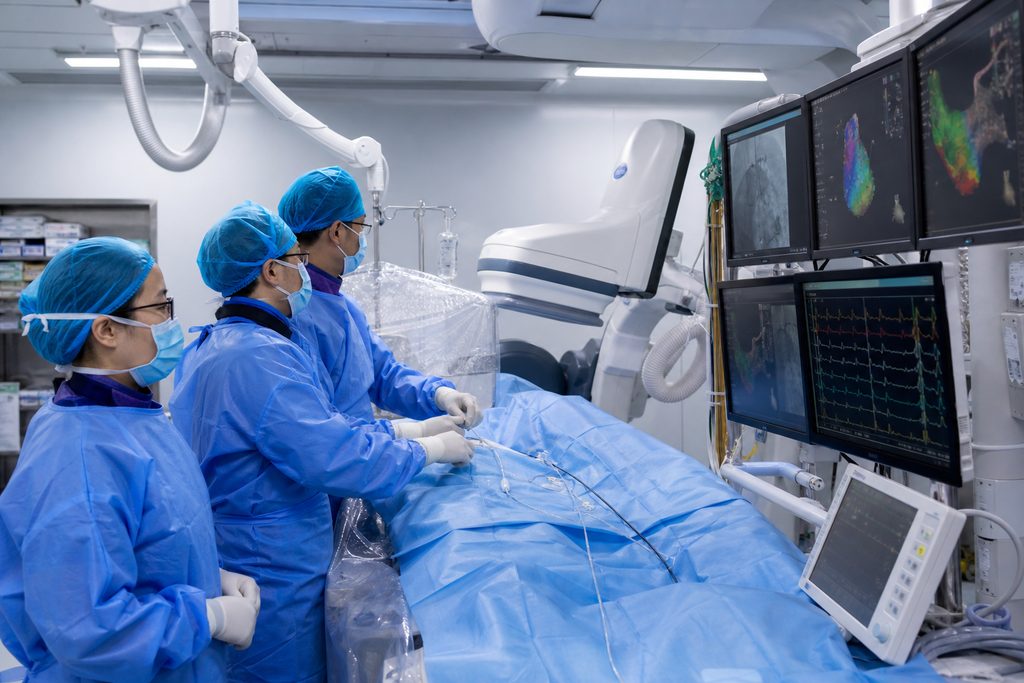
China’s top cardiac centers operate at a scale that most Western hospitals never approach. Fuwai Hospital in Beijing — the National Center for Cardiovascular Diseases — completes more than 14,000 cardiac surgeries each year. Their electrophysiology labs run multiple procedure rooms simultaneously, six days a week. A single experienced electrophysiologist at Fuwai may perform 300–500 catheter ablations annually. Compare that to the average US electrophysiologist, who might perform 50–80 per year. This is not a subtle difference. It is an order-of-magnitude gap. And it shows up in complication rates, procedure times, and long-term freedom from atrial tachyarrhythmia.
Shanghai’s Zhongshan Hospital, affiliated with Fudan University, runs a similarly high-volume electrophysiology program. Their team has published extensively on catheter maze procedures for persistent AFib — the more complex, longer-duration cases that many lower-volume centers are reluctant to take on. When you are looking for the best catheter maze hospital Shanghai has to offer, Zhongshan’s combination of academic rigor and raw procedural volume puts it on a very short list.
Technology Adoption Without the Lag Time
There is a persistent assumption that medical innovation flows from West to East with a delay. In cardiac electrophysiology, that assumption is outdated. China’s top hospitals adopt new ablation technologies as quickly as any center in Boston or Munich — sometimes faster, because the sheer patient volume justifies the capital investment immediately.
Contact force-sensing catheters, high-power short-duration ablation protocols, cryoballoon pulmonary vein isolation, and 3D electroanatomic mapping systems (Carto, EnSite, Rhythmia) are standard equipment in the electrophysiology labs we coordinate with. Some centers are already running clinical trials on pulsed field ablation — the non-thermal energy source that selectively targets cardiac tissue while sparing the esophagus and phrenic nerve. If you know what pulsed field ablation is, you know why that matters. If you do not: it means faster procedures with dramatically lower risk of atrioesophageal fistula, one of the rarest but most catastrophic complications of traditional radiofrequency ablation.
This is not “good enough” care. It is state-of-the-art electrophysiology practiced at extraordinary scale.
The Cost Equation: Structural Reasons, Not Corner-Cutting
Let us address the elephant in the room directly. When someone hears that the atrial fibrillation ablation cost China hospitals charge is one-fifth to one-seventh of the US price, the instinct is suspicion. What are they skimping on? The answer is nothing clinical. The cost difference is structural.
Chinese hospital systems operate on fundamentally different economics. Physician salaries are lower — not because the doctors are less skilled, but because the overall compensation structure for medical professionals in China differs from the US fee-for-service model. Hospital construction costs, administrative overhead, and malpractice insurance premiums are all substantially lower. A top-tier Chinese public hospital runs on thin margins and enormous volume. The math works because the volume is there.
Catheter ablation for paroxysmal AFib at Fuwai Hospital’s international department typically ranges from $15,000 to $25,000 USD. More complex persistent AFib cases requiring extensive substrate modification — what some surgeons still call a catheter maze procedure — may run $22,000 to $30,000. Surgical AFib treatment via minimally invasive thoracoscopic ablation, performed by cardiac surgeons rather than electrophysiologists, falls in the $25,000 to $35,000 range. These are all-inclusive figures covering hospital stay, procedure fees, anesthesia, catheter costs, and international department service charges.
For context: the same procedures in the United States bill at $80,000 to $120,000 for catheter ablation, and $150,000+ for surgical ablation. The savings are not marginal. They are life-changing. And they come from structural economic differences, not from any compromise in clinical standards.
What You Need to Know Before Going Alone
The clinical case for seeking AFib treatment in China is strong. The logistical barriers are equally real. We believe in telling patients the hard truths upfront, because surprises in a foreign hospital are the last thing anyone needs.
- Visa Requirements Are Specific and Unforgiving: Medical treatment in China requires an S2 visa with a notation specifying the medical purpose. This is not a tourist visa. It is not an M business visa. Applying for the wrong category will get you turned away at the embassy or, worse, denied entry at the border. The S2 requires an invitation letter from the receiving hospital — a document that public hospitals do not issue to individual overseas patients who simply email them. The invitation letter comes through the hospital’s international department or VIP coordination channel, and obtaining it requires a confirmed treatment plan first. It is a chicken-and-egg problem that frustrates many independent travelers.
- Payment Is Upfront and Cash-Flow Intensive: Chinese public hospitals — even the prestigious ones — operate on a prepayment model. You deposit funds before admission. The hospital draws down from that deposit as charges accrue. If the deposit runs low mid-treatment, additional payment is required before services continue. This is standard practice in China and completely normal for domestic patients, but it can feel jarring to Western patients accustomed to post-treatment billing cycles. International health insurance with direct billing arrangements is rare in Chinese public hospitals. Most international patients pay out of pocket and seek reimbursement from their insurer afterward. The private international hospital network — United Family, Jiahui, Parkway — does offer direct insurance billing, and some of these facilities are JCI accredited hospital afib ablation Beijing options worth considering if insurance compatibility is your top priority. But the trade-off is lower procedural volume compared to the giant public cardiac centers.
- Language Is the Real Gatekeeper: The clinical expertise exists. The technology exists. What does not exist, in any meaningful way, is English-language infrastructure at the operational level of Chinese public hospitals. Registration kiosks display Chinese characters only. Lab results come in Chinese. Nurses on the ward speak Mandarin, not medical English. Even in hospitals that employ interpreters, those interpreters are shared across entire departments and cannot accompany you to every interaction. Attempting to navigate a complex electrophysiology workup — pre-procedure transesophageal echocardiogram, CT pulmonary vein mapping, anticoagulation bridging protocols — without fluent language support is not brave. It is dangerous. Miscommunication about medication timing alone could lead to a thromboembolic event or a groin hematoma that should have been preventable.
How We Help You Navigate This
These barriers exist for structural reasons, not because anyone is trying to make things difficult. China’s hospital system was built to serve a domestic population of 1.4 billion people. International patients are an afterthought in that system. Our entire reason for existing is to make you not an afterthought.
Before you travel, we handle the hospital matching. This is not a generic referral. We look at your specific arrhythmia history — paroxysmal versus persistent, prior ablation attempts, comorbidities like hypertension or sleep apnea, CHA₂DS₂-VASc score, current anticoagulation regimen — and match you to a center with demonstrated expertise in your exact clinical scenario. A patient with long-standing persistent AFib and a dilated left atrium needs a different electrophysiology team than a young patient with lone paroxysmal AFib and a structurally normal heart. We know which centers excel at which scenarios. Our hospital database covers 340+ top-ranked institutions across 37 cities, and we draw on real outcome data and procedural volume statistics — not marketing brochures.
We secure the official invitation letter required for your S2 visa application. We coordinate the in-person consultation that must happen before any procedure can be scheduled, working through the hospital’s international department to compress timelines where possible. During your stay, a bilingual medical companion accompanies you to every appointment — registration, pre-procedure imaging, the electrophysiology consultation itself, the day of the procedure, and post-ablation follow-up. This person translates in real time, handles payment deposits at hospital counters, collects your discharge medications from the pharmacy, and makes sure you understand every instruction before you leave the hospital.
After the procedure, we remain involved. AFib ablation requires careful follow-up: blanking period management, antiarrhythmic drug tapering, Holter monitoring at 3, 6, and 12 months. We coordinate remote follow-up consultations with your treating electrophysiologist so you do not lose continuity of care once you return home. The relationship does not end when you board your flight.
Frequently Asked Questions
At the top-tier centers we work with, the safety profile is comparable to major Western electrophysiology programs. Complication rates for catheter ablation at Fuwai Hospital and Zhongshan Hospital have been published in peer-reviewed journals, showing major complication rates below 2% — in line with international benchmarks. The key variable is which hospital you choose. China has over 35,000 hospitals. The top 100 are world-class. The bottom 10,000 are not where you want an electrophysiology study performed. Our job is to ensure you never end up in the wrong category. When patients ask us is catheter ablation for afib safe in China, our answer is always: at the right center, with the right team, yes — and the volume data supports that. At an unvetted facility, the answer is less clear. This is why hospital selection matters more than any other single decision in your medical travel journey.
Surgical AFib ablation — typically a minimally invasive thoracoscopic procedure performed by a cardiac surgeon rather than an electrophysiologist — costs more than catheter-based approaches. Expect $25,000 to $35,000 USD at a top public hospital’s international department. This procedure is generally reserved for patients with persistent or long-standing persistent AFib who have failed one or more catheter ablations, or for patients undergoing concomitant cardiac surgery (like mitral valve repair) where the surgeon can address AFib in the same operation. The question how much is surgical afib treatment in China does not have a single answer because the cost depends heavily on whether it is a standalone thoracoscopic ablation or a concomitant procedure. Either way, the price remains a fraction of the $150,000+ that the same surgery commands in the US.
No — not through standard public hospital channels. Chinese law and hospital policy require an in-person consultation before any surgical procedure can be scheduled. The surgeon must examine you, review your imaging, and document the medical necessity of the procedure in your hospital record. This is non-negotiable. What can be arranged in advance is the consultation itself, through the hospital’s international department or VIP coordination channel. That is what we do. We secure the appointment, prepare your medical records in Chinese, and ensure the electrophysiologist has reviewed your case before you arrive. The consultation then serves as the gateway to scheduling. For patients searching book afib surgery China medical tourism, the realistic expectation is: you book the consultation and the logistical support package first. The surgery date follows from that consultation. Anyone promising to lock in a procedure date before you have set foot in the hospital is not being honest with you.
This is the hardest question in cross-border medical care, and we do not dodge it. If you experience a post-procedure complication — a groin pseudoaneurysm, pericarditis, a late recurrence of atrial arrhythmia — your local cardiologist or electrophysiologist will manage the acute issue. That is as it should be. Your treating team in China remains available for remote consultation, and we facilitate those video follow-ups at no additional coordination cost for the first 90 days post-procedure. But the reality is that emergency complications will be handled locally. This is why we strongly recommend that every patient establish a relationship with a local cardiologist before traveling — someone who knows you are going abroad for ablation and has agreed to provide follow-up care when you return. It is not optional. It is essential.
Your Next Step
Living with atrial fibrillation that no longer responds to medication is exhausting. The fatigue, the palpitations, the constant background anxiety about stroke risk — it wears people down in ways that are hard to explain to someone who has not experienced it. Catheter ablation offers a genuine chance at rhythm control, and for many patients, it works. The question is not whether the procedure exists. The question is whether you can access it at a cost and timeline that does not derail your life.
China’s top cardiac centers offer world-class AFib ablation at a fraction of Western prices, with procedural volumes that directly translate to better outcomes. The barriers are real — language, visas, hospital navigation — but they are solvable with the right support. If you want to understand whether this path makes sense for your specific situation, start with a free consultation. No pressure, no commitment. Just an honest conversation about your options.
For more medical information and treatment options in China, visit chinamedservices.com (China Medical Services).
