Awake Craniotomy Cost China: Brain Mapping Language Preservation with Companion Support
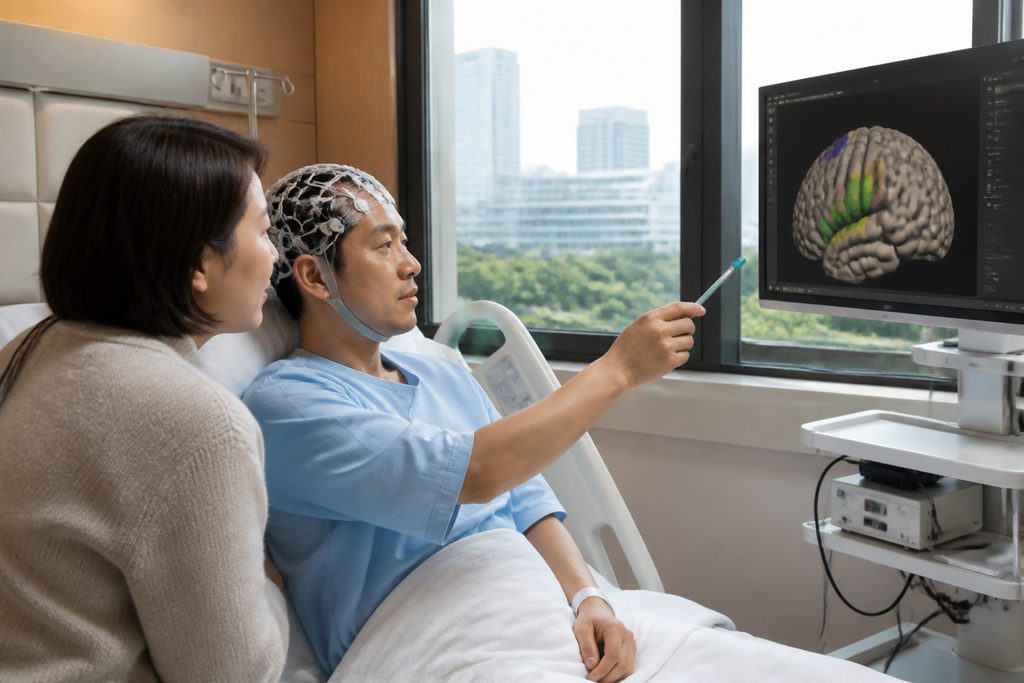
While patients in the United States face bills exceeding $80,000 for an awake craniotomy with cortical mapping, major neurosurgical centers in Shanghai and Beijing perform the same procedure for $18,000 to $32,000. That price gap isn’t a reflection of quality differential. It’s a structural cost difference that has been documented across dozens of published surgical series. The real question isn’t whether the savings exist. The question is whether you can access the right surgical team, with the right intraoperative language mapping protocols, without your native tongue becoming a barrier during the most conversation-dependent surgery in medicine.
How This Actually Works, Step by Step
You send us your existing imaging and reports. That’s the starting point. A DICOM file from your last MRI, the radiologist’s written report, and any neurology or neuro-oncology notes you already have. Our team translates these documents into clinical Chinese and routes them to the neurosurgery department at one of the hospitals in our network that performs high-volume awake craniotomies with direct electrical stimulation mapping.
The surgical team reviews your case. They look at tumor location relative to eloquent cortex — Broca’s area, Wernicke’s area, the arcuate fasciculus, the motor strip. They assess whether your lesion is a candidate for asleep-awake-asleep protocol or conscious sedation throughout. Within five to seven business days, you receive a written second opinion. This document outlines whether the team believes awake resection with intraoperative language mapping is indicated, what the anticipated extent of resection might be, and a preliminary treatment plan.
If the opinion is favorable and you decide to proceed, we coordinate a video consultation. You speak directly with the neurosurgeon. A bilingual medical interpreter stays on the line. The surgeon explains the mapping protocol, the language tasks you’ll perform during the awake phase, and the anesthesia plan. You ask your questions. The surgeon answers them.
After that consultation, if you’re ready to move forward, we handle the hospital appointment coordination, the visa invitation letter from the hospital’s international department, and the surgical scheduling. You apply for your S2 visa. You book your flight. You arrive. We meet you at the airport.
What “Awake Craniotomy With Language Mapping” Actually Means in a Chinese Operating Room
The term gets thrown around loosely on medical tourism websites. Let’s be specific about what you’re signing up for.
An awake craniotomy for tumor resection near language cortex is not a single technique. It’s a coordinated sequence. The neuroanesthesia team sedates you for the craniotomy opening. Once the dura is exposed, they lighten sedation until you’re conscious and responsive. The neurosurgeon then uses a bipolar stimulator to deliver low-amperage current to the cortical surface, systematically mapping which regions disrupt your speech, naming, or comprehension when stimulated.
You’re not just lying there. You’re actively performing language tasks. A speech-language pathologist or neuropsychologist — in your native language — shows you images on a tablet and asks you to name them. You read sentences aloud. You complete word-association exercises. The surgical team watches your responses in real time. When stimulation of a specific cortical site causes you to stop speaking, produce paraphasic errors, or fail to comprehend, that site gets marked with a sterile numbered tag. That cortex stays. The tumor resection proceeds around it.
The mapping protocol is language-specific. English mapping requires different stimuli and task batteries than Mandarin mapping. This is not trivial. A hospital that excels at awake mapping for Chinese speakers may not have the in-house speech pathology staff to conduct the same procedure in English, Arabic, or French.
This is where companion support becomes non-negotiable. You need someone in the operating room — or at minimum, someone who has prepared the surgical team with the correct language-specific mapping protocols — who ensures the linguistic bridge exists. Our companion team doesn’t scrub in. But we coordinate with the hospital’s international department to confirm that an English-proficient neuropsychologist or speech therapist will be present for the awake phase, and that the mapping stimuli have been prepared in your language.
awake craniotomy cost China: The Numbers, With Context
Let’s put real numbers on the table. These figures reflect the total hospital charges for the surgical admission, including operating room time, anesthesia, intraoperative neuromonitoring, cortical mapping, ICU stay, and ward recovery. They do not include pre-operative workup (which you may have already completed at home), travel, lodging, or our coordination fees.
| Procedure Component | China (Public Hospital International Dept) | United States (Hospital Charges, Uninsured) | Western Europe (Private Pay) |
|---|---|---|---|
| Awake Craniotomy with Cortical Mapping & Language Preservation | $18,000 – $32,000 | $70,000 – $120,000+ | €45,000 – €75,000 |
| Pre-operative fMRI & DTI Tractography | $800 – $1,500 | $3,000 – $6,000 | €2,000 – €4,000 |
| Intraoperative Neuromonitoring (IONM) | Included in surgical fee | $2,000 – $5,000 (separate billing) | €1,500 – €3,500 |
| Hospital Stay (5–10 days, including ICU) | $3,000 – $6,000 | $15,000 – $30,000 | €8,000 – €15,000 |
| Speech-Language Pathology (Inpatient) | $500 – $1,200 | $2,500 – $5,000 | €1,500 – €3,000 |
These are ranges. Final pricing varies by hospital, tumor complexity, length of stay, and whether any complications arise. The hospitals we work with provide a detailed cost estimate before you commit. You’re never walking in blind.
What drives the differential? Three factors. First, physician and staff labor costs in China are a fraction of those in the US or Western Europe — not because of lower training standards, but because of different healthcare economic structures. Second, hospital administrative overhead and billing complexity are dramatically lower. Third, the international department pricing, while higher than the domestic Chinese rate, still substantially undercuts Western private-pay rates.
For context on how we help patients navigate hospital selection across specialties, our top-ranked hospital database includes neurosurgery centers with documented awake craniotomy volumes exceeding 200 cases annually.
A Realistic Timeline
This is not a two-week process. Anyone promising that is not being honest with you. Here’s what the actual timeline looks like from the day you first contact us.
| Phase | What Happens | Duration |
|---|---|---|
| Week 1–2 | You submit imaging and records. We translate and route to the neurosurgery department. | 5–10 business days for document preparation and initial triage |
| Week 3–4 | Surgical team reviews your case. Written second opinion is prepared and delivered. | 5–10 business days, depending on department workload |
| Week 5–6 | Video consultation with the neurosurgeon. Discussion of mapping protocol, risks, recovery expectations. | Scheduled within 7–14 days of second opinion delivery |
| Week 7–10 | You decide to proceed. We coordinate hospital appointment, issue visa invitation letter. You apply for S2 visa at your local Chinese embassy or consulate. | Visa processing: 5–15 business days, sometimes longer depending on embassy volume |
| Week 11–13 | Travel to China. Pre-operative workup (repeat MRI, fMRI, DTI, anesthesia clearance). Surgery scheduled. | Pre-op workup: 2–5 days. Surgery typically scheduled 3–7 days after arrival. |
| Week 13–15 | Surgery and acute hospital recovery. Awake craniotomy patients typically stay 5–10 days. | 5–10 days inpatient |
| Week 15–18 | Early post-operative recovery in China. Staple removal, wound check, initial speech assessment. Clearance to fly. | 1–3 weeks post-discharge before long-haul flight is advisable |
Total elapsed time: roughly three to four months from first contact to flying home. Could it be faster? Sometimes. If your imaging is recent and complete, if the surgical team has immediate availability, and if your visa processes quickly, you might compress this to ten weeks. But planning for four months is prudent.
The step people consistently underestimate is document translation. Your MRI report isn’t the issue. It’s the operative notes from your prior biopsy, the neuro-oncology consult letters, the pathology reports. These documents contain the granular detail a surgeon needs to plan a safe resection. Machine translation is not acceptable for this. Clinical translation by a human who understands neurosurgical terminology takes time.
What Can Go Wrong — and What Happens Then
Let’s talk about the hard scenarios. Not because they’re likely, but because you deserve to know the contingency plan before you’re standing in it.
The most common disappointment: the surgical team reviews your imaging and determines you are not a candidate for awake craniotomy. Maybe the tumor involves deep white matter tracts that can’t be mapped from the cortical surface. Maybe your lesion is too extensive for a safe awake procedure. Maybe the language cortex is too diffusely involved. This happens. It’s not a failure of the process. It’s the process working correctly. If the written second opinion comes back recommending against awake surgery, you’ve spent $300–500 on an opinion that saved you from traveling across the world for a procedure that wasn’t right for you. That’s not wasted money. That’s money well spent.
Intraoperative mapping failure. Rare, but real. The patient cannot cooperate with language tasks due to anxiety, fatigue, or intraoperative confusion. The surgical team converts to a general anesthesia approach and proceeds with resection based on pre-operative fMRI and DTI tractography data. The extent of resection may be more conservative. The risk to language function may be slightly higher. But the surgery still happens, and the tumor still comes out. This is a known contingency that every awake craniotomy team prepares for.
Post-operative language deficits. Even with perfect mapping, some patients wake up with word-finding difficulty, paraphasias, or reduced verbal fluency. The brain has been manipulated. There’s edema. In the vast majority of cases, these deficits improve substantially over weeks to months. But you need to know: the speech-language pathologist in the Chinese hospital may not speak your language fluently. Post-operative speech therapy during your stay in China will be limited. The real rehabilitation happens when you get home. We can help coordinate a handoff to a speech therapist in your home country, but we cannot provide that therapy ourselves.
Visa delay. The S2 visa is generally straightforward, but embassies can be unpredictable. Processing times can stretch. Your surgical slot may need to be rescheduled. We’ve navigated this before. The hospital international departments we work with understand that foreign patients face visa uncertainty. They’ll work with us to adjust scheduling. But you should build buffer into your timeline.
How to Evaluate a Hospital for brain mapping surgery price in Shanghai and Beyond
Not every hospital that offers awake craniotomy should be doing yours. Here’s what to look for — and what questions to ask — when evaluating a center.
First, case volume. An awake craniotomy with language mapping is a team sport. The neurosurgeon, neuroanesthesiologist, neuropsychologist, and intraoperative monitoring technician all need to have done this together many times. Ask directly: “How many awake craniotomies with language mapping does this team perform per year?” A center doing fewer than 30–50 annually may not maintain the team cohesion that makes these procedures smooth. The top neurosurgery departments in Shanghai, Beijing, and Guangzhou routinely perform 100–200+ awake cases annually.
Second, language-specific mapping capability. This is the question most international patients don’t know to ask. “Has your team performed awake language mapping in my native language before?” If the answer is no, the follow-up is: “What is your plan for preparing language-appropriate mapping stimuli, and who will administer the intraoperative language tasks?” The answer should be specific. Names of protocols. Names of validated stimulus sets. A plan for an interpreter or bilingual neuropsychologist in the OR.
Third, pre-operative imaging protocol. A proper awake craniotomy workup includes high-resolution structural MRI, functional MRI (fMRI) for language lateralization and localization, and diffusion tensor imaging (DTI) tractography to map the subcortical white matter pathways. If a hospital proposes surgery without these studies, that’s a red flag.
Fourth, intraoperative monitoring technology. Direct electrical stimulation mapping is the gold standard. The hospital should use bipolar stimulation with current intensity monitoring, and should have the capability for continuous electrocorticography if seizure risk is a concern. Ask what equipment they use. A vague answer is a bad sign.
For patients asking how much is language preservation brain surgery abroad, the price range we’ve quoted reflects hospitals that meet all four of these criteria. You can find cheaper options. You can find hospitals in China that will do an awake craniotomy for $10,000. You should ask yourself whether those hospitals meet the volume, language, imaging, and monitoring standards that protect your speech.
Our specialty department rankings include neurosurgery centers with documented outcomes data, which can serve as a starting point for your own due diligence.
Practical Considerations: Language, Payment, and Recovery Abroad
Language in the OR. We’ve said it already, but it bears repeating: the awake phase of your surgery depends on real-time verbal interaction. The neuropsychologist or speech therapist administering your language tasks must be proficient in your native language. This is not negotiable. Before you commit to any hospital, get written confirmation of who will be in the OR for language testing, what their qualifications are, and what language they’ll be testing in.
Payment. Chinese public hospitals, including their international departments, require pre-payment. You’ll need to wire the estimated surgical fees before admission, or pay via credit card upon registration. Insurance reimbursement happens afterward — the hospital provides detailed invoices and medical records that you submit to your insurer. Private international hospitals in China, such as United Family or Jiahui, may offer direct billing arrangements with some international insurers. But for the high-volume neurosurgery centers that do the most awake craniotomies, expect to pay upfront and seek reimbursement.
Companion support during recovery. You’ll be in a Chinese hospital for a week or more after brain surgery. The nursing staff may have limited English. Your meals will be Chinese hospital food unless you arrange otherwise. Your family member or traveling companion will need help navigating the hospital, communicating with staff, and managing the discharge process. This is exactly what our bilingual medical companion service provides — not just translation, but someone who knows the hospital system, knows where the pharmacy is, knows how to get the discharge summary, and can advocate for you when you’re too exhausted to advocate for yourself.
Flying home after brain surgery. Neurosurgeons typically recommend waiting 10–14 days after craniotomy before flying, sometimes longer if there’s a CSF leak concern or significant cerebral edema. You’ll need a medical clearance letter for the airline. You should plan for business-class or premium-economy seating — you do not want to be upright in a narrow economy seat for 12+ hours with a fresh craniotomy. Budget for this. It’s not a luxury. It’s a medical necessity.
Frequently Asked Questions
can I stay awake during brain tumor removal in China if I don’t speak Mandarin?
Yes. The awake phase of the surgery relies on interaction with a neuropsychologist or speech therapist who administers language tasks in your native language. The surgical team’s internal communication may be in Mandarin, but your direct interaction during mapping is in your language. The key is confirming — before you travel — that the hospital has arranged for an English-proficient (or your-language-proficient) clinician to be present for the awake phase. This is one of the primary coordination tasks our team handles. Without this confirmation, you should not proceed.
What does the best hospital awake craniotomy with companion support China actually look like in practice?
The companion support doesn’t mean someone holds your hand in the OR. It means: pre-arrival coordination to confirm language mapping protocols are prepared in your language; on-the-ground assistance with hospital registration, pre-operative appointments, and communication with the surgical team; daily visits during your inpatient recovery to help you
For more medical information and treatment options in China, visit chinamedservices.com (China Medical Services).
