How to Book a Gastroscopy in China: Costs, Top Hospitals, and Step-by-Step Process
How to Book a Gastroscopy in China: Costs, Top Hospitals, and Step-by-Step Process
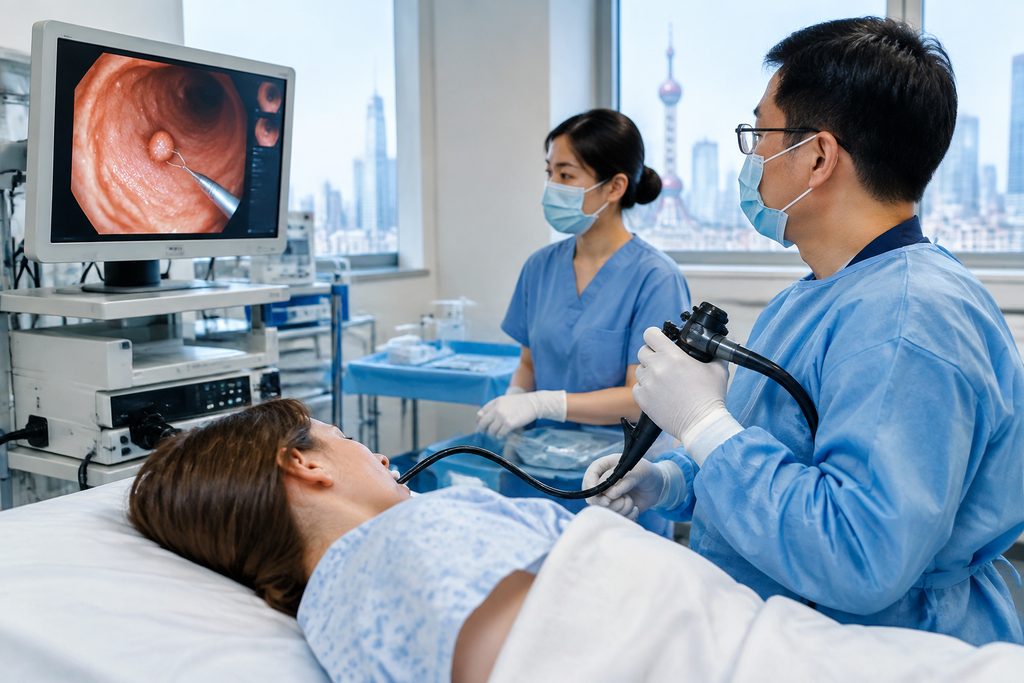
A gastroscopy — also called an upper endoscopy — is a short procedure where a thin, flexible tube with a camera slides down your throat to examine the esophagus, stomach, and the first part of your small intestine. In plain terms: the doctor looks directly at your upper digestive tract instead of guessing from symptoms alone. If you are researching how to book a gastroscopy in China, the short answer is that the gastroscopy cost in China typically runs $150 to $600 at a top public hospital, versus $1,500 to $3,500 in the United States. The procedure itself takes 5 to 15 minutes. Booking it as a foreigner, though, involves a few layers that most travel guides never explain.
That gap between the price and the process is where most patients get stuck.
Gastroscopy Cost in China: The Short Answer
Here is the number you came for. A standard diagnostic gastroscopy at a major Chinese public hospital generally costs between $150 and $600, depending on the city, the hospital tier, and whether sedation is included. Private international hospitals charge more — usually $800 to $2,000 — but bundle in English-speaking staff and shorter waits. Prices vary by hospital and case complexity, so treat every figure here as a range, not a quote.
What drives the variance? Four things. Whether you choose sedation or go awake with a throat spray. Whether the doctor takes biopsies during the exam. Which city you are in — Beijing and Shanghai run higher than Chengdu or Xi’an. And whether you use the standard outpatient channel or a hospital’s international department, which typically costs 1.5 to 2 times the standard rate but gives you an English-speaking coordinator and a booked slot rather than a same-day queue ticket.
Who This Is Right For — and Who It Isn’t
Medical travel for an endoscopy makes sense for a specific kind of patient. It is not for everyone, and pretending otherwise wastes your money.
You are likely a good candidate if:
- You need a diagnostic gastroscopy and face a long wait or a high deductible at home
- You are already traveling to China for work, family, or another medical reason
- You want a full endoscopy package bundled with a colonoscopy or abdominal imaging
- You are combining the trip with a broader health checkup at a top-tier hospital
- You need a second look after an inconclusive result elsewhere
You should probably not pursue this if:
- You have an acute emergency — active bleeding, severe pain, or vomiting blood. Go to the nearest emergency room, wherever you are.
- You have serious heart or lung disease that makes sedation risky and no cardiology clearance
- You cannot travel for medical reasons or lack the documents for a visa
- You expect to book a specific named specialist for a specific date from overseas. That is not how most public hospitals operate.
Being honest about the last point matters more than selling you a trip.
The Options, Compared
Three real paths exist for a foreigner needing a gastroscopy in China. They are not equivalent, and the cheapest one is not always the right one.
| Option | Typical Cost (USD) | Booking Method | English Support | Best For |
|---|---|---|---|---|
| Public hospital, standard outpatient | $150–$400 | Same-day queue, in person | Limited or none | Patients already in China, flexible on timing |
| Public hospital, international/VIP department | $400–$900 | Advance booking via coordinator | Yes | Patients who need a fixed date before flying |
| Private international hospital | $800–$2,000 | Advance booking, often online | Yes, full service | Insurance direct-billing, maximum comfort |
Which column fits you? If you are already in China and cost is the priority, the standard public channel delivers excellent clinical quality for a fraction of Western prices. If you are flying in specifically for this and need certainty, the international department is the realistic middle path. Private hospitals suit patients whose insurance covers them or who value a Western-style experience above all else.
Finding the Best Hospital for Gastroscopy in Shanghai and Beyond
China has more than 35,000 hospitals. The ones worth your time sit in the top 5%, ranked by the Fudan University hospital index and JCI accreditation. For digestive disease and endoscopy, the strongest concentrations are in Beijing, Shanghai, and Guangzhou.
If you are searching for the best hospital for gastroscopy in Shanghai, the city hosts 18 Fudan Top 100 hospitals — the second-highest concentration in the country. Shanghai’s major teaching hospitals run high-volume endoscopy centers, which matters: units performing thousands of scopes a year tend to be efficient and experienced. Beijing has 21 Top 100 hospitals, the most of any city, and its gastroenterology departments are among the busiest in the world.
To book a gastroscopy in Beijing or Shanghai through an international department, you generally need to send your passport details, a brief medical summary, and any prior reports. The hospital then issues a confirmation you can use for your visa application. Our directory of top-ranked Chinese hospitals groups these by city and specialty tier so you can see which institutions actually have a digestive disease program rather than guessing from a general ranking.
One caution: a hospital’s overall reputation does not automatically mean its endoscopy unit is the right fit for your specific case. A giant general hospital and a specialized digestive center both have strengths. Matching the department to your problem — reflux, suspected ulcer, celiac assessment, or a screening scope — is the part that decides whether the trip was worth it.
How Long Does a Gastroscopy Take — and What the Day Looks Like
The scope itself is quick. A diagnostic gastroscopy takes 5 to 15 minutes. With sedation, add 30 to 60 minutes of recovery. From walking in the door to walking out, budget half a day at a public hospital, mostly for registration, payment, and waiting.
A realistic timeline for a foreign patient:
- Day 1: Arrive, complete registration, pay the fee upfront (public hospitals require prepayment; insurance is reimbursed afterward)
- Same day: Pre-procedure check, throat spray or IV sedation, the scope, recovery
- 24–48 hours: Preliminary report. Biopsy results, if taken, usually take 3 to 7 days
- Follow-up: A consultation to discuss findings and next steps
Sedated or not? That is your call and the doctor’s. Many Chinese patients opt for the awake version with a local throat spray and tolerate it fine. If you are anxious or traveling a long distance, sedation is worth the extra cost.
Is Gastroscopy Safe in China?
Yes, when performed at an accredited hospital — and this is a fair question to ask. Endoscopy is a mature, standardized procedure worldwide, and China’s top hospitals perform it at enormous volume. The complication rate for diagnostic upper endoscopy is low, in the range of roughly 1 in 1,000 to 1 in 10,000 for serious events, comparable to Western centers. The main risks are minor: a sore throat, bloating, mild sedation reactions.
What raises or lowers your personal safety has less to do with the country and more to do with three things. The hospital’s accreditation and volume. Whether you disclose your full medication list — especially blood thinners, which must be managed before any biopsy. And whether you can communicate clearly with the team. That last point is where language becomes a genuine safety issue, not a comfort issue. If you cannot describe your symptoms or understand the consent form, the risk goes up. A bilingual medical companion exists precisely to close that gap.
Practical Considerations: Visa, Payment, and Records
For medical travel to China, the applicable short-stay visa category is S2, used for medical treatment and private affairs, subject to the latest embassy or consulate requirements and supporting hospital documents. Accompanying family members apply under the same category. Note that the M visa is for commercial and trade activities only — it has nothing to do with medical treatment. Always confirm current requirements with your nearest Chinese embassy or consulate, and never assume approval is guaranteed.
Payment works differently than in many Western countries. Public hospitals require upfront payment; you then claim reimbursement from your insurer afterward. Private international hospitals often bill your insurance directly. Carry a card that works internationally and confirm limits before you travel.
Records matter. Bring prior endoscopy reports, imaging, biopsy results, and a medication list — ideally translated. If you are considering this route, a written second opinion or video consultation before you fly can tell you whether the trip is even necessary. That single step has saved plenty of patients an unnecessary journey.
Frequently Asked Questions
Not through the standard public outpatient channel — those slots are taken in person on the day. You can, however, arrange it in advance through a hospital’s international or VIP department, or through a private international hospital. That requires sending your passport details, medical summary, and prior reports, and it costs more than the standard rate.
A basic diagnostic scope runs $150–$600 at a public hospital, or $800–$2,000 privately. A medical tourism endoscopy package in China often bundles the consultation, the procedure, sedation, and a follow-up visit. Biopsy pathology may be billed separately. Final pricing varies by hospital and case complexity, so ask for an itemized quote before committing.
At accredited, high-volume hospitals, diagnostic gastroscopy carries a low complication rate comparable to Western centers. If a problem arises, top hospitals have full emergency and surgical backup on site. The realistic risks are minor reactions and, rarely, bleeding after biopsy. Disclose all medications, especially blood thinners, and make sure you can communicate with the clinical team — that is the single biggest factor you control.
The procedure is 5 to 15 minutes. Including preparation and recovery, plan for half a day at the hospital. If biopsies are taken, results typically arrive within 3 to 7 days.
Medical travel to China uses the S2 short-stay category for treatment and private affairs, subject to current embassy or consulate rules and supporting hospital documents. Accompanying family members use the same category. The M visa is for business only and does not apply to medical treatment.
Your Next Step
The bottom line: a gastroscopy in China costs a fraction of Western prices, takes minutes to perform, and is safe at accredited hospitals. The hard parts are booking, language, and knowing whether the trip is worth it for your situation. We are China Medical Services — a coordination team, not a hospital, and we do not diagnose or treat. We help international patients match with the right department, prepare records, and navigate the process from first question to follow-up. If you would like a straight answer on whether this makes sense for you, you can start with a free consultation — no pressure, no obligation, just clarity before you decide.
This article is for general information only and is not medical advice. Gastroscopy carries individual risks and benefits. Always consult a qualified physician about your specific condition before making treatment or travel decisions.
For more medical information and treatment options in China, visit chinamedservices.com (China Medical Services).
