Heart Treatment in Nanjing Jiangsu Province Hospital: A Complete Cardiology and Cardiovascular Surgery Overview
Key Takeaways
- Jiangsu Province Hospital performs over 4,000 cardiac surgeries annually, placing it among China’s highest-volume heart centers with outcomes comparable to major Western institutions.
- Heart bypass surgery at this hospital typically costs $12,000–$20,000 USD — roughly one-tenth the price of the same procedure in the United States, without sacrificing clinical quality.
- The hospital’s public ward system operates entirely in Mandarin. Without a bilingual companion, navigating registration, testing, and post-operative instructions becomes nearly impossible for non-Chinese speakers.
- International patients cannot simply book a surgery date online. You need a formal evaluation first — either through a remote second opinion or an in-person consultation — before any procedure can be scheduled.
The Problem: Cardiac Care Wait Times and Costs Are Breaking the System
In Canada, the median wait time between seeing a specialist and receiving coronary artery bypass grafting reached 13.6 weeks in 2023, according to the Fraser Institute. In the United Kingdom, the NHS reported that over 7.6 million people sat on treatment waiting lists that same year. And in the United States, a single heart bypass surgery runs $120,000 to $180,000 before insurance — if your insurer approves it at all.
These numbers are not abstractions. They represent real people — a father in Manchester told he must wait five months for a valve replacement, a retiree in Houston facing a $45,000 out-of-pocket bill after insurance caps out. The cardiac care pipeline in Western systems is strained, and for patients who lack the time or the budget to wait, the standard pathways offer little relief.
Some patients explore medical travel. But choosing a destination means confronting a wall of unknowns: which hospitals are legitimate, what the real costs are, whether language barriers will create dangerous misunderstandings. This article addresses those questions directly for one specific institution — Jiangsu Province Hospital in Nanjing — so you can make a decision based on evidence, not guesswork.
Why Jiangsu Province Hospital Delivers Results for Complex Cardiac Cases
Surgeons here perform more than 4,000 cardiac operations each year. That figure includes coronary artery bypass grafting, valve repair and replacement, aortic surgery, and congenital defect corrections. Volume matters in cardiac surgery for a straightforward reason: the relationship between surgeon case volume and patient mortality is well documented. A 2017 study in The Lancet analyzing over 600,000 CABG patients found that each 100-case increase in annual surgeon volume was associated with a 4% reduction in operative mortality.
When you compare this to Western benchmarks, the contrast sharpens. The average cardiac surgeon in the United States performs roughly 100 to 150 bypass operations per year. At Jiangsu Province Hospital, lead surgeons routinely exceed 300. They have seen more variations of coronary anatomy, managed more intraoperative complications, and refined their techniques through sheer repetition. This does not guarantee a better outcome — no institution can promise that — but it shifts the probability in your favor.
Technology Deployed at Scale, Not in Silos
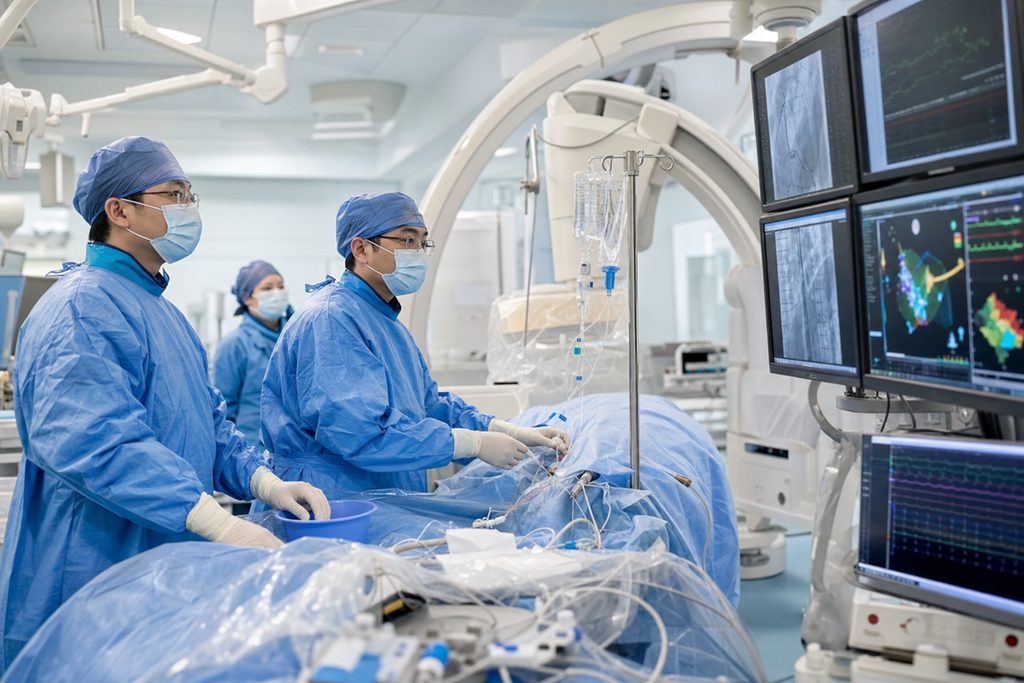
The cardiovascular center runs six dedicated cardiac operating rooms equipped for both conventional open-heart procedures and minimally invasive techniques. What distinguishes the setup is not any single piece of equipment but the integration: hybrid operating suites allow interventional cardiologists and cardiac surgeons to work on the same patient in the same room, switching between catheter-based and surgical approaches without moving the patient. This matters for complex multi-vessel disease where a combined strategy — stenting some vessels while bypassing others — may produce a better result than either approach alone.
Minimally invasive valve surgery, including transcatheter aortic valve replacement, is performed routinely here. The hospital was an early adopter of TAVR in China and now completes several hundred cases annually. For patients who are not candidates for full sternotomy, this option can mean a hospital stay measured in days rather than weeks.
Cost Structure That Changes the Calculus
Let us address the obvious question directly: does lower cost mean lower quality? The answer is no — and the reasons are structural, not magical. Chinese hospital costs are lower because physician salaries, facility fees, and device pricing all operate on a different economic base than in the US or Europe. A stent that costs $3,000 in an American hospital may cost $800 here. An ICU bed that bills at $5,000 per night in the US runs a fraction of that in Nanjing. The clinical protocols, sterilization standards, and surgical techniques are the same evidence-based practices used globally.
The heart bypass surgery cost Nanjing Jiangsu Province Hospital typically ranges from $12,000 to $20,000 USD, depending on the number of grafts and whether the procedure is performed on-pump or off-pump. Valve replacement surgery falls in a similar range. These are all-inclusive figures covering the surgery itself, hospital stay, and standard post-operative monitoring. By comparison, the same procedures in the United States routinely exceed $120,000.
What the Cardiology and Surgery Departments Actually Cover
A patient searching for cardiac surgery Nanjing hospital price for overseas patients needs more than a price tag. You need to know what conditions the hospital treats and which procedures are available. The cardiology division handles the full diagnostic and interventional spectrum: echocardiography, stress testing, coronary angiography, angioplasty with stent placement, and electrophysiology studies with ablation for arrhythmias. The cardiovascular surgery division covers coronary artery bypass grafting, valve repair and replacement, aortic aneurysm repair, and surgery for congenital heart disease in adults.
The hospital also runs a heart failure program that includes medical management, cardiac resynchronization therapy device implantation, and ventricular assist device placement for bridge-to-transplant or destination therapy. If you are researching whether is Jiangsu Province Hospital good for heart surgery, the answer lies partly in this breadth — a center that handles everything from routine stenting to complex aortic arch replacement has the infrastructure to manage complications that a smaller program might need to transfer out.
One limitation to note: while the hospital performs heart transplants, this article does not cover organ transplantation services. International patients considering transplant should seek specific guidance through formal medical channels, as eligibility criteria and regulatory requirements differ substantially from elective cardiac procedures.
Recovery Timelines: What to Expect Week by Week
Patients researching how long to recover from heart valve replacement in China often want a concrete timeline. While every recovery is individual, the typical trajectory for a valve replacement or bypass at this hospital follows a predictable pattern.
Days 1 through 3 post-surgery are spent in the cardiac surgical ICU. You will be extubated within hours of the operation and sitting up in a chair by day two. Chest tubes come out typically on day two or three. By day five, most patients transfer to a regular ward, where walking in the hallway and breathing exercises become the primary focus. Discharge usually occurs between days 7 and 10 for uncomplicated cases. The hospital’s rehabilitation team provides a written plan covering wound care, activity restrictions, and medication schedules — but this documentation is in Chinese. Having a translator review it with you before discharge is essential.
Weeks 2 through 6 are the critical healing phase at home or in a nearby hotel. Sternal precautions remain in place: no lifting more than 5 kilograms, no driving, no pushing or pulling heavy objects. Cardiac rehabilitation, if available in your home country, should begin around week 4 to 6. Most patients can return to desk work by week 8 and resume full physical activity, including exercise, by week 12. The hospital’s surgical team will want a follow-up echocardiogram and consultation around the three-month mark, which can often be arranged via a remote video consultation if you have returned home.
How International Patients Actually Access Care Here
Searching for book heart treatment package Nanjing international patient reveals a common misunderstanding. Jiangsu Province Hospital does not sell pre-packaged treatment bundles online. The pathway for an overseas patient is sequential, not transactional.
Step one is a formal medical evaluation. You can pursue this remotely through a written second opinion. You send your existing cardiac catheterization reports, echocardiogram images, CT scans, and clinical summary. The relevant specialist reviews them and provides a written analysis with treatment recommendations. This service costs from $300 to $500 USD and gives you a clear picture of whether the hospital believes it can help you — before you book a flight.
Step two, if the remote evaluation confirms that your case is suitable, is either a video consultation or an in-person visit. A video consultation with the specialist costs from $500 to $800 USD and allows you to discuss your condition directly, ask questions about the proposed approach, and understand the risks. If you proceed to an in-person visit, the hospital requires a face-to-face consultation before scheduling any surgery. This is standard policy across Chinese public hospitals — no surgeon will operate on a patient they have not personally examined.
Step three is admission and treatment. Once the surgeon confirms the plan, the hospital’s international department can coordinate admission dates, pre-operative testing, and the procedure itself. The entire process, from initial remote evaluation to surgery, typically spans four to eight weeks depending on the complexity of your case and the surgeon’s schedule.
For patients seeking the best cardiologist for foreigners Nanjing China, the international department can recommend specialists based on your specific condition. The department employs English-speaking coordinators who act as liaisons between you and the clinical team. However, ward nurses, technicians, and most physicians conduct their daily work in Mandarin. This is where a bilingual medical companion becomes practical — not as a luxury, but as a safety measure ensuring that post-operative pain levels, medication reactions, and discharge instructions are communicated accurately.
Practical Considerations: Documentation, Payment, and Logistics
Before you travel, assemble a complete medical dossier. This includes all cardiac imaging on CD or USB (not just printed reports), a detailed clinical summary in English, a list of current medications with dosages, and any prior operative notes if you have had previous heart surgery. The hospital’s specialists need to see the raw images, not just the radiologist’s interpretation, to make an independent surgical assessment.
Visa requirements: foreign nationals traveling to China for medical treatment apply for an S2 visa, which covers short-term private affairs including medical visits. Your accompanying family members also need S2 visas. The hospital provides an invitation letter and treatment confirmation document to support your application. Processing times vary by country, so begin this step at least six weeks before your intended travel date. Do not apply for an M visa — that category is for commercial and trade activities and does not apply to medical travel.
Payment works on a pre-deposit system. The hospital requires an upfront deposit before admission, with the final amount reconciled at discharge. International credit cards are accepted at the international department, but transaction limits may apply. Wire transfers are the more common method for large deposits. Most international health insurance plans operate on a reimbursement model for overseas treatment, meaning you pay the hospital directly and submit claims afterward. Confirm this with your insurer before committing to travel. The hospital can provide itemized invoices and translated medical records to support your claim.
After returning home, you will need a cardiologist who can manage your follow-up care. The Nanjing team can send a discharge summary and recommendations to your local physician, and a follow-up video consultation at the three-month mark allows the surgical team to review your progress remotely. This continuity matters — cardiac surgery is not a one-time event but the beginning of a long-term management plan.
Frequently Asked Questions
Can I schedule heart surgery at Jiangsu Province Hospital before traveling to China?
No. The hospital requires an in-person consultation before any surgery can be booked. What you can do remotely is submit your records for a written second opinion or video consultation. If the specialist confirms you are a surgical candidate, you then travel for the face-to-face evaluation, after which a surgery date is set. This is standard policy designed to protect patient safety, not an administrative hurdle.
What happens if there is a complication after I return to my home country?
The surgical team provides a complete operative report and discharge summary that your local cardiologist can use for continuity of care. You also have the option of follow-up video consultations with the Nanjing team. However, emergency complications must be managed locally — the hospital cannot provide emergency care across borders. This is why selecting a local cardiologist before you travel and ensuring they are willing to accept post-operative patients is an essential pre-trip step.
Are the cardiac surgeons at Jiangsu Province Hospital trained to Western standards?
Many senior surgeons have completed fellowships or observerships at major cardiac centers in the United States, Germany, or Japan. The department participates in international registries and publishes in peer-reviewed English-language journals. Surgical protocols follow American College of Cardiology and European Society of Cardiology guidelines. The standards are international; the language of daily work is Chinese.
What if I need a procedure the hospital cannot perform?
Jiangsu Province Hospital is a tertiary referral center with a full-spectrum cardiac program, so this is uncommon. However, if your case requires a sub-specialty intervention not available there, the international department can facilitate a referral to another top-ranked Chinese cardiac center, such as Fuwai Hospital in Beijing. This inter-hospital referral network exists precisely because complex cases sometimes need specific expertise.
Your Next Step
Jiangsu Province Hospital offers cardiac surgery outcomes comparable to Western centers at a fraction of the cost, supported by surgical volumes that place it among the highest-volume heart programs in China. The trade-off is logistical complexity: a foreign language environment, a sequential evaluation process rather than instant booking, and the need to coordinate follow-up care across borders. These challenges are manageable with proper preparation. Our team helps international patients navigate the evaluation, coordination, and on-the-ground support required to access care at this hospital and others like it across China. We do not provide medical advice or diagnoses — we connect you with the specialists who do. If you are considering cardiac treatment in Nanjing, the logical first step is a remote second opinion to determine whether this hospital is the right fit for your case.
For more medical information and treatment options in China, visit chinamedservices.com (China Medical Services).
