Brain Surgery in China: How to Arrange It and What It Costs
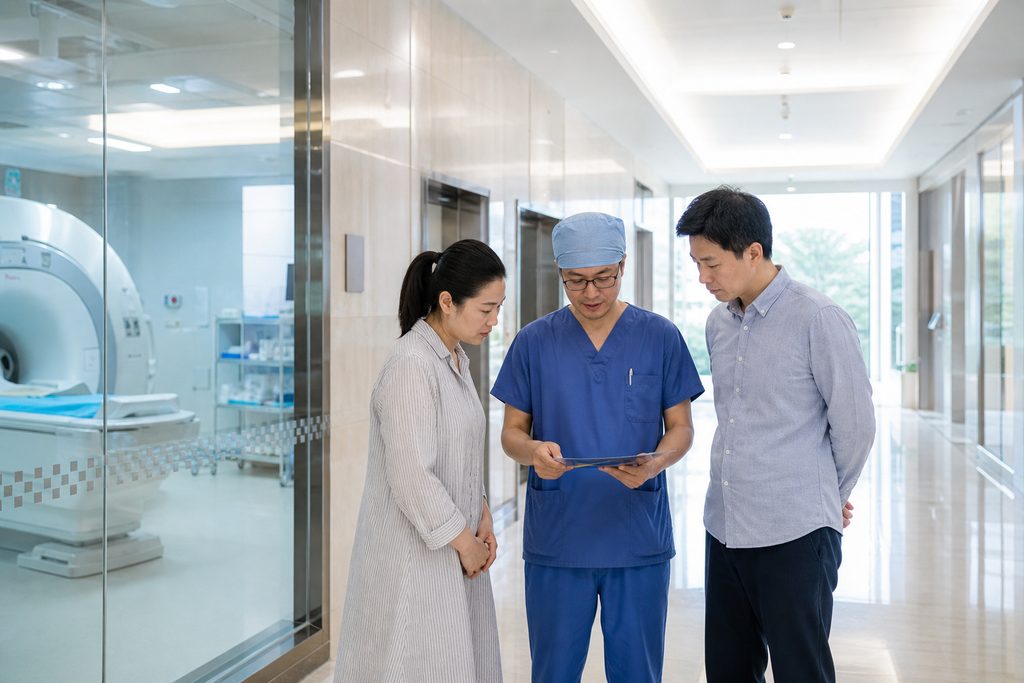
While patients in the UK wait a median 18.3 weeks for neurosurgery after an urgent referral, operating theatres at top Chinese hospitals run six days a week — and a craniotomy that bills at $150,000 in the United States is routinely performed in Beijing or Shanghai for a fraction of that figure. The gap is not a rumor. It is a structural difference in how the two systems price surgical time.
If you have found a brain tumor, an unruptured aneurysm, or a stubborn epilepsy focus, and your home system is quoting months of waiting or a bill you cannot carry, China deserves a serious look. Arranging it takes planning, not luck.
Brain Surgery in China: The Short Answer
You can arrange brain surgery in China in roughly four to eight weeks from first contact to operating table, and the total hospital bill for most cranial procedures lands between $15,000 and $40,000 at a top-tier public hospital — versus $100,000 to $250,000 in the United States. The brain surgery cost China figure depends on tumor type, surgical approach, and whether you use a standard ward or an international department.
Here is the complication nobody mentions in the brochures. Public hospitals in China do not let you book an operation from overseas. You must be seen in person first. Surgery is scheduled only after a face-to-face consultation, and the surgeon who examines you is the surgeon who decides the plan. That single rule shapes everything else in this article.
Who This Is Right For — and Who It Isn’t
Medical travel is not a universal solution. It suits some patients well and puts others at genuine risk.
Typically a reasonable fit:
- You have a diagnosed or strongly suspected intracranial lesion with imaging already in hand (MRI, CT, angiography).
- Your home waitlist is measured in months, and the lesion is not immediately life-threatening.
- You are medically stable enough for a long-haul flight — usually 10 to 14 hours.
- You can fund the procedure out of pocket or through a policy that reimburses internationally.
- You have a companion who can travel with you, or you are willing to pay for a bilingual medical companion.
Probably not the right path:
- You are in acute deterioration — a rapidly expanding hematoma, brainstem compression, or a herniating mass. Go to the nearest emergency department. Now.
- Your tumor is a diffuse glioma requiring complex intraoperative molecular workup tied to a specific trial protocol you are already enrolled in.
- You have severe cardiac or pulmonary comorbidity that makes air travel itself the dominant risk.
- You need a surgeon who has followed you for years and knows your seizure history in detail. Continuity has real value.
The Options, Compared
Four realistic routes exist for a patient facing neurosurgery. The table below uses published price ranges and typical wait times; individual figures vary by hospital and case complexity.
| Route | Typical Wait | Estimated Cost (Craniotomy) | Language Support | Insurance Handling |
|---|---|---|---|---|
| US academic medical center | 3–8 weeks | $100,000–$250,000 | Native English | Direct billing |
| UK NHS | 8–20+ weeks | $0 (tax-funded) | Native English | N/A |
| China — public tertiary hospital, standard ward | 1–3 weeks after in-person consult | $15,000–$28,000 | Limited; interpreter needed | Pay upfront, reimburse later |
| China — international / VIP department | 3–10 days after consult | $25,000–$40,000 | English-speaking staff | Some direct billing |
| China — private international hospital | Days to 2 weeks | $40,000–$70,000 | Full English service | Direct billing common |
Which column suits you? If cost is the binding constraint and you can bring a companion, the standard ward at a top public hospital delivers the same surgeon and the same operating theatre as the VIP floor — you simply pay less for the room. If you are traveling alone, or your family cannot be present, the international department is worth the premium. And if you carry a Western insurance policy that settles directly with JCI-accredited facilities, the private international hospitals remove almost all administrative friction.
Choosing the Right Neurosurgery Hospital
China has more than 35,000 hospitals. Roughly 340 of them sit in the top tier, and the ones with genuine neurosurgical depth cluster in a handful of cities.
Beijing carries the deepest bench. The city hosts 21 hospitals on the Fudan comprehensive ranking, and its neurosurgery programs handle volumes that would be unusual anywhere in Europe. If you are searching for the best neurosurgery hospital Beijing has to offer, look at institutions with dedicated neurosurgery departments that appear on the Fudan specialty reputation list for neurosurgery — these are ranked among China’s top 10 in that discipline. The department directory lets you filter by specialty rather than guess.
Shanghai runs a close second with 18 ranked hospitals, and its international departments are among the most foreigner-ready in the country. Guangzhou, Chengdu, and Wuhan each anchor a regional catchment of tens of millions. You can browse the full top hospitals by city if you want to compare geography against your own travel constraints.
Volume is the metric that matters most in neurosurgery. A center performing several hundred craniotomies a year has seen your complication before. A center performing thirty has not. Ask directly how many procedures of your specific type the department performs annually — a legitimate program will answer.
What It Costs, and What Drives the Number
Four variables move the price more than anything else.
Surgical complexity. A convexity meningioma resection is a different economic animal from a skull-base approach with neuro-navigation and intraoperative monitoring. Expect the former near the bottom of the range and the latter near the top.
Length of ICU stay. Cranial surgery typically includes at least one night in intensive care. Additional days add cost quickly.
Ward class. A standard multi-bed ward, a single room, and an international VIP suite are priced differently — often by a factor of two across the full spread.
Implants and consumables. Titanium fixation, dural substitutes, and any shunting hardware are billed separately from the surgical fee. Ask for an itemized estimate before you commit.
What is usually included in a quoted surgical package: surgeon and anesthesia fees, operating theatre time, standard implants, ICU and ward bed days, routine imaging, and basic medication. What is frequently excluded: extended ICU beyond the standard allotment, complications requiring a second procedure, rehabilitation, and follow-up imaging after you fly home. Anyone quoting you a single flat number without an itemized breakdown is guessing.
For patients comparing Shanghai options specifically, affordable neurosurgery packages Shanghai providers advertise tend to sit in the $20,000 to $35,000 band for standard craniotomy — again, contingent on the case.
How to Actually Arrange It
The sequence is more rigid than most patients expect.
Step one: gather your records. You need your MRI or CT on DICOM files, the radiology report, pathology if a biopsy was already done, and a current medication list. Send these ahead. A Chinese neurosurgery team can review them remotely and tell you whether your case is operable and roughly what it would cost.
Step two: get a written second opinion or a video consultation. This is the step that saves the most money. A written review of your imaging by a Chinese specialist costs $300 to $500 and takes several days. A video consultation runs $100 to $300 at a standard international department, or $500 to $800 with a senior specialist. Any consultation fee is credited in full toward on-the-ground coordination if you proceed within 90 days. If the answer is “this is not safely operable here,” you have spent a few hundred dollars instead of a few thousand on flights.
Step three: the visa. Foreigners coming to China for medical treatment apply for the S2 visa, annotated for medical purposes. Stays beyond 180 days use the S1. Accompanying family members apply for S2 as well. The M visa is for commercial and trade activity and has nothing to do with medical care — if an agency tells you otherwise, walk away. Requirements shift, so confirm current documentation with your nearest Chinese embassy or consulate and with the hospital’s international office, which can issue an invitation letter.
Step four: travel and the in-person consult. Surgery is scheduled only after a face-to-face examination. Plan for a gap of several days between arrival and operation — imaging is often repeated, and pre-operative clearance takes time.
Step five: admission and surgery. Public hospitals require prepayment. Private international hospitals often bill your insurer directly.
Practical Considerations: Recovery, Records, and the Trip Home
How long to recover from brain surgery abroad depends entirely on the procedure. A straightforward craniotomy for tumor resection usually means three to seven days in hospital, then a period of local recovery before you are cleared to fly — commonly 10 to 14 days post-surgery, sometimes longer if there is air trapped intracranially. Your surgeon, not your airline schedule, sets that date.
Arrange your follow-up before you leave China. Ask the treating team to prepare a discharge summary in English with imaging on disc, so your neurologist at home can pick up care without repeating everything. Bring more medication than you think you need; a disrupted supply chain mid-flight is a bad place to discover a gap.
On safety: is brain tumor surgery safe in China? The honest answer is that safety tracks the individual hospital and surgeon far more than the country. Top Chinese neurosurgery departments publish outcomes comparable to Western academic centers, and their case volumes are often higher. But outcomes at a mid-tier facility are not the same, and that is exactly why hospital selection matters more than the price tag. Ask about infection rates, mortality data, and complication management. A confident program will share them.
Frequently Asked Questions
No. Public hospitals require an in-person consultation before scheduling any operation, and this rule is not negotiable. What you can do remotely is have your imaging reviewed, receive a written opinion, and get a preliminary cost estimate — then travel once the plan is clear. This staged approach avoids flying blind.
It depends entirely on your policy. Most Western insurers reimburse treatment abroad at out-of-network rates, which means you pay upfront and claim afterward. A smaller number settle directly with JCI-accredited private hospitals in China. Call your insurer before you commit and ask specifically about international reimbursement, pre-authorization requirements, and whether a second opinion is needed first.
This is the real risk of medical travel, and it deserves a straight answer. Complications such as infection, cerebrospinal fluid leak, or seizures can emerge weeks after discharge. You need a local neurosurgeon willing to take over your care, and you need your English-language operative notes and imaging in hand. Have that conversation with a doctor at home before you leave, not after.
Strongly recommended. You will be groggy, possibly aphasic, and unable to manage registration, payment, or pharmacy runs in Mandarin. If no family member can come, a bilingual medical companion service covers queuing, payment, wayfinding, and translation — typically from $300 per day. It does not include medical care.
Your Next Step
The core message is simple: brain surgery in China is arrangeable, often at a fraction of Western cost, but it rewards preparation and punishes improvisation. Get your imaging reviewed remotely first. Choose the hospital on volume and outcomes, not on price alone. Sort the S2 visa early.
We are China Medical Services — a coordination team, not a hospital and not a physician. We do not diagnose, and we do not promise outcomes. What we do is connect your records with the right Chinese specialty, arrange written second opinions and video consultations, coordinate appointments through official international departments, and provide bilingual support on the ground. If you would like a straight assessment of whether your case fits this path, start with a free consultation and we will tell you honestly what is and is not realistic.
For more medical information and treatment options in China, visit chinamedservices.com (China Medical Services).
