Surgery in Chengdu: West China Hospital Access and Sichuan Recovery
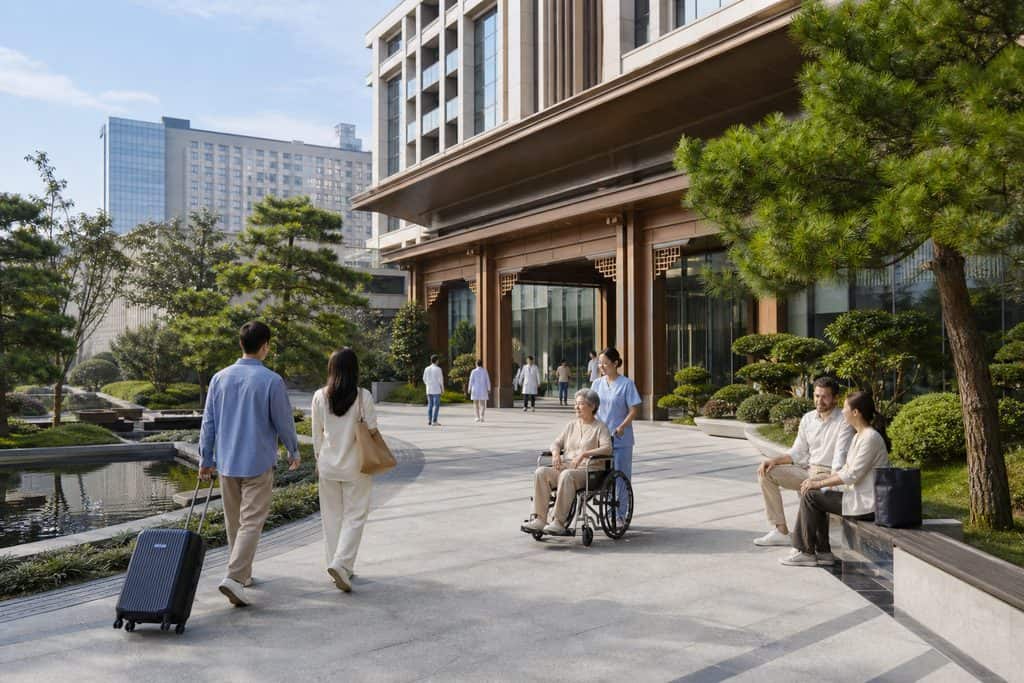
You have probably heard that choosing surgery abroad means accepting lower standards. The data tells a different story. West China Hospital of Sichuan University handles over 5 million outpatient visits and 200,000 inpatient admissions annually. It sits in the highest tier of China’s hospital ranking system — one of only a handful of institutions to earn the A++++ designation in the latest Fudan University national evaluation. For certain specialties, its surgical volume exceeds that of any single center in North America or Europe.
That volume matters. Studies consistently link high surgical volume to better outcomes, fewer complications, and shorter hospital stays. A 2017 analysis in *The Lancet* found that for complex cancer resections, patients treated at high-volume centers had significantly lower 30-day mortality rates. West China Hospital is, by any measure, a high-volume center.
But volume alone is not why international patients are looking at Chengdu. The city offers a combination that is genuinely hard to replicate elsewhere: a genuinely elite surgical institution, a cost structure that makes treatment accessible, and a recovery environment that patients consistently describe as restorative rather than stressful.
This article walks through what that actually looks like — from initial inquiry to post-operative recovery in Sichuan. No marketing gloss. Just the sequence, the costs, the timeline, and the things that can go wrong.
How This Actually Works, Step by Step
The path from searching “West China Hospital surgery cost” to actually recovering in Chengdu follows a predictable sequence. Here is what happens, in order.
First, you send your existing medical records. These include imaging reports, pathology results, treatment summaries, and any prior surgical notes. Our team translates these documents into clinical Chinese and submits them through West China Hospital’s International Medical Center channel.
The hospital’s specialty department reviews your case. This is not a quick triage. A senior attending physician examines your records and determines whether your condition falls within their treatment scope and whether a remote preliminary assessment is feasible. For complex cases, they may request additional imaging or lab work before responding.
If the department accepts the case for remote evaluation, you have two paths. The first is a written second opinion — the specialist reviews your records and provides a detailed treatment recommendation in writing. This costs between $300 and $500 and serves as a reference document, not a prescription. The second is a video consultation, where you speak directly with the specialist. This runs $500 to $800 for a top-tier expert and allows real-time discussion of your symptoms, goals, and concerns.
Both options give you something rare: an unfiltered assessment from a surgeon who performs your procedure hundreds of times per year. No referral chain. No insurance gatekeeping. Just clinical judgment.
If the recommendation points toward surgery and you decide to proceed, the hospital’s international coordination team sets a provisional treatment window. You apply for an S2 visa with supporting documents from the hospital. Visa processing takes one to three weeks depending on your home country and the current consular backlog.
You arrive in Chengdu. Within the first two days, you complete any outstanding pre-operative testing and meet your surgical team in person. Surgery typically follows within the week. Post-operative monitoring in the hospital runs according to the procedure’s standard protocol. Once discharged, you recover in Chengdu for a period determined by your surgeon before receiving clearance to fly home.
That is the sequence. It sounds straightforward. The friction points are real, and we will address them.
What West China Hospital Surgery Cost Actually Looks Like
The primary search that brings patients here is “West China Hospital surgery cost.” The honest answer: it depends heavily on the procedure, the complexity of your case, and which service channel you use. But ranges exist, and they are instructive.
For a cardiac procedure like a valve replacement, the total hospital bill at West China Hospital typically falls between $15,000 and $25,000 when accessed through the international department channel. The same procedure in the United States averages $130,000 to $170,000. A complex spinal fusion that might cost $80,000 to $110,000 in the US runs $18,000 to $28,000 in Chengdu. Major gastrointestinal cancer resections fall in the $12,000 to $22,000 range.
These are the all-in hospital charges: surgeon fees, anesthesia, operating room time, implants or devices, nursing care, and standard post-operative monitoring. They do not include your travel, accommodation, or the coordination services that make the process navigable.
Why the gap? Several structural factors. Chinese public hospitals operate on nonprofit models with state-subsidized infrastructure. Physician compensation is salary-based rather than fee-for-service. Device and pharmaceutical pricing, while higher than in some Asian neighbors, remains well below US levels. And the sheer volume of procedures drives per-case overhead down.
One thing to understand clearly: these prices apply to the international department or VIP channel. The standard public outpatient route is cheaper but functionally inaccessible to foreign patients — it requires Chinese-language navigation, same-day queuing for registration, and no advance scheduling. The international channel is the realistic path, and it costs roughly 1.5 to 2 times the standard rate. That premium buys English-capable coordination, advance appointment scheduling, and a significantly less chaotic experience.
If you are asking “is West China Hospital good for surgery” while also evaluating cost, the value proposition is this: you are paying for surgical expertise at a center that performs your procedure at extremely high volume, at a fraction of Western pricing, with international-department support that bridges the language gap.
A Realistic Timeline
Patients often underestimate the calendar. Here is what a typical surgical journey to Chengdu actually looks like, from first contact to flying home.
| Stage | Duration | What Happens |
|---|---|---|
| Document preparation | 1–2 weeks | Gathering, translating, and submitting medical records. Delays here are common — missing imaging files or outdated pathology reports are the top reason cases stall. |
| Hospital review | 1–3 weeks | The department evaluates your records. Complex cases take longer. Some departments are faster than others. |
| Remote consultation | 1 week | Scheduling and conducting the written second opinion or video call. This step may overlap with review. |
| Decision and visa | 2–4 weeks | You decide whether to proceed. Visa application, supporting document issuance from the hospital, and consular processing. |
| Travel and pre-op | 1 week | Arrival in Chengdu, in-person consultation, pre-operative testing. Surgery typically within 3–7 days of arrival. |
| Hospitalization | 3–14 days | Procedure and inpatient recovery. Duration depends entirely on surgery type. |
| Local recovery | 1–4 weeks | Post-discharge recovery in Chengdu before surgeon clears you for air travel. This is the Sichuan recovery experience — slower-paced, monitored, with follow-up visits as needed. |
| Total | 8–16 weeks | From first inquiry to flying home. Shorter for minor procedures, longer for major ones. |
The biggest variable is the hospital review stage. Some departments respond within days. Others, especially the most sought-after specialties, take longer. There is no way to rush this — the review is a clinical process, not an administrative one.
Visa timing is the second major variable. Some consulates process S2 applications in under a week. Others take a month. Check with your local Chinese consulate before setting any fixed travel dates.
What Can Go Wrong — and What Happens Then
Any honest discussion of medical travel must include failure modes. Here are the ones we see most often with Chengdu-bound surgical patients, and what recourse exists for each.
The hospital reviews your records and declines the case. This happens. Sometimes the condition is too advanced for surgical intervention. Sometimes the specific procedure is not performed on international patients due to follow-up complexity. Sometimes the department simply determines that the risk profile does not support travel. When this occurs, the remote consultation fees are still charged — the specialist did the work of reviewing your case. But you have avoided a wasted trip and received clinical clarity. That clarity has value, even when it is not the answer you wanted.
You arrive, complete pre-op testing, and the surgeon finds a contraindication. This is rare but real. A previously undetected infection, a cardiac issue that makes anesthesia risky, a lab value that needs correction before surgery is safe. The surgical date moves back while the issue is addressed. In some cases, the surgery is cancelled entirely. The hospital’s international department handles rescheduling. Your coordination team manages the logistics. You wait, or you go home and return later. There is no perfect solution here — only honest management of an unexpected problem.
Post-operative complications occur. They occur everywhere, at every hospital, in every country. West China Hospital’s complication rates are published in peer-reviewed literature and are consistent with major international centers. If a complication arises, you are already inside one of China’s largest and best-equipped hospitals. You are not being transferred. You are not navigating a fragmented system. The team that operated on you manages the complication. This is the structural advantage of receiving surgery at a comprehensive tertiary center rather than a standalone surgical facility.
You recover well but cannot get timely follow-up at home. This is the most underappreciated risk of medical travel. Your surgeon in Chengdu can provide detailed discharge instructions and is typically willing to communicate with your home-country physician. But the day-to-day follow-up falls to your local provider. Before you travel, confirm that your primary care physician or local specialist is willing to manage post-operative care for a surgery performed abroad. Some are. Some are not. Find out early.
Chengdu Medical Tourism Packages: What They Include and What They Do Not
The phrase “Chengdu medical tourism packages” suggests a tidy, all-inclusive product. The reality is more modular. What exists in the market falls into three broad categories, and understanding the differences prevents expensive misunderstandings.
The first category is hospital-coordinated care. West China Hospital’s International Medical Center provides appointment scheduling, inpatient admission coordination, and some English-language nursing support. It does not provide airport pickup, hotel booking, or translation during outpatient visits. Think of it as the clinical coordination layer — essential, but not comprehensive.
The second category is third-party facilitation. This is what organizations like ours provide: document translation, case submission, appointment coordination, bilingual medical companions who accompany you through every hospital visit, airport transfers, accommodation recommendations, and ongoing communication with your home-country providers. This layer costs from $300 per day for companion services up to $5,000–8,000 for comprehensive end-to-end coordination. Any remote consultation fees you pay are credited in full toward on-the-ground coordination if you proceed to treatment within 90 days.
The third category is hospitality packages offered by travel agencies and hotels near the hospital. These bundle accommodation, transportation, and sometimes meal services. They are not medical services. They are convenience layers. Some are excellent. Some are overpriced. Evaluate them as you would any travel product.
What no legitimate package includes: guaranteed surgery dates, promised outcomes, or “priority access” that bypasses clinical triage. West China Hospital admits patients based on medical need and surgical capacity, not on payment source. Anyone offering to jump the queue is either misrepresenting their service or describing something you should not want to be associated with.
The best hospital in Chengdu for international patients is not a separate facility — it is West China Hospital accessed through the right channel. The international department is that channel. It exists specifically to serve patients who cannot navigate the standard public system. Use it.
Practical Considerations: Records, Visa, Payment, and Recovery in Sichuan
How long to recover from surgery in Sichuan depends on the procedure, but the environment matters. Chengdu moves at a different pace than Beijing or Shanghai. The city is known for its teahouse culture, its green spaces, and a general attitude that does not rush recovery. Patients who spend their post-discharge weeks here often describe the experience as unexpectedly pleasant — quiet parks, mild food, affordable accommodation, and a hospital that is a short drive away if anything feels wrong.
Plan for at least one week of local recovery for minor procedures, two to four weeks for major ones. Your surgeon will specify a no-fly window based on your procedure type and individual risk factors. Do not book a return flight until you have that clearance window in writing.
Medical records must be in English or Chinese. If your records are in another language, factor in professional medical translation time and cost. Machine translation is not adequate for clinical documents. Errors in translated lab values or imaging reports can lead to misassessment.
The S2 visa is the correct category for short-term medical treatment. It requires an invitation letter or supporting documentation from the receiving hospital. Your coordination team or the hospital’s international department can provide this. The S2 typically allows a stay of up to 180 days. For treatments requiring longer stays, the S1 category applies. Do not apply for an M visa — that is for commercial and trade activities and has no connection to medical treatment.
Payment at West China Hospital’s international department is typically required as a deposit before admission, with final settlement at discharge. The hospital accepts wire transfers and major credit cards. International health insurance with overseas treatment coverage may reimburse you after the fact, but the hospital does not direct-bill foreign insurers. Check your policy’s out-of-network and international coverage provisions before committing.
Language is the most persistent friction point. Even within the international department, not every nurse, technician, or administrative staff member speaks functional English. A bilingual medical companion who knows the hospital’s layout, understands the queue systems, and can translate in real time during consultations is not a luxury. It is the difference between a manageable experience and a deeply stressful one.
Frequently Asked Questions
For the specialties in which it specializes at high volume, outcomes are comparable to major international centers. West China Hospital performs over 140,000 surgeries annually and is consistently ranked in China’s highest hospital tier. Specific departments — cardiac surgery, neurosurgery, oncology, and orthopedics — publish outcomes data in international journals. The question is less about quality in absolute terms and more about whether the specific department that would treat you has deep experience with your exact procedure. That is what the remote case review is designed to determine.
The quoted hospital charges cover the procedure itself: surgeon, anesthesia, operating room, standard implants or devices, nursing care, and routine post-operative monitoring. They do not include travel to Chengdu, accommodation, meals, non-standard medications taken after discharge, physical therapy, or any complication management that extends beyond the standard inpatient stay. Your coordination service fees are separate from hospital charges. Always request a detailed cost breakdown for your specific procedure before committing.
Technically yes, through the hospital’s International Medical Center. In practice, the language barrier, document requirements, and scheduling complexity make self-coordination extremely difficult for non-Chinese speakers. The hospital’s international department has limited bandwidth for individual patient navigation. A facilitator does not give you access you cannot get on your own — it handles the friction so you can focus on your health rather than on logistics.
Your surgeon determines this based on procedure type, your individual recovery trajectory, and standard aviation medicine guidelines. For laparoscopic procedures, the no-fly window may be as short as 5–7 days. For open abdominal or thoracic surgery, expect 2–4 weeks. For major orthopedic procedures involving joint replacement, 4–6 weeks is common. The concern is not just wound healing — it is the risk of deep vein thrombosis during long-haul flights and the availability of emergency care if a complication arises mid-journey.
Your Chengdu surgeon provides a detailed discharge summary, operative report, and follow-up recommendations. You share these with your local physician. The surgeon is generally available for one or two follow-up communications by email or video call. But ongoing care transfers to your home-country provider. This is why confirming your local doctor’s willingness to manage post-surgical follow-up before you travel is non-negotiable. Some physicians decline to manage cases operated on abroad. Find out where yours stands.
Your Next Step
Choosing Chengdu for surgery is not about finding the cheapest option. It is about matching your specific surgical need with a center that performs that procedure at exceptional volume, at a cost that keeps your financial future intact, in a city that supports recovery rather than fighting it.
Our team handles the bridge work: translating and submitting your records, coordinating the remote consultation, managing the appointment timeline, and providing bilingual companions who keep your hospital days from becoming overwhelming. We do not perform surgery. We do not guarantee outcomes. We make the process navigable.
If you want to understand whether West China Hospital is the right fit for your case, the starting point is a case review. Send your records. Get a clinical opinion from the surgeons who would actually treat you. That information, whatever it says, is worth having. Reach out for a free initial consultation — we will help you determine whether this path makes clinical and logistical sense for your situation.
For more medical information and treatment options in China, visit chinamedservices.com (China Medical Services).
