Navigating China for Medical Care: Apps, Maps, and the Full Setup Service
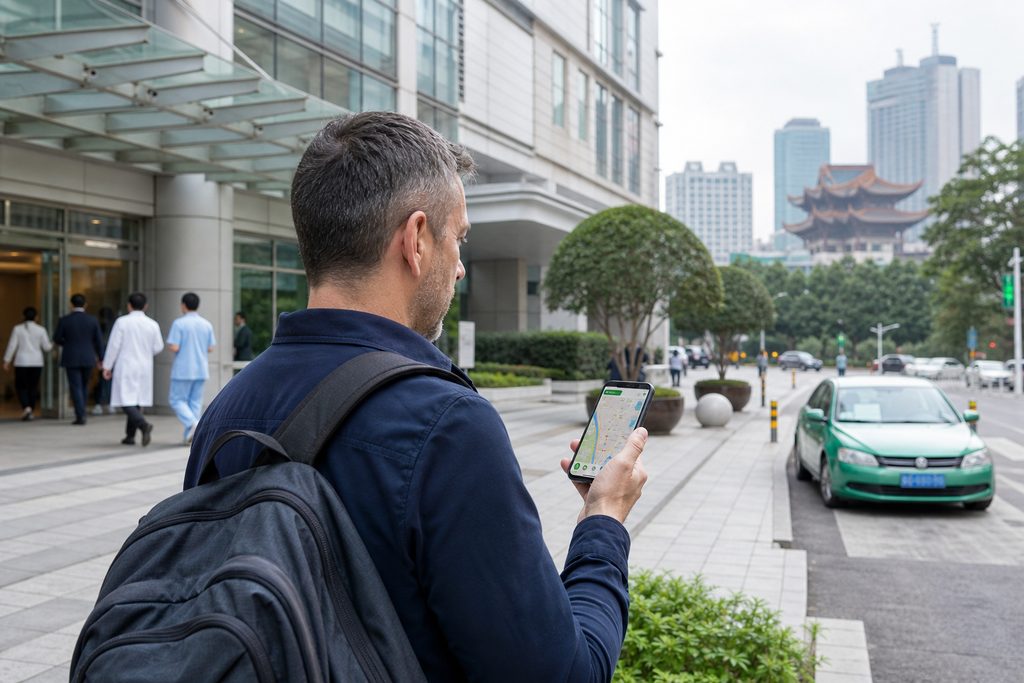
According to a 2024 report from the China International Medical Tourism Association, the number of inbound medical travelers has grown by nearly 40% year-over-year, driven by access to top 5% hospitals and procedures costing one-fifth of U.S. prices. A cardiac bypass that runs $120,000 in the States might cost $15,000 at a Fudan-ranked center in Shanghai. The math is clear. The logistics are not. You land with a folder of scans and a phone that suddenly feels useless. Google Maps stalls. WhatsApp goes silent. And Waze? The app that guided you to the airport simply draws a blank screen. So, the question “does Waze work in China for medical tourists” has a short answer: no. It does not. But that is the wrong question. The right one is what does work, and how you build a system that gets you from your hotel lobby to the specialist’s door without a single wrong turn.
How This Actually Works, Step by Step
A patient from Dubai contacted us last spring. He needed a hip replacement and had researched the best hospital for hip replacement Shanghai could offer. His sequence was typical. First, he sent his existing X-rays and MRI reports. Our team translated them into clinical Chinese and forwarded the file to the orthopedics department at a Fudan-ranked hospital. Five business days later, a written second opinion came back. It confirmed the diagnosis, proposed a surgical approach, and outlined a recovery timeline. The cost for that written analysis was $400. With the plan in hand, we moved to the next stage: a video consultation with the surgical team. That call cost $600 and lasted forty minutes. The surgeon reviewed the images on screen, asked about pain levels and mobility, and answered every question. Only after that call did the patient book his flight.
He arrived on an S2 visa, the short-stay category used for private medical treatment. We handled the invitation letter from the hospital. Our bilingual companion met him at Pudong Airport, took him to his serviced apartment near the hospital, and the next morning walked him through registration, blood work, and the pre-op consultation. Surgery happened on day four. He was discharged on day nine. Total coordination fee on the ground: $1,200. The hip implant and hospital stay were billed separately by the hospital. He saved roughly $35,000 compared to the quote he received at home. That is the sequence. Remote evaluation first, then travel, then treatment. No one flies blind.
Does Waze Work in China? A Reality Check for Medical Tourists
Waze relies on Google Maps data and a live community of users reporting traffic and hazards. Inside mainland China, Google’s mapping services are blocked at the infrastructure level. The GPS chip in your phone still knows where you are. But the map tiles never load. The app opens to a gray grid. No streets appear. No routes calculate. Even if you downloaded offline maps before arriving, Waze’s core routing engine cannot function without a connection to its servers, which are inaccessible. So the tool you trust at home becomes a paperweight.
This is not a minor inconvenience. When you are trying to find Building 3 of a hospital campus that sees 15,000 outpatients a day, navigation errors cost time you do not have. A foreign patient without local navigation tools can easily spend forty-five minutes wandering between the international department and the lab testing center. That is stress you do not need before a consultation. So what works?
Baidu Maps and Gaode Maps (Amap) are the two dominant platforms. Both offer English interfaces, though Baidu’s is more complete. Gaode is owned by Alibaba and integrates tightly with Didi, the ride-hailing monopoly. You can hail a car directly inside the map, pay with a linked international card, and track the driver’s arrival in real time. Baidu Maps has better public transit data and indoor navigation for large complexes, including some hospital campuses. Download both before you leave. Test them on airport Wi-Fi while you wait for your luggage. Get comfortable with the interface. The search bar accepts English keywords like “Shanghai Zhongshan Hospital” and will route you correctly. One critical tip: Chinese addresses are written in reverse order from Western ones. Province, city, district, street, building. Enter the hospital name, not the address, for best results.
And what about Google Maps? The question “does google maps work in China for tourists” comes up in every pre-travel briefing. The answer is technically yes, but practically no. If you have a roaming data plan from your home carrier, Google Maps will load because your traffic routes through your home country’s servers. But the location offset is severe. Chinese law requires all mapping data to use a coordinate obfuscation algorithm called GCJ-02. Google Maps uses the global WGS-84 standard. The result is that your blue dot appears 500 meters away from your actual position. You look like you are driving through a lake. It is unusable for navigation. Use it to browse a neighborhood before you travel. Do not use it to find a hospital entrance on the day of your appointment.
Medical Tourism Packages China All Inclusive: What That Really Means
Search for “medical tourism packages China all inclusive” and you will find a tangle of offers. Some include airfare, hotel, surgery, and a translator. Others are just a hospital bed and a prayer. The term “all inclusive” has no legal definition in Chinese medical tourism. You must read the fine print with a forensic eye. Here is what a legitimate package should cover and what it often hides.
A real coordination package starts with remote evaluation. Your records go to the relevant department. A specialist reviews them. You get a written opinion. That step alone filters out patients who are not good candidates for the procedure they want. It protects you from flying across the world only to be told in person that your case is too complex. The best packages treat this as a mandatory first stage, not an optional add-on. After the opinion, a video consultation lets you speak with the doctor. Then comes the on-ground service: airport pickup, hospital registration, bilingual companionship during every clinical encounter, and discharge coordination. Some packages include a recovery stay at a serviced apartment with nursing visits. Others include traditional Chinese medicine rehabilitation as a follow-up. The package price for coordination typically ranges from $5,000 to $8,000 for a major surgical episode. That fee covers the service layer. It never includes the hospital’s own charges for surgery, implants, or room and board. Those are paid directly to the hospital cashier, usually with a pre-admission deposit.
What to watch for: packages that promise a specific surgeon by name. China’s top specialists are in extraordinary demand. A coordinator can request a specific doctor and will often succeed, but no ethical service guarantees it. If a website lists surgeon names like a menu, walk away. Also, be wary of packages that bundle everything into one upfront payment with no breakdown. You should always see three distinct cost lines: hospital fees, coordination service fees, and accommodation or travel costs. Transparency is the test.
A Realistic Timeline
| Stage | What Happens | Duration |
|---|---|---|
| 1. Document Preparation | You gather existing scans, reports, and a summary of your medical history. We arrange certified translation into clinical Chinese. | 3–5 business days |
| 2. Written Second Opinion | Your translated file is reviewed by a specialist at the target hospital. A written report with treatment recommendations is returned. | 5–7 business days |
| 3. Video Consultation | A live online meeting with the specialist. You discuss the opinion, ask questions, and jointly decide whether to proceed. | Scheduled within 7–10 days of opinion delivery |
| 4. Visa Processing | We provide the hospital invitation letter and guidance for your S2 visa application at your nearest Chinese embassy or consulate. | 5–14 calendar days (varies by country) |
| 5. Travel and Arrival | You fly to China. Airport pickup, hotel check-in, and a rest day before the hospital visit. | 1–2 days |
| 6. In-Person Consultation & Pre-Op | Face-to-face with the surgeon. Physical exam, hospital registration, pre-operative testing (blood work, imaging, cardiac clearance). | 1–3 days |
| 7. Surgery & Inpatient Stay | The procedure and post-operative monitoring in the hospital ward. | 5–10 days (hip replacement); 7–14 days (cardiac) |
| 8. Discharge & Local Recovery | Move to a serviced apartment or hotel. Follow-up visits at the hospital. Staple removal, physiotherapy begins. | 7–14 days before flying home |
From first contact to walking through the hospital doors, plan on four to six weeks. The waiting steps that surprise people are document translation and visa processing. Translation is not just language conversion. Medical terms must be mapped precisely to Chinese clinical equivalents. A rushed translation leads to a confused specialist. A confused specialist cannot give a useful opinion. We budget five days for this and never cut corners. Visa timelines depend entirely on your home country’s Chinese consulate. Some issue in five days. Others take three weeks during peak season. Build in a buffer.
What Can Go Wrong — and What Happens Then
Shanghai has 18 hospitals on the Fudan Top 100 list. Several are internationally recognized for orthopedics. The best hospital for hip replacement Shanghai patients often choose is one with a dedicated joint surgery department performing over 1,000 hip procedures annually. During your video consultation, you can discuss implant options, surgical approach, and recovery protocols directly with the surgeon. The coordination team arranges the consultation but does not influence the medical recommendation.
Cancellation by the hospital is rare but possible. If it happens for medical reasons discovered during pre-op testing, the hospital refunds the unused portion of your deposit according to its published policy. The coordination service fee for days already worked is retained. Unused coordination days are credited back. If the cancellation is for non-medical reasons, such as an equipment failure, the hospital typically reschedules within days. Your coordination team handles the rescheduling and extends your support without additional fees for the delay period.
You need an S2 visa with a notation specifying medical treatment as the purpose. A tourist visa is technically not appropriate for planned surgery and may cause issues at hospital registration, where your visa type is recorded. The S2 is a short-stay visa for private affairs, including medical treatment. Your coordination team provides the hospital invitation letter required for the application. Processing time varies by consulate. Apply at least four weeks before your planned travel date.
Can I use my phone’s maps once I land?
Waze does not
Frequently Asked Questions
Yes. The hospitals used for international patients are JCI-accredited and follow the same international safety standards as top hospitals in the US and Europe. Surgical teams perform high volumes of procedures — often more than their Western counterparts — which studies show leads to better outcomes.
Costs vary by procedure and hospital, but international patients typically save 40-80% compared to US prices — even when factoring in travel and accommodation. A consultation with our team will give you an exact, all-inclusive quote with no hidden fees.
Send us your existing medical reports to get started. We handle everything from hospital selection and appointment scheduling to visa assistance and post-operative recovery planning. Your medical records are reviewed by the specialist before you even book a flight.
For more medical information and treatment options in China, visit chinamedservices.com (China Medical Services).
