Doctor Hierarchy in Chinese Teaching Hospitals Explained: Who Actually Treats You
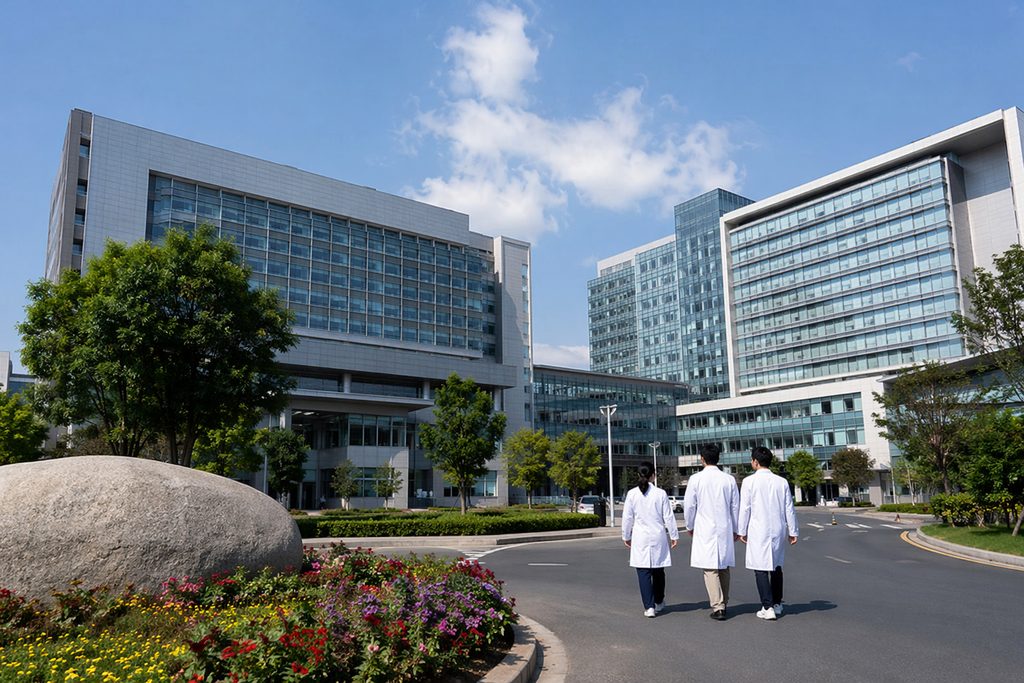
You land in a Chinese teaching hospital. Within minutes, five different people in white coats have examined you. Some look impossibly young. One barely speaks. Another is clearly in charge but hasn’t touched you. Who is actually your doctor? The confusion around the attending vs resident doctor China hospital structure is the single biggest source of anxiety for international patients we work with. It shouldn’t be. The system is rigid, transparent, and once you understand it, you can navigate it with precision.
The Short Answer: A Strict Four-Tier Ladder
Chinese teaching hospitals run on a formal hierarchy that governs who does what. From bottom to top: resident (住院医师), attending (主治医师), associate chief physician (副主任医师), and chief physician (主任医师). The attending is the first truly independent decision-maker. The resident is a trainee. The chief physician is the department authority. That is the skeleton. The flesh is more complicated—because a professor title often layers on top, and the person you pay to see may not be the person who performs your procedure. We will walk through every tier.
Who This Is Right For — and Who It Isn’t
Understanding this hierarchy matters most if you are planning surgery, a complex diagnosis, or a procedure where the operator’s experience directly changes the outcome. It matters less for routine blood work or a straightforward consultation.
You need this knowledge if:
- You are traveling to China specifically for a high-stakes procedure.
- You want to ensure a senior surgeon, not a trainee, performs your operation.
- You are comparing consultation fees and wondering why one doctor charges ten times another.
- You have a rare condition that demands the most experienced eyes in the department.
You can probably relax if:
- You are visiting for a basic health screening or an uncomplicated follow-up.
- You are at a private international hospital where the staffing model is flatter and more Western.
- Your condition is straightforward and well-managed by standard protocols.
The Options, Compared
The table below lays out the four core clinical ranks. Note that “Professor” is an academic title, not a clinical one, but in a teaching hospital, a chief physician is almost always also a professor. We address that overlap afterward.
| Title (English) | Title (Pinyin) | Typical Minimum Experience | Role in Your Care | Approx. Consultation Fee (Public Hospital) |
|---|---|---|---|---|
| Resident | Zhùyuàn Yīshī | 0–5 years post-MD | History-taking, initial exam, paperwork, first assistant in surgery | ¥10–50 (often included in registration) |
| Attending | Zhǔzhì Yīshī | 5+ years | Independent diagnosis, routine surgeries, supervises residents | ¥20–100 |
| Associate Chief | Fùzhǔrèn Yīshī | 10–15+ years | Complex cases, major surgeries, department subsection lead | ¥100–300 |
| Chief Physician | Zhǔrèn Yīshī | 15–20+ years | Final authority, rarest procedures, sets department standards | ¥300–800+ |
If you are comparing costs for a professor level surgeon cost China medical tourism plan, you are almost always looking at the Associate Chief or Chief Physician tier. These are the names that draw international patients. Their outpatient consultation fee in a top Beijing or Shanghai public hospital typically runs ¥300–800, though the international VIP clinic of the same hospital will charge ¥800–2,000 for the same 15-minute slot. That premium buys you English-capable coordination and a longer appointment window. It does not buy you a more senior doctor—the doctor is already the most senior available.
The Academic Layer: Where “Professor” Fits
This is the part that tangles everyone. In a Chinese teaching hospital, clinical rank and academic rank run on parallel tracks. A chief physician is usually a full professor (教授). An associate chief is usually an associate professor (副教授). But the hospital will often list a doctor as “Professor and Chief Physician.” The professor title signals that this person supervises doctoral students, publishes research, and shapes the field. For a foreign patient, the practical meaning is simple: a professor-level surgeon is a senior operator with a national reputation. When you search for what is the doctor hierarchy in Chinese teaching hospitals, the academic-clinical overlap is the detail most English-language resources miss entirely.
And here is a nuance that matters. Some younger stars—surgeons in their early forties—may hold the title of associate chief physician but already carry a full professor appointment because of research output. Their hands are excellent. Their academic pedigree is top-tier. But they are not yet the department’s final authority. Knowing the difference helps you ask sharper questions.
Who Actually Holds the Scalpel?
You can request it. The hospital may or may not accommodate you. In a teaching hospital, resident participation is part of the institutional mission. A reasonable middle ground is to request that the chief physician performs all critical portions personally and that residents are limited to closing and non-critical tasks. This request is usually honored if made respectfully and in advance.
Every licensed physician in China appears on a national public registry maintained by the National Health Commission. The hospital’s official website will list the doctor’s title in Chinese. Look for 主任医师 (chief physician) or 副主任医师 (associate chief physician). If the English translation on the hospital’s international page seems vague, ask to see the Chinese original. We verify credentials as part of our coordination service, and we encourage patients to ask directly: “What is your clinical rank, and how long have you held it?” No legitimate senior doctor will be offended by this question.
Chinese teaching hospitals carry medical liability insurance, but the system for foreign patients pursuing compensation is underdeveloped compared to Western jurisdictions. Your primary protection is choosing a top-tier hospital with strong internal quality controls. The hospitals in our top hospitals database are ranked in the top 5% nationally by Fudan University‘s hospital rankings. Their complication rates for high-volume procedures are comparable to major international centers. Still, you should understand that legal recourse as a foreigner is complex, slow, and uncertain. The best strategy is meticulous upfront selection of both hospital and surgeon.
It depends entirely on complexity. For a standard laparoscopic cholecystectomy, an experienced attending surgeon at a high-volume Chinese hospital has likely performed thousands. A chief physician adds marginal benefit. For a complex liver resection requiring vascular reconstruction, the chief’s experience meaningfully changes the risk profile. Be honest about where your case falls on this spectrum. If your home physician characterizes your procedure as “routine,” the attending tier is likely sufficient. If the words “complex,” “re-do,” or “rare” appear in your workup, aim for the associate chief or chief level.
Your Next Step
The Chinese teaching hospital hierarchy is not a barrier. It is a map. Once you can read it, you know exactly who you are seeing, what their training represents, and what questions to ask before you commit to a procedure. The system rewards prepared patients who understand its structure.
We help international patients navigate this system every day. Our team is not a hospital. We do not diagnose or treat. What we do is translate your medical history, identify the right department and senior physician for your specific condition, coordinate the appointment through the official international channel, and provide a bilingual companion so you walk into that consultation knowing exactly who is across the table. If you are considering treatment in China and want clarity on which tier of doctor is right for your case, request a free consultation and we will talk through your options honestly.
Frequently Asked Questions
Yes. The hospitals used for international patients are JCI-accredited and follow the same international safety standards as top hospitals in the US and Europe. Surgical teams perform high volumes of procedures — often more than their Western counterparts — which studies show leads to better outcomes.
Costs vary by procedure and hospital, but international patients typically save 40-80% compared to US prices — even when factoring in travel and accommodation. A consultation with our team will give you an exact, all-inclusive quote with no hidden fees.
Send us your existing medical reports to get started. We handle everything from hospital selection and appointment scheduling to visa assistance and post-operative recovery planning. Your medical records are reviewed by the specialist before you even book a flight.
For more medical information and treatment options in China, visit chinamedservices.com (China Medical Services).
